






























A look at the best-selling products on Amazon Australia, current trends shaping the market, and how to find best sellers on your own without paying for research tools.
Key takeaways
- Current best sellers on Amazon Australia span beauty (sunscreens, retinol, face masks), home and kitchen (cleaning sponges, quilts, hangers), travel accessories (luggage scales, compression bags), sports and fitness gear, and household essentials
- Demand shifts with the season. Australia heading into summer has driven a surge in sunscreens and travel-related products in 2026
- Free research methods, including Amazon’s own Best Sellers page, Movers & Shakers, search suggestions and review velocity, can help sellers spot demand without needing paid tools
- Choosing less saturated categories or niches on Amazon can lower competition and advertising costs, boosting profitability
- WorldFirst simplifies Amazon payment collections, with local receiving accounts in 20+ currencies for sellers expanding internationally
Australia is the 11th largest e-commerce market in the world. The Australian e-commerce market’s revenue is expected to reach $58.03 billion by 2029.
Amazon launched in Australia in 2017 and has seen rapid growth since. Amazon AU’s revenue increased to $1.57 billion in 2023, an increase from 1.29 billion in 2022. According to a report, more than 7.9 million Australians above the age of 14 shop on Amazon at least once a year. An average Amazon Australia customer makes up to 6 purchases in a given year on the platform.
There’s no denying that Amazon Australia presents a big opportunity for e-commerce businesses wanting to expand in Australia. But most new sellers get stuck on the same old question–what products to sell on Amazon?
To help you decide, we have compiled a list of the most potentially profitable product categories and the best selling products on Amazon Australia right now.
Best selling products on Amazon Australia by category
Before listing products on Amazon, conduct thorough research about what your target customers are currently buying. You can also use product research tools like Jungle Scout and Helium 10 to find out which products are performing better than the others. Also, take a deep dive into how to sell on Amazon so you understand everything it involves.
Here are the top Amazon best sellers in each major category as of 2026.
Note: Best sellers on Amazon change frequently, sometimes daily. The rankings below reflect the current state at the time of writing. For the most up-to-date rankings, visit the Amazon Best Sellers page directly.
1. Beauty and personal care
Beauty and personal care products consistently see high demand on Amazon across multiple regions, not just Australia. While profit margins can be strong, product pricing is often low and competition is high. Customers in this category also tend to show strong brand loyalty once they find products they like.
Demand in this category is also seasonal. Australia heading into summer has driven a noticeable surge in sunscreen sales, and warmer months typically see higher demand for lightweight skincare, tinted moisturisers and haircare products designed for humid conditions.
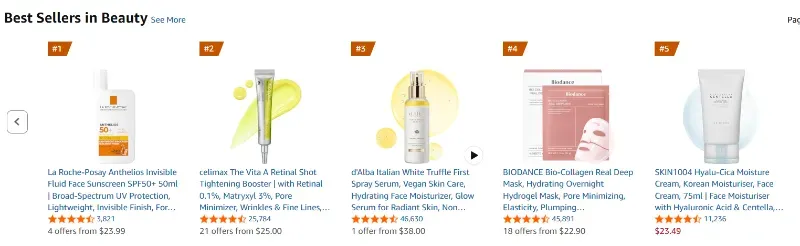
Current best sellers include sunscreens, retinol serums, sheet face masks, ear buds (personal grooming and cleaning), organic hair and skin oils, and lash extension kits.
2. Home and kitchen
The home and kitchen category remains one of the highest-demand categories on Amazon Australia. Customers are constantly looking for essential items and functional products for their homes. Standing out in this category usually means offering products with a unique design, better durability, or a smarter way to solve a common household problem.
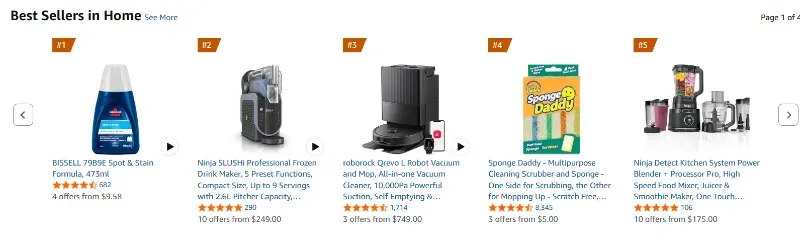
Current best sellers include cleaning sponges, quilts and quilt covers, spot cleaners (for carpets and upholstery), and kitchen equipment
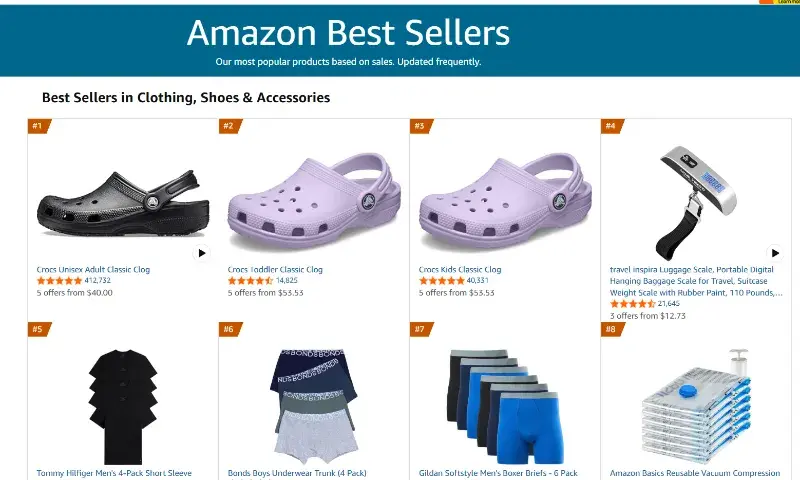
3. Clothing, shoes and accessories
This category sees intense competition, particularly for basic clothing and footwear where customers compare prices closely. Returns are also higher than most other categories due to sizing mismatches and expectation gaps.
A clear pattern in 2026 is that travel-related accessories are dominating this category’s best-seller lists. Current best sellers include luggage scales, vacuum compression bags for packing, universal travel adapters, and travel pillows. The pattern reflects Australians’ strong interest in international travel post-pandemic, and the practical items that make trips easier.
4. Toys and games
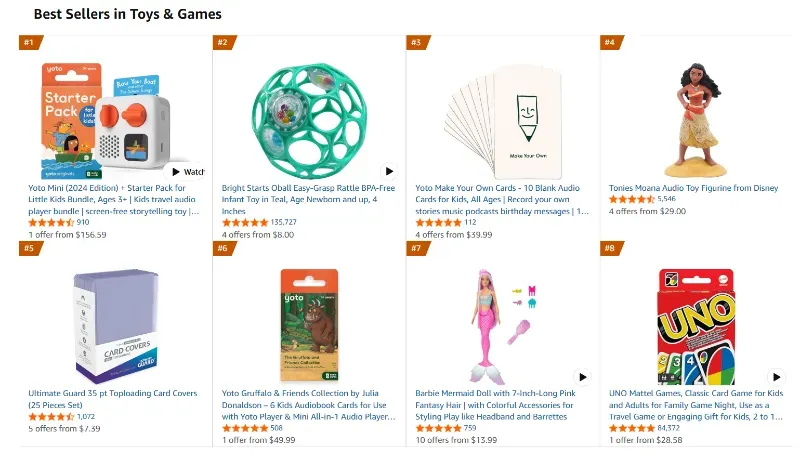
Toys and games see high demand throughout the year, with significant spikes around holidays and back-to-school periods. Educational, creative, and plush toys tend to perform well. Safety and eco-friendliness are two major factors parents consider when buying toys for their kids.
5. Health, household and personal care
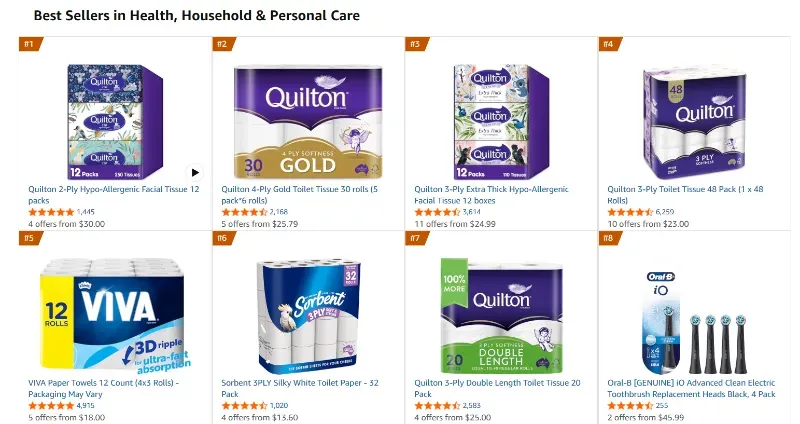
Products in this category are usually essentials and see steady, repeat demand. If you’re looking to expand into a category that offers consistent repeat purchases, this is one to consider.
Current best sellers are dominated by toilet tissues, garbage bags and dishwashing tablets.
6. Baby care
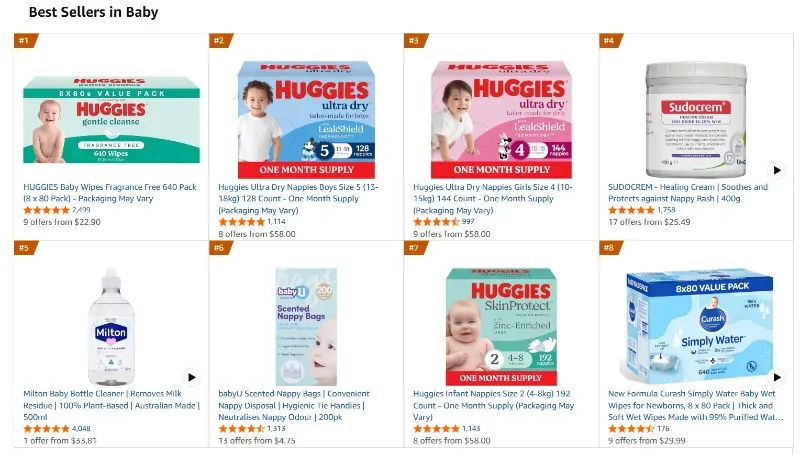
The baby care category requires understanding the diverse needs of modern parents. Awareness and demand for safe, non-toxic baby products has grown significantly, and sellers in this category face strict regulatory and compliance requirements.
Current best sellers include diapers, bottle cleaning liquids, and wet wipes.
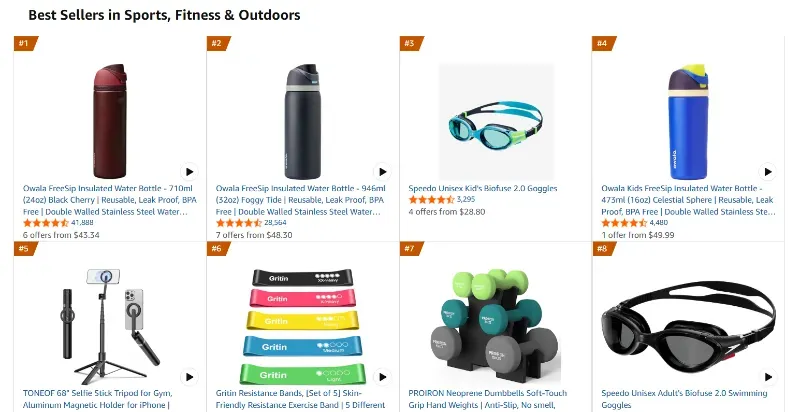
7. Sports, fitness and outdoors
Health and fitness continues to be one of Amazon Australia’s stronger growth categories in 2026, driven by growing interest in home-based workouts, outdoor activities, and hybrid lifestyles that split time between the gym and home training.
Current best sellers include insulated water bottles, resistance bands, selfie sticks (for hiking and travel content), walking pad treadmills, and ankle straps for cable machine workouts. Dumbbells for home strength training and head torches for camping and running are also seeing strong demand.
How to find best-selling products on Amazon for free
You don’t need paid tools like Jungle Scout or Helium 10 to research Amazon products. Amazon itself provides several free features that give directional data on what’s actually selling.
Amazon Best Sellers page
The most direct source. Amazon’s Best Sellers page (amazon.com.au/gp/bestsellers) is updated hourly and shows the top 100 products in every category and sub-category. Drilling into sub-categories reveals niche opportunities that don’t show up on the main category page.
Movers & Shakers
This page shows the biggest gainers in ranking over the last 24 hours. It’s useful for spotting emerging trends before they saturate the market. A product moving up quickly signals rising demand, and getting in early on such trends can be a real advantage.
New Releases
New Releases shows products launched recently that are gaining traction fast. Sellers looking to enter a category can use this to see what recent launches are working, and what design or feature choices are driving the traction.
Amazon search suggestions
When you type a keyword into Amazon’s search bar, Amazon suggests related keywords based on what real users are searching for. Reviewing each suggested keyword and checking the number of relevant products under each shows opportunity gaps. If a search suggestion returns fewer relevant products, that’s a niche with lower competition where a well-designed new product can rank quickly.
Review velocity
Total review count matters less than how fast a product accumulates reviews. A product with 500 reviews collected over five years is very different from one with 500 reviews collected in three months. The second one is selling faster right now. Looking at review dates on the top-ranked products in a category gives you a sense of current sales velocity.
“Bought in past month” data
Amazon displays “X+ bought in the past month” on many product listings, giving directional data on monthly sales volume without needing a paid tool. Cross-referencing this figure across similar products in a category gives a rough sense of what typical monthly sales look like at each price point.
Best Sellers Rank (BSR)
Every Amazon product has a BSR in its category and sub-categories. Lower BSR means higher sales rank. Comparing BSR across similar products in a category gives you a competitive benchmark. A product with a BSR of 500 in Home & Kitchen is doing significantly more volume than one ranked 50,000 in the same category.
Customer reviews and Q&A
Reading recent reviews (last 30 to 60 days) reveals whether customer sentiment is trending positive or negative on a product. A product with 4.5 stars overall but recent one-star reviews might be declining, or a competitor might have entered with a better version.
The customer Q&A section on top-selling products reveals what buyers actually care about, and what problems existing products aren’t solving. This is a genuine goldmine for identifying product improvement opportunities.
Combining several of these signals (BSR, review velocity, “bought in past month”, search suggestion depth) gives a more accurate picture than relying on any single signal alone.
Amazon product categories: which ones are the most profitable?
The most profitable Amazon categories tend to include beauty and personal care, home and kitchen, clothing and shoes, and arts and crafts. However, these are averaged category-wise figures. Individual product profitability depends on many other factors, including pricing, sourcing costs, shipping, marketplace fees and advertising spend.
The profitability of any specific product doesn’t directly depend on the major category’s average.
Here are some factors to consider when choosing a product category:
- Category saturation: Is the category already too competitive?
- Product similarity: Are too many products in the category already similar to what you plan to sell?
- Advertising costs: Oversaturated categories drive up CPC, which affects margins even when using paid ads.
- Pricing pressure: Competing in high-saturation categories often means cutting prices to stay competitive, which can quickly erode margins.
An already popular product category can make it harder for a new seller to gain traction. Similarly, less popular categories with fewer sellers can lead to more opportunities. Conduct product research across categories and don’t fixate solely on the current best sellers. The goal is to find a way to stand out from the crowd, not to sell what everyone else is already selling.
WorldFirst makes it easy to collect Amazon payments
WorldFirst is a participating Amazon Payment Service Provider (PSP) that simplifies cross-border collections and marketplace payouts from Amazon.
With the multi-currency World Account, Amazon Australia sellers can open local receiving accounts in 20+ currencies and collect funds from 130+ international marketplaces and payment gateways, including Amazon US, Amazon UK, Amazon Europe, Amazon Japan and Amazon Singapore. Connecting your World Account to your Amazon Seller Central account lets you expand your retail business into new regions and collect funds in the local currency of each marketplace.
Key features of the World Account for Amazon sellers:
- Local receiving accounts in 20+ currencies, including USD, GBP, EUR, JPY, SGD, CAD, HKD and CNH
- Send payments in 100+ currencies across 200+ countries and regions, useful for paying overseas suppliers
- Collect payouts from 130+ marketplaces and payment gateways
- The World Card, a Mastercard-powered business debit card with zero FX fees when spending in 15 supported currencies (with sufficient balance held in that currency), plus cashback on eligible spending (Terms and Conditions apply)
- Forward contracts for locking in exchange rates on future currency conversions
- Xero and NetSuite integrations for reconciliation
- Zero fees on opening the account, receiving funds and holding balances
→ Take a look at how to link Amazon seller account to WorldFirst
FAQs
1. What are Amazon Best Sellers?
Amazon Best Sellers are the top 100 highest-selling products in each Amazon category and sub-category, updated hourly based on actual sales data. The Best Sellers page is one of the most reliable free indicators of what’s currently in demand on Amazon.
2. How does the Amazon Best Sellers Rank (BSR) work?
BSR is a ranking number assigned to every Amazon product based on how well it sells within its category. The lower the BSR, the better the sales rank. BSR updates hourly and reflects recent sales performance rather than lifetime sales. A product’s BSR can vary significantly across the categories and sub-categories it’s listed under.
3. How do I become an Amazon Best Seller?
Becoming an Amazon Best Seller isn’t controlled by Amazon directly. It’s a function of sales volume. Products earn a “Best Seller” badge when they reach the top rank in their category or sub-category. Sellers who focus on well-researched niches, optimised listings, competitive pricing, quality customer service, and steady advertising typically have the best chance of ranking. Choosing a less saturated sub-category makes reaching the top rank significantly easier.
4. How do I check the most sold items on Amazon?
The easiest way is to visit Amazon’s Best Sellers page directly (amazon.com.au/gp/bestsellers), which shows the top 100 products across all main categories and sub-categories. You can also use Movers & Shakers for the biggest 24-hour gainers, or the New Releases page for products that have launched recently and are gaining traction. All three are free to access.
5. What are the most bought items on Amazon Australia?
Household essentials, beauty products, home and kitchen items, and travel accessories consistently dominate the most-bought lists on Amazon Australia. Specific top sellers change frequently, but categories like sunscreens (especially during Australian summers), cleaning products, travel adapters, insulated water bottles and diapers regularly appear near the top of their respective category rankings.
6. Do I need paid tools to research Amazon products?
No. Amazon provides several free features that give directional data on product demand, including the Best Sellers page, Movers & Shakers, New Releases, search suggestions, and the “bought in past month” display on many product listings. Paid tools like Jungle Scout and Helium 10 add historical data and forecasting features that can speed up research, but Amazon’s free tools cover the essentials for most sellers starting out.
7. How often do Amazon best sellers change?
Amazon Best Sellers can change hourly, since the rankings are based on real-time sales data. Seasonal categories (like sunscreens, holiday gifts, or back-to-school items) see the biggest shifts, while everyday essentials tend to have more stable rankings.
Disclaimer: The information contained is general only and largely our views. Before acting on the information, you should consider whether it is appropriate for you in light of your objectives, financial situation, or needs. Although information has been obtained from and is based upon multiple sources the author believes to be reliable, we do not guarantee its accuracy and it may be incomplete or condensed. All opinions, estimates, mentioned products/services and referenced material constitute the author’s own judgement as of the date of the briefing and are subject to change without notice. WorldFirst shall not be responsible for any losses or damages arising from your reliance on such information.


![How to set up your AliExpress dropshipping business in Australia [2026]](https://mdn.marmot-cloud.com/worldfirst/sites/8/2026/10/20261001222121715-300x200.webp)