





























Learn how to set up your Shopee store and start selling on one of the biggest marketplaces in Southeast Asia
Key takeaways
- Shopee is a leading e-commerce platform in Southeast Asia and is slowly expanding into Latin America
- Shopee doesn’t charge anything for setting up a seller account or listing a product. You’re only charged a commission fee when you sell a product
- Sellers on Shopee benefit from seamless shipping, supported by various logistics partners across multiple countries
- Shopee International Platform (SIP) enables cross-border selling, allowing you to expand your business globally with a single account
- Australian sellers listing on Shopee Singapore receive payouts in SGD, which usually converts to AUD at the bank’s rate on arrival unless you have an SGD receiving account
- A World Account from WorldFirst gives Australian sellers local receiving accounts in 20+ currencies, including SGD, and the Visa-powered World Card to pay Shopee Ads and seller tools in the matching currency

Introduction
The eCommerce industry in Southeast Asia is gaining momentum quickly and Shopee is at the forefront of it. It is one of Asia’s most popular e-commerce websites, with over 3 million monthly traffic.
Shopee was founded in Singapore in 2015 and the online shopping marketplace has quickly established itself as a leader in Southeast Asia, surpassing its competitors like Lazada. By the third quarter of 2023, Shopee had already processed over 2.5 billion orders.
Shopee SG quickly became popular and its success was replicated in other Southeast Asian countries. Shopee’s annual 9.9 Super Shopping Day campaign in 2021 attracted over 82 million visits from Singapore alone.
Shopee now has a big presence in countries like Vietnam, Thailand, Indonesia, Taiwan, Malaysia and Singapore.
Shopee can be a good place to start if you plan to expand your retail business in Asia. You can start your operations with Shopee Singapore and slowly expand your reach across Southeast Asia with the same Shopee seller account and logistics networks.
Keep reading to learn more about how to sell on Shopee.
What is Shopee?
Shopee is a popular B2C and C2C online marketplace in Southeast Asia owned by the Sea Group. The marketplace works as an intermediary between sellers and buyers. Since its launch, it has slowly expanded into East Asia and Latin America. Shopee now has a presence in 10+ countries.
Here’s the complete list of Shopee supported countries (as of September 2024):
| Southeast Asia | East Asia | Latin America |
|
|
|
Is Shopee legit?
Yes, Shopee is a secure and legit marketplace where millions of customers buy products from verified and reliable sellers. As a seller, you can start listing products on the marketplace and withdraw funds as per the platform’s payment cycles. Shopee also takes steps to help sellers reach a wider audience. According to a report, 145k Shopee sellers in Malaysia achieved a 25% growth in 2022.
All new sellers have to undergo a verification process before they can sell on the platform.
Does Shopee support cross-border sellers?
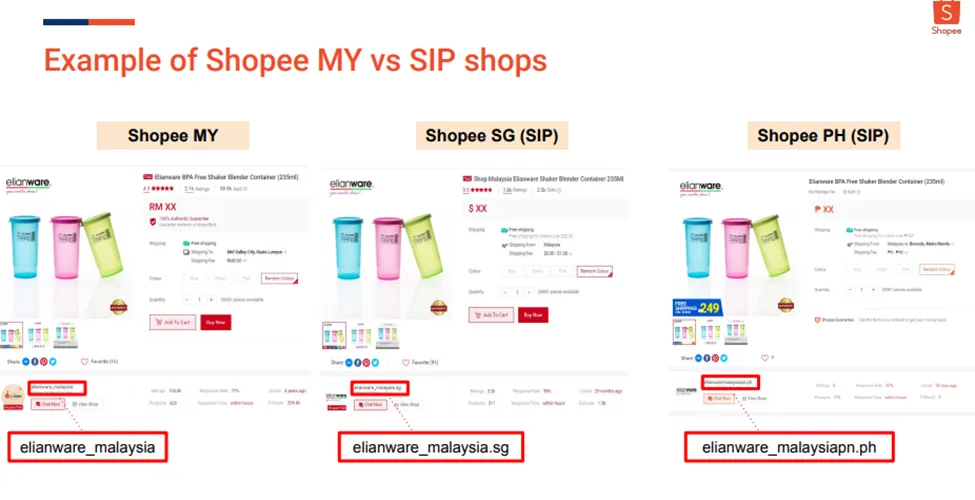
Shopee supports cross-border sellers through Shopee International Platform (SIP). It allows sellers to sell their products across various Shopee regions and take their business global.
SIP is currently available in Singapore, the Philippines, Vietnam and Thailand.
With SIP, sellers can sell their products globally while only managing their store in one source country. There are no extra costs involved. As a seller, you only need to manage your local Shopee store and Shopee will manage the end-to-end operations of your overseas stores, including:
- Pricing and product listings
- Marketing (like ads, discounts, flash deals)
- Customer service
- First to last mile fulfilment
Not every Shopee seller can directly apply for SIP. There are different eligibility rules for different countries. For instance, if you have a store on Shopee Singapore, you need a good fulfilment rate and a minimum of 1 completed order in a month to become eligible for SIP.
Shopee Malaysia doesn’t clearly state the eligibility rules. Instead, you will be notified directly once you are eligible to sign up for SIP.
As a seller, you’re responsible for arranging shipment to Shopee warehouses and Shopee handles the rest from there.
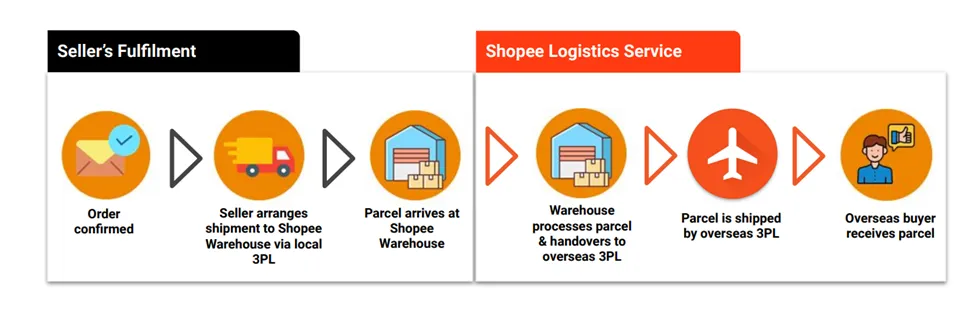
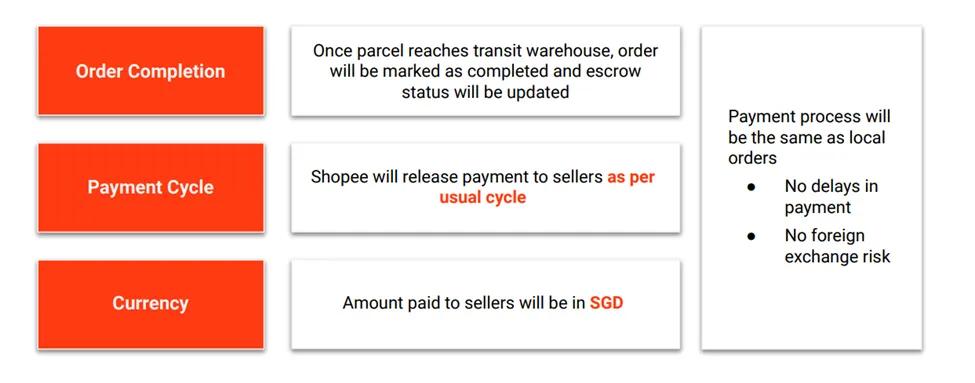
You get paid in your base currency and the payment process for international orders is the same as for domestic orders. Since you get paid in your base currency, there are no foreign exchange risks or delays in payment.
When you become eligible for SIP, you’ll be notified. To enrol in the program, you’ll have to fill up the onboarding form.
After onboarding, you can start listing your products in different Shopee regions and manage them all through the same seller account.
Benefits of selling on Shopee
Popular marketplace in Southeast Asia
Shopee is one of the most visited e-commerce marketplaces in Southeast Asia. With millions of visitors and a great online presence, Shopee gives you the opportunity to expand your business into Asia through a reliable partner that your prospective customers already trust.
Seamless shipping
Shopee has various shipping partners that make it easy for sellers to fulfil orders. Sellers can choose any supported shipping partners, arrange the shipment through the Shopee app, and automatically send tracking details to customers. The shipping fees are also automatically calculated, saving you from the hassle of constantly negotiating with shipping companies.
Optimum seller support
Through Shopee Seller Centre, you get access to various tools to manage and grow your online business. Apart from tools for managing orders, you also get access to a bunch of other tools, including:
Promotional tools for offering incentives to customers
- Discount
- Vouchers
- My Shop’s Shocking Sale
- Shipping Fee Promotion
- Seller Coins
Engagement tools to improve shop loyalty
- Live Streaming (Shopee Live)
- Review Prize
- Chat Broadcast
Paid targeting tools to increase traffic and conversions
- Shopee Ads
- Off-Platform Ads
- Affiliate Marketing Solution
Easy to communicate with customers
With Shopee, you can chat directly with customers and sort out their queries or complaints in real time. It’s also possible to set up automated messages for customers when they have added your products to the cart but have not made the purchase yet.
Support for international and domestic payment options
Shopee offers customers a wide range of payment options, including debit cards, credit cards, PayNow and ShopeePay.
ShopeePay is the platform’s digital wallet, which allows customers to pay for their orders directly through their Shopee account. The various payment methods encourage more customers to place orders.
Different e-commerce businesses you can do on Shopee
Shopee supports different e-commerce business models, including:
Dropshipping
Shopee supports dropshipping as an e-commerce fulfilment method. With dropshipping, products bought by customers through an online store are directly shipped to them by the supplier, manufacturer, or dropshipping agent. Online retailers don’t keep any inventory or ship the product themselves. Instead, they only focus on marketing their products and managing customer service. Dropshipping has low upfront costs, but the margins are low because of high commissions. You should consider using Alibaba dropshipping or AliExpress dropshipping for your Shopee store.
White labelling
You can also sell white-labelled products on Shopee. It involves sourcing products from a manufacturer and selling them under your brand name. Usually, product manufacturers can help relabel and rebrand the product with your brand’s logo and colours. You can easily find white-label products on wholesale B2B marketplaces in 1688 and Alibaba.
Retail
You can directly source products from manufacturers and wholesalers to resell them at retail prices on Shopee. It’s not uncommon to find Shopee sellers that source products from China and sell them at a profit on Shopee.
Wholesale
It’s also possible to sell wholesale products in large quantities on Shopee. You can set discounted prices for customers who buy a minimum order quantity to encourage them to buy more.
How to start selling on Shopee Singapore
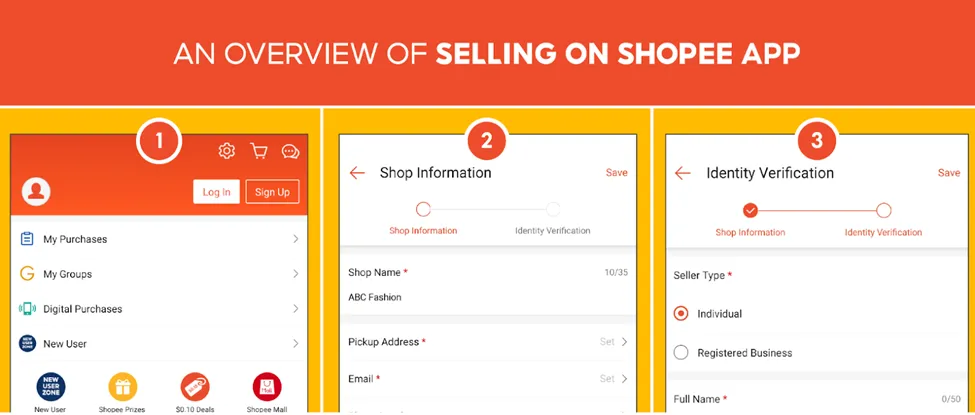
1. Register as a Shopee Seller
Your first step should be to register as a Shopee seller. If you are based in one of the countries that Shopee supports, you will be automatically redirected to the regional Shopee website. If you are not based in Shopee-supported countries, you can manually go to a regional Shopee store and open an account.
You can create a seller account on the Shopee website or mobile app available for iOS, Google Play and Huawei users.
Account registration only requires a valid phone number and email address. It’s necessary to maintain accuracy and ensure no issues during the account verification process.
There are two types of seller badges you can acquire on Shopee:
- Preferred badge is given to sellers who have been identified and verified through in-depth document review
- Mall badge is given to sellers who are either brand owners or authorised distributors of a brand
2. Add your bank account details
You’ll also have to add your local bank account details and link them to your Shopee seller account. For instance, if you are signing up on Shopee Singapore, you’ll need an SGD bank account.
3. Customise your shop
Your shop name will help build trust, confidence and loyalty among customers. It’s important that you choose a memorable and unique name that aligns with Shopee’s policy on shop naming.
Next, you can use the Shop Decoration tool to customise your shop home page for mobile and PC.
4. List your products on Shopee
You can start listing products on Shopee once your account is verified. An attractive and effective product listing is necessary to attract potential customers and drive sales. Before adding a new product, explore Shopee’s main product categories to see which category your product fits into. You should also review the prohibited and restricted items policy.
When selling on Shopee across different Southeast Asian markets, localisation is key. What works in your home country may not resonate with shoppers in Singapore, Malaysia, or the Philippines. Each market has different spending habits, preferred keywords, and even search patterns.
For instance, shoppers in the Philippines are highly price-sensitive, while those in Singapore may be willing to pay a premium for branded or high-quality goods. Tailoring your listings to these nuances helps you stand out.
Here are the main components of an optimum product listing:
Product name: Add a title that’s clear, crisp and easy to understand. To improve visibility, include keywords customers actually search for. Try using this formula:
Brand name + Product type + Key feature + Size/variant + SEO keyword.
Example: Samsung Galaxy S23 Ultra 5G – 12GB RAM 256GB – Smartphone + 200MP Camera.
For apparel or accessories, you can also add descriptors like “Women’s,” “Casual,” or “Summer” to help your listing appear in more searches.
Product description: Provide a detailed product description that includes the major features and benefits of the product. Avoid simply translating your English copy–localise it. Use region-specific measurements (for example, cm instead of inches) and terms that customers in that country understand. Include materials, dimensions, usage instructions, and care details. Good grammar and spelling are important too.
Product images: You should include high-quality images of your products, from different angles. Your visuals are the first thing buyers see, so invest in clean, professional photography. Avoid cluttered backgrounds, show the product in use when possible, and maintain consistent lighting. Study how top Shopee sellers in your category present their products for inspiration. Shopee recommends at least 3–5 images per listing, ideally in 1:1 ratio.
At the same time, focus on improving your searchability (SEO). If your listing doesn’t appear in the first few pages of Shopee’s search results, your chances of conversion drop drastically. Add popular, relevant keywords to your product title and description. Regularly update your listings with trending keywords to stay visible.
5. Shipping and fulfilment
Sellers can manage shipping themselves or through Shopee Supported Logistics (SSL) partners. Shopee has partnerships with major delivery companies in every country, allowing sellers to get fixed shipping rates and outsource the fulfilment process.
For instance, Shopee Supported Logistics partners in Singapore include:
- Shopee Express (SPX)
- Speedpost Standard (SingPost)
- Ninja Van
- J&T Express
- uParcel
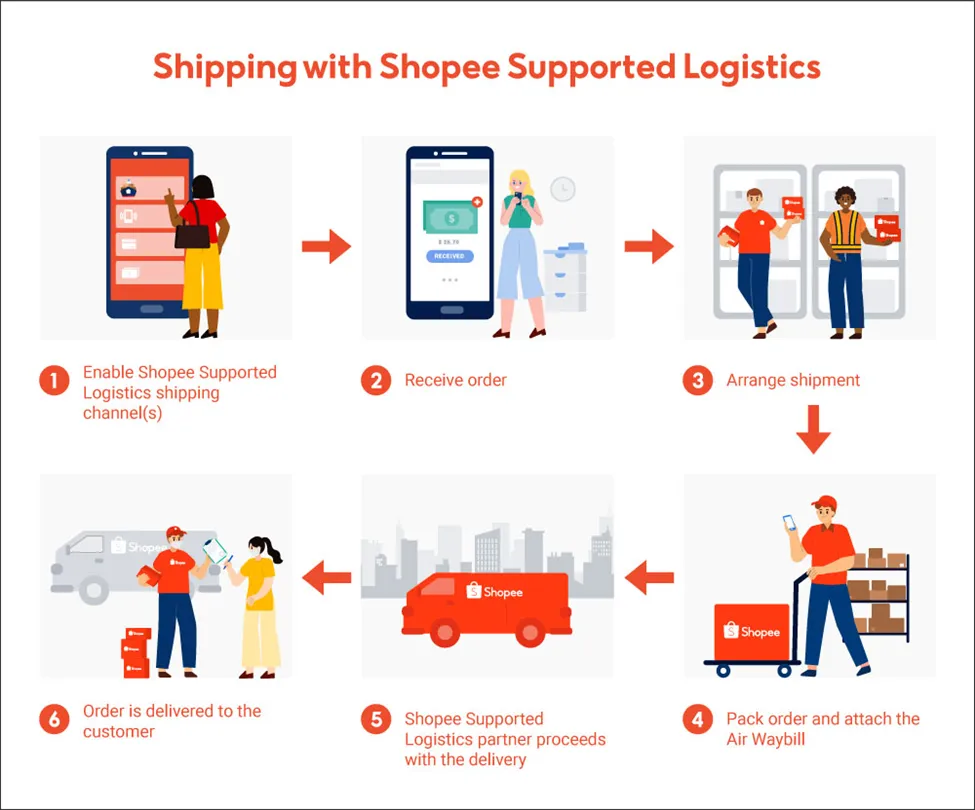
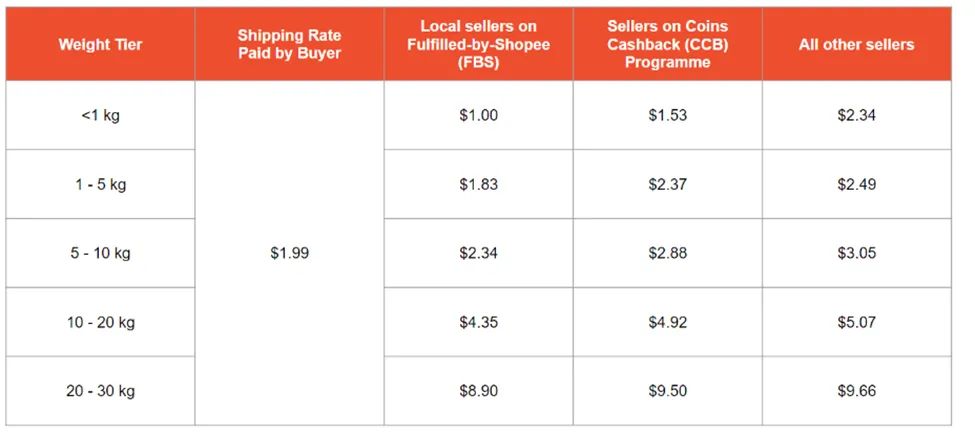
Before sending your orders through Shopee, make sure you are aware of the packaging guidelines and standardised shipping fees.
6. Marketing and promotions
There are many marketing and promotional tools available on Shopee that you can use to improve the visibility and sales of your Shopee store, including:
Putting your products up for sale is only the first step. To actually drive conversions, you need to be an active part of Shopee’s dynamic marketing ecosystem. Shopee offers multiple built-in promotional tools that help you reach new audiences, build trust, and boost sales, especially during high-traffic periods like 9.9, 10.10, 11.11, and 12.12 Mega Sales. These events attract millions of shoppers across Southeast Asia, so participating in them can significantly increase your store’s exposure.
Shopee ads
Shopee ads help you promote your products across the platform, including the Marketplace, the Shopee mobile app, and Shopee Supermarket. By bidding on relevant keywords, your products appear in search results when shoppers look for those terms.
There are two main ad types: “Search Ads,” which display your products on top of relevant search results, and “Discovery Ads,” which place your items in the “Similar Products” or “You May Also Like” sections. Discovery Ads are especially useful for new sellers trying to gain traction. To get the best ROI, start small, monitor performance in the Shopee Ads dashboard, and adjust your bids based on conversions, not just clicks.
Flash sales
Participating in flash sales is a great way to generate excitement and urgency around your products. These limited-time events offer significant discounts that draw in more customers and encourage impulse purchases.
If you meet Shopee’s eligibility criteria, such as maintaining a chat response rate above 80%, no penalty points, and a shop rating above 4.0, you can be nominated for flash sale slots. Even if you don’t qualify, you can still purchase a slot through the Seller Center’s Marketing tab.
When nominating products, make sure your listings are competitively priced, fully stocked, and feature clear, high-quality images. Always offer free shipping to improve your chances of approval. Flash sales not only drive immediate revenue but also bring long-term visibility by directing traffic to your entire store.
Campaigns
Shopee regularly runs campaigns around specific occasions or themes — for example, “Back to School,” “Beauty Week,” or “Tech Gadgets Sale.” These campaigns allow you to feature your products on Shopee’s homepage or category pages, dramatically improving reach.
You can join these from your Seller Center under the “Marketing Centre” → “My Campaigns.” Shopee selects listings based on factors like accurate product information, competitive pricing (usually 10-20% discounts), and strong visuals. These campaigns are free to join and a proven way to get discovered by new customers.
Vouchers and discounts
Shopee offers a range of voucher and discount options that can help you incentivize purchases.
You can create two types of vouchers: product vouchers (for specific listings) and shop vouchers (for your entire store). Offering vouchers during campaigns or after a customer’s first purchase can encourage repeat orders. Shopee also provides platform-sponsored vouchers like coin cashback and free shipping offers. You can create and manage your vouchers through the Marketing Centre → “Vouchers.”
Shopee Live
Shopee Live is another powerful promotional tool for sellers who want to connect with customers in real time. You can host live streaming sessions to demonstrate products, answer questions, and offer limited-time discounts exclusive to live viewers.
Here are some tips for running successful lives:
- Showcase your products clearly: Use close-ups, detailed shots, and short demos to highlight key features and benefits
- Engage actively: Respond to viewer questions about pricing, shipping, or product use in real time. Encourage comments and reactions to create a lively atmosphere
- Promote before going live: Announce your session on Shopee, social media, and email. Tease featured products and offer exclusive “follow prizes” or vouchers
- Offer live-only deals: Use “Live Flash Sales,” limited bundles, or freebies to build urgency and boost conversions.
Shopee seller fee: What does it cost to list products on Shopee?
While Shopee doesn’t charge anything for opening a new seller account or listing a product for the first time, there are other fees involved, including:
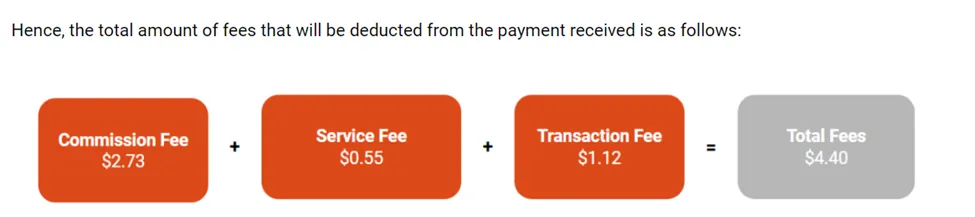
Commission fee: It applies to sellers who have registered for 120 days or more. You’re only considered a registered seller on Shopee when you take your first product listing live.
Transaction fee: It is the handling fee charged by Shopee for successful transactions.
Service fee: Sellers who sign up for the Coins Cashback Programme are charged a service fee, which is a percentage of the Cost of Goods Sold (COGS) on a product level.
WorldFirst for Australian Shopee sellers
Running a Shopee Singapore store from Australia creates a three-currency cycle: inventory paid in CNH or USD, Shopee payouts arriving in SGD, and spending happening in AUD. A standard AUD business account converts every leg of that cycle at the bank’s rate, which is where most sellers quietly lose 2% to 5% a month.
The World Account from WorldFirst is a multi-currency account built for this exact cycle. Here is what it does for an Australian Shopee seller.
Keep SGD payouts in SGD until you decide to convert: Shopee Singapore proceeds land in a dedicated SGD balance in your World Account rather than converting to AUD at your bank’s rate on arrival. You convert when the rate suits you, or spend from the SGD balance directly for SGD-denominated expenses.
Pay Chinese suppliers in CNH without going through USD first: Hold a CNH balance in the same account and settle supplier invoices in the currency most Chinese factories prefer, cutting out one of the two FX conversions a standard AUD-to-CNY payment usually involves.
Pay 1688.com suppliers directly from your CNH balance: World Pay is the authorised international payment provider for 1688.com, so you can source inventory from mainland China’s largest wholesale marketplace without opening a Chinese bank account.
Collect from more than Shopee alone: The same World Account acts as the payout destination for 130+ marketplaces and payment gateways, including Lazada, Amazon, eBay, Etsy, Shopify and Stripe. Each payout lands in the matching currency balance, with no mandatory conversion.
Protect margin on seasonal inventory buys: Lock in a future exchange rate today with a forward contract, so a supplier payment three months out settles at a known rate rather than whatever the market is doing on the day (subject to eligibility).
Pay Shopee Ads and seller tools in the native currency: The Mastercard-powered World Card draws from your currency balances. Up to 20 cards per account at no issuance cost means you can run separate cards for Shopee Ads campaigns across markets, Shopee Live promotional spend, product research tools, and Meta or Google ads driving external traffic to your store. No FX fees when you pay in any of the 15 supported currencies with a matching balance in place; competitive conversion rates when you don’t.
Earn cashback on business spend: Eligible card spending earns cashback that offsets some of the Shopee commission, Ads and seller fees you pay through the year (Terms and Conditions apply).
Reconcile across currencies without manual work: Xero and NetSuite integrations pull every multi-currency transaction into your accounting system automatically, so cross-border COGS, Shopee fees, ad spend and payouts arrive clean at month-end.
Pay only for the moves that generate value: No account opening fee, no monthly fee, and no fees for receiving funds in the 20+ supported currencies. Costs apply when you convert currency (from 0.6%) or send a cross-border payment to a non-World Account recipient.
How to receive payouts from Shopee Singapore with a World Account
For Australian sellers using Shopee Singapore as their SIP source country, Shopee pays out in SGD. Setting up a dedicated SGD receiving account inside your World Account means those payouts land in SGD rather than converting to AUD on arrival.
Here is how to set it up in two steps.
Step 1: Set up an SGD Receiving Account in your World Account
- On your World Account dashboard, go to the Collection tab
- Click Manage Accounts, then Add a New Receiving Account
- Select SGD as the currency
- Choose the account usage (marketplace collection), platform (Shopee), supported bank, and enter an account name
- Click Confirm to activate the receiving account
- Once the account is live, click Details to view the account number, bank code and other identifying details needed to link it to Shopee
If you also sell on Shopee markets in other currencies down the line, you can create additional receiving accounts in the matching currency (MYR for Shopee Malaysia, THB for Shopee Thailand, and so on) within the same World Account.
Step 2: Link your SGD Receiving Account to Shopee Singapore
- Log in to your Shopee Seller Centre
- Go to Finance → Bank Accounts
- Click Add Bank Account
- Enter your SGD Receiving Account details from your World Account exactly as shown (account number, bank code, bank name)
- Save the account and complete any verification Shopee requires
Once linked, future Shopee Singapore sales proceeds settle directly into your SGD balance in your World Account. From there, you can:
- Hold the SGD balance until the exchange rate is favourable
- Convert SGD to AUD at competitive rates when you need to repatriate funds
- Use the SGD balance to pay overseas suppliers invoicing in SGD
- Spend from the balance using the World Card for international business expenses
Note: WorldFirst currently supports collections from Shopee Singapore. For sellers collecting from other Shopee markets, contact the WorldFirst support team to confirm availability.
Disclaimer: The information contained is general only and largely our views. Before acting on the information you should consider whether it is appropriate for you, in light of your objectives, financial situation or needs. Although information has been obtained from and is based upon multiple sources the author believes to be reliable, we do not guarantee its accuracy and it may be incomplete or condensed. All opinions, estimates, mentioned products/services and referenced material constitute the author’s own judgement as of the date of the briefing and are subject to change without notice. WorldFirst shall not be responsible for any losses or damages arising from your reliance of such information.