































Your essential guide to navigating business travel in China, from building supplier relationships to mastering local customs, payment tools and tech.
Key takeaways
- Visiting suppliers in China builds long-term relationships and strengthens trust in the procurement process
- Formal business attire is expected, even in relaxed settings. Better to overdress than underdress
- Punctuality shows respect in Chinese culture; arriving early for meetings is essential
- Hiring an interpreter can help bridge language gaps during crucial negotiations or presentations
- Save hotel and important addresses in Chinese characters for easy communication with taxi drivers
- WorldFirst makes supplier payments and in-country spending straightforward. Use the World Card linked to Alipay for everyday payments while in China, and World Pay to send CNH to 1688 suppliers directly from the World Account without a Chinese bank account

Travelling to China to meet suppliers and business partners face to face opens up something that remote sourcing cannot. In-person visits build long-term relationships, let you observe manufacturing processes firsthand, and help you understand Chinese business culture for lasting partnerships.
A business trip to China involves preparation, especially the first time around. You’ll need to handle visas, factory visit checklists, cultural research, a few phrases of Mandarin, and payment setup for everything from supplier deposits to a cab ride back to the hotel.
One of the practical hurdles for Australian business travellers is payments. Alipay is used almost everywhere in China, from restaurants to taxis to supplier settlements, and foreign cards often don’t link cleanly to it. And when they do, they often charge FX fees on every transaction.
The World Card by WorldFirst is a Mastercard-powered business payment card linked to the World Account, and it can be added to Alipay for QR code payments across China.
This guide covers what you need to make a first business trip to China a success, from the visa process through to day-to-day spending while there.
What are the main benefits of visiting a factory?
- Build strong work relationships: When you meet suppliers face to face in their place of work, it shows your commitment to the procurement process, which can directly lead to improved cooperation and possibly more favourable terms
- Inspect production processes and factory equipment: By checking the factory yourself, you can get a more in-depth understanding of their equipment, processes, and workforce. You can address any issues in real time and minimise misunderstandings
- Connect directly with the people in charge: Apart from meeting your point of contact, you also get the opportunity to connect with other key people in the factory
- Better negotiation: When you meet suppliers face to face and show your sincerity, it directly leads to effective communication and better price negotiation
- Check a wide variety of samples: One of the biggest benefits of visiting factories in China is being able to check a wide variety of samples yourself instead of waiting for a few shortlisted samples to get shipped to you.
Before you plan your first business travel to China
Plan your visit agenda
Decide on everything you want to achieve from your business travel to China. Make a list of all the important aspects, like checking quality control, production lines, and the factory equipment.
You should also prepare a complete list of questions you want to ask the suppliers to ensure you don’t miss anything.
You can ask questions like:
- What is the typical production lead time?
- What processes or components are subcontracted?
- How many units can be produced in a day/ week?
- What quality control measures are in place?
- How do you manage defective and low-quality products?
- Can you share references from other clients or show recently manufactured products for other customers?
Understand the Chinese business culture
Travelling to China for business is different from a leisure trip. For starters, you’ll need to familiarise yourself with local business customs and etiquette, which play a big role in establishing trust and respect. From exchanging business cards to overcoming language barriers, it pays to be prepared and, above all, culturally aware.
Doing business in China is as much about understanding the culture as it is about business itself. Respect is a big part of that, with hierarchy playing a huge role in meetings. You’ll often find that the most senior person is greeted first and spoken to more formally. Similarly, how you dress reflects this respect for status. Business attire leans towards the conservative; even in a more relaxed setting, it’s better to dress up than down.
Unless you’re invited to do so, don’t address business partners or colleagues by their first names. Instead, use their titles and surnames – for example, ‘Mr Wang’ or ‘Director Li’.
Punctuality is another sign of respect. Running late, even by a few minutes, can create the wrong impression, so it’s best to arrive at business meetings early. It shows you value the other person’s time and helps set the tone for the meeting.
Then, there’s the business card exchange. When someone hands you their card, you should take it with both hands and give it a moment of attention before putting it away. Consider getting your own cards printed in both English and Simplified Chinese – it’s a nice touch, if not absolutely necessary.
In Chinese business culture, it’s common to hear responses like ‘maybe’ or ‘let me think about it’ instead of a direct ‘no.’ This practice is linked to the concept of ‘face’ (or miànzi), which emphasises maintaining respect, dignity and social harmony in interactions. Giving a blunt ‘no’ can cause embarrassment or discomfort. By using more indirect responses, Chinese professionals can decline without offending or creating tension. Understanding this nuance is crucial, as what may seem like a tentative answer could, in reality, be a polite way of saying no.
You’ll find that business conversations often happen over meals, but don’t expect to jump into business matters right away – meals are more about developing personal connections. And when it comes to ordering, let the host take the lead by following their order or letting them decide for you.
Lastly, building relationships – or guanxi – is vital in China. Trust isn’t built on contracts and negotiations; it’s developed through personal connections and time, which is why you may feel that deals move at a slower pace than you’re used to. Chinese business culture values relationships that extend beyond the boardroom. Don’t be surprised if your counterpart wants to get to know you on a personal level before diving into business.
Tips for travelling to China
Before you board
Business visa
As an Australian traveller heading to China for business, you’ll need to apply for a business visa (M visa) before departure. To apply, an official invitation letter from your Chinese business partner or host company explaining the purpose and details of your visit is required. Along with the letter, you’ll submit your passport, completed application forms and a few recent passport-sized photos.
Depending on how often you expect to be travelling to China, you can apply for a single-entry, double-entry or multiple-entry M visa. Since processing times can vary based on your Chinese consulate or embassy, starting the process well in advance is a good idea.
Professional interpreter
In urban centres, or within companies used to dealing with foreign businesses, you’ll likely find a decent level of English. However, when there’s a lot riding on negotiations or presentations, or where language barriers might impact business outcomes, you might consider hiring an interpreter before you leave.
Hiring one on arrival is possible, but it could be more costly or time-consuming to find someone last minute who understands your industry.
That said, many business travellers to China manage without an interpreter by using translation apps like WeChat’s built-in translator or Google Translate (with a VPN). These tools work fine for informal settings or quick exchanges but may fall short for formal meetings or detailed discussions.
Here are a few other details you should consider before boarding your flight:
General information
Time zone: GMT + 8 hours
Dress: Formal business attire; business-casual workwear for less formal events
Electricity: Flat 3- and 2-prong plug sockets, 220v / 50Hz
In-bound flights
The most popular flight destinations in China from Australia are Beijing, Shanghai and Guangzhou. Shenzhen is growing in popularity for travellers heading to the tech hub of southern China, while Chengdu is a major hub for western China.
Payment methods
Digital wallets, like Alipay, are widely used in stores, restaurants and for services like taxis. We highly recommend downloading one.
Tech
Install a VPN service, like ExpressVPN, on mobile devices and laptops for your apps to work as they do at home.
Phone
Enable roaming on your mobile phone and plan. Alternatively, we recommend buying an eSIM, like Holafly, which enables you to have internet access as soon as you land in China.
On arrival
When you land, you should be prepared to navigate China with confidence
General information
Driving: Vehicles drive on the right-hand side of the road
Public transport: You can buy tickets at station vending machines or use mobile payment apps like WeChat Pay and Alipay: Some cities offer rechargeable metro cards or transport apps.
Passports: As a foreign visitor, it’s better to upload a passport copy than to use facial recognition technology for verification purposes.
WiFi
Widely available; sometimes, a local number might be needed to sign in.
Addresses
Save your hotel address and other important addresses in Chinese for taxi drivers.
Where to eat
Use recommended sites like TripAdvisor or review apps like Dianping to find the best places to eat.
Transport
In major cities, there are many transport options including taxi, metro, bullet, ferry and train.
Safety
Generally safe, but be aware of pickpockets and money fraud.
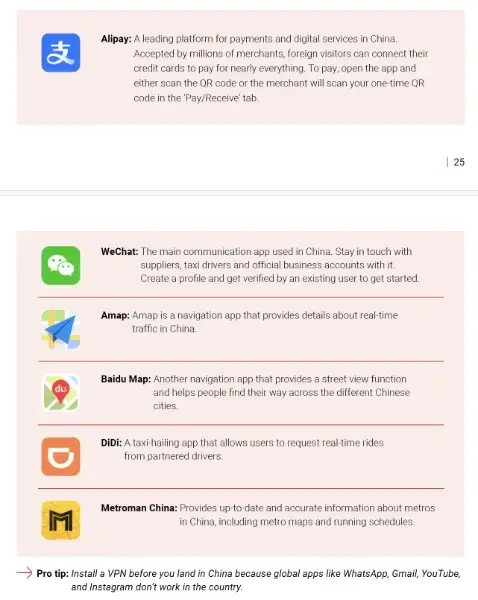
Useful apps
China has its own range of apps for making payments, sending messages and managing
transportation. Make sure you have all the important apps downloaded on your phone when you
land in China.
Useful phrases
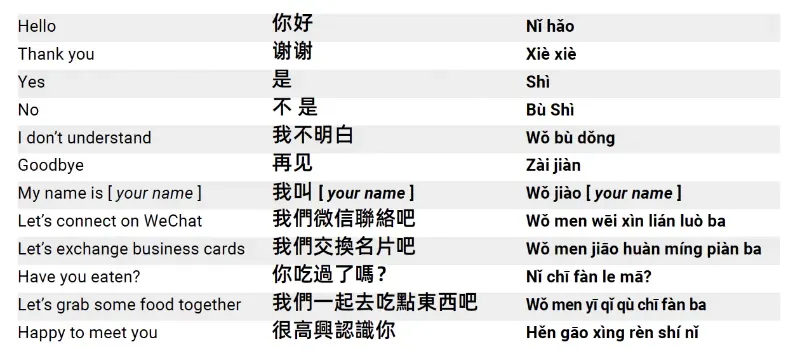
It’s good to show appreciation for Chinese culture by learning a few common phrases.
Pro tip: The popular question, “I scan or you scan me?” is often asked in stores.
Alipay: Your all-in-one travel companion in China
Alipay is one of China’s most popular mobile payment platforms and much more than just a payment app. It’s widely used for making everyday payments, booking transportation, splitting bills, and even booking hotels.
Whether you’re grabbing a meal, shopping, or taking a taxi, Alipay is accepted almost everywhere, making it essential for travellers who want to avoid carrying cash. It also offers additional features like maps, public transportation schedules, and even money transfers between users.
What Alipay lets you do
- Make mobile payments at restaurants, shops and public transport
- Book transportation such as taxis, trains and flights
- Pay bills and utilities, if staying long-term
- Split bills with friends directly through the app
- Access local deals and promotions for restaurants and shopping
- Use mini-apps within Alipay to navigate, find services and even translate
How to open an Alipay account and link your card
- Download the app: First, download Alipay from your app store (available on both iOS and Android)
- Sign up: Open the app and sign up using your phone number. You’ll receive a verification code via SMS to complete registration.
- Link your credit card:
- Go to the ‘Account’ section of the app
- Select ‘Bank Cards’
- Tap ‘Add Card’ and enter your credit card details
Once your card is linked, you can start making payments by scanning QR codes. Using Alipay simplifies travel in China, allowing you to go cashless in a country where mobile payments are the norm.
Pay like a local in China: Alipay with the World Card
Alipay is one of China’s most popular mobile payment platforms and much more than just a payment app. It’s used for everyday payments, booking transportation, splitting bills and even booking hotels. From taxis to restaurants to supplier settlements, Alipay is accepted almost everywhere, making it essential for business travellers who want to avoid carrying cash.
The challenge for foreign business travellers has traditionally been linking a card that works smoothly with Alipay without stacking up foreign transaction fees on every tap.
Why the World Card works with Alipay
The World Card is a Mastercard-powered business payment card linked to the World Account. It links to Alipay and works at the QR code level across China. When paying in CNY, the World Card can draw from an existing CNH balance in the World Account with zero foreign exchange fees, unlike most Australian-issued cards, which apply a foreign transaction fee of around 3% on every CNY purchase.
With the World Card linked to Alipay, you can:
- Pay in CNY at competitive rates without the 3% foreign transaction fees typically charged by Australian cards
- Spend from existing CNH balances held in the World Account — zero foreign exchange fees on 15 supported currencies including CNH when spending from balance
- Issue up to 20 cards at no additional cost for team members travelling together
- Set card-level spending limits and track transactions in real time through the World Account dashboard
- Earn cashback on eligible spending (Terms and Conditions Apply)
- Use the same card for business supplier payments and personal travel expenses without juggling multiple cards
How to set up Alipay and link the World Card
Step 1: Download the app
Download Alipay from the app store (available on both iOS and Android).
Step 2: Sign up
Open the app and sign up using the mobile number. A verification code arrives via SMS to complete registration.
Step 3: Link the World Card
- Go to the “Account” section of the app
- Select “Bank Cards”
- Tap “Add Card” and enter the World Card details
Once linked, payments can be made by scanning QR codes anywhere Alipay is accepted. Set this up before the flight to avoid troubleshooting on arrival.
Pay suppliers in China: What to use when
Business travel to China often leads directly to supplier commitments. A factory visit turns into a sample order, a sample order turns into a bulk purchase and how you pay depends on what the supplier accepts and where you’re buying from.
For 1688 suppliers: World Pay
Most suppliers encountered through factory visits in southern China (Guangdong, Fujian) are listed on 1688.com, Alibaba Group’s domestic B2B wholesale platform. 1688 supports some international credit cards but its limited support.
World Pay by WorldFirst is the authorised international payment provider for 1688.com. It allows Australian buyers to pay 1688 suppliers in CNH directly from the World Account, without needing a Chinese bank account.
Benefits of World Pay for 1688 payments:
- Competitive exchange rates of up to 0.8% on 1688 payments
- Full integration with 1688.com so orders and payments stay connected
- No Chinese bank account required
- Buyer protection retained through 1688’s standard protection program
Set up a World Account and link World Pay to a 1688 account before travel, so purchases can be initiated and paid as soon as a supplier is confirmed.
For USD payments to suppliers: Direct from the World Account
Many Chinese suppliers encountered on international-facing platforms like Alibaba prefer USD payments. USD is widely accepted globally, protects suppliers from CNY exchange rate volatility, and simplifies export paperwork.
The World Account is a multi-currency account that lets you hold USD, GBP, EUR, CNH and 20+ other currencies in local balances and send payments in 100+ currencies across 200+ countries and regions at competitive conversion rates. For USD payments to Chinese suppliers, hold USD in the World Account and send directly to the supplier’s USD account, with no intermediary bank fees and transparent delivery times.
For in-country payments: Alipay linked to the World Card
Alipay with the World Card handles taxi rides, restaurants, hotel incidentals and smaller supplier payments during the trip itself.
FAQs
1. Can I use my Australian credit card in China?
Most Australian credit cards work in China but attract foreign transaction fees of around 3% per transaction, plus the issuer’s FX markup on the CNY-AUD conversion. Many smaller merchants also don’t accept international cards and prefer Alipay or WeChat Pay. Linking the World Card to Alipay avoids both issues–zero FX fees on 15 supported currencies including CNH when spending from an existing balance, and acceptance anywhere Alipay is accepted.
2. How do I set up Alipay as a foreigner?
Download the Alipay app, sign up with a mobile number, verify with the SMS code, then link a supported international card. The World Card by WorldFirst is a Mastercard-powered business payment card that links to Alipay for payments in CNY.
3. How do I pay a 1688 supplier from Australia?
Use World Pay by WorldFirst, the authorised international payment provider for 1688.com. It links the World Account to 1688 orders and lets buyers pay suppliers in CNH at competitive rates (up to 0.8%) without needing a Chinese bank account.
4. What apps should I download before travelling to China?
Alipay for payments, WeChat for messaging, Dianping for restaurant reviews, and a VPN like ExpressVPN for accessing Western apps blocked in China. Download and set up Alipay with a linked payment card before the flight, setting it up on arrival is harder without a local SIM.
The information contained is general only. Before acting on the information you should consider whether it is appropriate for you, in light of your objectives, financial situation or needs. Although information has been obtained from and is based upon multiple sources the author believes to be reliable, accuracy is not guaranteed and the information may be incomplete or condensed. All opinions, estimates, mentioned products/services and referenced material constitute the author’s own judgement as of the date of the article and are subject to change without notice. WorldFirst shall not be responsible for any losses or damages arising from reliance on such information.