




























Learn how Australian businesses can expand into Southeast Asia through Lazada–from setting up a LazGlobal seller account to managing multi-currency payouts across SEA markets
Key takeaways
- Lazada operates across six Southeast Asian markets (Singapore, Malaysia, Thailand, Indonesia, Vietnam and the Philippines), reaching a combined base of 35 million+ monthly users.
- Australian businesses can sell on Lazada as a LazGlobal (cross-border) seller, listing products in local currencies without needing a legal entity in the destination country.
- Lazada charges no fixed monthly fee. Sellers pay commissions per sale, a payment processing fee, and shipping costs based on the fulfilment method chosen.
- Payouts from Lazada come in the local currency of each market you sell in (SGD from Singapore, MYR from Malaysia, and so on). A multi-currency account lets Australian sellers collect these payouts without forced conversion to AUD.
- The World Account from WorldFirst supports 20+ currencies including SGD, HKD, CNH, USD, GBP and EUR, so Australian Lazada sellers can collect Singapore payouts in SGD, receive Hong Kong fulfilment invoices in HKD, and pay Chinese suppliers in CNH from a single account.

Lazada is one of the biggest e-commerce marketplaces in Southeast Asia, with an annual revenue of over $4.4 billion. It has over 160 million active users along with one million active sellers–every month.
The marketplace is the most popular in the Philippines, with 35 million monthly users, followed by Thailand, Indonesia, Malaysia, Vietnam and Singapore.
When Lazada kicked off its 9.9 Mega Sale in 2025, the platform saw a double digit YoY growth with nearly 30% in average order value (AOV), compared to the year before that. The top 100 sellers saw a growth of more than 49 times YoY. But here’s the best part, brand driven sales still make up for less than 30% of Southeast Asia’s ecommerce on Lazada, meaning there is clear opportunity here to capture high value customers
If you are planning to expand your business in Southeast Asia, Lazada can be the easiest and quickest way to enter the vast market.
In this detailed guide, we take a look at everything you should know about selling on Lazada as an international seller.
This guide covers everything Australian businesses need to know about selling on Lazada as a cross-border seller.
What is Lazada?
Lazada is an international e-commerce marketplace with a presence across Southeast Asia. Founded in 2012, it became a part of the Alibaba group in 2016 and the company’s headquarters are located in Singapore.
Currently, Lazada operates in the following countries
- Philippines (35 million+ monthly users, the largest Lazada market)
- Thailand (Lazada is the second-largest marketplace after Shopee)
- Indonesia
- Malaysia
- Vietnam
- Singapore (also Lazada’s headquarters)
The platform hosts millions of product listings across categories including home and living (its largest category), fashion, health and beauty, groceries, pets and electronics.
Can you sell on Lazada as an Australian seller?
Lazada allows international sellers to list their products on the platform even when they aren’t based in the countries listed above. For each Lazada region, you can set up a store, customise product listings and add prices in local currency. It’s a good idea to start with one or two regions and slowly expand your store operations to more Lazada-supported countries.
To make shipment and fulfilment easier, Lazada has an international fulfilment centre in Hong Kong, which works pretty similarly to Amazon FBA. As a seller, you can ship all your products to the fulfillment center in bulk and let Lazada manage all the logistics. Whenever you receive a new order, Lazada will be responsible for shipping, returns, customer service and even lost packages.
International sellers can manage multiple Lazada stores across different countries with a single account. To become a cross-border seller on Lazada (also known as LazGlobal seller), you need a registered business and you shouldn’t be based in the country you’re trying to sell.
Pros and cons of selling on Lazada as an Australian cross-border seller
Pros
- Access to six SEA markets from a single seller account, without needing legal entities in each country
- No fixed monthly cost for the seller account. Commission is only charged on completed sales
- Lazada’s international fulfilment centre in Hong Kong handles logistics, returns and customer service across the region
- Product listings can be translated into local languages and priced in local currencies
- Faster route to SEA expansion than setting up in-market operations
Cons
- Sellers incur different types of fees, including commission fees, payment processing fees and shipping fees
- Shipping bulk products to Lazada warehouses can get expensive and cut through your margins, making it difficult to compete with local sellers in terms of pricing
- Cash on delivery is a popular method of payment in Southeast Asia, which can be risky and increase the return rate
- Local sellers within SEA often have pricing advantages on shipping and taxes
Step-by-step guide to start selling on Lazada from Australia
Step 1: Set up your LazGlobal seller account
There are three types of seller accounts supported on Lazada:
Lazada Seller: This option is only for local sellers who want to sell products in the region where they are located. For instance, if you are located in Singapore, you can sell on Lazada Singapore directly with no commission fees. You don’t have to be the authorised distributor of products
LazMall Seller: If you have a trademark for a product or you’re the authorised distributor of a brand, you can sign up as a LazMall seller and offer exclusive products on the platform
LazGlobal Seller: This option is especially for international sellers based abroad who want to sell their products in Southeast Asia. You can ship your goods to a Lazada global shipping warehouse and let Lazada handle all the customer fulfilment for you.
Step 2: List your products
To become a LazGlobal, you’ll need the following documents:
- A business license (This applies to both companies and sole traders)
- A corporate or personal Alipay account for identity verification (In case you are using a personal Alipay account, you’ll also have to upload photos of your ID, a photo of you holding the ID and a photo of you holding the business license)
Lazada also requires cross-border sellers to deposit up to 3000 RMB to sell their products on the platform (The exact deposit can vary depending on the region). You only need to put in the deposit once to open your stores in up to 6 countries. Currently, there is a 90-day no-deposit policy, which means you can put up the deposit any time before the 90 days are over.
If you decide to close down your Lazada store in the future, the deposit will be refunded to you within 30 days.
After activating your seller account, you need to list at least 5 products to take your Lazada store live. You can manually list each product or use Lazada’s bulk upload feature to add multiple products to your store.
Here are the steps to add products to your store:
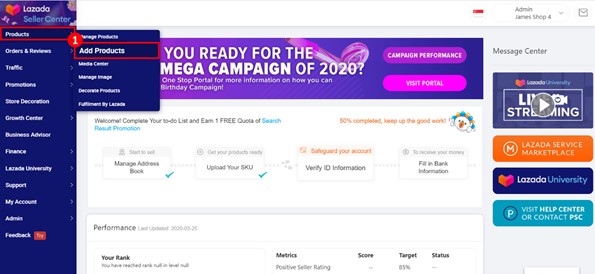
a. Go to your Seller Center account → click on Products → Select ‘Add Products’
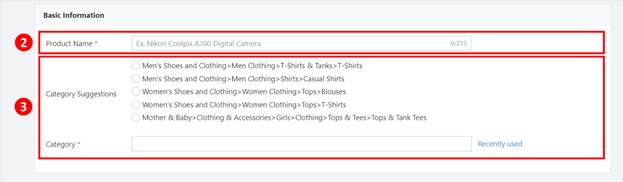
b. Add the product title, category and brand (If applicable)
c. Add the key features of the product under the product highlight section. Use bullet points to keep the content concise and engaging
d. Now, add the actual product description with as many details as you’d like to include. You can also add product images here. Lazada recommends adding a minimum product description of 50 words and at least one image
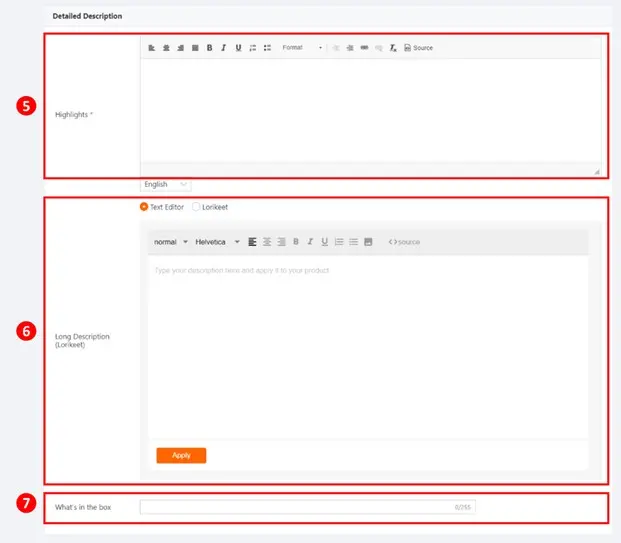
e. The next field you’ll have to add is ‘What’s in the box,’ which helps detail everything the customers will receive in their package. For instance, if you’re selling a rechargeable toy, add ‘toy and battery charger’ here. In case there are no extra add-ons, you can just add ‘product only’
f. Select product variations (size and colour), if applicable. In case you’re adding a new colour, it’s also recommended to add images for the different colour options available
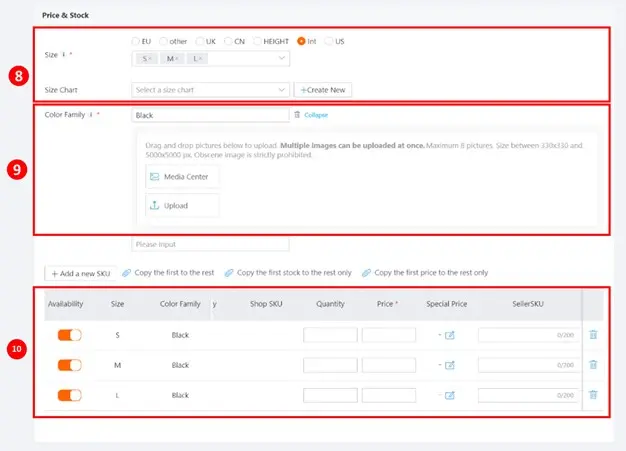
g. The last step is to add pricing, quantity, package dimension and weight. Before you add pricing, make sure you factor in the shipping fees and other Lazada’s commissions
While listing products, keep a note of the following:
- Not all products are allowed to be sold on Lazada. Always check the updated prohibited products list before you take any product live
- Lazada doesn’t support or allow dropshipping
- Once you have created the initial listing, you can reuse it to sell the same product across different regions. Lazada lets you translate product descriptions into local languages and set prices in local currencies
Step: Manage shipping and fulfilment on Lazada
There are different ways to fulfil your orders on Lazada. You can choose to manage the entire fulfilment process yourself or let Lazada handle it for you.
Fulfilment by Lazada
Lazada Global Shipping program is an end-to-end shipping solution that lets cross-border sellers manage the ‘selling’ part of the business while Lazada takes care of shipping. You also get access to competitive international and domestic shipping rates.
Here’s how fulfilment by Lazada works:
1. You send a bulk product shipment to any of Lazada’s international fulfilment centres. In case you are sourcing products from a supplier, you can ask your supplier to directly send products to any of the fulfilment centres
2. Lazada manages order fulfilment on your behalf. When a new order comes in, the Lazada team manages the store, selection and order shipping. It’s also responsible for managing returns and lost packages in case things go wrong
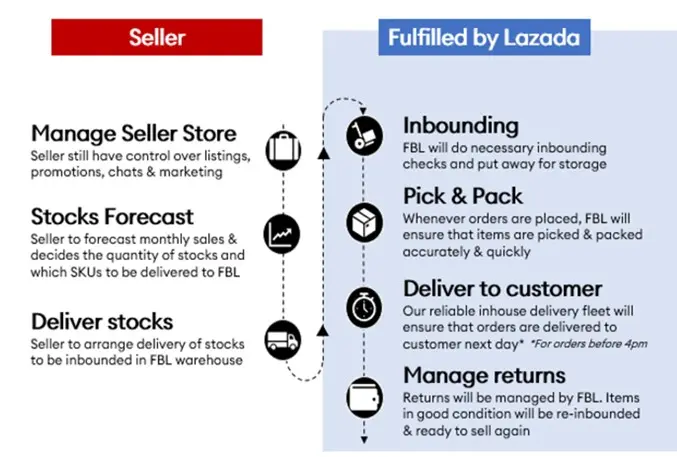
The shipping costs for FBL can depend on which fulfillment center you are sending your products to, how long they are stored there and how much they weigh. Spreading out shipments across different fulfillment centers can help cover more regions and enable faster local delivery to customers.
Delivered by seller
You can also use third-party logistics (3PLs) to fulfill your orders locally. Lazada has a list of logistics partners that you can connect with to streamline operations and get better rates. You can also find your own partners to manage the entire shipping process yourself. Opting for this means potentially saving more on commissions and shipping costs, but you’ll also have to spend a lot of time managing shipping and returns.
Step 4: Manage payouts across multiple currencies
This is where cross-border selling on Lazada gets operationally interesting. Lazada pays sellers in each market’s local currency:
- Lazada Singapore pays in SGD
- Lazada Malaysia pays in MYR
- Lazada Thailand pays in THB
- Lazada Indonesia pays in IDR
- Lazada Vietnam pays in VND
- Lazada Philippines pays in PHP
Your Lazada Seller Balance shows your net sales for orders marked as delivered each week. You can withdraw manually (the first request per week is free; subsequent requests may attract a fee) or wait for automatic withdrawal, which typically runs every Monday (except in the Philippines).
If you provide an AUD-only bank account as your withdrawal destination, every payout gets converted from the local currency to AUD at the bank’s exchange rate. Over a year, this can significantly reduce your effective earnings from SEA sales.
Lazada seller fees and charges
While the exact seller fees charged by Lazada can depend on the region you’re registering in, these are the main fees you’ll be expected to pay as a Lazada seller.
Commission fee
Lazada does not charge a fixed monthly fee. Instead, it takes a small percentage of the products you sell on the platform. Commission fees can vary depending on the product category and region.
Payment fee
A percentage of the total transaction cost, including the item price and customer shipping fee, is charged as the payment fee. Usually, Lazada charges a 2% payment fee.
Shipping fee
The shipping fee will depend on whether you are opting for Fulfilment by Lazada or third-party partners. The weight and dimensions of the package will also determine the exact shipping amount.
Advertising fee
These are optional charges that you’ll have to pay if you use ads on Lazada to boost the visibility of your product listings.
Cancellation fees
You may incur a cancellation fee if the order is returned and the reason is attributed to the seller. For instance, if the order is returned because the product quality wasn’t as expected or if the received product was entirely different from the ordered product, then you’ll be charged with a cancellation fee.
How WorldFirst supports Australian Lazada sellers
The World Account is a multi-currency account from WorldFirst that lets Australian businesses collect, hold, convert and send funds in 20+ currencies from a single online platform. For Australian sellers on Lazada, it addresses the multi-currency payout challenge that comes with cross-border selling across SEA.
Collect Lazada payouts in the local currency
Instead of receiving every Lazada payout into an AUD account and losing margin to conversion, you can add local currency receiving details from your World Account to your Lazada Seller Center:
- Lazada Singapore payouts collected in SGD through your SGD local receiving account
- Lazada Hong Kong fulfilment-related transactions managed in HKD through your HKD local receiving account
- Payouts from other Lazada markets managed within the multi-currency capabilities of your World Account
Your SGD, HKD and other currency accounts are opened under your Australian business’s name and come with local bank details you can share with Lazada, marketplaces, payment processors and clients.
Hold and convert on your own terms
Once payouts arrive in the original currency, you can hold the balance and convert to AUD (or another currency) when the rate is favourable. Conversion happens at competitive rates within the account, so you’re not accepting whatever rate applies on the day of every payout.
Pay suppliers, freight forwarders and Lazada fees
The same World Account handles outbound payments:
- Pay Chinese suppliers on 1688.com in CNH through World Pay, the authorised international payment provider for 1688.com
- Pay freight forwarders and shipping partners in USD, HKD or their preferred currency
- Pay Alibaba, AliExpress and other supplier platforms using the World Card, a Mastercard-powered business payment card supporting payments in 150+ currencies with no fees when paying in any of the 15 supported currencies (with sufficient balance held in that currency). Cashback on eligible spending (Terms and Conditions Apply).
- Pay Lazada fees and other business expenses in the currency the invoice is issued in
Other WorldFirst features that support cross-border sellers
- Collect from 130+ marketplaces and payment gateways, so Lazada, Amazon, eBay, Etsy, Shopify and others can all settle into the same account
- Send payments in 100+ currencies to 200+ countries and regions
- Forward contracts for locking in exchange rates on future currency conversions (subject to eligibility)
- Xero and NetSuite integrations for reconciliation
- Zero fees on account opening, monthly maintenance and receiving funds
- Up to 20 World Cards issued per account at no additional cost, useful for managing purchasing across teams
FAQs
1. Can Australian businesses sell on Lazada?
Yes. Lazada’s LazGlobal programme is designed for international sellers based outside its six SEA markets. Australian businesses can register as a LazGlobal seller, list products across Singapore, Malaysia, Thailand, Indonesia, Vietnam and the Philippines, and use Lazada’s international fulfilment centre in Hong Kong to handle logistics.
2. What currency does Lazada pay Australian sellers in?
Lazada pays sellers in the local currency of each market you sell in: SGD for Singapore sales, MYR for Malaysia, THB for Thailand, IDR for Indonesia, VND for Vietnam and PHP for Philippines. To avoid losing margin to FX conversion on every payout, many Australian sellers use a multi-currency account like the World Account to collect payouts in the original currency.
3. How much does it cost to sell on Lazada from Australia?
There’s no fixed monthly fee. Costs include a commission per sale (varies by category and market), a payment processing fee of around 2%, shipping fees (depending on the fulfilment method), optional advertising fees and cancellation fees for seller-attributed returns. Cross-border sellers also pay a security deposit of up to 3,000 RMB, refundable within 30 days of closing the store.
4. Does Lazada handle fulfilment for cross-border sellers?
Yes. Through Lazada Global Shipping, cross-border sellers can ship bulk inventory to Lazada’s international fulfilment centre in Hong Kong. Lazada then manages storage, order picking, shipping to end customers, returns and customer service across all six SEA markets.
5. Do I need a business entity in Singapore or Malaysia to sell on Lazada there?
No. As a LazGlobal cross-border seller, your Australian business can sell into all six Lazada SEA markets without establishing a local entity in each country. You’ll need a valid Australian business licence to register.
6. How do I collect Lazada payouts in Singapore or Malaysia?
Lazada requires you to add a bank account as your withdrawal destination. Multi-currency account providers like WorldFirst give Australian sellers local receiving details in SGD (and other supported currencies) that can be added to your Lazada Seller Center. This lets you collect payouts in the original local currency without forced conversion to AUD.
7. Can I sell the same products across all Lazada markets?
Yes. Once you’ve created a product listing, you can reuse it across Lazada’s six SEA markets, translating the description into local languages and setting pricing in each market’s local currency. Some product categories are restricted in specific markets, so check Lazada’s prohibited products list per country before listing.
8. How long does Lazada take to pay sellers?
Your Lazada Seller Balance updates weekly for orders marked as delivered. You can withdraw manually (first weekly withdrawal is free; subsequent requests may attract a fee) or wait for automatic withdrawal, which typically runs every Monday (except in the Philippines).
Disclaimer: The information contained is general only and largely our views. Before acting on the information you should consider whether it is appropriate for you, in light of your objectives, financial situation or needs. Although information has been obtained from and is based upon multiple sources the author believes to be reliable, we do not guarantee its accuracy and it may be incomplete or condensed. All opinions, estimates, mentioned products/services and referenced material constitute the author’s own judgement as of the date of the briefing and are subject to change without notice. WorldFirst shall not be responsible for any losses or damages arising from your reliance of such information.





![How to set up your AliExpress dropshipping business in Australia [2026]](https://mdn.marmot-cloud.com/worldfirst/sites/8/2026/10/20261001222121715-300x200.webp)