































Your guide to BSB numbers for Australian businesses and individuals, covering what they are, how to find them, what to do if you get one wrong, and how they compare to international payment systems.
Key takeaways
- A BSB number is a 6-digit code used to identify Australian bank branches for domestic payments.
- You need both a BSB and account number to send or receive money within Australia.
- Australian banks have been rolling out Confirmation of Payee, which checks whether the recipient’s name matches the account before a transfer goes through.
- BSBs aren’t used internationally. Cross-border payments to and from Australia use SWIFT codes instead.
- You can find your BSB in online banking, on account statements, or by asking your bank directly.

If you’ve ever needed to send or receive money within Australia, chances are you’ve come across the term BSB number. It’s a key part of making sure your payment reaches the right account, and every Australian bank uses one to route domestic transfers.
This guide explains what a BSB number is, where to find it, what happens if you get one wrong, and how it compares to international payment systems like SWIFT. Whether you’re a business owner or managing your personal banking, here’s everything you need to know.
BSB number format and structure
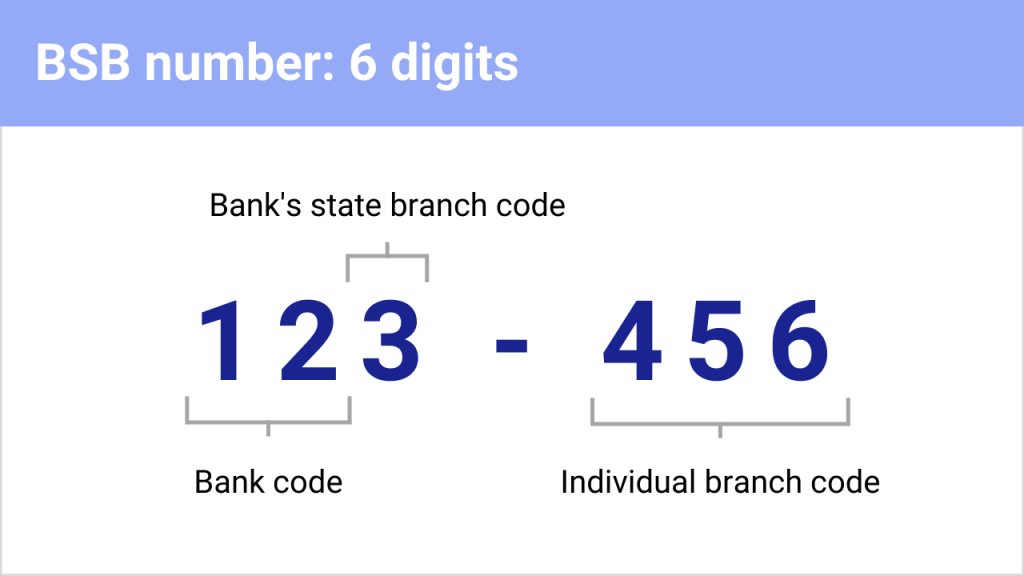
A BSB number (Bank State Branch number) is a six-digit code used in Australia to identify individual bank branches. It’s used when transferring money between bank accounts within Australia.
Here’s what it does:
- Tells the system which bank the account is with
- Points to the specific branch where the account was opened
- Works alongside the account number to make sure the funds land in the right place
BSB numbers are formatted as XXX-XXX. The first two digits identify the bank, and the next four identify the branch. Every Australian account is linked to a BSB, and no two branches share the same one.
Some banks use a universal BSB across all branches, while others assign different BSBs to different branches. For example:
- AMP Bank uses a universal BSB (939-200) across all accounts.
- Bank of Queensland uses a universal BSB (124-001).
- Macquarie Bank uses a universal BSB (182-512).
- Commonwealth Bank BSBs generally begin with 06, with different branch codes following.
- ANZ BSBs generally begin with 01, varying by branch.
- Westpac BSBs generally begin with 03, varying by branch.
- NAB BSBs generally begin with 08, varying by branch.
If you’re unsure whether your bank uses a universal BSB or branch-specific ones, the bank’s website usually has a branch locator tool that will confirm the correct BSB for the specific branch.
How do I find a BSB number?
If a supplier is requesting payment to their Australian bank account, the BSB number will be stated before the account number on the invoice.
If you’re looking for your own BSB number, here’s where you can find it:
- Internet banking: Log in and head to your account details.
- Bank statement: Usually listed right next to your account number.
- Mobile app: Most banks show the BSB on the main account screen.
- Cheque book: Printed on each cheque if your bank issued one.
- Ask your bank directly: In a branch, over the phone, or through online support.
Every Australian account is linked to a BSB tied to its branch. If you switch banks or open a new business account with another provider, your BSB number will change too.
How to find your beneficiary’s BSB number
If you’re sending money to someone else in Australia, you’ll need their BSB number. There are a few ways to find it:
- Ask the recipient directly: This is the most reliable method. The recipient can share their BSB and account number, or point you to a recent invoice or bank statement.
- Check the invoice: For business payments, the BSB is typically printed alongside the account number on the invoice.
- Use the bank’s branch locator: If you know which bank the recipient uses and their branch location, the bank’s website usually has a branch locator tool that displays the correct BSB.
- Universal BSB banks: For banks that use a universal BSB (like AMP, Bank of Queensland or Macquarie), the BSB is the same regardless of the recipient’s branch.
Before initiating the transfer, double-check the BSB with the recipient, especially for larger amounts or first-time payments. The next section explains why.
What happens if you get the BSB number wrong?
Every domestic payment in Australia depends on the BSB and account number pairing being correct. Getting the BSB wrong can create real problems for the payment.
Here’s what can happen if the BSB is entered incorrectly:
- The transaction may be rejected outright if the BSB doesn’t match any active branch code. In this case, the funds usually stay in your account.
- The transfer may be sent to the wrong branch, and possibly to the wrong account if the account number happens to match a valid account at that branch.
- You may need to request a trace or reversal through your bank, which can take several business days to complete and isn’t always successful.
- Delayed or lost transactions can affect supplier relationships, payroll runs and time-sensitive payments.
Since mid-2025, Australian banks have been rolling out Confirmation of Payee, a system that checks whether the recipient name you enter matches the account holder at the receiving bank before the transfer is processed. If there’s a mismatch, the system displays a “no match” warning so you can review the details before confirming. This adds an extra layer of protection against BSB errors, transposed digits or scams.
Even with Confirmation of Payee in place, the safest habit is to double-check both the BSB and account number before confirming any transfer, particularly for large amounts or first-time payments to a new recipient.
Do I need a BSB for international transfers?
If you’re transferring money from an overseas account to an Australian account, you’ll usually need both the BSB number and the bank account number. Australia doesn’t use IBANs (International Bank Account Numbers).
Some overseas banks don’t require the BSB to form part of the account number and just need the SWIFT code and account number. Others require it. In cases where an IBAN is requested, combining the BSB and account number without spaces or hyphens gives the correct format.
Likewise, if you’re invoicing an overseas client for payment into an Australian bank account, you’ll need to provide your BSB number.
If you’re transferring money to an overseas bank account, you won’t need a BSB number. BSBs are unique to Australia’s banking system, and other countries use their own systems for identifying banks and branches.
Is it safe to share your BSB and account number?
Generally, providing your BSB and account details to suppliers is safe, since the details are used to deposit funds rather than withdraw them. However, there’s a possibility your details may be used to set up direct debits if the debiting business doesn’t verify ownership of the account with a signature or ID. As long as you regularly check your statements and activity, unauthorised debits are relatively quick to spot.
To be safe, only share your bank details with people you trust, or with businesses and suppliers who genuinely need the information.
BSB number: Australia vs New Zealand
Australia uses BSB numbers to identify banks and branches for domestic payments. A BSB number is six digits long and formatted as XXX-XXX. The first two digits identify the bank, and the next four identify the branch.
New Zealand doesn’t use BSB numbers. Instead, it uses a different format for bank account numbers. A New Zealand bank account number follows this structure: BB-bbbb-AAAAAAA-SSS
- BB: bank code
- bbbb: branch number
- AAAAAAA: account base number
- SSS: suffix for account type
If you’re sending money between Australia and New Zealand, you won’t be using a BSB number for the New Zealand side. You’ll need the full New Zealand bank account number and may also need a SWIFT/BIC code depending on the transfer method.
How can you transfer money with a BSB number?
To send money within Australia, you’ll need two key details:
- The recipient’s BSB number
- Their account number
Here’s how it works:
- Log in to your online banking or use a mobile app.
- Choose the option to make a domestic payment.
- Enter the BSB and account number of the recipient.
- Add the payment amount and reference if needed.
- Review and confirm the transfer.
The BSB number tells the bank where the money should go. It works like a postcode for the branch. BSB-based transfers usually land on the same day or the next business day, depending on the bank’s processing time.
Is a BSB code the same as a SWIFT code?
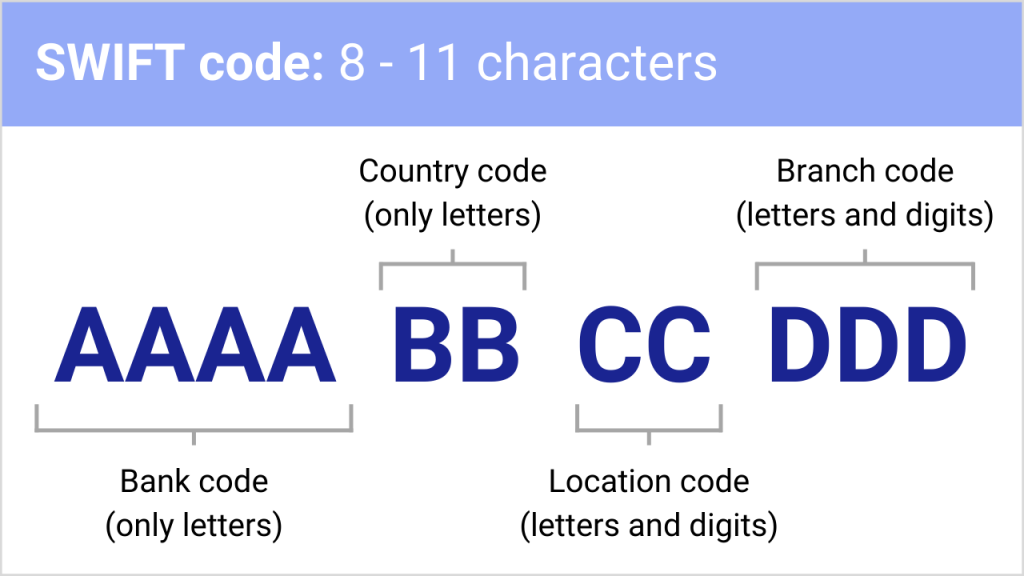
While BSB numbers and SWIFT/BIC codes are both used to identify the receiving bank when making a money transfer, the SWIFT/BIC code is used for international payments. SWIFT is a messaging network with a standardised system of codes used by financial institutions globally to allow them to securely transfer funds across borders. The acronym stands for Society for Worldwide Interbank Financial Telecommunication.
BSB numbers are for domestic transfers within Australia, and SWIFT codes are essential for international transactions.
Here’s what a SWIFT/BIC code does:
- Identifies the bank involved in the transfer
- Makes sure the funds reach the correct country, bank and branch
- Required for both sending and receiving payments internationally
You can find your bank’s SWIFT code:
- On their official website
- In the international transfers section of your online banking
- On your bank statement
Fast and secure international payments for your business
The World Account is a multi-currency account from WorldFirst, an international payments provider for cross-border businesses. For Australian businesses that handle international payments alongside domestic BSB-based transfers, the World Account provides:
- Local currency accounts in 20+ currencies, including AUD, USD, GBP, EUR, CNH, SGD, JPY, NZD, HKD and CAD, each with local receiving details for collecting payments as if the account were domestic to that currency.
- Send payments in 100+ currencies to 200+ countries and regions, for settling supplier invoices, contractor payments and overseas expenses.
- Collect payments from 130+ marketplaces and payment gateways, including Amazon, Stripe, Etsy and PayPal.
- The World Card, a Mastercard-powered multi-currency business debit card supporting payments in 150+ currencies, with zero foreign exchange fees in 15 supported currencies when sufficient balance is held in that currency. Up to 20 virtual cards can be issued at no additional cost. Cashback is available on eligible spending (Terms and Conditions Apply).
- Forward contracts for locking in exchange rates on future currency conversions.
- Xero and NetSuite integrations for multi-currency reconciliation.
- Zero fees on opening the account, receiving funds and holding balances.
FAQs
1. Is BSB the same as IBAN?
No. A BSB number is a 6-digit code specific to Australia that identifies the bank and branch of a domestic account. An IBAN (International Bank Account Number) is used in many European and Middle Eastern countries to identify an account for international payments. Australia doesn’t use IBANs. Some overseas banks that need an IBAN-format field for Australian accounts accept the BSB and account number combined (without spaces or hyphens).
2. How do I check my BSB and account number?
The easiest way is to log in to your online banking. Your BSB and account number are typically shown on the main account screen or under account details. You can also find them on your bank statement, in your mobile banking app, on a cheque if your bank issues them, or by calling your bank directly.
3. Does a credit card have a BSB?
No. Credit cards use a 16-digit card number instead of a BSB and account number. BSBs are used for bank account transfers, not credit card transactions. If you’re making a payment to a credit card, you generally use the card number and expiry details (for card payments) or the credit card provider’s BSB and account details (for a bank transfer to pay off the card balance).
4. How do I find my BSB and account number?
You can also find them on a bank statement, on a cheque, or by contacting your bank directly. If you’re opening a new account, the BSB and account number are typically included in your welcome pack.
Disclaimer: The information contained is general only and largely our views. Before acting on the information you should consider whether it is appropriate for you, in light of your objectives, financial situation or needs. Although information has been obtained from and is based upon multiple sources the author believes to be reliable, we do not guarantee its accuracy and it may be incomplete or condensed. All opinions, estimates, mentioned products/services and referenced material constitute the author’s own judgement as of the date of the briefing and are subject to change without notice. WorldFirst shall not be responsible for any losses or damages arising from your reliance of such information.


![How to set up your AliExpress dropshipping business in Australia [2026]](https://mdn.marmot-cloud.com/worldfirst/sites/8/2026/10/20261001222121715-300x200.webp)