





























You may commit a deposit on an overseas order weeks before you know the final GBP cost of the stock. If sterling weakens before the balance is due, the same order requires more cash and leaves less margin.
Currency losses and other types of negative FX movements affected cash flow for 17% of UK importers surveyed by Bibby Financial Services in 2026. The finding shows why businesses need a clear FX plan when approving orders and setting purchasing budgets, rather than waiting until the payment day.
This article explains the main benefits of foreign exchange risk management for businesses, including protecting margins, planning costs more accurately and making clearer purchasing decisions.
Key takeaways:
- FX risk starts when you commit to an order: Deposits, staged payments and long lead times can expose supplier costs before the final invoice is due
- A clear FX plan protects margins and landed costs: Using a budget rate and tracking confirmed payments can support more reliable pricing, purchasing and cash-flow decisions
- Confirmed payments should take priority over forecasts: A known currency amount and payment date usually deserve more attention than an early estimate that may still change
- Matching currency income with expenses can reduce conversions: Using USD revenue to pay a USD supplier can avoid converting into GBP and then buying USD again
- WorldFirst can connect FX planning with supplier payments: You can receive and hold foreign currencies, convert funds, pay overseas suppliers and access eligible FX tools for confirmed future payments
Open a World Account to manage currency exposure alongside your international collections and supplier payments.
What foreign exchange risk management means for established importers
Foreign exchange risk management means identifying which overseas payments are exposed to exchange-rate changes, estimating the possible effect on your costs and deciding how to respond. It also involves comparing the expected and final GBP cost so you can improve future purchasing decisions.
You take on this risk when you commit to an order, not only when you pay. Deposits, staged payments and long lead times can leave part of an order open to rate changes for weeks or months. Repeat orders may also leave several supplier payments exposed to that risk.
Separating the currency effect makes it easier to see whether costs rose because of the exchange rate, supplier pricing or logistics.
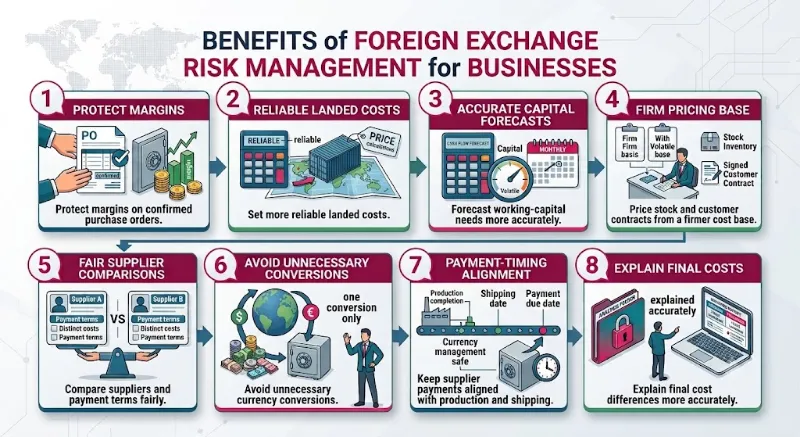
The 8 main benefits of foreign exchange risk management
The first three benefits matter most once you’ve committed to an overseas order. They affect the margin agreed at approval, the expected landed cost and the cash needed for payment.
The remaining benefits support pricing, supplier selection, currency use, payment timing and cost analysis.
1. Protecting margins on confirmed purchase orders
Once you’ve agreed the supplier price and customer price, the exchange rate may be one of the few significant costs still outside your control.
If sterling weakens against the invoice currency, you’ll need more GBP to settle the same supplier balance. Recovering that increase may be difficult after you’ve accepted wholesale orders, published prices or signed a fixed-price customer contract.
The commercial effect depends on the margin available, not only the invoice value. A smaller order with a narrow margin may carry more risk than a larger purchase with more room to absorb cost changes.
A 2025 MillTech survey of more than 250 UK CFOs and treasurers found that 48% of UK companies had lost money because of movements in sterling, showing how rate movements can create a financial loss after you’ve fixed customer prices and committed to supplier payments.
For a confirmed amount and payment date, a forward contract can replace an uncertain GBP cost with a known one. The contract remains binding, so you must use the agreed rate even if the market later moves in your favour.
2. Setting more reliable landed costs
The supplier’s unit price is only one part of your final stock cost. Freight, inspection, tooling, packaging and sourcing fees may also arrive in foreign currencies at different stages of the order.
Converting each expense at a different spot rate can move the landed cost away from the figure used when approving the purchase.
A more reliable figure supports several parts of the order:
- Purchase approval: Check the expected total before committing funds
- Inventory planning: Estimate how much cash incoming stock will require
- Product analysis: Compare the anticipated selling price with the full import cost
- Repeat ordering: Assess later purchases using the same calculation
You gain a more dependable estimate of landed cost before the goods arrive, rather than discovering the full GBP value only after every invoice has settled.
3. Forecasting working-capital needs more accurately
The pressure increases when sterling weakens before several foreign-currency payments fall due.
Deposits, final supplier balances and freight charges may need payment alongside duty, payroll and tax. Even a moderate rate movement across several invoices can raise the total GBP required during a busy month.
Timing matters as much as the overall amount.
A deposit may fall due before customer revenue arrives, while the final balance may overlap with freight and import charges. Several individually manageable payments can still create pressure when they fall within the same month.
Late customer receipts can leave less room for that increase. Coface’s 2025 survey of almost 700 UK companies found that 90% had experienced late customer payments, with an average delay of 32 days. Smaller companies generally had less capacity to absorb those delays.
A clearer view of confirmed currency costs gives you a more reliable forecast of how much cash you may need and when. It can also reduce the risk of exchange-rate movements creating an unexpected shortfall.
4. Pricing stock and customer contracts from a firmer cost base
You may need to set selling prices before paying the full cost of the stock.
Seasonal catalogues can go out months before delivery. Wholesale quotes may remain valid for a set period, while marketplace listings and customer contracts can fix the revenue side of an order before the final supplier payment.
A defined budget rate gives you a firmer cost base for setting quote periods and deciding when prices need to change. An earlier shipment may have arrived at a more favourable exchange rate than the next one. Using that lower historical cost for new quotes could leave less margin on the next order.
You can price future sales against the expected replacement cost of the next shipment, rather than the historical cost of stock already on hand.
5. Comparing suppliers and payment terms fairly
You can’t fairly compare a USD quote to an offer in EUR or GBP until you convert both using the same assumption.
Payment terms change how long each part of the order remains exposed to rate movements. A 30% deposit followed by a 70% balance after production leaves part of the order exposed for longer than it would be if you paid the full amount upfront or shortly after ordering.
A useful comparison should account for:
- Invoice currency: Which exchange rate will affect the final GBP cost
- Deposit size: How much foreign currency you need when placing the order
- Payment schedule: When deposits and balances fall due and how long each unpaid amount remains exposed to rate changes
- Production lead time: How long the order remains in production before final settlement
- Freight terms: Which additional overseas costs remain your responsibility
A lower headline price may offer less value once the payment schedule and wider terms are included. The decision should reflect the full supplier offer, not the spot rate available on the day you compare quotes.
6. Avoiding unnecessary currency conversions
Some importers receive revenue in the same currencies they use for supplier payments. Converting every incoming balance into GBP can add an avoidable exchange when you’ll need that currency again.
For example, converting USD marketplace revenue into GBP and later buying USD for a supplier means exchanging the funds twice. Using the USD balance for the supplier payment avoids that round trip, leaving only any shortfall to convert.
The same approach can apply to recurring costs such as overseas software, logistics or contractor payments. Using revenue in the same currency to cover part of those expenses reduces the amount you need to exchange.
The GBP value of a foreign-currency balance can still rise or fall. The benefit comes from avoiding FX costs on conversions you don’t need.
Read more: How to manage risk in international business
7. Keeping supplier payments aligned with production and shipping
Planning the currency cost keeps payments tied to the order schedule instead of to last-minute rate decisions.
An initial deposit may allow the supplier to buy materials. A staged payment may follow inspection, while the final balance may release shipping documents or allow the goods to leave the factory.
Waiting for a preferred exchange rate leaves less time for internal approval, conversion and supplier account checks, and a problem can surface close to a production or shipping deadline.
Knowing the expected cost earlier reduces the risk that an unresolved currency decision delays the next order stage.
8. Explain final cost differences more accurately
A higher GBP cost doesn’t always mean the supplier increased the price.
The difference may come from freight, a changed order quantity, the exchange rate, the provider’s FX margin, an intermediary bank charge or an extra conversion. Combining every change into one final figure hides the reason the order moved outside budget.
Recording the expected GBP value and the final GBP cost shows how much of the difference was due to the exchange rate.
You can then examine the other changes separately:
- Supplier pricing: Check whether the original quote remained competitive
- Freight and services: Identify charges that moved outside the approved budget
- Conversion costs: See how much FX margins and payment fees added
- Payment timing: Assess whether a longer settlement period increased the amount affected by rate changes
That evidence supports future supplier negotiations, product-cost checks and sourcing decisions. It also shows where currency risk keeps recurring across repeat orders.
Read more: 10 benefits of using a business bank account in the UK
Which foreign-currency exposures should you prioritise?
Priority depends on how certain the payment is and how much an unfavourable rate movement could change the order’s GBP cost.
| Exposure | Typical priority | Why it matters |
| Confirmed supplier invoice | High | The currency, amount and payment date are known |
| Repeat order with predictable demand | Medium to high | Previous purchases provide a useful estimate, but the next order may still change |
| Unconfirmed seasonal order | Medium | The purchase is likely, but the quantity or timing remains uncertain |
| Early purchasing forecast | Low | No firm supplier commitment exists yet |
| Currency purchase with no genuine business payment | Not FX risk management | No invoice, approved order or forecast cost exists to match the currency purchase |
One purchase order may create several exposures when the deposit and final balance fall due on different dates. Each instalment can therefore carry a different GBP cost.
Forecasts require more caution because order values, quantities and payment dates can change. Treating the full estimate as fixed could leave you with more currency than the final order requires or tie up cash before the purchase is confirmed.
Keep every FX decision tied to a real business payment. Otherwise, it becomes speculation.
Bring FX planning and supplier payments together with WorldFirst
Foreign exchange risk becomes harder to track when purchase orders, currency balances and supplier payments sit across several accounts. You may know the invoice amount and deadline but still lack a clear view of what’s already funded and what still needs converting.
The World Account is a multi-currency account that supports receiving and holding 20+ currencies and paying suppliers in 100+ currencies across 200+ countries and regions.
Bringing currency balances, conversions and outgoing payments together gives you a clearer view of what’s covered and what still needs funding. It can also avoid converting USD revenue into GBP only to buy USD again for the same supplier.
Suppose you confirm a US$200,000 stock order with a 30% deposit due immediately and the remaining 70% due after production in 90 days. The US$60,000 deposit creates an immediate payment requirement, while the US$140,000 balance remains exposed until you fix the rate, convert the funds or settle the invoice.
With a World Account, you could convert the funds needed for the deposit and pay the supplier. Eligible USD payments received through your World Account details can remain in your USD balance instead of converting automatically into GBP.
Say you receive US$40,000 in USD revenue before the final supplier payment falls due. You could use that balance towards the US$140,000 still owed, leaving a US$100,000 shortfall to fund or convert.
If the amount and settlement date are confirmed and your business is eligible, a forward contract could fix the exchange rate for that shortfall, subject to the contract and deposit requirements.
WorldFirst isn’t a bank. World First UK Limited is authorised by the Financial Conduct Authority as an Electronic Money Institution under the Electronic Money Regulations 2011, with FCA Firm Reference Number 900508. Customer funds are safeguarded rather than protected by the FSCS.
Open a World Account to put overseas revenue towards supplier payments and manage upcoming currency needs.
FAQs
1. Should I hedge all or part of a supplier payment?
You can hedge all or part of a supplier payment. Base the decision on payment certainty, available margin and cash commitments.
2. Is a budget exchange rate the same as a booked exchange rate?
No, a budget rate is an internal planning assumption, while a booked rate is the exchange rate agreed for a currency transaction. The budget rate supports costing and pricing, but it doesn’t protect you from market movements.
3. How do I measure whether FX risk management is working?
Compare the expected GBP cost of each order with the final amount paid. Track margin differences, conversion costs and payments made outside your planned exchange-rate range across repeat orders.
4. What happens if my order changes after I book a forward contract?
The forward contract remains binding even if the order value or payment date changes. Contact the provider promptly to discuss the available options, as adjustments or early closure may involve additional costs.
5. What should a foreign exchange risk management policy include?
Include who can approve FX decisions, how much exposure can remain open, which tools staff can use and when the policy should be reviewed. Add clear rules for forecasts, confirmed payments, order changes and exceptions.
Sources:
- https://www.bibbyfinancialservices.com/assets/documents/bltcaabb0e00358b2d2/bltd589063bacfff623/trading-places-2026.pdf
- https://www.reuters.com/world/uk/many-uk-firms-say-volatile-pound-triggered-losses-2025-need-hedge-grows-2025-12-11/
- https://www.coface.com/news-economy-and-insights/2025-uk-payment-survey-companies-face-rising-payment-delays-amid-buyer-cash-flow-concerns


![Revolut Business Card review Singapore [2027]: Features, fees & more](https://mdn.marmot-cloud.com/worldfirst/sites/9/2026/09/20261001002258848-300x200.webp)