



























Most FX payments for business look simple on the surface – a transfer fee and an exchange rate. But the real cost is hidden under that. The rate you’re given, hidden margins, how the payment is routed, and how long it takes to settle all affect what you actually pay.
The United Kingdom plays a central role in global payments. According to the latest BIS Triennial Survey, the UK accounts for approximately 37.8% of total global FX market turnover, reinforcing London’s position as the world’s largest foreign exchange centre.
However, global regulators continue to note that cross-border payments remain more expensive, slower, and less transparent than domestic transfers. In the UK, local payments can clear in seconds, while international transfers often pass through multiple banks and time zones before reaching the beneficiary.
This article looks at FX payments for business, including how exchange rates are set, how payments settle and how businesses can track costs.
Key takeaways:
- The exchange rate matters more than the transfer fee: In FX payments for business, the applied rate and built-in margin usually drive the highest cost. Even small differences in benchmark rates can significantly affect margins as invoice values increase
- Unnecessary conversions quietly erode profit: Double conversions often occur when accounts can’t hold foreign currency, forcing automatic exchange on receipt and again on payment. Holding funds in the same currencies and using them for payments is one of the most practical ways to protect margin
- Speed depends on structure, not assumptions: Domestic UK payments can clear in seconds, but cross-border transfers vary by payment corridor, cut-off times, intermediaries, and compliance checks
- Control breaks down at predictable pressure points: Forced conversions, fragmented visibility, poor payment processes and unclear settlement outcomes all reduce financial control
- Multi-currency accounts strengthen FX control: Managing FX payments for the business becomes easier when businesses can receive, hold, convert and pay in different currencies from one account
Open a World Account to manage international payments with greater control and more transparent FX pricing.
What FX payments for business are
FX payments for business are international transactions that involve converting one currency into another when sending or receiving money across borders.
In practice, a UK company might pay a US supplier in USD using GBP revenue, or receive EUR sales proceeds and choose when to convert those funds into GBP.
A useful reference point is the spot exchange rate, which represents the current market price for exchanging one currency for another. It’s standard to settle spot FX transactions two working days after the trade date.
That settlement convention matters because it highlights a key point: even when a conversion price is agreed immediately, the movement of funds still follows rules, windows and processes.
In day-to-day terms, FX payments for business show up in common UK scenarios:
- A UK importer pays a US supplier in USD while sales are in GBP
- An e-commerce seller receives marketplace payouts in USD or EUR, then pays logistics or manufacturing companies in a different currency
- A services firm pays overseas contractors and needs predictable arrival times and clear invoices
The operational goal is simple: match the currency you receive with the currency you need to pay, and only convert when you choose.
When do businesses need FX payments?
Many UK firms encounter FX payments as a routine part of trading, often without explicitly categorising them as foreign exchange activity.
As soon as revenue arrives in one currency and expenses fall due in another, currency conversion becomes part of day-to-day finance management.
Common examples include:
- E-commerce sellers receiving marketplace payouts in USD or EUR while operating primarily in GBP
- Importers paying manufacturers in China, Europe, or the United States in the supplier’s local currency
- Exporters issuing invoices to customers in North America or Asia and managing settlement in foreign currency
- Wholesalers and distributors sourcing inventory across Asia while selling domestically in sterling
- Professional services firms paying overseas contractors, consultants, or remote teams
- Growing businesses expanding into new regions and introducing foreign currency billing
International exposure often builds gradually. Online platforms, advertising networks, and logistics providers frequently settle in foreign currencies, even when a company’s headquarters and primary reporting remain in the UK. Over time, these flows accumulate and require structured oversight.
When revenue and costs are in different currencies, FX becomes a core part of business operations. At that point, conversion timing, settlement routing and rate management become more important for financial health.
How to measure the true cost of FX payments for business
In FX payments, the rate applied typically drives the highest cost, rather than the line-item transfer charge.
Cross-border payments still carry higher costs and weaker transparency than domestic transfers.
For a business, that translates into four cost categories:
1. Exchange rate margin
Most businesses benchmark FX using a “mid-market” reference rate, then compare it with the rate actually applied.
A high-quality UK benchmark is the Bank of England’s daily spot exchange rate database, which publishes spot rates and clearly states they are statistical data and not official rates. It’s useful as a consistent reference point for estimating FX impact.
Why it matters: Even a small percentage difference between a reference rate and the rate applied can translate into a meaningful cost as invoice values rise. When you calculate the numbers, the financial impact becomes clear.
2. Payment fees and deductions
International transfers can include:
- A sender fee (charged by your provider)
- An intermediary deduction (taken mid-route)
- A beneficiary bank fee (charged on receipt)
The risk is not only cost but predictability: if intermediary deductions occur, the supplier may receive less than expected, which creates reconciliation and relationship friction. The G20 roadmap’s focus on transparency is a direct response to those real-world issues.
3. Double conversions
A business creates a double conversion when it converts funds unnecessarily and triggers an additional currency exchange.
A typical example is receiving USD revenue into a GBP-only setup (auto-converted), then later paying a USD supplier (converted again). Each conversion can introduce a margin.
Reducing double conversions is often one of the most effective ways to protect margin without altering supplier or customer terms.
4. Timing risk as a cost driver
FX markets move continuously. According to the Bank for International Settlements Triennial Survey, global foreign exchange trading averaged approximately US$9.6 trillion per day in April 2025, underscoring the depth and constant repricing of currency markets.
Individual businesses don’t trade at those volumes, but they remain exposed to the same market movements between the invoice date, conversion date and payment date. Even small shifts in exchange rates during that period can change the final cost of a transaction.
The operational question becomes clear: “Do we control when conversion occurs, and can we align currency inflows with upcoming outflows to reduce unnecessary exposure?”
A practical way to calculate your effective FX cost
To make FX costs measurable inside finance operations:
- Record the invoice currency and amount
- Capture the applied rate and total GBP outlay
- Compare that outlay to a consistent benchmark rate for the same date (Bank of England daily spot rates are one such benchmark)
- Track the variance across payment types and corridors over time
Settlement speed in FX payments: what drives timing and how to plan
Settlement speed depends on the payment network used, the currency corridor involved, and the number of intermediary steps required before funds reach the beneficiary.
UK domestic speed: real-time and same-day payments
The UK operates a fast domestic payment infrastructure:
- The Faster Payment Service processes transfers in near real time, with payments typically arriving within seconds, 24/7, for amounts up to £1,000,000.
- CHAPS provides same-day settlement for high-value or time-critical sterling payments and operates on weekdays during standard business hours, excluding bank holidays.
Understanding which domestic payment system you use helps set clear expectations for internal transfers, treasury movements, and supplier payments within the UK.
Cross-border speed: why it varies
Cross-border payments have been explicitly targeted for improvement because outcomes remain uneven in terms of speed and cost.
Speed varies because of:
- Cut-off times: payments submitted after a cut-off may wait until the next processing window
- Time zones and settlement windows: payment systems do not all operate with aligned hours
- Intermediaries: each step can add timing uncertainty
Compliance screening: additional checks may pause processing
What “fast” means in cross-border payments
Several global payment networks report substantial improvements in time-to-credit when participants use improved tracking and messaging standards. In some cases, a majority of cross-border payments reach the end beneficiary within minutes, and most complete within 24 hours.
However, timing still depends on the specific currency corridor, the banks involved and the compliance checks. Faster processing in ideal conditions doesn’t eliminate the need to plan for tighter supplier deadlines or potential delays on more complex routes.
A practical planning approach for UK businesses
To introduce greater predictability into international payments, it helps to separate two distinct questions:
- When do we need the currency? This determines conversion timing and rate exposure
- When does the supplier require cleared funds? This determines routing choice and realistic settlement expectations
Making that distinction reduces the risk of converting funds too early as a precaution or sending payment too late and relying on the network to make up for lost time.
Where control breaks down in FX payments
In international payments, control determines financial outcomes. Without it, margins erode gradually, liquidity planning weakens, and internal processes become more difficult to manage.
Cross-border payments involve multiple institutions, currency movements, and settlement stages. Control typically breaks down at specific operational pressure points, and those breakdowns directly affect financial performance:
1. Forced conversions
Forced conversion occurs when an account structure can’t hold the currency received, and funds convert automatically on arrival. If the business later needs to make a payment in that same currency, it converts again.
This sequence introduces avoidable exchange cost and removes discretion over timing.
The structural solution is to hold incoming funds in the original currency and convert only when it supports cash flow or pricing objectives, or use those funds directly to meet expenses in the same currency.
2. Fragmented visibility
International operations often rely on multiple accounts and platforms, which fragments cash visibility across currencies and regions.
The operational consequences include:
- Slower confirmation of cash positions
- Weaker forecasting accuracy
- Delayed reconciliation, especially where references vary
The deeper issue is decision latency. When finance teams lack consolidated visibility into currency balances, conversion timing, and funding decisions, they become reactive rather than deliberate.
3. Weak payment governance
Cross-border payments require explicit governance. Your team should be able to define:
- Who can create or amend beneficiary details
- Who authorises payment release
- What thresholds trigger additional approval
- How payment evidence is retained for audit
Control is strongest when governance is embedded directly in the payment system, with role-based permissions and approval workflows built into the infrastructure.
4. Unpredictable settlement outcomes
Extended correspondent chains reduce predictability around:
- Exact arrival timing
- Potential intermediary deductions
- The final amount credited to the supplier
Uncertainty in these areas affects supplier confidence and working capital planning.
Restoring control requires:
- Reducing unnecessary currency conversions
- Consolidating visibility across accounts and currencies
- Embedding governance directly within payment systems
- Choosing settlement routes with clear timing expectations
When these elements align, finance teams regain authority over pricing, timing, and policy enforcement in FX payments for business.
How the World Account supports FX payments for business
FX payments for business work well when receiving, holding, converting and paying remain separate decisions. But when each step is combined into a single automatic process, your control weakens.
WorldFirst offers the World Account, a multi-currency business account built to manage those stages in one operational environment. WorldFirst is not a bank. It’s a regulated payment institution that provides international payment and foreign exchange services to businesses trading across borders.
Core capabilities aligned to cost, speed, and control
The World Account supports the full lifecycle of an FX payment:
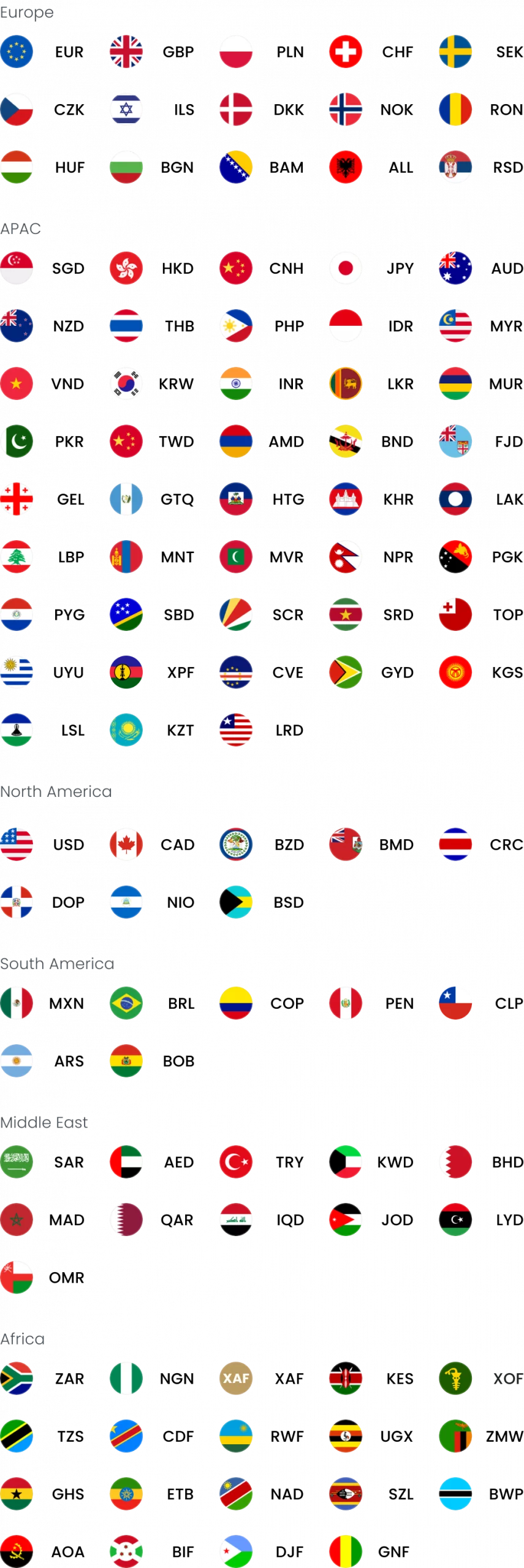
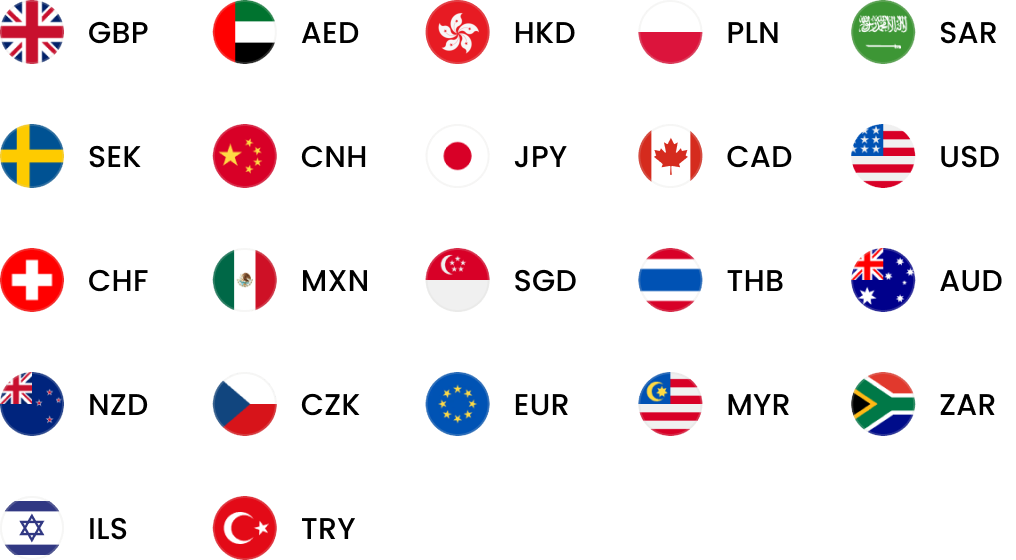
- Receive: Collect funds in 20+ currencies using local account details in supported regions. Revenue arrives through domestic payment networks in the payer’s market, helping preserve the original currency and reduce unnecessary routing
- Hold: Maintain balances in 20+ currencies within a single account. This structure prevents automatic conversion on arrival and gives greater control over when and how exchange takes place
- Convert: Exchange existing balances into another currency within the account at a time that aligns with your pricing or cash flow objectives, rather than converting automatically at settlement
- Pay: Send payments in 100+ currencies. The system routes transactions through domestic rails in the destination country, where available, and uses international payment networks where required
Withdraw to a UK bank account: Transfer funds from the World Account to an external bank account held in your company’s name, enabling movement of sterling or other balances for payroll, tax, or domestic expenses
Why does this structure change financial outcomes?
In many traditional arrangements, receiving, converting, and paying occur in one bundled sequence.
Separating these functions produces clearer control:
- Revenue can remain in its original currency.
- Conversion can align with pricing objectives and cash flow planning.
- Supplier payments can draw directly from existing currency balances.
- Settlement expectations become easier to plan.
Avoiding repeated conversions reduces cumulative spread impact across a transaction chain. Over time, eliminating unnecessary exchanges helps protect margins.
For UK businesses handling FX payments for business activity, separating receipt, holding, conversion, and payment introduces greater pricing discretion, clearer liquidity visibility, and more predictable cross-border execution.
Improving FX payments for businesses begins with gaining control over when and how currencies are received, converted, and paid.
Open a World Account to manage international payments with clearer FX pricing, stronger visibility, and tighter operational control.
Sources:
- https://www.bankofengland.co.uk/news/2025/september/bis-triennial-survey-of-foreign-exchange-and-over-the-counter-interest-rate-derivatives-markets
- https://www.fsb.org/uploads/P091025-1.pdf
- https://www.bis.org/statistics/rpfx25.htm
- https://www.bankofengland.co.uk/statistics/details/further-details-about-spot-exchange-rates-data
- https://www.worldfirst.com/uk/blog/international-transactions/cross-border-business-payments/
- https://assets.publishing.service.gov.uk/media/6736385fb613efc3f182317a/National_Payments_Vision..pdf
- https://www.ukfinance.org.uk/system/files/2025-10/Payment%20Markets%20Report%20Summary.pdf
- https://uk.finance.yahoo.com/news/cross-border-payments-market-report-080200446.html?guccounter=1
- https://www.worldfirst.com/uk/