



























When a UK business trades overseas, every invoice paid or received triggers a series of processes.
Funds pass through currency conversion, clearing systems, correspondent banks and compliance checks before reaching the recipient. The route taken, the exchange rate applied and the settlement time all affect the final cost.
UK exports totalled £897.9 billion in 2024, up 2.2% on the previous year. Each of those transactions relied on cross-border payment infrastructure to settle funds between businesses in different countries.
For companies operating internationally, knowing how much you’re paying in costs and fees, and when payments will land, directly affect margin and working capital. Small differences in FX markups or intermediary deductions compound across regular supplier payments and overseas revenue collection.
This guide explains how international payment processing works, where charges typically arise and how UK businesses can structure cross-border payments with better visibility over FX, timing and cash flow.
Key takeaways:
- International payment processing involves FX conversion, compliance checks, correspondent banks and settlement systems, all of which influence cost and timing
- The FX margin often represents the highest single cost in a cross-border transfer, not the flat payment fee
- Routing payments through the right rail for each corridor can reduce delays and intermediary deductions
- Holding foreign currency balances and offsetting incoming and outgoing payments in the same currency can reduce unnecessary conversions
- Structured FX planning improves margin control and cash flow visibility
- A multi-currency solution such as the World Account can simplify how UK businesses manage global payments
Open a World Account to manage multiple currencies in one place, access transparent FX pricing and send overseas payments with greater control over cost and timing.
What is international payment processing?
International payments (or cross-border payments) are transactions in which the payer and payee are in different countries. They cover business activities such as paying foreign suppliers, receiving overseas sales revenue and funding global expansion.
Unlike domestic transfers (one currency, one clearing system), international payments often involve multiple currencies, banking systems and regulations.
For example, a UK retailer paying a Chinese manufacturer may need to convert GBP to USD or RMB and route the payment through banks in both countries, each with its own rules. These extra steps introduce delays, costs and compliance checks.
How international payment processing works: step by step
Every international payment follows a defined sequence. The infrastructure behind it may vary, but the core stages remain consistent from instruction to settlement:
1. Payment initiation
A UK business instructs its bank or payments provider to send funds overseas. At this stage, the payer specifies:
- Beneficiary name and bank details
- Recipient country
- Payment currency
- Amount to be delivered
- Payment route, where available
If the payment requires currency conversion, the FX rate is agreed or applied at this point. The timing of the rate application matters, as market movements can affect the final GBP cost.
2. Compliance and validation
Before funds move, the transaction must pass regulatory screening.
Financial institutions operating in the UK must comply with Anti-Money Laundering (AML), Know Your Customer (KYC) and sanctions requirements.
Financial institutions check the payment against:
- UK sanctions lists
- International watchlists
- Internal risk controls
- Transaction monitoring rules
The receiving bank in the destination country conducts its own screening. If the transaction triggers an alert, compliance teams pause it for manual review. Manual reviews are one of the most common causes of cross-border payment delays.
3. Currency conversion
If the sender’s account currency differs from the payment currency, conversion takes place.
The exchange rate applied typically consists of:
- The underlying interbank or market rate
- The provider’s FX margin
Providers embed the FX margin within the quoted rate. For many businesses, that margin represents the highest single cost in an international transfer.
Banks and payment firms apply an FX rate plus a markup, often 0.5–3% above the mid-market rate. The difference directly affects the sterling cost of supplier payments or the value of overseas revenue received.
Clear rate transparency at this stage is critical for cost control.
4. Payment routing
After clearing and converting, where required, the sending institution routes the payment through the relevant payment network.
Common routes include:
- The SWIFT network of correspondent banks
- Local clearing systems in the destination country
- Direct banking relationships
When the payment travels through correspondent banking channels, intermediary banks process the transfer before it reaches the beneficiary’s bank. Each intermediary can add processing time and may deduct lifting fees from the transfer amount.
Some providers use local payment rails in certain corridors to reduce intermediaries and accelerate settlement.
5. Settlement and receipt
After routing completes, the recipient’s bank credits the beneficiary account.
Settlement speed depends on several variables:
- Currency pair
- Cut-off times
- Time zone differences
- Chosen payment route
- Compliance checks at either end
Many transfers settle same-day or next-day via modern rails, but legacy routes like SWIFT often take 1–5 business days.
International payment systems UK businesses use
International payments move through established global infrastructure.
Each system supports a different stage of the transfer, from secure messaging and routing to clearing and final settlement.
| Rail / network | Currency | Settlement | Typical cost | Best for |
| SWIFT | Major global currencies | 1–5 business days | Transfer fee + FX spread + possible intermediary deductions | Standard international supplier payments |
| CHAPS | GBP | Same business day (before cut-off) | Flat fee + FX if needed | Urgent high-value UK transfers |
| Faster Payments | GBP | Seconds | Usually free or low cost | Immediate UK transfers and funding outbound payments |
| SEPA | EUR | Usually one business day | Low cost within SEPA | Paying EU suppliers in euros |
| ACH (US) | USD | 1–3 business days | Low domestic fee + FX if required | Routine US supplier payments |
| Card networks | Multi-currency | Around one business day | Merchant fee percentage | E-commerce and recurring payments |
Where multi-currency accounts fit
Multi-currency accounts sit alongside these rails rather than replacing them. They allow UK businesses to:
- Hold USD, EUR or other supported currencies
- Receive funds locally where supported
- Pay suppliers in matching currencies
- Reduce repeated conversions between GBP and foreign currencies
Instead of defaulting to SWIFT for every transaction, finance teams can combine multi-currency balances with local rails to improve cost visibility and manage FX exposure more deliberately.
Why international transfers cost more and take longer
Domestic payments in the UK are fast and cheap. The UK’s Faster Payments (GBP) and BACS/CHAPS systems offer near-instant or same-day clearing at low fees.
By contrast, international payments involve extra challenges:
- Multiple intermediaries: A single SWIFT transfer may pass through 2–4 banks before reaching the beneficiary. Each intermediary can charge ~£10–£25 and add a delay of 1–2 days. For example, a £50,000 payment to Singapore might incur £75 in hidden correspondent fees and a 5-day wait
- Currency conversion risk: FX rates fluctuate. Banks typically lock in a rate only at the time of transfer, which may be worse than the market rate. The hidden margin on FX can easily add 0.5–3% (or more) to the cost. An SMЕ paying a large invoice of US$100,000 could lose over $2,000 (2%) in markup alone
- Regulatory checks: Each transfer must comply with the rules of both the sender’s and the receiver’s countries (e.g., sanctions lists, AML requirements). These additional checks can slow processing by hours or days
- Lower transparency: Many banks do not fully disclose fees. Banks often charge $10–$30 plus an FX spread (often 5–7%), meaning the final recipient gets 4–15% less than sent. Business banking surveys find that total international transfer costs typically exceed local payments by 5–10 times
Common mistakes UK SMEs make with cross-border payments
Cross-border payments are part of everyday operations for many UK SMEs. Yet small inefficiencies in pricing, routing and FX handling can quietly reduce margins.
The challenges below are common among UK businesses that rely on traditional bank processes or lack visibility into FX:
1. Focusing only on the transfer fee
Many SMEs compare providers based on the stated transfer charge. A £10 or £20 fee appears competitive at first glance.
In practice, the flat fee is rarely the main cost. Exchange rate markups and intermediary deductions often outweigh the visible transfer charge. Looking only at the headline fee can create a false sense of savings.
2. Ignoring the FX margin
The exchange rate applied to a payment usually includes a margin above the interbank rate. That margin may range from under 1% to several percentage points, depending on the provider and corridor.
On a £100,000 equivalent payment, even a 2% markup represents a £2,000 cost. SMEs that do not compare effective FX rates across providers often accept pricing that quietly reduces profit on each transaction.
3. Converting currency more than once
Some businesses convert GBP into a foreign currency to pay an overseas supplier, then convert unused balances back into GBP later. Each conversion applies a spread.
Repeated conversions increase cost without adding value. Holding funds in the required currency through a multi-currency account can reduce unnecessary FX transactions and provide more control over timing.
4. Using urgent wires for routine payments
SWIFT transfers remain common for international payments, but not every invoice requires an urgent international wire.
Routine supplier payments often move through SWIFT even when local clearing routes could offer lower cost and predictable settlement. Using premium payment routes for standard invoices increases expenses over time.
5. Not tracking the effective FX rate paid
Many SMEs record the invoice amount and the total sterling cost but don’t track the actual exchange rate applied after margins and fees.
Without reviewing the effective rate across multiple transactions, finance teams can’t identify pricing patterns or negotiate better terms. Over time, this lack of visibility makes it difficult to control currency costs or forecast accurately.
6. Overlooking corridor-specific settlement timelines
International payments don’t settle uniformly. Cut-off times, local bank holidays and compliance checks vary by country.
Failing to account for these differences can delay supplier payments and strain relationships. Planning around corridor-specific timelines improves predictability and cash flow management.
How UK businesses can reduce international payment costs
UK businesses can take practical steps to improve efficiency:
1. Use local rails where they fit, not default international wires
Many UK firms route routine supplier payments through SWIFT because it works in most corridors. That choice can add intermediary handling and slower settlement when a domestic rail exists in the destination market.
Local rails reduce the number of banks involved in the chain, often improving predictability and reducing deductions.
2. Compare FX margins, not only transfer fees
A flat transfer fee rarely drives total cost. FX pricing often has a greater impact on the final amount paid or received.
Action steps:
- Record the rate quoted and the amount delivered for each payment.
- Calculate an effective spread by comparing the quoted rate with a market reference at the time of execution.
- Review spreads by corridor and currency pair rather than averaging them across all transfers.
If you can’t see the exchange rate clearly before you confirm the payment, treat that as a commercial risk, not a minor inconvenience.
3. Hold foreign currency balances to avoid unnecessary conversions
Many UK SMEs convert GBP to pay an invoice, then convert remaining funds back to GBP later. Each conversion applies a spread.
A multi-currency balance can reduce that churn by letting you:
- Receive revenue in a foreign currency and hold it
- Pay suppliers in the same currency later
- Convert only the amount you actually need
4. Net payables and receivables before you convert
If you pay suppliers in a currency you also receive, convert only the difference. Treasury teams describe this as FX netting and the goal is simple: reduce the number of conversions and cross-border transfers you execute.
Practical ways to apply it in an SME context:
- Match USD customer receipts against USD supplier invoices
- Match the EUR marketplace payouts against the EUR fulfilment and freight bills
- Convert the remaining amount at a chosen time
5. Time FX conversion with intent, not habit
FX risk can erode profits if you convert at the point of payment without a plan, especially when operating on tight margins.
Good practice for UK SMEs:
- Set internal budget rates for key currencies and track variances
- Convert earlier for known, dated liabilities when visibility matters
Use tools to lock in rates for committed future payments when a fixed rate improves planning
6. Consolidate payment volumes to improve pricing and control
Sending 10 small payments across the week often costs more than sending a single planned batch, especially when each payment triggers fees, screening and operational handling.
Action steps:
- Batch routine supplier payments into fixed weekly runs
- Standardise payment cut-off times by corridor
- Consolidate FX conversions into fewer, larger trades when operationally feasible
How to choose the right international payment route
Here’s how to apply simple rules based on urgency, currency and corridor:
- Use SWIFT when coverage matters more than speed: Choose SWIFT for payments that require a broad global reach or involve less common currencies. It suits higher-value or complex transfers where local clearing is unavailable. Intermediary banks may deduct correspondent fees along the chain, reducing the final amount received and extending settlement time
- Use SEPA for routine EUR payments into Europe: Choose SEPA Credit Transfer when paying EU suppliers in euros from a SEPA-reachable account. It typically offers predictable next-business-day settlement and reduces reliance on correspondent banking chains
- Use CHAPS for urgent, high-value GBP settlement in the UK: Choose CHAPS when a sterling payment must arrive the same business day. It fits time-critical domestic transfers and same-day funding needs
- Use local USD clearing, such as ACH for US beneficiaries when available: Choose local USD clearing when paying US suppliers and your provider supports domestic payout capability. Settling the final leg within the US banking system can improve predictability and reduce reliance on international wire routes for routine payments
Use a multi-currency account when you have repeat flows in the same currency: Choose a multi-currency account when you both receive and pay in the same foreign currency. Holding balances allows you to control conversion timing, reduce repeated FX spreads and convert only the net difference between inflows and outflows
How WorldFirst simplifies international payments processing
International payments become complex when businesses rely on multiple bank accounts, repeated currency conversions and disconnected systems.
WorldFirst addresses these operational pressures through the World Account, an integrated multi-currency business account designed for cross-border trade.
WorldFirst is not a bank. It operates as a regulated payment institution, providing international payment and foreign exchange services rather than traditional lending or deposit products.
Key benefits of the World Account (versus juggling many single-currency bank accounts) include:
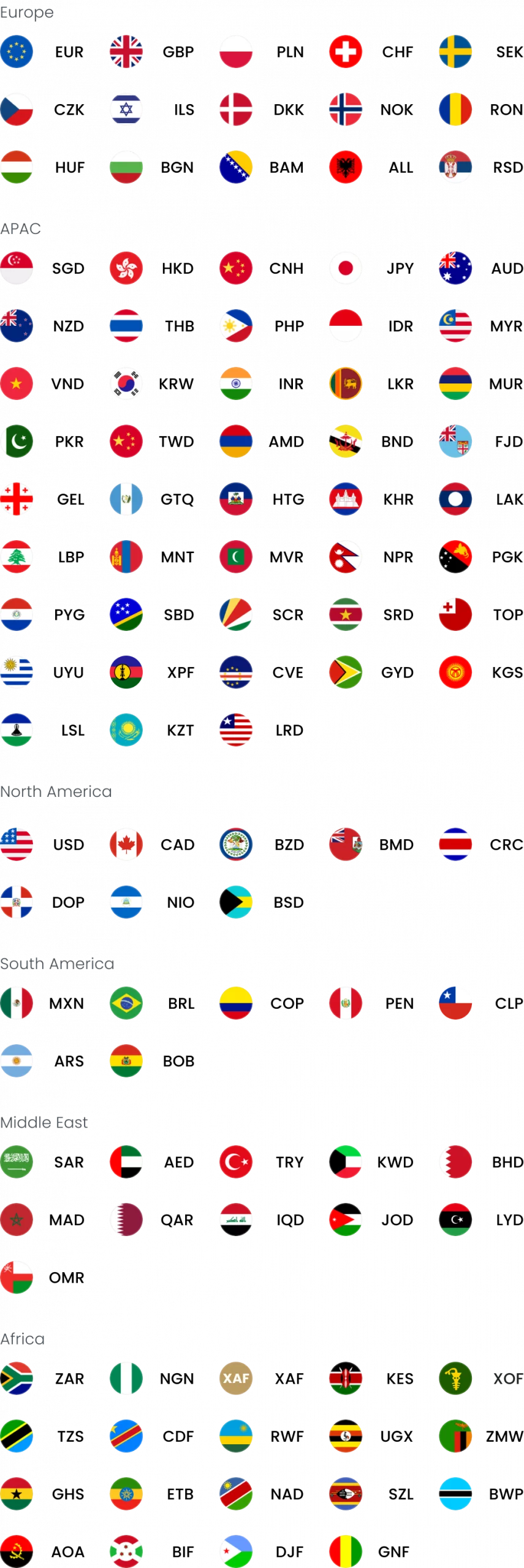
- Multiple currencies in one platform: Hold and manage 20+ currencies simultaneously
- Competitive FX rates: Market-leading rates (as low as 0.3% FX fees for new customers) save money versus banks’ spreads. Rates and forward contracts ensure visibility of costs
- Faster transfers via local rails: Use local networks (CHAPS, Faster Payments, US Fedwire, etc.) for major currency corridors, often enabling same-day or next-day settlement. For example, WorldFirst’s UK platform taps Faster Payments/CHAPS for GBP and “virtual IBANs” for quick USD/EUR payments
- No hidden fees: World Account charges are transparent – the account is free to open, there are no monthly fees, inbound transfers are free and and per-payment fees are≈£0.30–£4.00 depending on currency
- Marketplace integrations: Direct connections with marketplaces and payments gateways mean you can get paid by Amazon,Etsy, Shopify and more straight into your World Account in local currency
- Global payout: You can also pay suppliers and contractors worldwide (200+ countries, 100+ currencies) using your multi-currency balances. Payments route via local accounts to avoid extra correspondent charges
Discover how the World Account helps UK businesses manage FX, local rails and global pay-outs more efficiently.
Sources:
- https://www.bankofengland.co.uk/payment-and-settlement/cross-border-payments
- https://www.bankofengland.co.uk/payment-and-settlement/chaps
- https://www.worldfirst.com/uk/blog/international-transactions/trends-in-cross-border-payments/
- https://www.worldfirst.com/uk/blog/international-transactions/cross-border-payments-challenges/
- https://www.worldfirst.com/uk/
- https://www.starlingbank.com/resources/banking/guide-to-faster-payments/