



























If your business invoices clients in euros, pays a supplier in dollars, or collects marketplace payouts in three or four currencies at once, you’ve probably already looked at the Wise multi currency account. It’s usually the first name that comes up when a UK SME starts comparing alternatives to a high-street bank, and for good reason: the pricing is public, the mid-market rate is genuinely mid-market, and setup takes minutes rather than weeks.
Wise Business now moves over £12 billion a month for more than 700,000 businesses globally, which tells you how mainstream fintech alternatives to bank FX have become. That scale matters when you’re deciding whether to trust a non-bank provider with regular international payments.
This article breaks down what the Wise multi currency account actually costs, what it does well, where it falls short for growing importers and marketplace sellers, and how it compares with WorldFirst’s World Account so you can make a properly informed switch.
Key takeaways:
- Wise keeps pricing transparent: conversion fees are shown before you confirm a transfer, with costs varying by currency pair and payment route
- Receiving features depend on the plan: the free Essential plan covers sending and holding, while the paid Advanced plan unlocks local receiving details and extra business tools
- Transfers are usually fast: many payments arrive within seconds or the same day, although timing still depends on the destination and currency
- Wise is a payments provider, not a bank: balances are safeguarded rather than FSCS-protected, and the account doesn’t include lending or overdrafts
- FX risk tools are limited: Auto Conversions can trigger at a target rate, but Wise doesn’t offer forward contracts for fixing future exchange rates
- WorldFirst is stronger for trade-heavy workflows: businesses managing supplier payments, marketplace collections and FX exposure can access broader trade-focused tools alongside multi-currency payments
Open a World Account to compare FX margins, marketplace collection tools and supplier payment options against your current provider before you commit to switching.
What is the Wise multi-currency account?
Wise Business is a multi-currency account, an electronic money account that lets you hold, send and receive money in dozens of currencies from a single login rather than juggling separate bank accounts.

Wise Payments Ltd is authorised by the FCA as an electronic money institution (FRN 900507), which means it isn’t a bank: funds are safeguarded in separate accounts rather than covered by the Financial Services Compensation Scheme, and the account doesn’t offer overdrafts, lending, cheque handling or cash deposits.
The core appeal is pricing transparency. Wise converts currency at the mid-market exchange rate and charges a separate, disclosed conversion fee rather than baking a hidden margin into the rate itself, which is how most high-street banks operate.
Wise Business is structured as two plans.
- The Essential plan is free and lets you send and hold money, but you can’t receive payments into it
- The Advanced plan carries a £50 one-off setup fee and unlocks local account details for receiving in 22 currencies, direct debits, invoicing tools and payment links
Neither plan carries an ongoing monthly account fee, which is a genuine point of difference from many business bank accounts that charge a flat monthly charge regardless of usage.
Wise multi-currency account features at a glance
Here’s what you actually get once you’re past the setup screen, and how it holds up for a business handling regular cross-border transactions.
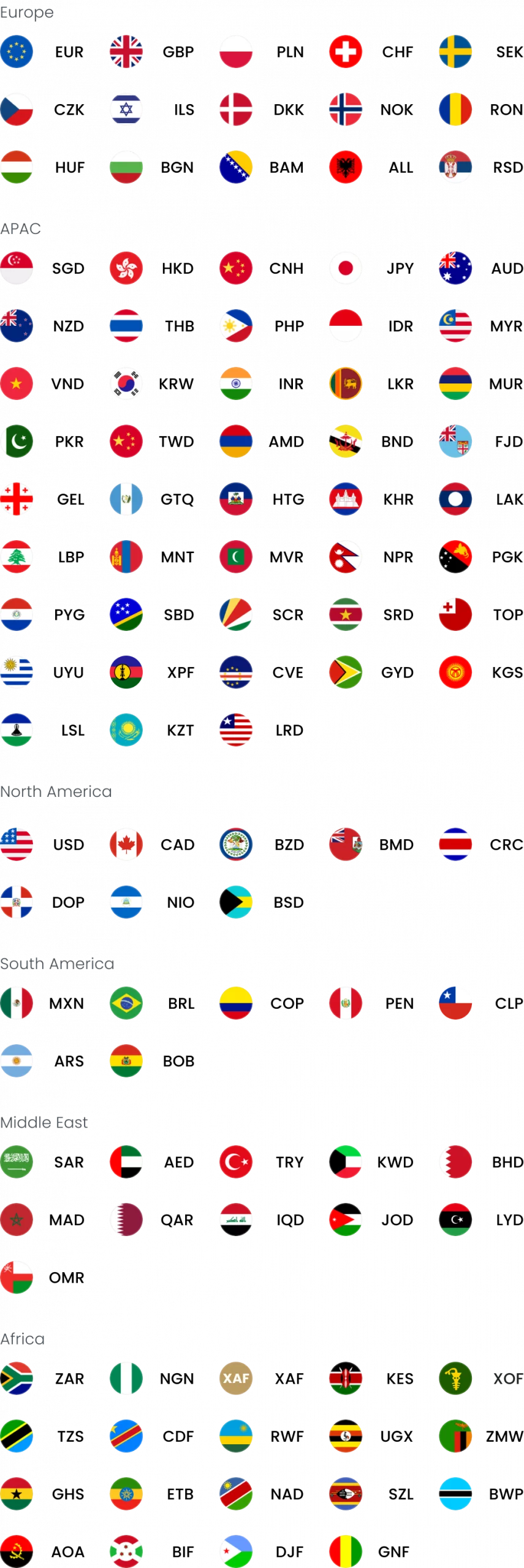
- Currency coverage: You can hold 40+ currencies, receive local payment details in 22 currencies including GBP, EUR, USD, AUD, CAD and SGD, and send to 160+ countries
- Transfer speed: Around 70% of transfers clear in 20 seconds and 95% within 24 hours, though actual timing depends on the currency pair, payment method and destination bank
- Batch payments: You can upload a CSV file to pay up to 1,000 recipients in a single batch, which is genuinely useful if you’re running payroll-style payments to contractors or suppliers across several countries
- Accounting integrations: Wise connects with Xero, QuickBooks and FreeAgent for automated transaction reconciliation, plus a free API if you want to build your own payout automation
- Debit cards: Physical and virtual cards let your team spend directly from existing currency balances with no FX cost on card spend; ATM withdrawals are free up to £250 a month per account before a 2.69% charge applies, and employee expense cards start from £3 each
- Auto Conversions: You can set a target exchange rate and let Wise convert automatically once it’s hit, with up to 15 pending Auto Conversions running at once, which is a lightweight way to manage FX timing without a dedicated treasury tool
- Interest and Stocks: Wise also offers an investment product in GBP, EUR and USD, with an annual fee from 0.26% for Interest and 0.59% for Stocks. It’s worth remembering this is an investment product with capital at risk, not a savings deposit account
If your business is a sole trader, freelancer, limited company, partnership or even an overseas-owned UK company, you should be eligible, subject to standard verification checks. Straightforward applications are typically reviewed quickly, but more complex ownership structures can take up to 10 working days to clear.
Wise multi-currency account fees explained
The honest answer is that Wise’s fees are genuinely low for straightforward currency conversion, but they’re not the whole cost picture once you factor in receiving fees and setup charges.
Conversion fees start from 0.33% and vary by currency pair and payment route. A GBP to EUR conversion typically costs around 0.37%, verified independently in July 2026. There’s no percentage markup hidden in the exchange rate itself, since Wise applies the mid-market rate and shows the fee separately before you confirm.
Receiving fees depend on the currency and payment method. Domestic, non-SWIFT payments are free in nine currencies, including AUD, CAD, EUR, GBP, HUF, NZD, PHP, SGD and USD. If a client pays you via SWIFT instead, you’ll pay a fixed fee per payment: $6.11 for USD, £2.16 for GBP, and €2.39 for EUR, with SWIFT receiving also available in 19 further currencies.
If your monthly transfer volume exceeds £20,000 or the equivalent, Wise applies volume discounts that reduce the percentage fee on further transfers, which rewards businesses moving meaningful sums regularly rather than occasional small transfers.
To put the savings in context: converting £5,000 from GBP to EUR costs roughly £18.50 on Wise at a 0.37% margin, compared with approximately £100 at a typical high-street bank charging a 2% margin.
A separate 2024 study found average total fees on a £10,000 GBP to EUR transfer came to £41.25 through Wise versus £286 through standard banking channels. Even accounting for the one-off setup fee, that gap adds up quickly if you’re converting currency every month.
What the Wise multi-currency account does well
The strongest case for Wise centres on pricing clarity and reach, not on advanced treasury features.
- Upfront, disclosed pricing: Every conversion fee is shown before you confirm the transfer, and the mid-market rate means you’re not paying a concealed spread the way you often are with a bank
- Local receiving details: Getting local account numbers in 22 currencies means an overseas client can pay you as though you were a local business, which usually costs them less and speeds up settlement on your end
- Fast settlement on major corridors: With most transfers clearing within 24 hours and a large share landing in seconds, cash flow timing is generally predictable for common currency pairs
- A strong fit for lighter cross-border needs: Freelancers, services exporters, and SMEs invoicing occasional international clients get most of the value here without paying for tools they won’t use
The wise multi currency account genuinely competes with, and often beats, high-street bank FX pricing for straightforward conversion and invoicing use cases. If your business model is largely invoicing overseas clients and receiving payment back into sterling, this is a legitimate option to shortlist.
Where the Wise multi-currency account has limitations
Every provider makes trade-offs, and Wise’s limitations become more relevant the more your business looks like an importer or marketplace seller rather than a services exporter.
- No FSCS protection or banking services: As a non-bank EMI, Wise doesn’t offer overdrafts, lending, cash or cheque deposits, and your funds sit outside FSCS deposit protection. It’s designed to sit alongside a traditional bank account, not replace one entirely
- No forward contracts or rate-locking tools: If you’re placing a large supplier order today for delivery in eight weeks, Wise gives you no way to lock in today’s exchange rate. Auto Conversions only trigger once your target rate is hit; they don’t protect you against the rate moving against you before then
- Lighter marketplace integration: Wise doesn’t offer the breadth of direct marketplace and payment gateway connections that dedicated trade-focused platforms provide, which matters if you’re collecting payouts from multiple marketplaces and want automated reconciliation against each one
- No direct CNH settlement for China sourcing: If you’re paying suppliers in China regularly, it’s worth knowing that suppliers invoice onshore in CNY while international payments typically settle offshore in CNH. Wise doesn’t offer the kind of dedicated China-corridor settlement infrastructure that specialist providers have built specifically for this trade lane
- Card and cashback limits: While the debit card is genuinely useful for team spend, there’s no cashback reward on card spending, and ATM withdrawal allowances are relatively modest before charges kick in
None of this makes Wise a poor choice for the right business. It simply means the account is optimised for currency conversion and invoicing, not for active FX risk management or supplier-heavy trade workflows.
Read more: 6 cross-border e-commerce payment solutions in 2026
How to decide when switching providers
Switching your primary cross-border payment provider isn’t a decision to make on headline FX rates alone. Work through the total picture before you move.
- Calculate total cost of ownership: Add the FX margin or conversion fee, any fixed SWIFT charges on receiving, and setup or card fees together, then model it against your actual monthly transfer volume rather than a single hypothetical transfer.
- Identify your FX risk exposure: If you’re placing supplier orders with a deposit now and balance due on shipment weeks later, work out whether you need a forward contract to fix the rate, because Auto Conversion tools don’t protect against adverse rate movement before your target is hit.
- Check marketplace and platform connections: If you sell on Amazon, eBay, Shopify or similar, confirm the provider connects directly to reconcile payouts automatically rather than requiring manual matching.
- Assess your support needs: Decide whether self-service help centre support suits your business, or whether you’d value a dedicated account manager and faster phone or chat response during time-sensitive payment windows.
- Review card and expense requirements: If your team needs multiple cards with cashback or 0% FX fees on spend, compare that against the debit card options each provider actually offers today.
Research from McKinsey in 2024 found that between 35% and 50% of SMEs across several surveyed regions had already moved at least part of their cross-border payments to a fintech or non-traditional provider rather than sticking exclusively with a bank, underlining how mainstream this kind of comparison has become for growing businesses. Treat that as directional context for the wider shift toward fintech providers rather than a UK-specific figure.
The most reliable way to test any of this is to run a live comparison. Send or convert a small amount through your current provider and through an alternative side by side, then compare the landed amount, not just the quoted rate.
Wise vs WorldFirst: which is right for your UK SME?
If your business is mostly invoicing and getting paid, Wise likely covers what you need. If you’re managing recurring supplier payments, multi-marketplace collections, or exposure to FX rate movements on larger orders, it’s worth comparing against WorldFirst‘s World Account before you commit.
WorldFirst isn’t a bank. WorldFirst UK operates as World First UK Limited (company number 05022388), authorised by the FCA as an electronic money institution under the Electronic Money Regulations 2011, with FCA firm reference number 900508. Like Wise, it’s a regulated payments provider rather than a bank, so the same FSCS caveat applies: client funds are safeguarded, not deposit-protected.
The table below compares pricing, currency coverage, FX tools, marketplace support and payment features across Wise Business and WorldFirst:
| Feature | Wise Business | WorldFirst World Account |
| Setup fee | Free (Essential) / £50 one-off (Advanced) | Free |
| Monthly account fee | None | None |
| Currencies supported | 40+ | 100+ (send) |
| Currencies received locally | 22 | 20+ with zero receiving fees |
| Send destinations | 160+ countries | 210+ regions |
| FX model | Mid-market rate plus disclosed fee (from 0.33%) | Margin-based pricing on conversions |
| FX risk tools | Auto Conversions only | Live rate alerts, forward contracts, firm orders |
| Marketplace integrations | Not a core focus | 130+ marketplaces and gateways, including Amazon, AliExpress, Shopify |
| Transfer speed | 70% in 20 seconds, 95% in 24 hours | Most instant, 95% within hours |
| Transfers between own account holders | Standard fees apply | Free and instant |
| Card | Debit card, no cashback | World Card, up to 1.2% cashback on eligible spend, 0% FX fees |
| Batch payments | Up to 1,000 via CSV | Batch payment tools available |
| Accounting integration | Xero, QuickBooks, FreeAgent | Xero |
| Support model | Self-service, help centre | Phone and chat typically under 60 seconds, local teams in 20+ regions |
Wise’s genuine advantages are its broader currency-holding range, no setup cost if you only need to send and hold, Auto Conversions for lightweight rate management, and the option to add Interest or Stocks products.
WorldFirst‘s advantages sit on the trade-operations side: marketplace integrations for sellers collecting payouts across platforms, forward contracts and firm orders for businesses that need to fix a rate ahead of a future supplier payment, World Card cashback on eligible spend, and instant free transfers between WorldFirst account holders.
The practical distinction is workflow, not raw pricing. Wise suits a business whose cross-border activity is mostly invoicing and receiving. WorldFirst is built around the mechanics of paying overseas suppliers, collecting marketplace revenue in multiple currencies, and managing FX exposure on orders placed weeks or months in advance.
Open a World Account to see how WorldFirst’s FX margin, marketplace collection tools and forward contracts compare against your current provider on a real transaction.
FAQs
1. Is Wise Business a bank?
No. Wise Business is provided by Wise Payments Limited, an FCA-authorised electronic money institution rather than a bank. Customer funds are safeguarded under e-money rules rather than protected as bank deposits under the FSCS.
2. How much does a Wise Business account cost?
Wise Business does not charge a monthly account fee. Its Essential plan is free, while the Advanced plan currently has a one-off setup fee that unlocks additional receiving and business features. Currency conversion and some receiving or transfer methods carry separate transaction fees.
3. What currencies can Wise Business hold?
Wise Business supports holding more than 40 currencies in one account. It also provides local receiving details for a smaller number of supported currencies, so the number of currencies you can hold is not the same as the number for which local account details are available.
4. Does Wise Business use the mid-market exchange rate?
Wise says it uses the mid-market exchange rate and charges a separate conversion fee rather than adding a hidden FX margin to the rate. The exact fee varies by currency pair, amount and payment route and is displayed before the transaction is confirmed.
5. Can Wise Business receive international payments?
Yes. Wise Business can receive supported international payments using local account details and SWIFT routes, depending on the currency. Some receiving methods are free, while SWIFT receipts can carry fixed receiving fees.
6. Can I use Wise and WorldFirst together?
Yes. There is no requirement to use only one international payment provider. A business can use different providers for different payment flows, although using multiple accounts can add reconciliation and operational complexity, so the setup should have a clear practical purpose.
Sources:
- https://www.mckinsey.com/industries/financial-services/our-insights/global-payments-in-2024-simpler-interfaces-complex-reality
- https://wise.com/gb/business/
- https://www.businessexpert.co.uk/business-banking/wise-business-account-review/
- https://wise.com/gb/blog/manage-currencies-in-one-account