





























If you’re running a Shopify store or an Amazon storefront out of Singapore, you’ve probably already integrated Stripe at checkout without thinking twice about what it actually costs you per sale.
That’s fine for domestic transactions, but once your buyers start paying in USD, GBP, or EUR, or once you’re stacking Stripe Invoicing and Stripe Tax on top of card processing, the effective rate per order can surprise you.
This guide breaks down every Stripe fee in Singapore and shows you where the real cost bottleneck sits for marketplace sellers moving money across borders.
Key takeaways:
- Stripe is easy to start with, but transaction costs can stack quickly: Singapore businesses pay no setup or monthly fees on the Standard plan, but card fees, international surcharges, currency conversion, disputes, and add-ons can materially increase the effective cost per sale.
- The payment method makes a major difference to your margins: PayNow is significantly cheaper than cards for local transactions, while international card payments that also require currency conversion can approach 6% in total fees on a single transaction.
- Cross-border sellers need to look beyond Stripe’s headline processing rate: Fixed fees weigh more heavily on low-value orders, overseas card surcharges can stack with FX costs, and the default T+7 payout schedule can affect cash flow for inventory and supplier payments.
- You can reduce Stripe costs through smarter payment and currency routing: Encouraging PayNow for local customers, matching settlement currencies, using in-balance conversion where appropriate, and negotiating custom pricing at higher volumes can lower your effective processing cost.
- WorldFirst complements Stripe by helping manage the money after checkout: Sellers can keep marketplace and Stripe payouts in multiple currencies, hold 20+ currencies, and pay overseas suppliers directly, helping avoid unnecessary conversions.
Open a World Account to see how marketplace payouts and supplier payments can sit outside your Stripe fee stack.
Can you use Stripe in Singapore?
Yes. Stripe fees Singapore sellers pay come through a fully licensed local entity, not an offshore workaround. Stripe Payments Singapore Pte. Ltd. holds a Major Payment Institution licence under the Payment Services Act 2019, covering account issuance, domestic and cross-border money transfer, merchant acquisition, and e-money issuance, with its registered office at 60 Anson Road, Mapletree Anson.
Stripe fee breakdown
Stripe’s Singapore pricing is pay-as-you-go on the Standard plan, with no setup fees, no monthly fees, and no long-term contracts, according to Stripe’s official Singapore pricing page.
That simplicity is useful for sellers who want to avoid fixed costs while testing a new market, but the per-transaction stack is where the real cost lies, especially once you add payment-method surcharges, currency conversion and payout fees.
| Payment method or service | Fee | Notes |
| Domestic card (Visa, Mastercard, Amex, prepaid) | 3.4% + S$0.50 | Per successful transaction |
| International card | 3.9% + S$0.50 | Adds a 0.5% surcharge on the domestic rate |
| USD-settled card charge | 3.4% + US$0.50 | Applies when settlement currency is USD |
| Currency conversion | +2% | Applied when transaction currency differs from settlement currency |
| PayNow | 1.3% | No fixed fee |
| GrabPay | 3.3% | Per successful charge |
| Alipay | 2.2% + S$0.35 | Per successful charge |
| WeChat Pay | 2.2% + S$0.35 | Per successful charge |
| Apple Pay / Google Pay | 3.4% + S$0.50 | Same as domestic card pricing |
| In-person (Stripe Terminal, domestic card) | 3.4% + S$0.50 | Plus S$0.15 per authorisation for Tap to Pay |
| Dispute (chargeback) received | S$15.00 | Refunded if you win via Smart Disputes |
| Dispute countered | S$15.00 | Not refunded if you lose |
| Smart Disputes (won only) | 30% of disputed amount | Only charged on disputes you win |
| USD payout to local bank account | 1% of payout volume | Minimum US$5.00 |
| Instant Payouts | 1% of payout volume | Minimum S$0.50 |
| In-balance currency conversion | From 0.35% | Converting funds already in your Stripe balance |
| Stripe Invoicing | 0.4% per paid invoice | Capped at US$2.00 per invoice |
| Stripe Tax | 0.5% + S$0.70 per transaction | Where you’re registered to collect tax |
Rates checked against Stripe’s official Singapore pricing page on 12.8.2026.
Custom pricing, including interchange-plus (IC+) rates, volume discounts and multi-product bundling, is available for higher-volume merchants, but the standard published rates above are what most marketplace sellers will actually pay.
How much does Stripe charge for S$1,000?
On a S$1,000 transaction, Stripe’s fee ranges from S$13.00 on PayNow up to S$59.50 on an international card payment that also requires currency conversion, a difference of more than 4.5x depending purely on how the customer pays and where they’re paying from.
| Payment method | Fee calculation | Total fee | Effective rate | Net received |
| Domestic card | 3.4% × S$1,000 + S$0.50 | S$34.50 | 3.45% | S$965.50 |
| International card | 3.9% × S$1,000 + S$0.50 | S$39.50 | 3.95% | S$960.50 |
| International card + currency conversion | 5.9% × S$1,000 + S$0.50 | S$59.50 | 5.95% | S$940.50 |
| PayNow | 1.3% × S$1,000 | S$13.00 | 1.30% | S$987.00 |
| GrabPay | 3.3% × S$1,000 | S$33.00 | 3.30% | S$967.00 |
| Alipay / WeChat Pay | 2.2% × S$1,000 + S$0.35 | S$22.35 | 2.24% | S$977.65 |
If a large share of your S$1,000 orders come from overseas buyers paying by card and requiring currency conversion, you’re losing nearly 6% of revenue before the sale even reaches your bank account, compared with 1.3% if that same buyer had used PayNow domestically.
For a marketplace seller running thin margins on physical goods, that gap is often the difference between a profitable order and a break-even one.
Hidden costs marketplace sellers miss
The published rate table tells you the headline cost, but it understates what marketplace sellers actually pay once order size, currency mix and payout timing enter the picture:
- Low-ticket orders carry a heavier fixed-fee burden: the S$0.50 fixed fee turns a 3.4% headline rate into roughly 5.9% on a S$20 order, 4.4% on S$50, and 3.9% on S$100, only settling near the advertised 3.4% once order values climb past a few hundred dollars.
- Cross-border surcharges stack silently: the 0.5% international card surcharge and 2% currency conversion fee apply independently and compound, so a seller with a mostly overseas customer base can be paying close to 6% per transaction without realising the two charges are separate line items.
- T+7 payout timing delays cash flow: Stripe’s default payout schedule for Singapore users is T+7 calendar days, meaning funds from a payment captured today aren’t available until a week later, which matters if you’re funding supplier deposits or restocking inventory on tight timelines.
- Dispute fees hit regardless of outcome on the counter side: you pay S$15 when a dispute is received and another S$15 if you contest it, refunded only if you win; a seller with even a modest chargeback rate on high-volume marketplace sales can see this add up quickly.
- Add-on products carry their own percentage: Stripe Invoicing adds 0.4% per paid invoice (capped at US$2.00) and Stripe Tax adds 0.5% or S$0.70 per transaction if you’re using it to collect GST, both on top of whatever payment method fee already applied.
Practical tips to reduce Stripe costs in Singapore
Small changes to how you route payments can reduce what you pay Stripe:
- Push local buyers toward PayNow: At 1.3% with no fixed fee, PayNow is substantially cheaper than the 3.4% + S$0.50 card rate for domestic Singapore transactions, and it’s worth surfacing as the default option at checkout for local buyers.
- Minimise unnecessary currency conversions: Matching your settlement currency to your primary sales currency avoids the 2% conversion surcharge on transactions that don’t actually need it.
- Negotiate custom pricing once you scale: Stripe’s published rates are the default, but IC+ and volume-based pricing become available for higher-volume merchants, so it’s worth asking once your monthly processing volume grows.
- Use Stripe’s built-in fraud tools to cut dispute volume: Stripe includes Radar Lite fraud protection as standard, and lowering your chargeback rate directly reduces exposure to the S$15 dispute fees on both sides of a contested payment.
- Compare in-balance conversion against checkout-time conversion: Converting funds already sitting in your Stripe balance starts at 0.35%, a fraction of the 2% checkout-time conversion fee, so batching conversions after capture rather than at the point of sale can meaningfully lower your effective cost.
Read more:
- 6 best SME bank accounts in Singapore
- Five best money changers in Singapore
- 8 benefits of foreign exchange risk management for businesses
How Stripe fees compare for cross-border marketplace sellers
Stripe is built to be excellent at one job: getting a customer’s payment authorised and captured at checkout, across cards, PayNow, GrabPay, Alipay and WeChat Pay.
Where the fee structure gets expensive for marketplace sellers specifically is everything that happens after that capture, when the money still needs to become usable working capital in the currency you actually need it in.
Consider what a typical cross-border seller experiences: a UK-based Shopify customer pays in GBP, Stripe converts that to your settlement currency (adding the 2% conversion fee and, if the card is issued overseas, the 0.5% international surcharge), the funds sit for up to seven days before payout, and then land in your local bank account, likely already converted to SGD at whatever rate applied at settlement.
If your actual need is to pay a supplier in China in CNH, you’re now converting SGD back into another currency, absorbing a second conversion spread on top of what Stripe already charged.
This is the gap that a multi-currency account is designed to close by giving you a better option than a forced SGD conversion when Stripe pays out.
Where WorldFirst fits alongside Stripe
Stripe and WorldFirst solve different problems, and treating them as competitors misses the point for most marketplace sellers.
Stripe is the checkout layer: it authorises and captures customer payments across cards, PayNow, GrabPay and wallets.
WorldFirst sits downstream, handling what happens to the money once it’s collected and needs to be used to pay overseas suppliers in a different currency.
Take a practical example: a Tanjong Pagar-based marketplace seller running a Shopify store collects GBP and USD payments through Stripe, then also receives Amazon US payouts in USD each fortnight. Instead of letting Stripe or Amazon force a conversion to SGD at each step, holding those USD balances in a World Account means the seller can pay a Guangzhou supplier directly in CNH via 1688 World Pay, avoiding the double conversion chain of USD to SGD to CNH that a standard bank transfer would otherwise require.
WorldFirst isn’t a bank. It’s a regulated payments provider, and WorldFirst entities in Singapore hold MAS licences for services including account issuance, domestic and cross-border money transfers, and e-money issuance.
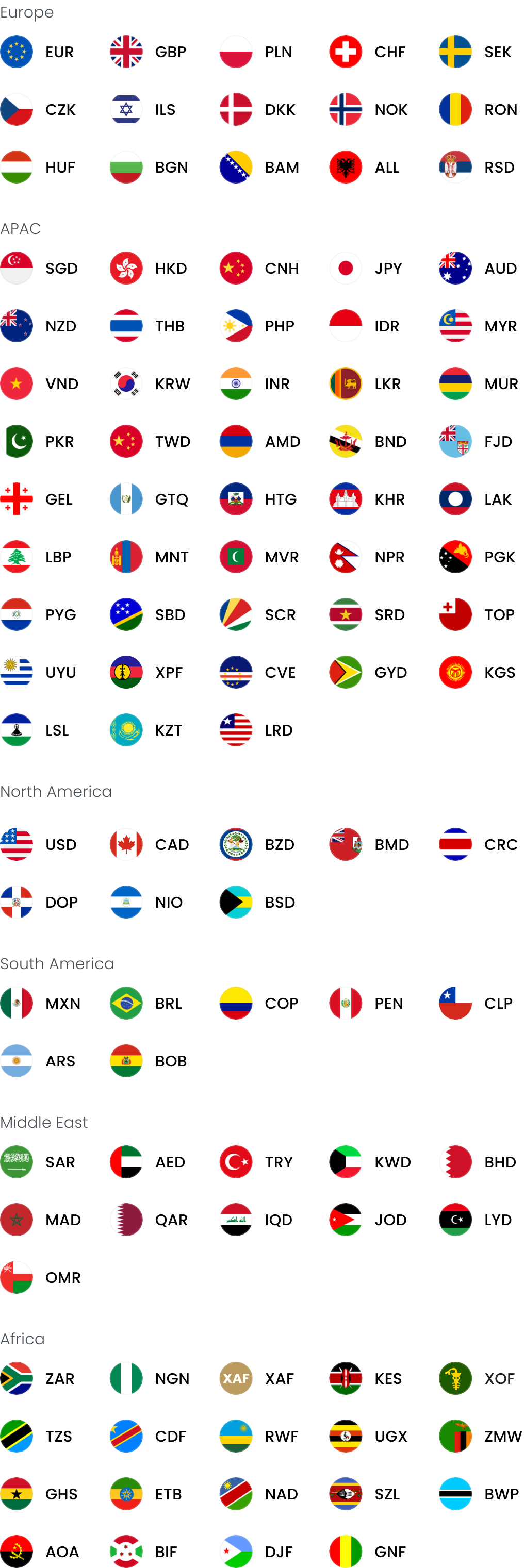
The World Account lets you hold 20+ currencies, including SGD, USD, EUR, GBP, AUD, CNH and HKD, and make payments in 100+ currencies to 210+ countries and regions, with no setup fees, no monthly fees, and no minimum balance.
Open a World Account to keep your marketplace payouts and supplier payments in the currencies you actually need, without adding a second conversion on top of what Stripe already charges.
FAQs
1. How much does Stripe charge for fees?
It depends entirely on the payment method and whether currency conversion applies. Card payments sit between 3.4% and 3.9% plus a fixed S$0.50, with a further 2% if the transaction requires currency conversion.
Local rails like PayNow (1.3%) and Alipay or WeChat Pay (2.2% + S$0.35) are cheaper than cards. Payouts, disputes, invoicing and tax collection each carry their own separate fee on top of the core transaction charge.
2. How much is the Stripe fee for $1000?
On a S$1,000 transaction, a domestic card payment costs S$34.50 (a 3.45% effective rate), an international card costs S$39.50 (3.95%), and an international card requiring currency conversion costs S$59.50 (5.95%).
PayNow is the cheapest option at S$13.00 (1.3%), while GrabPay costs S$33.00 and Alipay or WeChat Pay costs S$22.35.
Sources:
- Stripe Singapore Pricing
- Stripe Singapore Disclosures
- Stripe: Singapore Payment Services Act 2019 Guide
- MAS: Licensing for Payment Service Providers
- MAS: Written Reply on Funds Collected by Payment Service Providers (2024)



![AliExpress dropshipping: How to source and pay suppliers from Singapore [2026]](https://mdn.marmot-cloud.com/worldfirst/sites/9/2026/10/20261021131155864-300x200.webp)

![Trust card review [2027]: Features, fees and more](https://mdn.marmot-cloud.com/worldfirst/sites/9/2026/10/20261020214810193-300x200.webp)