




























Your supplier in Guangzhou wants a 30% deposit before shipping, and the balance in six weeks. Between now and then, the renminbi could move enough to wipe out your margin on the order entirely.
If you’re still calling your bank for a spot rate each time this happens, or watching PayNow and GIRO for a cross-border option that doesn’t exist, you already know the domestic rails won’t help you here. Bank transfers and telegraphic transfer fees stack up fast when you’re paying suppliers weekly.
Singapore is no small player in this game. The city-state’s FX average daily trading volume climbed to US$1.485 trillion in April 2025, up 60% from 2022, making it the world’s third-largest foreign exchange centre behind only the UK and the US.
Yet the scale at the top doesn’t trickle down automatically. 36% of Singapore SMEs report ongoing problems with cross-border payments, including delays and failed transfers, and Visa research found 35% are actively open to switching FX providers.
This listicle compares the providers Singapore SMEs use to manage foreign exchange risk, from forward contracts and rate alerts to multi-currency accounts, so you can match the right tool to your trade flow.
Key takeaways:
- Forward contract terms differ significantly: WorldFirst offers rate locks for up to 24 months, compared with 12 months at Wallex and 365 days at Airwallex, while Wise does not offer forward contracts
- FX pricing can have a bigger impact than transfer fees: published margins range from 0.4% at Airwallex and 0.6% at WorldFirst to higher typical bank markups, so compare the full conversion cost
- MAS licensing should be a baseline check: regulated providers may hold similar licences, making pricing, hedging tools, currency coverage and payment routes more useful points of comparison
- Traditional banks still have a place for more complex hedging: DBS, HSBC, UOB and CIMB combine FX tools with broader banking services, although preferential pricing may depend on transaction size and the banking relationship
- WorldFirst stands out for businesses combining FX management with cross-border trade: forward contracts, multi-currency balances, 130+ marketplace connections and access to a large Chinese supplier network can support Singapore SMEs managing recurring international payments
Open a World Account to compare forward contracts, FX margins and supplier payment speed against your current provider.
What to look for in an FX risk management provider
Before comparing named providers, it helps to fix the criteria you’re actually testing against. Foreign exchange risk management for a Singapore SME isn’t just about getting a decent rate once.
It’s about the whole payment path holding up over months of recurring supplier payments and customer collections:
- Hedging instruments: Forward contracts, firm orders and rate alerts let you lock in or plan around a rate before you need to pay, rather than reacting to whatever the market gives you on the day
- Transparent FX margin: A markup buried inside the exchange rate is harder to compare than a stated percentage above the mid-market rate confirmed before you convert
- Multi-currency holding: Holding SGD, USD, CNH and other currencies in one account creates a natural hedge, letting you receive in one currency and pay suppliers in the same currency without converting twice
- Supplier payment speed: For recurring China or regional supplier payments, same-day settlement and free transfers between accounts on the same network reduce both cost and timing risk
- Marketplace collections: If you sell on Amazon, Shopee, Lazada or TikTok Shop, native integrations remove a manual reconciliation step that eats hours every month.
- Accounting reconciliation: Direct integrations with Xero or NetSuite mean FX activity flows into your books automatically instead of requiring manual matching
- MAS licensing: Confirm the provider holds a Monetary Authority of Singapore licence under the Payment Services Act 2019, since this governs how it can handle your funds and which services it can legally offer
Top FX risk management providers for Singapore SMEs
The table below compares FX risk management providers in Singapore by licensing, forward contract terms, FX pricing, currency coverage and marketplace integrations:
| Provider | MAS licence | Max forward term | FX markup (majors) | Currencies | Marketplace integrations |
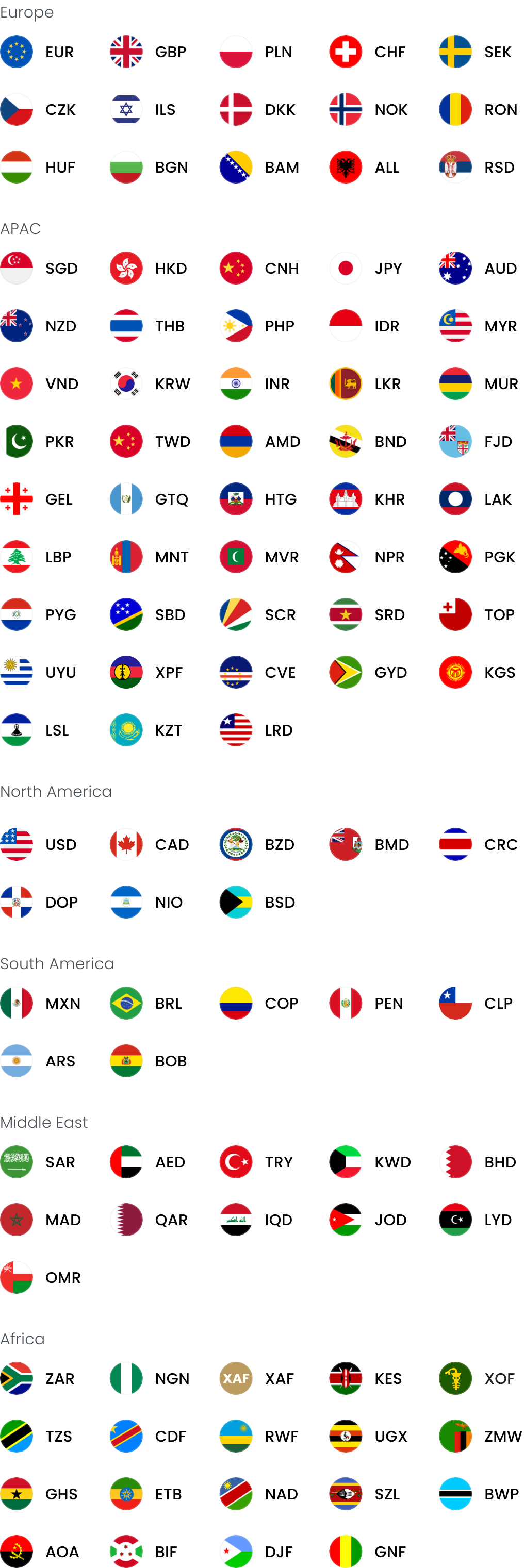
| WorldFirst | Major Payment Institution | 24 months | 0.6% | 20+ | 130+ |
| OFX | Major Payment Institution | Forward + limit orders | Not published | 7 (Global Currency Account) | Limited |
| Wallex | Not specified in public materials | 12 months | Near mid-market | 47 | Not specified |
| Airwallex | Major Payment Institution + Capital Markets Services | 365 days | 0.4% | 20+ | Amazon, Lazada, Shopify |
| Wise Business | Major Payment Institution + Capital Markets Services | None published | From 0.26% | 40+ | Not a core feature |
| MonFX | Major Payment Institution | Forward + margin agreements | Dealer-quoted | 60+ | Not applicable |
| DBS | Bank | Spot and options | Bank-quoted | 130+ | Not applicable |
| HSBC Singapore | Bank | Forwards, swaps, FX orders | Bank-quoted | 130 | Not applicable |
| UOB | Bank | Full suite incl. NDF | Bank-quoted, S$20K minimum | 37 | Not applicable |
| CIMB Singapore | Bank | FX Online (spot-focused) | Zero fee first transfer | ASEAN corridors | Not applicable |
Table checked and current as of the most recent publication of this article.
1. WorldFirst
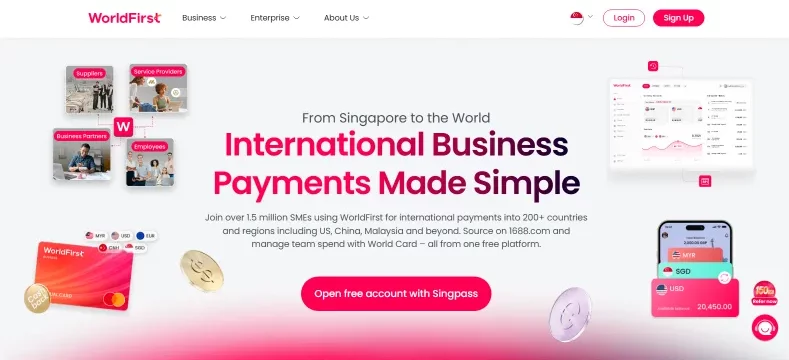
Best for: Singapore SMEs importing from China, selling across multiple marketplaces, or managing recurring supplier and customer FX exposure.
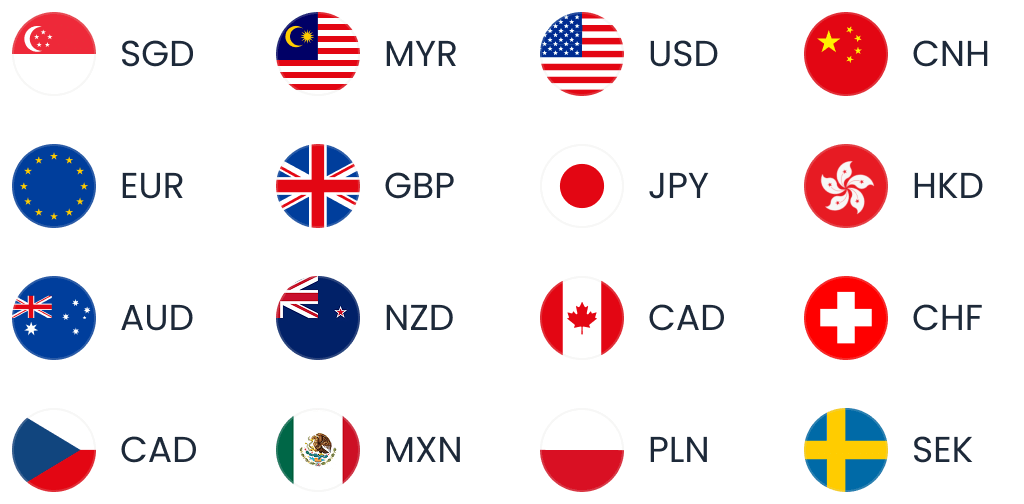
WorldFirst is licensed by MAS as a Major Payment Institution under the Payment Services Act 2019, covering account issuance, domestic and cross-border money transfer, and e-money issuance. Its World Account gives you local receiving details in 20+ currencies, including SGD, USD, CNH, and MYR, and lets you send in 100+ currencies to 200+ countries and regions.
Key FX and cross-border payment features include:
- Forward contracts up to 24 months: You can lock today’s rate for any amount, currency or end date, and WorldFirst states it will not cancel the agreement unless terms are breached, a longer commitment window than most competitors offer
- Firm orders and rate alerts: Firm orders execute automatically once your target rate hits, staying active for a month after booking, while rate alerts notify you with no obligation to trade, useful for tracking multiple currencies at once
- 0.6% FX markup on major currencies: Rates are based on the mid-market rate and confirmed before you convert, a materially tighter margin than the 1 to 3% typically charged by traditional banks
- 150,000 Chinese supplier accounts on the network: Payments between WorldFirst accounts in the same currency settle instantly and are free, and roughly 80% of payments overall reach recipients the same day
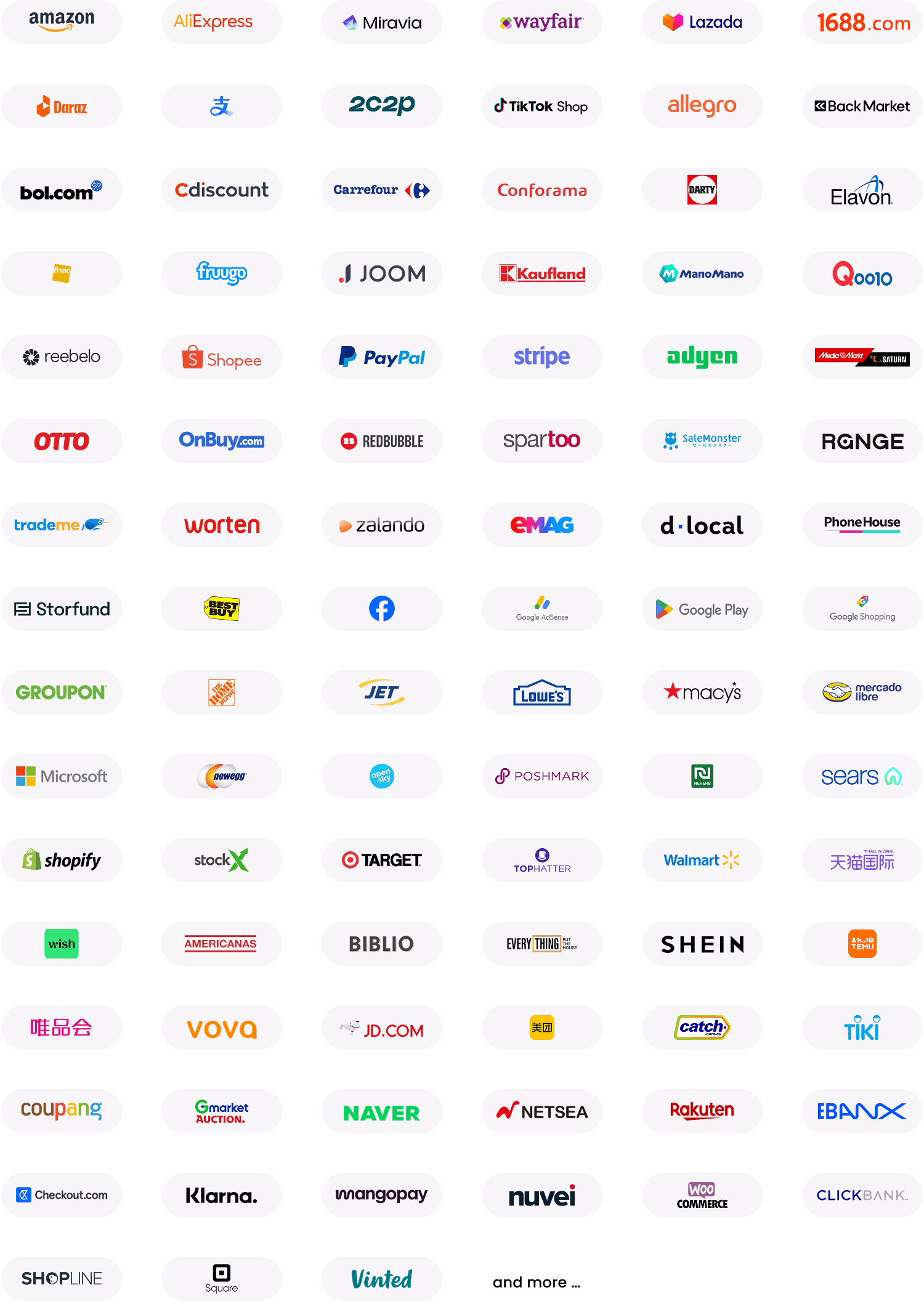
- 130+ marketplace and payment gateway connections: Amazon, Shopee, Lazada, Etsy, Shopify and TikTok Shop collections feed directly into the account, alongside Xero and NetSuite integrations for reconciliation
Pricing:
Free to open and maintain, with no account opening or monthly fees and no receiving fees. FX conversion is capped at a 0.6% markup for major currencies.
Trade-offs:
WorldFirst isn’t a bank. It’s a regulated payments provider, and Singapore entities hold MAS licences for services including account issuance, cross-border money transfer and e-money issuance, but it doesn’t offer lending, payroll or full domestic banking. Client funds are safeguarded in segregated accounts rather than covered by the Singapore Deposit Insurance Scheme, which only applies to eligible SGD bank deposits.
2. OFX
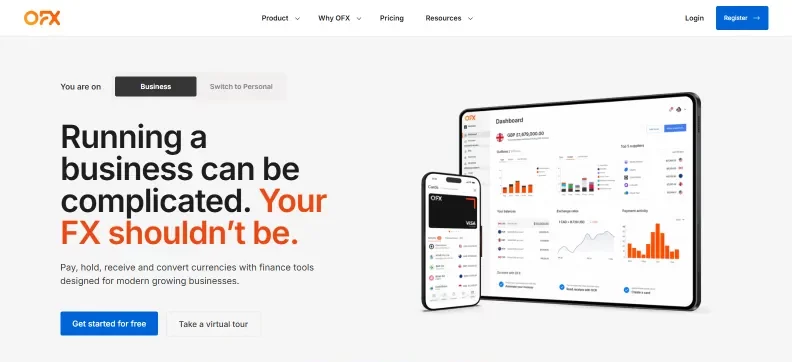
Best for: Larger or less frequent international payments where phone-based expert guidance matters more than a marketplace-native workflow.
OFX Singapore Pte. Limited is MAS-licensed as a Major Payment Institution for cross-border and domestic money transfer, e-money issuance, and account issuance.
Its main business FX features include:
- Forward contracts and limit orders: OFX lets you lock a rate for a future date or set a target rate for automatic execution, comparable in structure to WorldFirst’s toolset though with less published detail on maximum terms
- 24/7 OFXpert support: A dedicated support model suits businesses that want a human on the line for large or irregular transfers
- Batch payments up to 500 recipients: Useful if you’re running payroll-adjacent or bulk supplier disbursements internationally
- Global Currency Account in 7 currencies: Covers USD, EUR, GBP, CAD, AUD, SGD and HKD with Xero integration
Pricing:
OFX doesn’t publish a standard FX markup; rates are typically quoted per transaction.
Trade-offs:
Global Currency Account is no longer available to new business and eCommerce clients globally, so confirm current product availability directly with OFX before assuming this account is open to you.
Read more:
3. Wallex
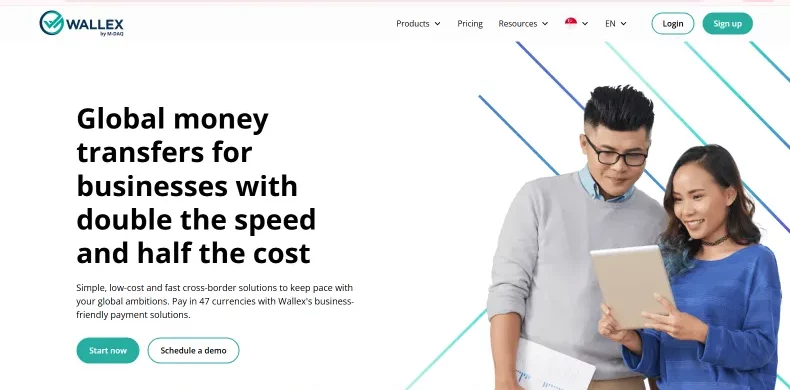
Best for: ASEAN-focused SMEs prioritising competitive rates on regional currencies alongside majors.
Wallex is a Singapore-based cross-border payments and FX platform supporting 47 currencies with near mid-market rates and real-time conversions.
Key features for regional FX management include:
- Forward contracts up to 12 months: Shorter than WorldFirst’s 24-month window but longer than Airwallex’s 365-day cap
- 47 currencies supported: A broad range that extends beyond the majors most competitors focus on
- Singpass onboarding: Sign-up designed for Singapore-registered entities, reducing paperwork friction
- Free to start, no commitments: Positioned for businesses wanting to test the platform before scaling volume
Pricing:
Wallex advertises rates near the mid-market rate rather than a fixed published markup percentage.
Trade-offs:
Public materials don’t specify Wallex’s marketplace integration depth or accounting connections in the same detail as WorldFirst or Airwallex, so verify these directly if reconciliation automation matters to your workflow.
4. Airwallex
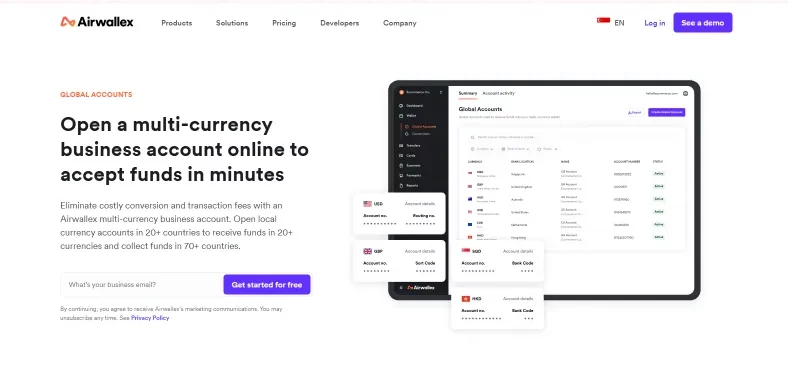
Best for: E-commerce SMEs wanting integrated payments, spend management and FX hedging in one platform.
Airwallex holds both a MAS Major Payment Institution licence and a Capital Markets Services licence through Airwallex Capital Singapore, the latter specifically covering FX forward transactions.
Its main FX and payment capabilities include:
- Scheduled Conversions up to 365 days: Airwallex’s help centre confirms this forward-style booking functionality, though a third-party comparison from Statrys lists Airwallex as lacking advanced FX tools, so confirm current functionality before relying on it for hedging
- 0.4% markup on major currencies: A tighter published margin than WorldFirst’s 0.6%, rising to 0.6% for non-major currencies
- 20+ currencies with local bank details: Comparable coverage to WorldFirst’s World Account
- Broad integration set: Xero, Sage, QuickBooks, NetSuite, Amazon, Lazada and Shopify connections support both accounting and marketplace-selling workflows
Pricing:
0.4% markup above interbank rate for major currencies, 0.6% for others.
Trade-offs:
The conflicting evidence on forward contract availability means you should test the Scheduled Conversions feature directly with your actual currency pair and term before treating it as a reliable hedging instrument.
Read more: Airwallex review
5. Wise Business
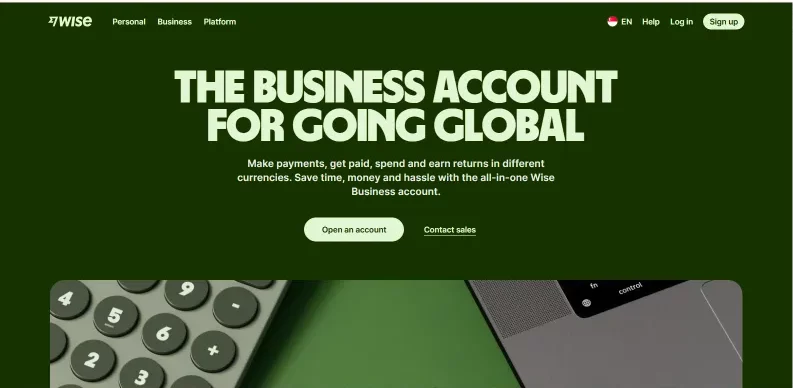
Best for: Smaller digital-first businesses that want transparent pricing and simplicity over hedging sophistication.
Wise Business is MAS-licensed as a Major Payment Institution and separately holds a Capital Markets Services licence.
Key features for managing international currencies include:
- Mid-market rate with fees from 0.26%: Among the most transparent published pricing in this category, calculated as a fee on top of the mid-market rate rather than a hidden markup
- 40+ currencies held, 25+ received: Solid multi-currency coverage for a fintech of its size
- PayNow support: Useful for Singapore domestic transfers, though PayNow itself is a domestic rail only and shouldn’t be confused with cross-border capability
- One-time SGD 99 fee: Required to unlock local account details, a cost most competitors on this list don’t charge
Pricing:
No monthly fees; conversion fees from 0.26%; one-time SGD 99 unlock fee for local account details.
Trade-offs:
Wise does not currently offer forward contracts in Singapore. If locking a rate for a future supplier payment is central to your risk management, Wise’s toolset falls short regardless of how clean its pricing looks.
6. MonFX
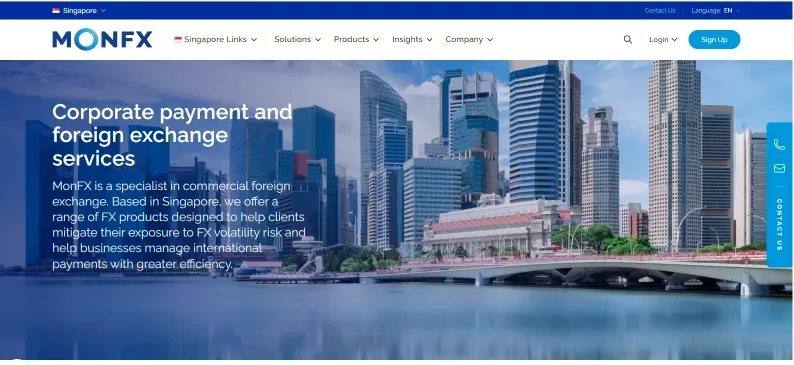
Best for: SMEs wanting a dedicated FX dealer and tailored hedging strategy rather than a self-serve platform.
MonFX Pte. Ltd. is MAS-licensed as a Major Payment Institution, with client funds safeguarded in segregated trust accounts held with DBS Bank.
Its main FX management features include:
- Spot FX, forward contracts and margin agreements: A fuller institutional-style hedging suite than most fintech competitors offer self-serve
- Dedicated FX dealer per client: Personalised service rather than an app-only relationship, which suits businesses wanting strategic input
- 60+ currencies via MonFX Pay: Broad currency coverage for payments alongside hedging
- Serves importers, exporters and multinationals: Positioned slightly higher up-market than some fintech-first competitors
Pricing:
Rates are dealer-quoted rather than published as a standard markup.
Trade-offs:
The dealer-led model suits businesses with meaningful FX exposure and time to build a relationship, but it’s less suited to SMEs wanting instant self-serve rate locking or marketplace-native collections.
7. Traditional banks: DBS, HSBC, UOB and CIMB
Best for: Businesses already banking with one of these institutions, or needing FX hedging bundled with trade finance and lending.
Its main FX management features include:
- DBS: Offers spot FX and vanilla FX options for SMEs, with access to 130+ currencies and pricing that benefits from the bank’s scale as Singapore’s largest
- HSBC Singapore: Supports 130 currencies and payments to 175 markets, with forwards, flexible time-option forwards, automatic FX orders and swaps available through its Evolve platform
- UOB: Runs the fullest hedging suite in this list, spot, forward, swaps, long-term forwards, non-deliverable forwards, par forwards and options across 37 currencies, though preferential pricing typically requires a S$20,000 equivalent minimum
- CIMB Singapore: Launched CIMB FX Online in August 2025, a digital FX tool guaranteeing competitive rates for SGD to MYR, IDR and THB corridors, with zero fees on a first transfer and no requirement to hold a CIMB business account
Pricing:
Bank-quoted, typically ranging from 1 to 3% markup on FX conversion, though CIMB’s ASEAN-corridor pricing and first-transfer waiver are notable exceptions.
Trade-offs:
Banks generally require higher transaction minimums for preferential pricing and lack the marketplace-native collections that e-commerce sellers need. They do, however, bundle FX with lending, trade finance and cash management in ways no fintech on this list currently matches.
Read more:
How to choose between these providers
Match the decision to the friction that actually costs you money.
- If China sourcing drives your payment volume, WorldFirst’s supplier network and CNH capability are directly relevant since so many of your counterparties may already hold accounts on the same rails
- If you sell across multiple marketplaces, weigh WorldFirst’s 130+ integrations against Wise’s simpler but narrower setup. If long-dated rate certainty matters most, compare forward contract terms directly: WorldFirst’s 24 months against Wallex’s 12 and Airwallex’s 365 days
- If cost predictability is your primary concern, line up the published FX markups side by side rather than trusting headline claims: WorldFirst’s 0.6%, Airwallex’s 0.4%, Wise’s 0.26% plus its unlock fee, and the 1 to 3% typical of bank pricing.
- If reconciliation eats your bookkeeper’s time each month, confirm Xero or NetSuite integration is live for your specific account type before switching, since availability can vary by provider and region
Turn an FX decision into a payment plan with WorldFirst
Choosing an FX provider is only the first part of managing currency risk. The next challenge is making sure the supplier payment actually goes out when planned, especially when deposits, balances and invoices fall on different dates.
Consider a Singapore importer that has agreed a CNY 500,000 balance payment due in six weeks. Once the business has decided how to manage the exchange rate, WorldFirst can also handle the payment workflow around that obligation. Invoice payments can be scheduled for a future date, while businesses with multiple overseas invoices can process up to 200 payments in a batch on supported routes rather than setting up each transfer separately.
China payments can also follow the currency the supplier actually requests. WorldFirst supports direct CNY payments to eligible supplier bank or Alipay accounts, including payments funded from supported balances such as SGD, USD and CNH. That can be useful when a Guangzhou supplier invoices locally rather than asking you to settle in USD.
For other international operating costs, the World Card adds another layer to the same setup, with zero FX fees when spending directly from supported currency balances and up to 1.2% cashback on eligible business spend.
WorldFirst isn’t a bank. WorldFirst (Singapore) Merchant Services Pte. Ltd. operates as a regulated payments provider in Singapore, so the World Account can sit alongside your existing bank relationship for lending, trade finance and other banking services.
Open a World Account to connect your FX decisions with scheduled supplier payments and day-to-day international business spending.
FAQs
1. What is foreign exchange risk management?
Foreign exchange risk management is the process of reducing the impact of currency movements on international payments and collections. Businesses can use tools such as forward contracts, firm orders, rate alerts and multi-currency balances to make future FX costs more predictable.
2. What is the best way for a Singapore SME to manage FX risk?
The best approach depends on how often you transact, which currencies you use and how far ahead you know your payment dates. Regular importers may benefit from combining multi-currency holding with forward contracts, while businesses making occasional transfers may prefer spot conversions or rate alerts.
3. How do forward contracts reduce currency risk?
A forward contract lets you agree an exchange rate for a payment that will take place later. It can protect your budget from adverse currency movements between agreeing a supplier order and paying the invoice, although eligibility, funding requirements and contract terms vary by provider.
4. What should I compare when choosing an FX provider in Singapore?
Compare the total FX cost, available hedging tools, supported currencies, payment speed, account fees and regulatory status. Businesses with recurring international trade should also check supplier-payment routes, marketplace collections and accounting integrations rather than relying on the headline exchange rate alone.
5. Should I use a bank or fintech provider for business FX?
Banks can be a better fit when you need FX alongside lending, trade finance and broader cash-management services. Regulated payment providers such as WorldFirst may offer a more focused setup for multi-currency balances, international supplier payments and FX management, so the better choice depends on the wider banking and payment services your business needs.
Sources:
- https://www.pilotoasia.com/guide/cross-border-payments-singapore-smbs-2025
- https://www.mas.gov.sg/news/media-releases/2025/singapore-strengthens-position-as-third-largest-global-fx-centre
- https://www.mas.gov.sg/regulation/payments/licensing-for-payment-service-providers
- https://help.airwallex.com/hc/en-gb/articles/16075164734479-How-can-I-book-a-conversion-for-a-future-date-SG
- https://www.dbs.com.sg/sme/global-financial-markets/foreign-exchange/spot-fx
- https://www.business.hsbc.com.sg/en-sg/products/fx-managing-currency-risk
- https://www.uob.com.sg/business/treasury/currency-hedging/index.page
- https://www.cimb.com.sg/en/business/cimb-insights/media/2025/fxonline.html



![AliExpress dropshipping: How to source and pay suppliers from Singapore [2026]](https://mdn.marmot-cloud.com/worldfirst/sites/9/2026/10/20261021131155864-300x200.webp)

![Trust card review [2027]: Features, fees and more](https://mdn.marmot-cloud.com/worldfirst/sites/9/2026/10/20261020214810193-300x200.webp)