





























A ‘bank transfer’ can mean more than one thing once your team starts paying suppliers. A same-day SGD payment to a local warehouse, a PayNow transfer to a Singapore vendor and a USD payment to an overseas factory all need different details, timelines and checks. Treat them the same, and you risk late payments, short receipts and messy reconciliation.
That distinction matters in a market built on trade. Singapore’s total merchandise trade reached SG$140.9 billion in January 2026, with imports at SG$63.4 billion. For importers, every transfer route can affect cost, timing, the amount received and reconciliation.
This guide explains the main bank transfer methods in Singapore, when each one makes sense, and what to check before paying local vendors or overseas suppliers.
Key takeaways:
- Different transfer routes solve different payment problems: FAST, PayNow Corporate, GIRO, MEPS+ and international transfers each fit different business payment scenarios, depending on urgency, supplier location and payment details
- Local SGD payments need the right rail: FAST suits urgent one-off transfers, PayNow Corporate works for UEN or QR payments, GIRO/eGIRO support recurring local costs and MEPS+ fits high-value SGD transfers
- Overseas supplier payments need tighter checks: Confirm the beneficiary name, bank details, SWIFT/BIC, payment currency, invoice reference and any intermediary bank details before sending funds
- Fees and FX can change what your supplier receives: Fee instructions, currency choice, FX margins and recipient bank charges can affect the final amount received, especially across repeat supplier payments
- WorldFirst can help importers manage repeat supplier payments with more control: With a World Account, you can hold supported currency balances, schedule invoice payments, send batch payments and track supplier payment records from one platform
Which bank transfer method should Singapore importers use?
The best transfer method depends on the payment amount, urgency, currency and supplier location. Use this table to match the route to the payment:
| Transfer method | Use it when | Why it makes sense | Check before sending |
| FAST | You’re paying a local vendor in SGD | Moves SGD between participating banks almost instantly | Account number, beneficiary name, limit and invoice reference |
| PayNow Corporate | The vendor asks for UEN or PayNow QR | Lets entities send and receive SGD using a linked UEN | Displayed recipient name |
| GIRO / eGIRO | You’re setting up recurring local payments | Suits regular payments, with online setup where available | Deduction date, amount rules and cancellation process |
| MEPS+ | You’re sending a high-value SGD transfer | Supports high-value SGD interbank transfers | Cut-off time, charges and approval workflow |
| International bank transfer / SWIFT | You’re paying an overseas supplier | Supports payments to bank accounts outside Singapore | Currency, SWIFT/BIC, account details and fee option |
Local bank transfers in Singapore
Local transfers matter most when a payment affects the next step in your import workflow: warehouse release, freight movement, vendor confirmation or recurring operating costs.
1. FAST for urgent SGD payments
The Association of Banks in Singapore describes FAST as a service that allows customers of participating banks to transfer Singapore dollar funds between banks in Singapore almost instantly. This makes FAST the clearest option when your team needs to move SGD quickly to another Singapore bank account.
It works best for one-off payments where your team already has the recipient’s bank account details.
Before sending a FAST payment, check:
- Beneficiary name
- Bank and account number
- Payment limit
- Invoice or shipment reference
- Internal approval status
FAST supports transfers of up to SG$200,000 per transaction, though your bank may apply lower daily or monthly limits. Check the limit before using FAST for larger supplier, warehouse or freight payments.
2. PayNow Corporate for UEN and QR payments
PayNow Corporate works when a Singapore vendor asks for payment by UEN or PayNow QR instead of full bank details.
PayNow is available 24/7, 365 days, while PayNow Corporate lets entities pay and receive SGD instantly by linking their UEN to a Singapore bank or e-wallet account.
For importers, PayNow Corporate can make local payments easier when the vendor sends an invoice with a UEN or QR code. That could include packaging suppliers, last-mile delivery partners, local service providers or smaller vendors that don’t want to share full bank account details.
Before confirming the payment, ensure that the displayed recipient name matches the invoice or vendor record.
PayNow payments may run through FAST or GIRO, depending on the bank and payment setup.
PayNow Corporate reduces bank-detail handling, but your team still needs a clean payment record. Add the invoice reference where possible and save the confirmation for reconciliation.
3. GIRO and eGIRO for recurring payments
The Association of Banks in Singapore describes GIRO as an electronic direct debit mechanism and notes that it’s especially useful for payments that are regular in nature and fixed in amount.
For an importer, GIRO can suit recurring local costs such as rent, utilities, insurance premiums or regular service charges. It’s less suitable for order-by-order supplier payments where the amount, currency or shipment timing can change.
eGIRO moves the setup process online. Paper-based GIRO applications take an average of three weeks before businesses can start auto deductions. eGIRO can significantly reduce that turnaround time.
Before setting up GIRO or eGIRO, check:
- Authorised billing organisation
- Deduction date
- Amount rules
- Approval workflow
- Cancellation process
- Finance record owner
GIRO is useful when the payment should run without a new manual transfer each time. It’s not the best choice for supplier invoices that need review before each shipment.
4. MEPS+ for high-value SGD transfers
MEPS+ belongs in a different category from everyday FAST and PayNow payments.
Most importers won’t use MEPS+ for everyday local supplier payments. It’s more relevant when the payment value is high, the deadline is tight or your bank specifically recommends that route.
Before using MEPS+, confirm:
- Bank cut-off time
- Transfer charges
- Approval workflow
- Required documents
- Value date
- Recipient bank details
Use MEPS+ when the payment value or urgency justifies the process. For most local SGD vendor payments, FAST or PayNow Corporate will be easier to manage.
International bank transfers from Singapore
1. SWIFT transfers for overseas supplier payments
Suppliers often request SWIFT/BIC details when they want payment into an overseas bank account.
Swift describes itself as a secure financial messaging system and explains that financial institutions use it to send payment instructions across borders.
You’ll often see SWIFT details on invoices from factories, logistics partners, distributors or service providers outside Singapore.
Before sending a SWIFT payment, confirm:
- Beneficiary legal name
- Beneficiary bank name and address
- Account number or IBAN, where required
- SWIFT/BIC code
- Intermediary bank details, if requested
- Invoice number or purchase order reference
- Payment currency
SWIFT helps banks and payment providers exchange instructions, but it doesn’t hold or move funds. Banks, fintechs and other institutions handle the actual transfer, so timing still depends on the route, checks and recipient bank.
2. Local payment routes in the destination country
Where supported, some providers can route international payments through local payment networks in the supplier’s country. This route can help when your supplier wants funds paid into a local bank account in supported markets such as China, Malaysia, Thailand, Europe or Singapore.
For importers, local routes matter when the supplier expects a domestic receipt format or local bank details. Depending on the market, your team may need a local account number, bank code, branch code, routing number or another country-specific identifier.
Before using a local route, check:
- Supported destination country
- Supported payment currency
- Required local bank details
- Recipient name format
- Expected delivery timing
- Payment reference field
- Proof of payment format
Use this route when the country, currency and local details match the supplier’s invoice.
Read more:
What affects the amount your supplier receives?
Supplier receipt depends on three decisions your team makes before payment:
- Fee instruction
- Payment currency
- Funding account
1. Fee instructions: OUR, SHA and BEN
International transfer forms may ask you to choose OUR, SHA or BEN. This choice decides who pays the transfer charges:
- OUR means you pay the transfer charges
- SHA means you and the recipient share the charges
- BEN means the recipient pays the charges from the amount received
For importers, the wrong fee instruction can leave the supplier short. If your supplier invoices US$30,000 and needs the full amount before dispatch, a BEN or SHA instruction could delay the order.
2. Currency choice
Currency choice affects your SGD cost and the final invoice match. A Singapore importer may fund the payment in SGD, while the supplier invoices in USD, CNH, MYR, EUR or another currency.
If the supplier invoices in USD, paying in USD can make reconciliation cleaner because the payment matches the invoice. If the supplier invoices in CNH, sending another currency may trigger conversion on the supplier’s side.
Before approving the currency, check:
- Invoice currency
- Supplier’s receiving currency
- FX rate and margin
- Transfer fee
- Recipient bank charges
- Expected received amount
- Landed-cost record
For repeat orders, track the full payment cost after FX and deductions, rather than the transfer fee alone.
Read more:
3. The account you send from
The right account setup should help your finance team answer three questions before payment:
- What currency are we funding from?
- What amount will the supplier receive?
- Where will we track the record?
If you only send the odd overseas payment, a standard SGD business account may be enough. Monthly supplier invoices create a different problem: currency timing, payment tracking and repeat reconciliation.
Read more:
A multi-currency account can let your business hold supported currencies, convert before the invoice due date and pay suppliers from the relevant balance where available.
For example, a Singapore importer paying monthly USD invoices may choose to hold USD rather than convert from SGD each time a payment falls due. Holding USD doesn’t remove FX exposure, but it separates the conversion decision from the payment deadline.
Before choosing the account to send from, reevaluate these key points:
- Supported currencies: Prioritise an account that covers the currencies you use most often, such as USD, CNH, MYR or EUR
- FX rate and margin: Compare the quoted rate with the market rate so your team can record the full SGD cost
- Transfer fees: Look beyond the headline charge, because FX margin and recipient deductions can change the real cost
- Payment tracking: Choose a setup that shows payment status clearly, without extra back-and-forth with banks or suppliers
- Batch payment support: Make sure the account can handle several supplier invoices in one payment run
- Approval controls: Match the payment workflow to your internal sign-off process before funds leave the account
- Reconciliation records: Keep the invoice reference, currency, amount, fee and payment date easy to match later
How long do bank transfers in Singapore take?
Payment timing depends on the rail, bank cut-off time, payment details and checks:
| Transfer type | Usual timing |
| FAST | Almost instant for SGD transfers between participating banks |
| PayNow | Instant for SGD transfers through FAST |
| GIRO | Batch-based, mainly for regular fixed payments |
| eGIRO | Follows GIRO processing once active, with faster digital setup where available |
| MEPS+ | Real-time settlement for eligible high-value SGD interbank transfers |
| International transfer | Same day to several business days, depending on route, checks and destination |
When a standard bank transfer setup needs more control
A standard transfer process can be enough for occasional payments. It becomes harder to manage when supplier payments repeat every month across currencies, banks and invoice references.
For importers, the pressure usually shows up in these areas:
- Several supplier currencies: Paying in USD, CNH, MYR or EUR from one SGD account can add conversion steps
- Short receipts: Intermediary or recipient bank charges can leave the supplier with less than the invoice amount
- Manual tracking: Your bank may show the payment as sent, while the supplier still needs proof or reference details
- Multiple invoices: Paying several suppliers manually increases the risk of wrong references, wrong amounts or delayed approvals
Manage bank transfers and overseas supplier payments with WorldFirst
WorldFirst supports Singapore businesses that need to manage repeat overseas supplier payments from a multi-currency account.
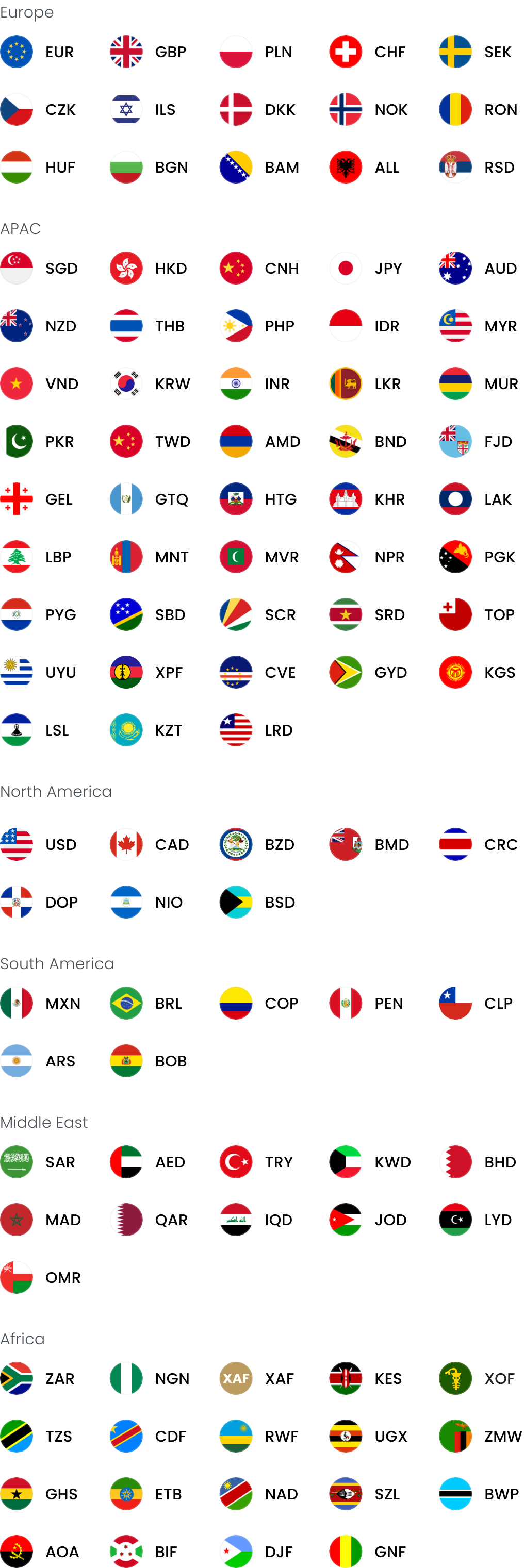
With a World Account, you can make payments to 210+ countries and territories in 100+ currencies, hold supported currency balances and track outgoing payments from one platform.
Monthly supplier invoices can create the same work again and again for importers: checking FX, approving payments, matching references and tracking proof of payment.
WorldFirst also supports scheduled invoice payments, batch payments of up to 200 invoices in one go and supplier payments through local networks or SWIFT where available. Local network routes cover markets including Malaysia, China, the US, Thailand and Europe.
Example: Paying a repeat overseas supplier
Imagine your Singapore business pays US$80,000 to the same overseas supplier each month. You also pay local SGD logistics costs before goods move from the port to the warehouse.
If every overseas invoice starts from an SGD account, your team has to check the FX rate, approve the conversion, choose the payment route and track proof of payment for each order.
With a World Account, your team can hold supported currencies, convert before the invoice deadline where useful and pay suppliers in their preferred currency where supported. You can also schedule invoice payments, send multiple supplier payments in one batch and track payment records from the same account.
WorldFirst isn’t a bank. In Singapore, WorldFirst (Singapore) Merchant Services Pte. Ltd. is licensed by MAS as a Major Payment Institution under the Payment Services Act 2019 to provide account issuance, domestic and cross-border money transfer and e-money issuance services.
FAQ
1. Can you cancel a bank transfer in Singapore after sending it?
2. What should you do if you send a bank transfer to the wrong supplier account?
3. Why do banks hold or review overseas supplier payments?
Banks and payment providers may review overseas transfers for KYC, payment screening, sanctions exposure, transaction purpose, missing documents or unusual activity.
4. How can importers check new supplier bank details safely?
5. What happens if a supplier says they haven’t received the bank transfer?
The payment may still be with your bank, an intermediary bank or the supplier’s bank. Check the payment status, value date, currency and reference. Send proof of payment, then ask your bank or provider to trace the payment if the supplier still can’t find it.
Sources:
- https://www.singstat.gov.sg/find-data/explore-data-themes/trade-investment/merchandise-trade/latest-news-data
- https://www.abs.org.sg/e-payments/fast
- https://www.abs.org.sg/e-payments/pay-now
- https://www.abs.org.sg/e-payments/giro
- https://www.abs.org.sg/e-payments/eGIRO
- https://www.swift.com/about-us/who-we-are


![Revolut Business Card review Singapore [2027]: Features, fees & more](https://mdn.marmot-cloud.com/worldfirst/sites/9/2026/09/20261001002258848-300x200.webp)