



























If you’re doing business internationally, you need a way to make cross-border payments quickly and affordably. Global B2B cross-border payment volumes are projected to exceed $32 trillion by 2028, yet many businesses are still relying on methods built decades ago. Traditional routes like the SWIFT network typically take 3 to 5 business days and carry high costs per transaction, and those costs add up fast once you’re paying suppliers, staff or partners regularly.

A better option for most growing businesses is a multi-currency account, which lets you hold, receive and transfer funds in foreign currencies from a single account. A multi-currency account like WorldFirst’s World Account can help you save on fees, access better FX rates and make faster payments.
In this article, we compare the main options for international business payments, starting with WorldFirst, then working through the pros, cons and best use cases of the other methods businesses commonly rely on.
Key takeaways
- Traditional SWIFT bank transfers cost $25 to $50 per payment on top of a 2% to 5% exchange rate markup, and typically take 3 to 5 business days to arrive.
- SEPA transfers have changed significantly: since October 2025, EU regulation requires payment providers across the eurozone to offer SEPA Instant, settling euro payments within 10 seconds, 24/7, at no extra cost.
- A multi-currency account like WorldFirst’s World Account caps FX fees at 0.5% for major currencies (0.3% for new customers in their first 180 days), with 80% of transfers arriving the same day.
- The right method depends on transaction size, destination and how often you’re paying, so most growing businesses end up using a mix rather than a single method.
- For high-value or higher-risk transactions, traditional trade finance tools like letters of credit and credit insurance still play a role alongside modern payment platforms.
Why WorldFirst is a strong way to make international business payments
Since 2004, WorldFirst has processed more than $500 billion in transactions for over 1.5 million businesses worldwide, helping them navigate the complexities of international trade.
Our multi-currency World Account helps eliminate the traditional pain points of international business payments, reducing transfer times and offering competitive fees and conversion rates.
Here are some of the reasons to consider WorldFirst for your international transactions.
Make payments faster, with 80% arriving the same day
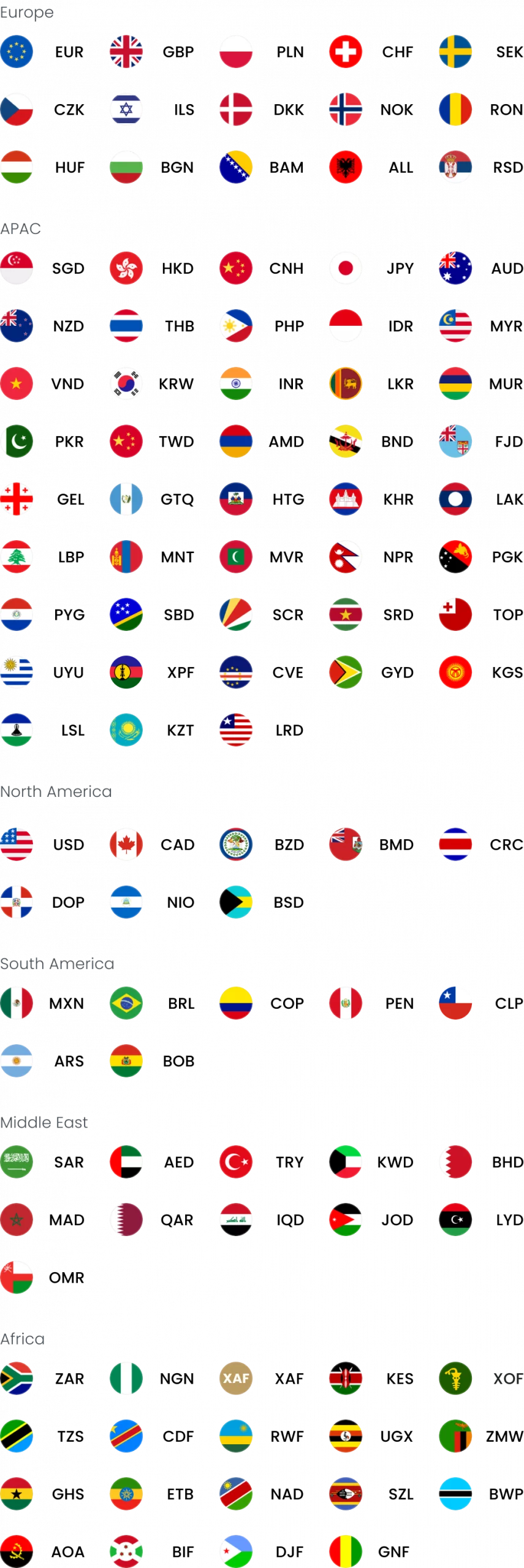
Unlike SWIFT transfers, which can take 3 to 5 business days or more, 80% of WorldFirst transfers arrive the same day. WorldFirst lets you send payments in 100+ currencies to 210+ countries and territories directly from your multi-currency World Account.
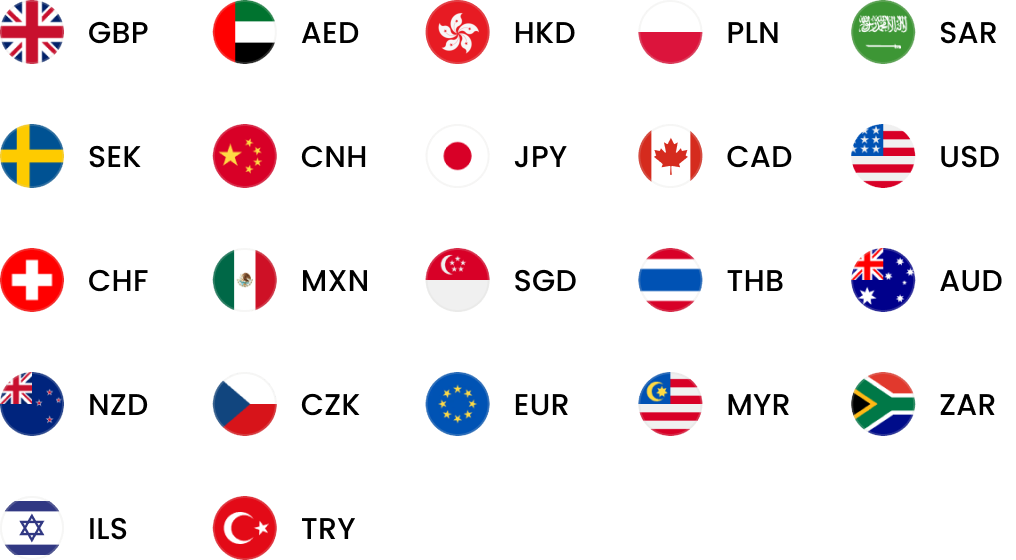
Your World Account also lets you hold funds in 20+ currencies, so you can pay suppliers, contractors and others using local payment systems rather than international wires. This helps you avoid intermediary bank delays and the fees that come with them.
You can also pay other World Account holders instantly, for free. Alternatively, use your World Card to pay instantly in 150+ currencies across 200+ countries, with zero FX fees on 15 major currencies from your World Account balance, plus up to 1.2% unlimited cashback on business expenses. Read more: how a multi-currency virtual card helps your business grow.
Keep costs low when holding and moving money
There are no fees to open or set up a World Account, and no monthly or annual maintenance fees. There are also no fees to receive or hold currency. You only pay when you transfer, convert or withdraw funds.
Our exchange rates are based on the mid-market rate, with FX fees capped at 0.5% for major currencies, dropping to 0.3% for new customers in their first 180 days. There are no hidden markups and no surprise charges, and all other fees are clearly shown on our pricing page.
WorldFirst also makes it easier to receive payouts from 130+ marketplaces and payment gateways in your customers’ currencies. Collect funds from Amazon, TikTok Shop, Etsy and other major platforms directly into your World Account, for faster access and zero collection fees.
Protect your margins against currency volatility with firm orders and forward contracts
Currency fluctuations can quickly erode your profit margins, especially when you’re operating on payment cycles that span weeks or months. WorldFirst offers FX risk management tools to help you take control:
- Lock in favourable rates with forward contracts. Secure today’s exchange rate for payments up to 24 months in the future. This is particularly valuable for businesses with recurring supplier payments or long-term contracts where you need cost certainty.
- Automate conversions at target rates with firm orders. Set your ideal exchange rate and WorldFirst automatically executes the conversion once the market hits your target, 24 hours a day, letting you capture favourable movements without watching the market yourself.
Read more: Business foreign currency accounts: 4 options compared.
Find and pay Chinese suppliers more easily on 1688.com
Browse over 10 million suppliers across 1,700 product categories on 1688.com, one of China’s leading wholesale marketplaces, where prices can run up to 40% cheaper than other platforms and minimum order quantities can be as low as one or two items.
Through our integration as 1688.com’s official international payment partner, you can pay suppliers directly from your World Account using World Pay. Simply select World Pay as your payment method to pay from your CNH balance at checkout.
You can also send CNH payments directly to Chinese bank accounts without needing your own local Chinese account. Suppliers receive funds in their local currency, typically within 24 hours, while you stay compliant with Chinese foreign exchange regulations.
Read more: how to source wholesale using 1688.com outside China.
How to open a World Account
To open your World Account:
- Go to our sign-up page
- Fill in your personal and business details
- Upload your verification documents
- Set your account preferences
- Start making simplified international business payments
Need extra help? Visit our official Help Centre guide.
Alternative payment methods for international business
There are a range of alternative payment methods that may suit particular transactions better than a multi-currency account. Here’s a closer look at the main options.
| Method | Speed | Cost | Best for | Key limitations |
|---|---|---|---|---|
| WorldFirst multi-currency account | Same day (80% of transfers) | FX fee capped at 0.5% (0.3% for new customers), no receiving fees | Growing international businesses | Requires business verification |
| Traditional bank transfers (SWIFT) | 3 to 5 business days | $25 to $50 per transfer plus a 2% to 5% FX markup | Large corporates with established banking relationships | Slow and expensive |
| SEPA Instant transfers | Within 10 seconds, 24/7 | No extra fee versus standard SEPA transfers | Eurozone businesses (EUR only) | Limited to euro payments within the SEPA zone |
| Online platforms (Wise, PayPal) | 1 to 3 business days | Mid-market rates plus transparent fees | Small businesses, ad-hoc payments | Limited business features, transfer caps |
| Remittance services (Western Union, MoneyGram) | Minutes to hours | Very high fees plus poor rates | Emergency personal transfers | Not designed for business use |
| Credit cards and digital wallets | Instant | High FX fees, typically 1% to 3% | Small business expenses | Can’t receive payments, limited amounts |
| Cryptocurrency and stablecoins | Minutes | Network fees plus volatility risk (lower with regulated stablecoins) | Tech-savvy businesses in specific sectors or corridors | Limited supplier acceptance, regulatory complexity |
1. Traditional bank transfers (SWIFT)
Banks use the SWIFT network to move funds internationally, which usually takes between three and five business days. Funds pass through multiple correspondent banks, which can delay transactions and add fees along the way.
Advantages: This method is reliable, globally accepted and trusted by regulated industries. It can also handle very high-value transactions under strict compliance controls.
Disadvantages: Transfers are costly, often $25 to $50 per payment before factoring in an unfavourable exchange rate and any intermediary bank fees. Processing is slow, transfers can be delayed by banking hours or holidays, and funds may be held for compliance checks.
Best for: Large enterprises that value compliance and stability over speed or cost savings.
2. SEPA transfers
SEPA (the Single Euro Payments Area) treats euro transfers between participating European countries as domestic payments. This method has changed meaningfully in the last year: since October 2025, EU regulation requires payment service providers across the eurozone to both send and receive SEPA Instant payments, settling within 10 seconds, 24 hours a day, 365 days a year, at no extra cost compared with a standard transfer. Standard (non-instant) SEPA transfers, where still used, typically settle within one business day.
Advantages: SEPA Instant now makes euro transfers close to real time in most cases, at minimal or no cost. Standardised formatting reduces processing errors, and the infrastructure is stable and heavily regulated.
Disadvantages: SEPA is limited to euro-denominated transfers between participating countries. It can’t be used to pay suppliers outside the SEPA zone or to cover other currencies your business needs.
Best for: European businesses conducting most of their operations in euros within SEPA countries.
3. Online platforms (Wise, PayPal, and similar)
Online money transfer platforms let businesses and individuals send money with transparent pricing and often favourable exchange rates. Transfers typically take one to three business days, often using local payment rails.
Advantages: Online platforms are easy to sign up for and start using quickly, and generally offer better exchange rates than banks. Pricing is usually transparent, and the process is quicker than a traditional wire transfer.
Disadvantages: Some platforms cap transfer amounts too low for regular business use, and may hold funds during fraud or risk checks with limited visibility into why.
Best for: Freelancers or small businesses making occasional international payments without needing advanced FX or treasury features.
4. Remittance services (Western Union, MoneyGram)
Built mainly for personal transfers rather than business payments, remittance services let people send funds quickly, often within minutes, to cash pickup locations and mobile wallets worldwide.
Advantages: Remittance services are fast and can reach areas underserved by traditional banking infrastructure. Recipients don’t need a bank account to collect funds.
Disadvantages: Fees are high and exchange rates are generally poor, fraud risk is a genuine concern with this method, and these services largely lack business-specific features. Daily limits can also be low for unverified accounts.
Best for: Personal transfers, or occasional situations where a recipient lacks bank access, such as an importer paying a small, one-off order to an artisan supplier in an area with limited banking infrastructure.
5. Credit cards and digital wallets
Most personal and business credit cards, along with linked digital wallets, allow international purchases online and in person.
Advantages: Card payments are accepted almost everywhere and process instantly. Some cards offer rewards or cashback, and most include fraud protection and chargeback procedures.
Disadvantages: Cards generally carry high transaction fees, typically 1% to 3% of each purchase, and the exchange rate applied often isn’t favourable. Many suppliers won’t accept cards for large B2B transactions, and cards don’t provide a way to receive payments.
Best for: Day-to-day business expenses like subscriptions, marketplace seller fees, ad spend and small cross-border purchases. Not ideal for core supplier or operational payments.
6. Cryptocurrency and stablecoins
Cryptocurrencies such as Bitcoin and Ethereum let businesses bypass banks entirely, with transactions that can settle within minutes, any time of day. In 2026, the more relevant development for business payments is the growing use of regulated stablecoins, tokens pegged to a fiat currency such as the US dollar, for B2B settlement in specific corridors, offering more price stability than volatile cryptocurrencies like Bitcoin while still settling near-instantly outside banking hours.
Advantages: Payments can avoid traditional conversion fees and settle at any time, day or night, without waiting on banking hours.
Disadvantages: Supplier acceptance is still limited outside a handful of sectors and corridors, regulatory requirements are complex and still evolving market to market, and volatile cryptocurrencies carry real price risk between initiating and settling a payment. Using crypto or stablecoins also demands technical knowledge and secure wallet management, which has a real learning curve for a finance team used to conventional banking.
Best for: Niche, tech-savvy businesses in sectors or corridors where both parties are comfortable transacting in crypto or stablecoins.
Managing risk beyond standard transfers
For high-value or higher-risk transactions, traditional trade finance tools are still widely used alongside the payment methods above. Letters of credit and documentary collections reduce the risk of non-payment by requiring banks to verify documents before releasing funds or goods. Credit insurance can protect exporters against buyer default or political risk in a specific market.
Modern fintech platforms like WorldFirst are reshaping cross-border payments with faster settlement, transparent pricing and built-in FX risk management tools, often with far less complexity than traditional instruments. Many businesses use a mix of approaches in practice, combining a multi-currency account for everyday payments with trade finance solutions for larger or riskier deals.
International business payments made simple with WorldFirst
International business payments can get complicated, with slow transfers, unexpected delays, high fees and hidden charges. WorldFirst simplifies cross-border payments with faster transfers, clear and transparent pricing, and no surprises.
To pay suppliers on time, keep cash flow steady and reduce costs, consider a multi-currency account with WorldFirst. WorldFirst isn’t a bank; in the UK it’s authorised by the Financial Conduct Authority as an Electronic Money Institution, and customer funds are safeguarded in line with regulatory requirements. Open a World Account for free and start making faster, easier global payments today.
FAQs
1. How long do international business payments usually take?
It depends on the method. Traditional SWIFT bank transfers often take 3 to 5 business days, sometimes longer with multiple correspondent banks involved. SEPA Instant transfers within the eurozone now settle within 10 seconds. Online platforms like Wise or PayPal typically take one to three days. With WorldFirst, 80% of transfers settle the same day, and payments between World Accounts are instant.
2. What are the main fees I should watch out for with cross-border payments?
Common costs include transfer fees, exchange rate markups and intermediary bank charges. Traditional banks tend to have the highest fees and the least transparent pricing, and remittance services also charge steep markups. Online platforms are more transparent but can still be costly for high-volume businesses. WorldFirst caps FX fees at 0.5% on major currencies (0.3% for new customers) and avoids hidden markups.
3. Which international payment method is best for my business?
It depends on your needs. Large corporations often stick with SWIFT for its established compliance framework, while European businesses may prefer SEPA for euro transactions. Freelancers and small businesses sometimes use online platforms for simplicity. Growing international businesses usually benefit most from a multi-currency account like WorldFirst, which combines speed, transparent fees, marketplace integrations and FX risk management tools in one place.
4. Are there alternatives to standard transfers for managing risk in international payments?
Yes. For high-value or higher-risk transactions, traditional trade finance tools are still widely used. Letters of credit and documentary collections reduce the risk of non-payment by requiring banks to verify documents before releasing funds or goods, and credit insurance can protect exporters against buyer default or political risk. Many businesses combine fintech platforms for everyday payments with trade finance tools for larger or riskier deals.
5. Is SEPA Instant now the default way to send euros within Europe?
For payment providers based in the eurozone, yes. Since October 2025, EU regulation requires them to offer SEPA Instant alongside standard transfers, at no additional cost, so funds typically arrive within 10 seconds rather than the one business day a standard SEPA transfer can take.