

























Setting up a bank account in Poland can be a complex process for non-residents, especially when you’re applying from outside of the EU.
Whether you’re a business or an individual, you’ll likely need to apply for a Polish ID number, as well as an official tax number, just to open a simple transaction account. On top of that, you’ll also need to provide a local address in Poland and be able to visit a bank branch in-person to sign documents.
Luckily, there’s a simpler way to start holding PLN like a Polish citizen.
WorldFirst’s World Account can be used in place of a traditional bank account to help non-residents send, hold and receive funds in Polish zloty.
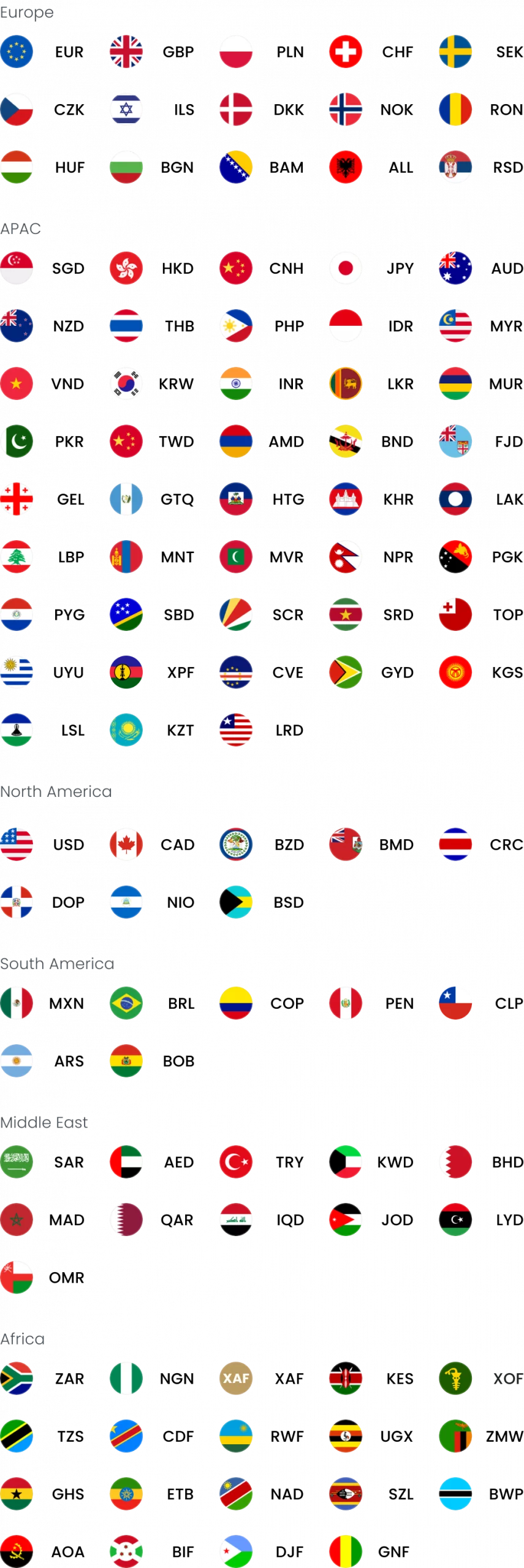
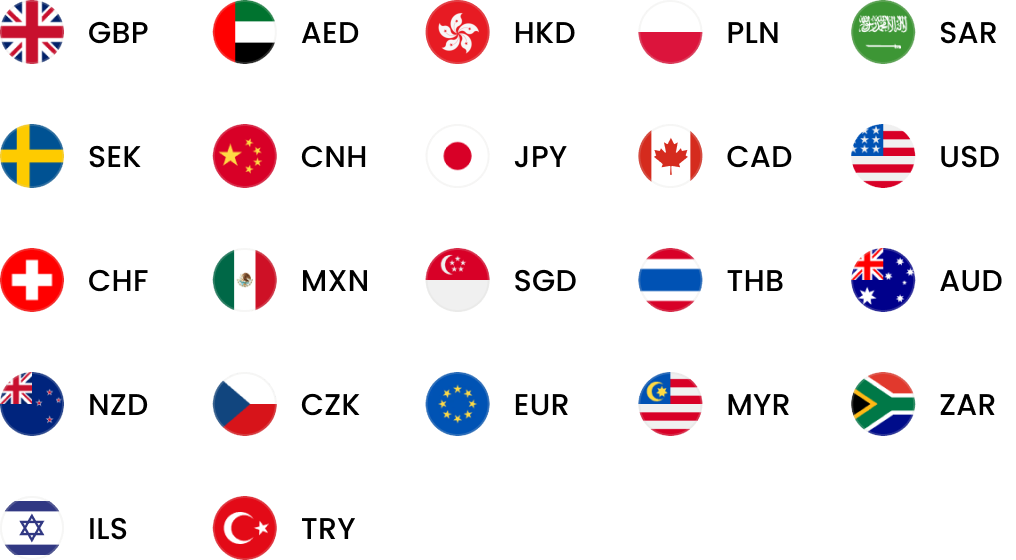
Unlike traditional banks, WorldFirst allows you to hold several balances in PLN, GBP and 20+ other global currencies, all for free. Plus, you don’t need to have a Polish address or a Polish ID number in order to create an account.
In this guide, we share the key features of our World Account for non-residents looking to set up a business account in Poland.
We also run through the steps that non-residents should take to open a traditional bank account, as well as three of the best Polish bank accounts currently available to non-residents.
We cover:
- How WorldFirst helps non-residents send, receive and hold PLN like a local
- How non-residents can open a traditional Polish bank account step-by-step
- 3 alternative bank accounts in Poland
Ready to start holding, sending and receiving funds in PLN? It’s free to sign up for a World Account today.
How WorldFirst helps non-residents send, receive and hold PLN like a local
WorldFirst is a digital payments platform that helps you send payments in 100+ currencies to 200+ destinations worldwide. We’re governed by the Financial Conduct Authority in the UK. Since 2004, over 1.5+ million business customers have sent US$500+ billion through our platform.
Our multi-currency World Account lets you hold PLN like a local Polish company, without having to provide an identity number or register your business in Poland. It’s free to sign up for a World Account, and the sign-up process can be completed within minutes, from anywhere in the world.
Here’s what you can do with a World Account:
Hold PLN, GBP and 20+ other currencies in your World Account
Alongside your main PLN balance, you can hold multi-currency balances in GBP, EUR and 20+ others in your World Account.
You can hold these balances for as long as you like, without being charged. This allows you to wait until exchange rates are favourable before converting a large amount, and can also save you money by avoiding unnecessary conversion fees.
For example, as a business based in Poland, you could make a sale in France and receive a payout in EUR. Then, instead of auto-converting to PLN, you could hold those funds in your World Account for free. When you go to pay a French supplier, the payment will simply draw from your existing EUR balance and bypass currency conversion entirely.
Additionally, you can make payments in 100+ global currencies from your World Account dashboard. This allows you to pay your suppliers in their preferred currency without needing to go through the hassle of opening a new currency account in a new territory each time.
Read more: How to open a foreign currency account [complete guide]
Enjoy low, transparent FX rates and lock in prices for up to 2 years with forward contracts
There are no monthly fees, sign-up fees, top-up fees or minimum spend requirements when you open a World Account.
While we do charge for currency conversions, we use the mid-market exchange rate and only add a 0.5% markup for major currencies and a 0.75% markup for all other currencies.
If you’re worried about fluctuations in the underlying exchange rate impacting your profit margin, you can always lock in today’s rate with a forward contract. Forwards are legal agreements to buy or sell currency at a fixed price on a future date, regardless of the current FX rate.
In recent years, PLN has been incredibly strong against the euro. By taking out a forward contract with WorldFirst, you could secure that favourable rate up to two years in advance of your actual payment date.
If you don’t want to enter a formal contract, we also offer other currency conversion tools. For example, you can create a rate alert to notify you once an exchange rate hits your target. Or, alternatively, you could take out a firm order and allow WorldFirst to automatically convert currency on your behalf.
Read more: How to lock in exchange rates as a cross-border business: 3 best methods
Create up to 50 virtual cards to better budget your spending
With WorldFirst, you can create up to 50 virtual debit cards – World Cards – which you can use anywhere that Mastercard is accepted.
These cards can be used as a budgeting tool, allowing you to easily assign different cards for different purposes. As a business you might create one virtual card for digital ads and another for paying a specific Polish vendor. And to keep your spending within budget, you can set daily, monthly or per-transaction limits for each card as well as add authorised users.
If you suspect your card details have been stolen, simply freeze your card from your World Account dashboard.
Alternatively, you can delete and reissue them instantly with a new set of details, which is especially useful if you’re purchasing from a new vendor for the first time. For example, you can create a new card, make a payment to the supplier then immediately delete your card afterward to prevent any details from being kept or leaked.
All card transactions are tracked in real time and can be automatically synced to accounting tools like Xero and NetSuite to help you reduce manual reconciliation.
Read more: Virtual business debit cards: Top options for multi-currency spending
How non-residents can open a traditional Polish bank account step-by-step
If opening a World Account isn’t the right option for you, here’s a step-by-step process for how to open a traditional Polish bank account as a non-resident:
1. Register for a PESEL and NIP in Poland
Even as a non-resident, most local banks will require you to have a PESEL number (Polish resident identification number), and in some cases, a NIP (tax identification number) too.
- A PESEL is an 11-digit national ID number used by individuals for general registration, medical services and personal tax identification. Individuals without businesses use PESEL for all tax matters.
- An NIP is a 10-digit tax identification number mandatory for businesses (sole traders or companies) for VAT, invoicing and tax payments.
Non-residents can apply for a PESEL at any municipality office by sharing their passport and stating the legal basis for needing a number. For example, you might be waiting to sign a contract that requires you to have one.
On the other hand, to obtain a NIP you just have to fill out Form NIP-7 for individuals or NIP-8 for companies, then submit it to the Head of the Tax Office in your Polish municipality.
If you’re a business owner, you should also officially register your company in Poland at this stage. To do this, you must first decide on the legal structure of your company:
- One-person business activity
- Civil law partnership
- Limited liability company
- Joint-stock company
- General partnership
- Professional partnership
- Limited partnership
- Partnership limited by shares
Once you’ve decided, you can submit an application with the relevant authorities, which varies depending on your business structure:
- For one-person companies, you only need to register at the Central Register and Information on Economic Activity (CEIDG)
- For all other business types, you’re required to register at the National Court Register (Krajowy Rejestr Sądowy, or KRS)
Read more: Can a non-UK resident open a bank account? What you need to know
2. Choose a bank to register with
The next step is choosing a Polish bank that accepts non-residents. For example, you could choose:
- PKO Bank Polski
- Bank Pekao SA
- Santander Bank Polska
- ING Bank Śląski
- mBank
- Bank BNP Paribas
- Bank Millenium
- Alior Bank
- Bank Handlowy (CitiBank)
Most of the above banks offer both personal and business bank accounts, online banking platforms and 24/7 client support directly through their respective mobile apps, which have interfaces for English-speaking users.
Some of these mobile platforms also support additional languages like German or Czech.
Read more: UK online business bank accounts for non-residents: 4 options compared
3. Prepare the necessary documentation
In order to apply for a traditional Polish bank account as a non-resident, you’ll need to present the following documents:
Personal documents:
- Proof of identity, such as a passport or national identification card
- Proof of address, such as a utility bill or rental agreement
- A PESEL number for the main applicant (and possibly for each director)
- Visa or residence permit (applicable if you aren’t an EU citizen)
- Some banks may request details about your employment history and income sources for credit assessment purposes
- A statement regarding the purpose of opening the Polish account
- A recommendation letter from another bank (if available)
- A local address is typically required for foreign nationals (especially those from outside of the EU or EEA)
Business documents:
- Articles of Association detailing the purpose of your company, its members and its operational structure
- List of major stakeholders (and their roles in your company)
- Identification for individuals authorised to act on behalf of the company
- Director’s signatures
- Proof of your company’s registration with the Poland Business Register and proof of your legal status
- A current extract from the KRS register (not older than three months)
- Certificate of assignment of a REGON number
- Certificate of assignment of a NIP tax number
- Detailed business plans, particularly for startups or foreign companies
Bear in mind that foreign companies will be subjected to stricter KYC procedures than local companies, especially if you don’t have any Polish directors, which means you may be asked for additional documents.
Also, your foreign documents may need to be translated into Polish by a sworn translator, though this depends on the bank.
Read more: Business foreign currency accounts: 4 options compared
4. Visit a branch to sign documents
Once your application is approved, the bank will invite you to sign the bank account agreement (and any other forms) in person.
Very few banks allow you to sign agreements without visiting a branch, though even if they do, it’ll significantly speed up your application if you can visit in-person. These visits allow the bank officer to verify your ID and have you sign all required documents in one sitting.
If you submit a fully online application as a Polish non-resident, you’ll likely have to wait between two weeks and three months for your account to get approved.
Read more: How to pick the best online business bank account (12 options)
3 alternative bank accounts in Poland
While not all Polish bank accounts are available to non-resident applicants, here are three of the most accommodating options:
1. Citi Handlowy’s CitiKonto Account
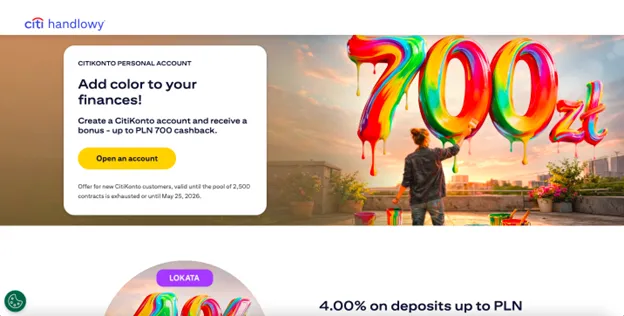
The Citi Handlowy CitiKonto Account1 is best for frequent travellers, Polish expats and individuals seeking a low-cost account with multi-currency capabilities.
For example, if you link a CitiBank global wallet to your account, you won’t be charged a currency exchange fee if you hold an existing currency balance in 12 foreign currencies. These include EUR, USD, CHF, GBP, AUD, CAD, SEK, NOK, DKK, CZK, HUF or ZAR.
You can also earn 4% interest on deposits up to PLN 20,000 by opening a short-term “Twoja Lokata” deposit account alongside your CitiKonto Account. Additionally, the Super Savings Account offers 3.25% interest on balances up to PLN 20,000, and 0.6% on amounts above PLN 20,000. The account is free when your salary deposits total at least PLN 2,000 monthly.
The CitiKonto Account and card are both completely free to open and maintain. Withdrawals from Citi Handlowy ATMs are also free of charge, but you only get four free monthly withdrawals from other ATMs. Domestic transfers within Poland cost nothing, and you can add your card to Google Pay, Apple Pay or BLIK for contactless or code-based payments.
Read more: 10 best multi-currency accounts the UK [2026 list]
2. PKO Bank Polski’s Currency Account
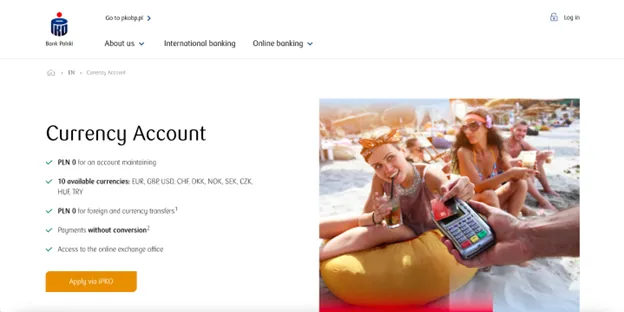
PKO Bank Polski’s Currency Account2 is great for expats receiving foreign income and travellers or non-residents managing frequent local and international payments. Bank Polski is also well geared to support entrepreneurs and startups, since they’ve run a leading startup support program named Let’s Fintech since 2015.2a
Once you open an account, you can create a debit card and link it to your PLN account. You can also link this same card to 10 other currency accounts, including EUR, GBP, USD, CHF, DKK, NOK, SEK, CZK, HUF and TRY. PKO’s exchange rates are updated daily on their website.2b
In a given month, your first withdrawal in-branch is free, though you’ll pay 0.5% on each subsequent withdrawal for that same month, with a minimum charge of 10 PLN. You’ll also pay 0.5% for branch deposits made in bank notes (again, the minimum charge is 10 PLN), and 50% for branch deposits made in coins within any given month.
Read more: Overseas business bank accounts: 4 options compared
3. Bank Millenium’s 360 Account
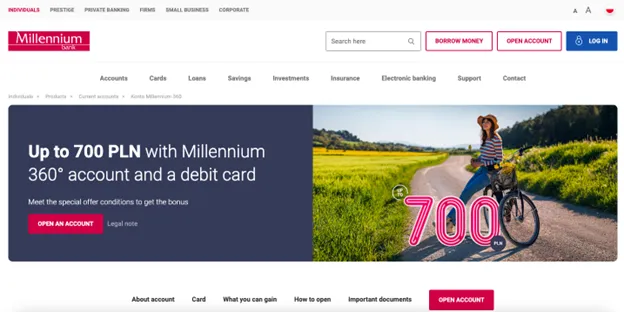
Bank Millennium’s 360 Account3 is best for individual users that need free ATM withdrawals worldwide and the ability to hold major currencies alongside your Polish Zloty balance.
Non-residents can open separate foreign currency accounts (Konto Walutowe) to hold balances in EUR, USD, GBP and CHF. Convert currency in the Bank Millennium app to top up these balances, and have your funds be instantly transferred into your currency accounts.
With Bank Millennium, non-residents can pay up to 5,000 PLN/month with a debit card, as well as withdraw cash from ATMs in Poland without paying any FX margin set by the bank. Once you exceed this limit, the bank’s additional margin will be 2%.
While the bank allows you to make free cash withdrawals from all ATMs in Poland, you must make at least five card/BLIK payments per month to receive this benefit. However, only one payment is required if you’re between the ages of 18 and 26.
Bank Millennium also allows you to earn up to 25% cashback on selected spending, though this is limited to specific vendors such as Allegro, Empik and RTV Euro AGD.
Read more: Best euro business account UK: 4 options compared
Open a World Account with WorldFirst to start holding PLN like a local
In this article, we’ve outlined a step-by-step process for how non-residents can open a Polish bank account from overseas.
We’ve also explained why opening a World Account with WorldFirst is the easiest way to hold PLN like a local business. For example, with WorldFirst you can:
- Hold multi-currency balances in PLN, EUR, GBP and 20+ other currencies for free
- Lock in currency exchange rates for up to 24 months with our forward contracts
- Pay zero account fees and benefit from low and transparent foreign exchange rates
- Create up to 50 virtual cards to better manage your spending
Ready to get started with WorldFirst? Sign up for a World Account today and start sending, holding and receiving PLN.
Sources:
- https://www.citibank.pl/konta-osobiste/citikonto-lp/?prid=kontaosobiste
- https://www.pkobp.pl/en/currency-account
- https://www.pkobp.pl/oplaty-i-oprocentowanie
- https://fintech.pkobp.pl/eng
- https://www.bankmillennium.pl/en/individuals/current-accounts/konto-millennium-360