



























For years, opening a British business account was off limits without a local presence. Banks demanded a UK address, in-person checks and regional directors, which made securing a GBP account from abroad nearly impossible.
That has changed. Digital banking now gives international companies access to multi-currency accounts with UK bank details, letting them send, receive and hold GBP as if they were based locally.
So, can a non-UK resident open a bank account? The answer is yes, but not through traditional banks.
This article explores how to open a UK account as a non-UK resident, the benefits these modern solutions bring and how they compare with the limitations of conventional banking.
Key takeaways:
- Traditional banks are restrictive for non-residents: UK high-street banks typically demand proof of a UK address, in-person checks and sometimes local directors.
- Multi-currency accounts remove residency barriers: Modern providers issue local GBP account details without requiring a UK address
- Common hurdles can be worked around: High minimum balances, director residency rules and forced currency conversions still trip up non-residents. Choosing platforms that allow global directors, offer no minimum deposits and let you control FX timing solves these pain points
- Preparation speeds up approval: Having documents ready, such as a valid passport, proof of your home-country address and company registration details, reduces friction and helps you get verified quickly
- WorldFirst offers the most practical solution: With the World Account, you can open a UK-ready GBP account online, collect from 130+ marketplaces, pay suppliers in 100+ currencies, and manage cash flow across 20+ currency accounts
- Digital-first solutions are now the default for non-residents: Opening a UK account no longer requires a local presence, as modern fintech platforms provide faster onboarding, remote verification, and full access to GBP accounts from abroad.
Opening a UK bank account as a non-resident
Traditional banks in the UK primarily serve residents and typically require two key documents: proof of identity and proof of address.
For non-residents, the address requirement is the sticking point when trying to open a UK account for non-residents through traditional banks. Banks usually require recent utility bills, tax letters, or financial statements associated with a UK address. Their flexibility with overseas applicants is limited.
Business accounts, however, are a different story. Non-resident entrepreneurs often have more options than individuals seeking personal current accounts.
Specialist providers and multi-currency business accounts enable the receipt of local GBP payments and payments to UK suppliers, all without the need to register a UK branch or provide local address documentation.
Common challenges for non-UK account holders (and how to work around them)
Opening a UK account as a non-resident is possible, but it comes with obstacles. Here are the most common ones and how to solve them:
1. Proof of address
High-street banks still require recent UK utility bills, council tax letters, or bank statements. Non-residents rarely have these documents, and even returning expats report friction until they rebuild a local paper trail.
Solution:
Start with a digital multi-currency account that issues UK bank details without demanding a UK address. This approach allows you to trade immediately and retain the option to add a traditional account later.
2. High minimums and relationship thresholds
Expat and international banking arms often expect deposits or income of £50,000–£75,000 to qualify. For many businesses, that’s working capital better spent on operations.
Solution:
Use providers that don’t impose minimum balance requirements. Multi-currency platforms like WorldFirst let you receive GBP payments locally with no receiving fees and no lock-up of funds.
3. Residency or director restrictions
Some banks, including popular digital challengers, require UK-based directors or a UK correspondence address before issuing a debit card.
Solution:
Choose services that explicitly accept non-UK directors and overseas beneficial owners. Specialist cross-border platforms are built for this purpose and won’t tie eligibility to local residency.
4. Hidden FX costs and forced conversions
Receiving GBP but being forced into automatic conversion at poor exchange rates can quietly eat into your margins. Over time, these hidden costs add up significantly.
Solution:
Use a multi-currency account that lets you hold sterling alongside other currencies. By deciding when to convert, you can time exchanges for better rates and pay UK suppliers directly in GBP without unnecessary losses.
What documents do non-residents usually need?
Paperwork can vary widely between traditional banks and modern fintech providers.
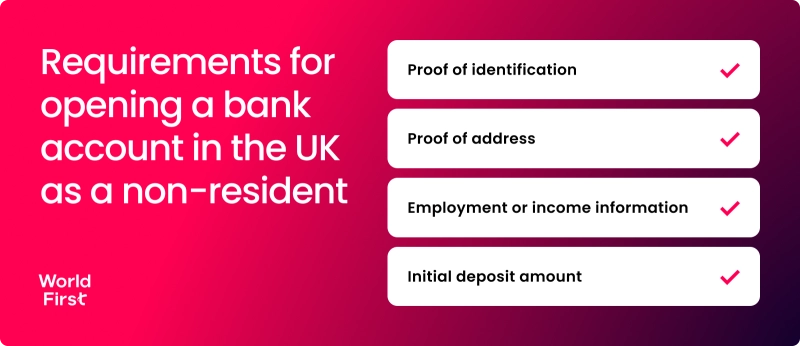
Preparing the proper documents in advance saves time and reduces the chance of rejection:
Essential documents:
1. Proof of identity
A valid passport is the most commonly accepted document. In some cases, an EU/EEA national ID card or a driving licence may also work.
2. Proof of address
High-street banks usually require a UK-based proof, such as a recent utility bill, council tax statement, tenancy agreement or a UK bank/credit card statement. Fintechs and international banking platforms are generally more flexible, often accepting documents from your home country, such as utility bills or bank statements.
3. Company and business documents
You will need to provide the company’s certificate of incorporation or official registration documents. Banks also require details of the directors and ultimate beneficial owners (UBOs).
Additionally, proof of trading activity is often required, which may include contracts, invoices, or recent financial statements.
4. Immigration or residency status (if you live in the UK)
Banks may ask for evidence such as a valid visa, Biometric Residence Permit (BRP) or residence permit.
Best account options for non-UK residents
Here are four of the most practical routes non-UK residents use to get a UK business-banking or multi-currency solution:
1. Open a multi-currency business account
For most non-UK residents, the most practical way to access the UK market is by opening a multi-currency business account.
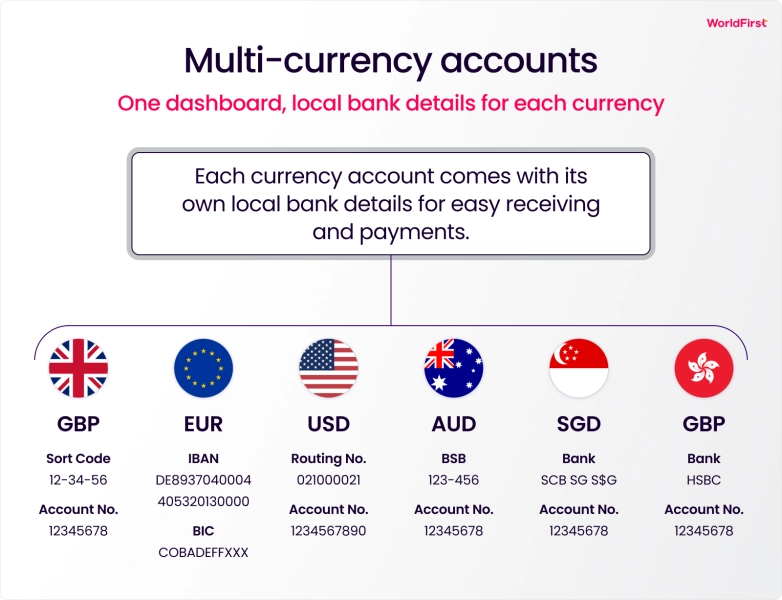
These accounts serve international companies that sell, buy or operate across borders. Instead of dealing with constant conversions or being blocked by proof-of-address rules, you get local account details in multiple currencies, including GBP, so you trade as if you are in the UK.
Why multi-currency accounts work for non-residents:
- No UK address required: Providers issue local bank details (sort code and account number for GBP, IBANs for EUR, etc.) without demanding a British utility bill or tenancy agreement
- Hold and manage funds in multiple currencies: You decide when to convert, protecting margins from poor FX timing
- Lower transfer costs: Payments often move via local banking “rails,” which are faster and cheaper than international wires
- E-commerce ready: Accounts integrate with platforms like Amazon, Etsy, Shopify and TikTok Shop, enabling sellers to collect sales revenue directly in GBP or other currencies
Notable example: WorldFirst World Account
WorldFirst is one of the best-known providers in this space. Its World Account lets businesses collect in 20+ currencies and make payments to 200+ markets in 90+ currencies. Collections in supported currencies are free and FX tools help you choose when to convert for better rates.
Case study: KeaBabies
KeaBabies, a Singapore-based e-commerce brand, used WorldFirst to expand into the UK, Europe and the US. They needed a way to receive payments from Amazon UK and pay Chinese suppliers without incurring significant FX fees.
By using WorldFirst’s World Account, they obtained local account details in GBP, USD and EUR, which allowed them to:
- Sell on Amazon UK and get paid in GBP without forced conversions
- Pay Chinese manufacturers via local rails, saving time and fees
- Manage all cash flow in one place across multiple markets
During this expansion, they even earned $1,800 in one week through cashback on the World Card, a perk that offset costs and improved margins.
Steps to open a WorldFirst GBP business account (non-resident)
Here are the step-by-step instructions to open a WorldFirst GBP business account as a non-resident:
- Register online: Visit WorldFirst’s registration portal and sign up for a World Account. You’ll provide your company name, registration number (or business ID), industry and business address (your home-country address is fine). Also, enter the names and addresses of directors or company owners
- Submit documents: Upload the required documents, including a photo ID (passport or national ID) for each director/owner, proof of address for each (e.g., a utility bill) and your company registration certificate. If someone owns 25% or more of the company, the company must disclose their details
- Verification: WorldFirst reviews the application and verifies most applicants within 24–48 hours. You’ll receive an email when your World Account is approved
- Activate GBP account: Once approved, log in to your World Account and create a new currency account in GBP. The platform will instantly provide you with a UK sort code and account number for that GBP account
- Start transacting: Use your new GBP account details for business. You can now receive GBP from UK clients or marketplaces and make GBP payments from your World Account
2. Open an account with a UK high-street bank
Traditional UK banks such as HSBC, Barclays, Lloyds and NatWest remain a trusted route, but they are also the most demanding for non-residents.
These banks typically expect:
- Proof of UK address (utility bill, council tax statement, tenancy agreement or a recent UK bank statement).
- Proof of identity (passport, national ID or driving licence).
- In-person verification may be required, which can mean a branch appointment.
For business accounts, many banks also want a UK-registered entity and, in some cases, at least one UK-based director. Without those documents, banks usually decline applications.
Best suited for:
Those who already have a UK footprint. For example, returning expats, companies with local directors or entrepreneurs planning to establish a permanent presence in Britain.
Drawbacks:
Onboarding can be slow (weeks or months) and requirements vary between banks and even branches. If you don’t have UK address documents, expect significant friction.
3. International and expat banks
A third route is to open an account with an international or expat banking arm. These institutions typically operate from offshore centres such as Jersey, Guernsey or the Isle of Man. These banks serve globally mobile clients who want a single relationship that spans multiple countries.
Strengths:
These banks offer premium services, multi-currency facilities and the credibility of a well-established financial institution. They can be useful if you want to consolidate wealth across regions or need access to specialist international products.
Limitations:
Entry requirements are steep. Expect high minimum balances, income thresholds or proof of international status before you qualify. While attractive for high-net-worth individuals or large corporations, they are rarely cost-effective for SMEs or startups that want to collect GBP and pay suppliers efficiently.
Best suited for:
Expatriates, globally mobile professionals or businesses seeking a premium banking relationship rather than a lean, transactional solution.
4. Challenger banks
Challenger banks are newer, digital-first institutions that position themselves as alternatives to the established high-street players. They are popular for their quick onboarding, transparent fee structures and user-friendly platforms.
For non-residents, however, the benefits often come with caveats. Most challenger banks still tie eligibility to UK residency or UK company registration, which can create immediate roadblocks. These conditions make it difficult for overseas companies to qualify unless they already have a formal presence in Britain.
Strengths:
Challenger banks usually provide faster account setup, low or no monthly fees and modern tools for managing payments, invoicing and multi-currency transactions. They often integrate seamlessly with digital marketplaces and business platforms, which makes them appealing to online sellers and globally active SMEs.
Limitations:
Despite their flexibility, most challenger banks are not truly global. Their account eligibility rules remain tied to UK residency or incorporation, which excludes many non-residents. Even when accessible, their services may lack the depth of international banks or the tailored FX solutions that specialist providers offer.
WorldFirst’s World Account: Why non-UK businesses choose WorldFirst over traditional banks
The assumption that non-UK residents can’t open a bank account no longer holds. Yes, it’s technically possible to navigate high-street banks, but the process is slow, document-heavy and often discouraging. The smarter move for most businesses today is to bypass those hurdles entirely.
WorldFirst’s World Account is one of the most straightforward ways to achieve this. As an FCA-authorised e-money institution, it provides you with local GBP account details, a UK sort code and account number that work just like a domestic bank account. That means UK clients, marketplaces and suppliers can pay you in pounds via Faster Payments, with no SWIFT delays or hidden charges.
The benefits of World Account:
- Hold and manage 20+ currencies in one account, including USD, EUR, JPY, AUD and CNH
- Collect sales revenue directly from 130+ global marketplaces and platforms like Amazon, Shopify, TikTok Shop and AliExpress
- Send payments in 100+ currencies to over 200 countries, often through local rails that cut costs and speed up settlement
- Use FX tools like forward contracts and target-rate orders to protect your margins against rate swings
- Issue up to 20 virtual debit cards, spend in 15 currencies with 0% FX fees and even earn cashback on purchases
- Manage everything through a single dashboard with team permissions and integrations for accounting systems like Xero or NetSuite
There are no set-up or monthly fees; you only pay when you convert or send money. That makes the World Account not just an alternative to a UK bank account, but often a faster, cheaper and more flexible option for international businesses.
If your priority is to trade like a local in the UK without moving there, this is the direct route.
Get started with WorldFirst today and open your UK-ready account in minutes.
FAQ
How to open a UK bank account for a non-resident?
Opening a UK bank account as a non-resident is possible, but it depends on the provider. Traditional banks usually require proof of a UK address, which makes the process difficult without residency. However, many digital banks and fintech platforms allow non-residents to open an account remotely by verifying identity through a passport, video verification, and proof of business activity if applicable. To get started, choose a provider that supports international users, complete the online application, submit your documents, and wait for approval. Some accounts may have limitations compared to full UK resident accounts.
Can a non-UK resident open a bank account?
Yes, a non-UK resident can open a UK bank account, but options are more limited than for residents. Most high street banks require a UK address, while digital banks and international financial platforms offer more flexible onboarding for non-residents. Approval typically depends on identity verification, intended use of the account, and compliance checks. Many non-residents choose fintech solutions as they provide faster setup, fewer location restrictions, and support for international transactions.