



























A repeat overseas order can cost more in GBP by the time the balance is due. If sterling weakens after you pay the deposit, settling the unchanged supplier invoice can reduce the order’s margin.
Bibby Financial Services’ 2026 survey of more than 500 UK importers and exporters found that currency volatility had negatively affected 44% of respondents in the previous 12 months. For established importers, the finding shows why FX decisions should form part of the order process.
The guide explains how to mitigate foreign exchange risk by tracking upcoming supplier costs, setting a budget rate and matching each payment to an FX method based on its timing and certainty.
Key takeaways:
- Track exposure from the purchase order stage: Record each foreign-currency cost and payment deadline as soon as you commit to an order
- Set a budget rate and margin limit: Use a consistent exchange-rate assumption to calculate the expected GBP cost and define when action is required
- Match the FX method to payment certainty: Use spot transfers for immediate costs and consider forward contracts for confirmed future payments
- Cover only the genuine shortfall: Subtract matching currency income and available balances before deciding how much currency to secure
- Manage FX and supplier payments together: A World Account can support currency balances, spot transfers and eligible forward contracts within the same payment process
Open a World Account to manage supplier currencies, spot transfers and eligible forward contracts.
What is foreign exchange risk?
Foreign exchange risk appears when exchange-rate movements change the GBP value of money your business expects to pay or receive in another currency. Your business remains exposed until it buys the required currency, offsets the amount with matching income or secures a rate in advance.
Importers can face three main types of FX risk:
1. Transaction risk
Transaction risk applies to specific amounts due in another currency.
It can affect supplier balances, freight charges, inspection fees and other overseas costs that your business has agreed but hasn’t yet paid.
2. Economic risk
Economic risk develops over a longer period.
Ongoing currency movements can change sourcing costs, pricing decisions and competitiveness, especially when your business depends on one market or currency.
3. Translation risk
Translation risk concerns the GBP value of foreign assets, liabilities or overseas entities in your financial statements. It matters most when a business holds substantial foreign balances or operates through companies in other countries.
For most established small importers, transaction risk needs the closest attention because it connects open supplier costs to future cash requirements.
Where foreign exchange exposure begins in an import order
A supplier quote shows the possible currency cost, but your business becomes exposed when you accept the price or issue a purchase order.
From that point, each instalment and overseas charge can carry its own amount, currency and due date, so the final supplier balance may show only part of what remains at risk.
| Order stage or cash flow | What it means for your exposure | What to record |
| Supplier quotation | The quote provides the currency cost used for early pricing and margin estimates, but may not yet represent a firm commitment | Quote currency, validity period and budget rate |
| Purchase order | Accepting the quote or issuing the order creates a committed foreign-currency cost | Agreed amount, payment terms and expected dates |
| Deposit | The payment fixes the GBP cost of the first instalment, while later amounts remain open | Amount paid, rate achieved and remaining balance |
| Production balance | A milestone payment or final balance may remain outstanding for weeks or months and fall due on a different date | Currency amount, production milestone and due date |
| Freight and inspection fees | Shipping, quality checks and agent charges can add separate costs in another currency | Provider, amount, currency and payment date |
| Final settlement | Paying the supplier closes its invoice, although freight or other order costs may still be due | Supplier amount paid, unpaid charges and GBP cost to date |
| Foreign-currency income | Receipts in the same currency can offset part of the cost when they arrive before the payment deadline | Expected amount, arrival date and available balance |
Your net currency exposure is the foreign-currency cost left after subtracting matching income available by the payment date and funds already held in that currency.
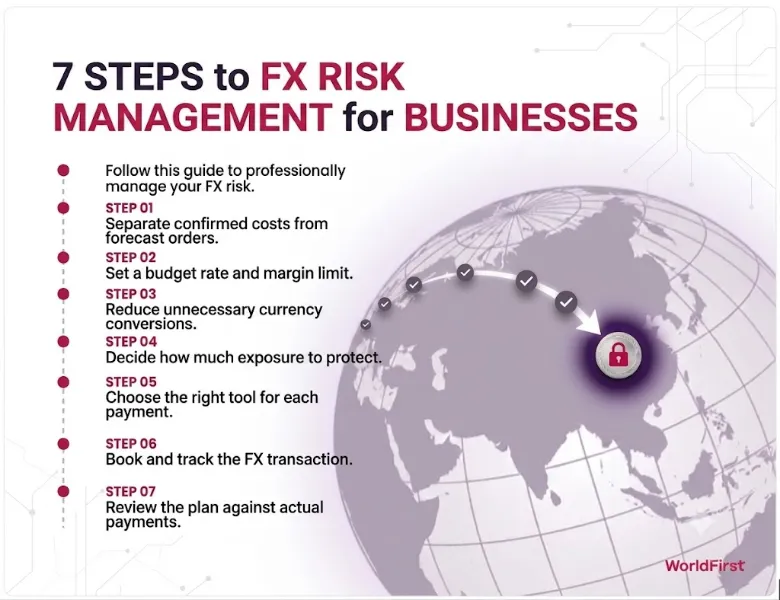
How to mitigate foreign exchange risk in 7 steps
An FX risk management plan should connect every currency decision to a confirmed cost, payment date and margin limit.
1. Separate confirmed costs from forecast orders
Group upcoming costs by how certain they are. A fixed invoice makes it easier to decide how much to cover and which FX method to use.
| Exposure type | Examples | How to treat it |
| Confirmed costs | Signed purchase orders, fixed invoices, required deposits and booked freight | Record the amount and due date, then decide how much certainty the payment needs |
| Forecast costs | Expected repeat orders, estimated service fees and purchases linked to future demand | Keep the plan flexible until the amount and timing become clearer |
Move an item into confirmed exposure when you approve the order or receive the final charge.
2. Measure FX exposure with a budget rate and cost threshold
A budget rate is the exchange rate used to estimate the GBP cost of an order. It doesn’t reduce FX exposure, but it gives purchasing and finance teams a consistent basis for pricing, margin checks and deciding when action is needed.
For each order:
- Record the supplier’s foreign-currency price
- Apply the budget rate
- Add freight, duty and other landed costs
- Set the minimum margin the order must achieve
- Calculate the maximum landed cost that still achieves that margin
The maximum landed cost becomes your cost threshold. If exchange-rate movements push the expected GBP cost above it, review the selling price, supplier terms or amount of confirmed exposure to cover.
Review the budget rate when exchange rates move materially, budgets are updated or planning assumptions change. Update the landed-cost calculation when the supplier price, freight cost, duty or order quantity changes.
3. Reduce unnecessary currency conversions
Check available currency balances before arranging another conversion.
Matching currency income with supplier costs can reduce the amount your business needs to convert.
With a World Account, you can receive and hold eligible currencies, pay suppliers from an available balance and convert only the remaining shortfall.
Holding another currency doesn’t remove FX risk because its GBP value can still move. Keep a balance when you have a defined business use for it.
4. Decide how much exposure to protect
Protecting exposure means hedging some or all of a future foreign-currency cost. Hedging can involve securing a rate in advance or offsetting the payment with matching currency income. It doesn’t stop exchange rates from moving, but it can reduce uncertainty around the GBP cost of the covered amount.
Choose the amount based on the certainty of the payment, the margin at risk and the flexibility your business needs.
- Covering the full amount: Secure a rate for the entire confirmed requirement when the order can’t absorb an adverse movement
- Partial cover: Secure enough of the currency requirement to keep the planned GBP cost within your margin limit
- Layered cover: Add protection as quantities, charges and dates become firm
A 2025 MillTech survey reported by Reuters found that the mean hedge ratio among more than 250 surveyed UK CFOs and treasurers reached 53%, up from 45% in 2024. The average shows that the surveyed group protected part of its overall exposure, but 53% isn’t a recommended target for a small importer.
Base your decision on:
- Order certainty: A fixed invoice carries less mismatch risk than an estimate
- Margin tolerance: Lower margins leave less room for a higher GBP cost
- Pricing flexibility: Fixed customer prices reduce your options
- Available cash: Confirm that you can meet the contract’s funding requirements
- Payment schedule: Deposits and balances may need separate decisions
Avoid covering more currency than you expect to use. A changed order can leave a contract that no longer matches the payment.
5. Choose the right tool for each payment
Match the method to the timing and certainty of the underlying cost.
| Payment situation | Approach to consider | Main point to check |
| Immediate payment | Spot transfer | You fix the rate when you book |
| Confirmed future payment | Forward contract | The agreement is binding |
| Matching foreign-currency income and cost | Natural hedging | The amount and timing must align |
| Target rate with flexible timing | Firm order | The market may not reach the target |
| Uncertain future order | Wait or cover only the confirmed part | The order may change |
A spot transfer converts currency at the current available rate for an immediate payment. Natural hedging applies when matching currency income becomes available before the supplier payment is due.
A forward contract fixes a rate for an eligible future business payment. Most WorldFirst forwards require a deposit of 5–10%, depending on the currency and contract length, although some customers may qualify for a margin waiver. A significant adverse movement may lead to a margin call, and you won’t benefit from a better rate on the contracted amount.
A firm order instructs WorldFirst to convert currency when the market reaches your target rate. It can remain active for up to one month but may expire without execution, so set a fallback date for payments with fixed deadlines.
Read more: What is hedge accounting?
6. Book and track the FX transaction
Connect each FX transaction to the supplier payment it covers. That link shows how much exposure remains and reduces the risk of duplicate bookings.
The steps depend on whether you’re making an immediate payment, booking currency for a future date or connecting an existing forward contract to a supplier payment.
Make a spot conversion and supplier payment:
- Go to Payments > Send & withdraw
- Select or add the supplier
- Choose the currencies and enter the amount
- Select Pay as soon as possible
- Review and confirm the payment
WorldFirst books the conversion and payout in the same flow.
Book an eligible forward contract
If you’re using WorldFirst forward contracts for the first time, contact the WorldFirst team before booking. Eligible existing customers can book online or through the team.
To book online:
- Open Foreign Exchange or Payments > Book FX trade
- Choose the currencies and enter the amount
- Select the settlement date
- Review the rate, deposit and terms
- Confirm the trade
Connect the forward to a payment
Open Foreign Exchange > FX trades, select the contract and choose Add payment. Add the supplier, amount and payment date, then review and confirm the instruction.
You can also settle the purchased currency into your World Account for a later payment.
7. Review the plan against actual payments
Use an FX international payments tracking process to compare each completed order with the figures used at approval:
| What to compare | What it shows |
| Budget rate and achieved rate | Difference between the budgeted and final GBP cost |
| Forecast and final invoice | Changes in the invoice amount or payment date |
| Amount covered and amount paid | Excess cover or an uncovered amount |
| Open forwards and due dates | Funding needed to complete each contract |
| Currency balances and future costs | Currency available for future payments |
| GBP debit and supplier receipt | FX margins, fees and intermediary deductions |
Purchasing should confirm order values and dates, finance should maintain the exposure record, and authorised users should approve FX transactions and payments.
Don’t judge a forward only against the later spot rate. If it kept the order within budget and gave the business a known GBP cost, it achieved its goal.
Repeated forecast differences, late funding or unused balances show what to adjust before the next buying cycle.
What should an FX risk policy include?
An FX risk policy sets the rules before an overseas payment requires a last-minute decision. Keep it focused on authority, limits and accountability.
| Policy area | What to define |
| Scope | Covered currencies, payment values and order types |
| Decision trigger | Trigger point for a quote, purchase order or invoice |
| Cover limits | Maximum confirmed and forecast exposure that authorised users may cover |
| Approvals | Authorised users for spot transfers, forwards and firm orders |
| Funding | Responsibility for checking deposits, settlement funds and possible margin calls |
| Records | Required location and details for each FX decision |
| Review | Review frequency and comparison with the original budget |
The policy should also explain how teams handle exceptions. A delayed shipment, reduced order or changed invoice may require a different response, so staff need a clear approval route.
Keep the document short enough for purchasing and finance teams to use while an order is active.
Read more:
Manage supplier payments and FX with WorldFirst
Suppose your UK business places a EUR 120,000 repeat order with a European supplier. A 30% deposit of EUR 36,000 is due now, with the remaining EUR 84,000 payable in four months. Your wholesale prices are already fixed in GBP, so a higher sterling cost would reduce the order’s margin.
The fragmented approach:
You convert GBP for the deposit and leave the final balance open until production ends. During that period, your business expects EUR 25,000 from European customers.
If your existing account automatically converts those receipts into GBP, you’ll need to buy EUR again when the supplier balance falls due. That adds two conversions the business may not need. Your team may also need to track customer receipts, exchange rates and supplier instalments across separate accounts or spreadsheets.
The WorldFirst approach:
WorldFirst’s World Account is a multi-currency business account that lets companies receive payments in 20+ currencies, hold eligible currency balances and make supplier payments to 200+ countries in 100+ currencies.
You can use a spot transfer for the EUR 36,000 deposit and hold the EUR 25,000 customer receipts when they arrive. If the funds reach your account before the supplier deadline, they reduce the remaining currency requirement to EUR 59,000.
Once the expected receipts and the final supplier balance are sufficiently certain, you could consider an eligible forward contract for the remaining requirement. The agreed rate would give you a known GBP cost for the covered amount before payment falls due. You can also connect the FX transaction to the supplier payment and track its status alongside your currency balances.
WorldFirst doesn’t stop exchange rates from moving or guarantee a better rate.
WorldFirst isn’t a bank. World First UK Limited is authorised by the Financial Conduct Authority as an Electronic Money Institution under the Electronic Money Regulations 2011, with Firm Reference Number 900508. Customer funds are safeguarded in line with regulatory requirements.
Open a World Account to manage supplier currencies, spot transfers and eligible forward contracts from one platform.
FAQs
1. Is it cheaper to pay an overseas supplier in GBP or in their local currency?
Neither option is guaranteed to be cheaper, so compare the total GBP cost of both quotes. A GBP quote may include the supplier’s FX margin, while paying in local currency lets your business control the conversion.
2. Can paying an overseas supplier early reduce FX risk?
Yes, because it closes the foreign-currency exposure sooner. Compare any early-payment discount with the FX cost and the effect on cash flow before paying ahead of schedule.
3. Can one forward contract cover several supplier instalments?
Yes, a flexible forward can cover several payments up to the total amount booked. You can draw down part of the contract for a deposit, production payment or final balance while keeping the remaining amount available for later instalments.
4. What happens to a forward contract if my supplier delays or cancels the order?
The forward contract usually remains binding, so contact the provider as soon as the order changes. Depending on the contract and market movement, you may need to amend, extend, close or use the purchased currency for another eligible business payment.
5. How can I compare the true FX cost of banks and international payment providers?
When comparing currency exchange services for international businesses, compare the total GBP amount needed for the supplier to receive the same foreign-currency payment. Include the exchange-rate margin, transfer fee and any intermediary deductions rather than comparing headline fees alone.
Sources:
- https://www.bibbyfinancialservices.com/assets/documents/bltcaabb0e00358b2d2/bltd589063bacfff623/trading-places-2026.pdf
- https://www.reuters.com/world/uk/many-uk-firms-say-volatile-pound-triggered-losses-2025-need-hedge-grows-2025-12-11/