





























An exchange rate is the value of one currency expressed in another, while the exchange rate formula shows how much you’ll receive or need to pay when converting between them.
The Straits Times reported that the Singapore dollar gained about 6% against the US dollar in the 12 months to 26 January 2026. If you regularly pay suppliers in USD, a movement of that size changes the amount of SGD needed for the same invoice. Reading the currency pair in the wrong direction can throw off the result further.
In this article, you’ll learn how to use the exchange rate formula to work out the SGD cost of an overseas supplier payment.
Key takeaways:
- The currency-pair order determines the formula: Multiply when your starting amount is in the base currency and divide when it is in the quote currency
- Full precision produces a more accurate result: Early rounding can change the SGD amount required, especially on higher-value supplier payments
- A quoted rate doesn’t show the full payment outcome: Check the FX margin, separate payment charges, final SGD debit and amount received by the supplier
- Comparable rates need the same basis: Use the same currency-pair direction and rates captured at the same time so the comparison isn’t distorted
- Multi-currency balances can reduce repeat conversions: The World Account shows the quoted rate, payment charge and total SGD amount before you approve an overseas supplier payment
Open a World Account to consolidate SGD conversion and overseas supplier payments into a single account.
What is the exchange rate formula?
The exchange rate formula converts an amount in one currency into its equivalent value in another using the quoted rate.
The calculation depends on which currency amount is already known:
- Base currency amount × exchange rate = quote currency amount
- Quote currency amount ÷ exchange rate = base currency amount
For example, at a USD/SGD rate of 1.35, US$10,000 is worth:
US$10,000 × 1.35 = SG$13,500
How to read a currency pair
A currency pair presents an exchange rate as two three-letter currency codes, such as USD/SGD.
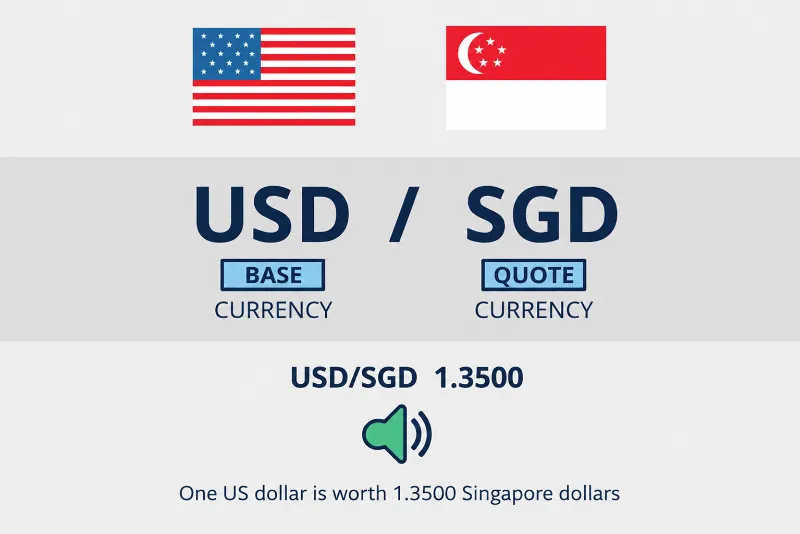
Each position determines how the quoted rate should be read:
Base currency
The base currency appears first, and the rate shows the value of one unit in the quote currency.
In USD/SGD, USD is the base currency.
Quote currency
The quote currency appears second and shows how much of that currency equals one unit of the base currency.
In USD/SGD, SGD is the quote currency. A rate of 1.35 means US$1 equals SG$1.35.
Why the order matters
Reversing a currency pair changes both its meaning and numerical rate. USD/SGD shows the SGD value of one US dollar, while SGD/USD shows the USD value of one Singapore dollar.
When should you multiply or divide an exchange rate?
The correct operation depends on whether the currency you’re starting with appears first or second in the pair.
Follow these three rules when applying a quoted rate:
1. Multiply when starting with the base currency
When your starting amount is in the first currency, multiply it by the quoted rate to find its equivalent in the second.
At a hypothetical USD/SGD rate of 1.3462, funding a US$50,000 supplier invoice requires:
US$50,000 × 1.3462 = SG$67,310
2. Divide when starting with the quote currency
When your starting amount is in the second currency, divide it by the exchange rate to find its equivalent in the first currency.
If you have SG$67,310 available, the same rate shows how many US dollars it can cover:
SG$67,310 ÷ 1.3462 = US$50,000
3. Round only after completing the calculation
Exchange rates often extend to several decimal places. Use the full quoted rate for the calculation, then round the final currency amount.
How to calculate a reverse exchange rate
Divide 1 by the original rate to express a currency pair in the opposite direction:
Reverse exchange rate = 1 ÷ original exchange rate
Using USD/SGD at 1.35:
1 ÷ 1.35 = 0.74074
The reversed pair is therefore:
SGD/USD = 0.74074
The reversed rate means SG$1 equals approximately US$0.74074.
A reverse rate allows you to compare quotes or accounting records that present the same currencies in different directions.
Read more: Five best money changers in Singapore
How to calculate the effective exchange rate
The effective exchange rate is the rate implied by the amounts in a completed currency conversion.
To express the result as USD/SGD, divide the SGD amount paid by the USD amount received:
SGD amount paid ÷ USD amount received = effective USD/SGD rate
For example, suppose a conversion debits SG$67,750 and produces US$50,000:
SG$67,750 ÷ US$50,000 = 1.355
The effective rate is therefore:
USD/SGD = 1.355
You can compare this figure with the original USD/SGD quote, provided both rates use the same currency-pair direction.
Read more: Eight best payment gateway providers in Singapore
What the exchange rate formula doesn’t include
The exchange rate formula calculates the converted amount, but it doesn’t show every cost that may affect a supplier payment.
The quoted conversion amount is only one part of the payment outcome.
1. FX margin within the quoted rate
A public reference rate may differ from the transaction rate offered by a payment provider.
The difference may include an FX margin built into the quoted rate rather than shown as a separate fee. Applying the formula gives the correct amount for that quote, but it doesn’t reveal the size of the margin.
A valid comparison uses a reference rate captured at the same time as the provider’s quote.
2. Separate payment charges
A supplier payment may carry charges outside the quoted rate, including a transfer fee, intermediary bank charge or receiving bank deduction.
These costs relate to the payment route rather than the currency calculation. Their amount and treatment depend on the provider, destination and receiving bank.
The quoted rate therefore can’t show the total payment cost on its own.
Read more: Cross-border payment fees in Singapore
3. Final debit and supplier receipt
The final SGD debit shows the amount taken from your account for the conversion. Separate fees may appear as additional entries.
The supplier receipt records the amount credited to the beneficiary account. A charge added to your debit increases the total cost, while a deduction in transit reduces the amount received.
Together, those records show the amount paid and the amount the supplier received.
How to calculate the percentage difference from a reference rate
The percentage difference shows how much a transaction rate differs from a reference rate captured at the same time.
Compare both rates in the same currency-pair direction:
Percentage difference from reference rate = (transaction rate − reference rate) ÷ reference rate × 100
Suppose the reference USD/SGD rate is 1.3480 and the transaction rate is 1.3540:
(1.3540 − 1.3480) ÷ 1.3480 × 100 = 0.45%
The transaction rate is approximately 0.45% higher than the reference rate. For USD/SGD, a higher rate means more SGD is required for each US dollar.
On a US$40,000 conversion, the reference rate produces SG$53,920, while the transaction rate produces SG$54,160. The SG$240 difference comes from the rates alone.
How to calculate the total SGD debit for a supplier payment
To calculate the total SGD debit, add any separately charged payment fee to the converted invoice amount:
Total SGD debit = converted invoice amount + separately charged payment fees
Suppose you need to pay a US$35,000 supplier invoice at a hypothetical USD/SGD rate of 1.3520:
US$35,000 × 1.3520 = SG$47,320
If the payment provider charges a separate SG$15 transfer fee:
SG$47,320 + SG$15 = SG$47,335
Your total account debit is SG$47,335.
Why an exchange rate quote can change before confirmation
A rate viewed before confirmation may differ from the rate applied when you confirm the conversion.
Two factors can change the rate available at confirmation:
- Market movement: The available USD/SGD rate may update between viewing and confirming the conversion
- Quote validity: A provider may show an expiry time or countdown for the displayed rate. A new quote may appear when that period ends
According to The Straits Times, the Singapore dollar was 0.14% stronger against the US dollar by 11.50 am on 30 July 2025. The intraday move shows that USD/SGD can change within a single morning.
If you return to a supplier payment after the original quote expires, the provider may display a new rate for the conversion.
Before approving the conversion, check:
- Time remaining: When the displayed quote expires
- Confirmation summary: The quoted rate, payment charge and total SGD amount
Use the confirmation record when reconciling the payment. It shows the applied rate rather than an earlier rate viewed during planning.
Read more: Five traditional banks in Singapore
Common input mistakes when calculating an exchange rate
Even the correct exchange rate formula can produce an inaccurate payment calculation when the invoice amount, settlement currency or charges are entered incorrectly. Some of the most common mistakes include:
- Using an earlier invoice amount: Calculate from the final amount payable after confirmed discounts, credits, deposits and other adjustments
- Assuming the pricing and payment currencies match: Check the currency in the supplier’s final payment instructions before calculating the conversion
- Adding charges stated in different currencies: Convert each separate charge into SGD before adding it to the total SGD debit
- Relying on currency symbols alone: Confirm the three-letter currency code because symbols such as $ can refer to several currencies
- Applying a percentage charge to the wrong base amount: Confirm whether the percentage applies to the invoice amount, converted amount or another amount stated in the fee terms
Calculate and pay overseas suppliers with WorldFirst
Suppose your Singapore homeware business owes an overseas supplier a US$28,000 final balance before the goods can be released to your freight forwarder.
When rate checks, currency conversion and supplier payments happen in separate places, you have to track the quote, charges and invoice while working against the goods-release deadline.
At a hypothetical USD/SGD reference rate of 1.35, the invoice equals SG$37,800 before the FX margin. If one provider applied a 0.9% margin, the conversion would add SG$340.20. A 0.6% margin would add SG$226.80, a difference of SG$113.40.
The comparison is illustrative, not a guaranteed saving, and covers the FX margin only. Separate payment charges or bank deductions may still affect the total cost or supplier receipt.
WorldFirst lists currency conversion costs of up to 0.6% for major currencies. The World Account is a multi-currency account that lets you hold supported currencies, convert SGD and pay overseas suppliers in 100+ currencies.
An existing USD balance can also fund a USD supplier payment without another currency conversion. Keep the payment confirmation to match the completed payment with the supplier invoice, then confirm receipt before arranging the release of the goods.
WorldFirst isn’t a bank. It’s a regulated payments provider, and WorldFirst entities in Singapore hold MAS licences for services including account issuance, domestic and cross-border money transfers and e-money issuance.
Open a World Account to convert SGD and pay confirmed overseas supplier balances before the goods-release deadline.
FAQs
1. How do I calculate the exchange rate when I pay a supplier deposit and final balance on different dates?
Calculate the deposit and final balance separately using the rate applied to each payment. Add both SGD amounts to find the full invoice cost.
2. Should I pay an overseas supplier in SGD or the currency on the invoice?
Pay in the invoice currency unless the supplier has agreed to accept SGD. Sending another currency may leave part of the balance unpaid after conversion.
3. How do I compare supplier quotes issued in different currencies?
Put every quote into SGD using rates checked at the same time. Add freight, payment fees and other confirmed costs to each total.
4. How do I calculate landed cost when the goods, freight and other charges use different currencies?
Add the SGD value of every confirmed cost. Include the goods, freight, insurance, any applicable duties and other confirmed import charges.
Sources:
- https://www.straitstimes.com/business/companies-markets/singapore-dollar-hits-highest-against-us-dollar-in-over-11-years
- https://www.straitstimes.com/business/economy/mas-keeps-singapore-dollar-policy-unchanged-amid-us-tariff-risks-to-economy


![Revolut Business Card review Singapore [2027]: Features, fees & more](https://mdn.marmot-cloud.com/worldfirst/sites/9/2026/09/20261001002258848-300x200.webp)