




























If you send money overseas on a regular basis, then you’ve likely faced unpredictable costs due to exchange rate volatility.
Even small shifts in currency value can have big impacts on your bottom line. For instance, if you import goods from Malaysia, you face the risk that the ringgit will strengthen against the Singapore dollar. And if you’re making large orders, this can significantly eat into your margins.
That’s why it’s important to have strategies in place to manage foreign exchange risks. And in this guide, we’re here to help.
We share the most common foreign exchange risks to be aware of, as well as the best strategies for managing these risks as a Singapore business.
We also introduce you to WorldFirst’s World Account, a multi-currency account that helps you make payments to over 200+ countries at low and transparent rates.
With a World Account, you can manage currency risk by locking in rates for up to 24 months – or by holding balances in 20+ currencies and avoiding conversions altogether.
We cover:
- What are the main FX risks you should be aware of?
- Seven best FX risk management strategies for businesses and individuals
- How to manage foreign exchange risk with WorldFirst’s World Account
Ready to start reducing your foreign exchange risk on international payments? Sign up for a World Account today.
What are the main FX risks you should be aware of?
While it’s impossible to eliminate foreign exchange risk entirely, understanding the different types of exposure can help you manage them more effectively:
Transaction risk
Transaction risk arises from exchange rate movements between the time a transaction is agreed and when it is settled. It affects known, contracted cash flows.
For example, a Singapore-based company agrees to sell goods to a US customer for US$80,000, payable in 60 days. At the time of the agreement, this might be worth around SG$100,000. But if the US dollar weakens before payment is received, the company could end up with significantly fewer Singapore dollars than expected.
Because transaction risk directly impacts incoming or outgoing payments, it can affect cash flow and profit margins – especially for businesses making large or frequent cross-border transactions.
Economic risk
Economic risk (also known as operating or competitive risk) refers to the longer-term impact of exchange rate movements on a company’s market position and future earnings.
For instance, if the US dollar weakens over time, goods priced in Singapore dollars become more expensive for US buyers. Even if no specific transaction is affected, demand may fall as customers switch to cheaper alternatives from other countries.
Unlike transaction risk, economic risk is not tied to a specific contract. Instead, it influences pricing power, competitiveness and long-term revenue potential – making it particularly relevant for exporters and multinational businesses.
Translation risk
Translation risk (or accounting exposure) arises when financial results from foreign subsidiaries are converted into the parent company’s reporting currency.
For example, a Singaporean company with a Malaysian subsidiary records profits in Malaysian ringgit. If the ringgit weakens against the Singapore dollar, those profits will appear smaller when consolidated into the group’s financial statements – even if the subsidiary’s performance hasn’t changed in local terms.
While translation risk doesn’t directly impact cash flow, it can affect reported earnings, balance sheets, and investor perception.
Read more: FX international payments: How to affordably send money abroad
7 best FX risk management strategies for businesses and individuals
When making an international payment, you can use any of the following risk management strategies to reduce your exposure to transaction risk:
1. Hold multiple currencies with a multi-currency account
With a multi-currency account, you can store balances in various currencies (such as SGD, USD, JPY, etc.) in separate local currency accounts within the same account.
For example, you could receive a payment in MYR and hold those funds in your multi-currency account instead of auto-converting into SGD. Then, the next time you make a payment to a Malaysian payee, your payment will draw from your existing ringgit balance.
It allows you to store international funds easily, and it also makes transactions cheaper since you don’t need to convert between currencies you already hold. As a result, it can reduce the amount you pay in conversion fees, and it can reduce your exposure to FX fluctuations by limiting unnecessary conversions.
However, it won’t eliminate FX risk altogether, as the value of the currency you’re holding can still rise or fall against your home currency until you use or convert it.
Read more: Multi-currency account Singapore – 8 best options
2. Forward contracts
A forward contract is a type of currency hedging instrument (also called a derivative), which allows you to lock in an exchange rate today for a future transaction.
With a forward contract, you agree to convert a fixed amount of currency at a set FX rate on a future date, regardless of what the current conversion rate is.
For example, say you need to buy €3,000 worth of clothing stock from France in 30 days. You take out a forward contract today that locks in the exchange rate at 1.15 SGD to 1 EUR, with SG$3,450 buying you €3,000. No matter what happens to the exchange rate over the next 30 days, you’ll pay SG$3,450 when your clothing shipment arrives.
The biggest advantage of forward contracts is the cost certainty it gives you, since you can accurately plan ahead for future payments without worrying about currency fluctuations. Plus, forwards can also be customised to different currency amounts or end dates because they’re private contracts between two parties.
However, once the forward contract is created, you’re legally required to complete the trade. This means you might end up with a less favourable conversion rate than the prevailing spot rate on the settlement date, and it can leave you worse off than if you’d simply used the spot rate (current rate) instead. Depending on the provider, you may also need to put down a deposit or margin.
3. Firm orders
Firm orders are agreements to buy or sell a set amount of currency at a specified market price. Once the target rate is hit, the trade executes immediately.
Firm orders can help you target a preferred exchange rate without watching the market constantly, which may improve budgeting if your order is filled. However, they are better thought of as execution tools than full hedging instruments, because they don’t protect you if the market never reaches your target rate.
Firm orders are finalised once executed, which means they can’t be cancelled, changed or returned after execution. This rigidity can be a drawback if demand drops or supply chains shift, especially if you no longer need the currency when the order is triggered.
4. Currency options
A currency options contract gives you the ability to convert funds at a fixed exchange rate in the future. They can be used alongside other hedging tools (like forward contracts) to build a more flexible currency strategy rather than locking everything in at one rate.
Option contracts are some of the most flexible derivatives, since you can choose whether or not to exercise the option and there’s no penalty for not completing the trade. This allows you to protect yourself if the market moves against you, while still benefiting if the market moves in your favour.
It’s also possible to tailor option contracts to specific dates and amounts, which means you can set them up to match your expected invoices, payroll or other cash flows very closely.
On the downside, you’ll be asked to pay an ‘options premium’ in order to create a contract, which is non-refundable whether you use the contract or not. This can make options more expensive than straightforward forward contracts. Additionally, if the market never moves against you, the premium can feel like a “wasted” cost, since you paid for protection you didn’t end up needing.
5. Currency futures
Currency futures are standardised agreements where you agree to convert currency at a fixed exchange rate on a future date.
They’re publicly traded on an exchange, which means they’re highly liquid and allow for easy buying/selling. This also reduces counterparty risk, since the clearinghouse effectively becomes your trading partner.
Additionally, futures come with transparent, standardised terms regarding expiry dates, buying prices and conversion amounts. This differentiates them from forward contracts, which are private and customisable.
However, your account balance will be updated daily to reflect the price changes in the futures contract, and you may be required to deposit more funds if the position loses value. This can strain your cash flow during particularly volatile markets, even if your overall position later recovers.
Unfortunately, standardisation also limits flexibility since you’re stuck with fixed contract sizes, end dates and currency amounts.
Read more: What’s the cheapest international money transfer method?
6. Currency swaps
Currency swaps are contracts where two parties exchange payments in different currencies for a set period of time, which allows each party to effectively ‘borrow’ funds in a foreign currency.
For example, imagine a Singapore company needs to borrow AUD$10 million to fund operations in Australia, while an Australian company needs SG$9.1 million for a project in Singapore. If each company borrows in its own country, then they’ll receive loans with better domestic interest rates.
However, currency swaps involve counterparty risk and extensive legal work to cover events of default, close‑out and dispute resolution. They’re generally more relevant for larger corporations, financial institutions or long-term financing needs than for routine day-to-day payment risk.
7. Natural hedging
Natural hedging involves keeping your payables and receivables in the same currency where possible. This doesn’t mean operating in one currency across all foreign subsidiaries, but rather creating outflows (like loans or supplier payments) to match your foreign currency revenue in each location.
This reduces your FX exposure because it minimises the amount of currency you need to convert when transferring cash between locations. It also removes the need to calculate FX losses/gains on your balance sheet.
However, it can reduce operational flexibility, because you may choose suppliers, pricing structures or financing arrangements based partly on currency matching rather than purely on commercial terms.
Read more: What’s the best way to do an international money transfer?
How to manage foreign exchange risk with WorldFirst’s World Account
WorldFirst is a digital payments platform licensed by the Monetary Authority of Singapore (MAS) that helps businesses and individuals send money to over 200 destinations across the globe.
Since 2004, we’ve helped 1.5+ million customers send more than US$500 billion overseas at low and transparent rates.
Our multi-currency World Account lets you hold and receive funds in 20+ currencies, completely for free. We don’t charge account opening fees, monthly maintenance fees or fees for receiving payments.
What’s more, we offer a range of tools to help you manage the risks of doing business and sending money internationally. For instance, you can set up forward contracts, rate alerts or even firm orders from your account dashboard.
Read on for more detail on what you can do when you sign up for a World Account. You can:
Hold 20+ currencies in your World Account and avoid unnecessary currency exchange risk
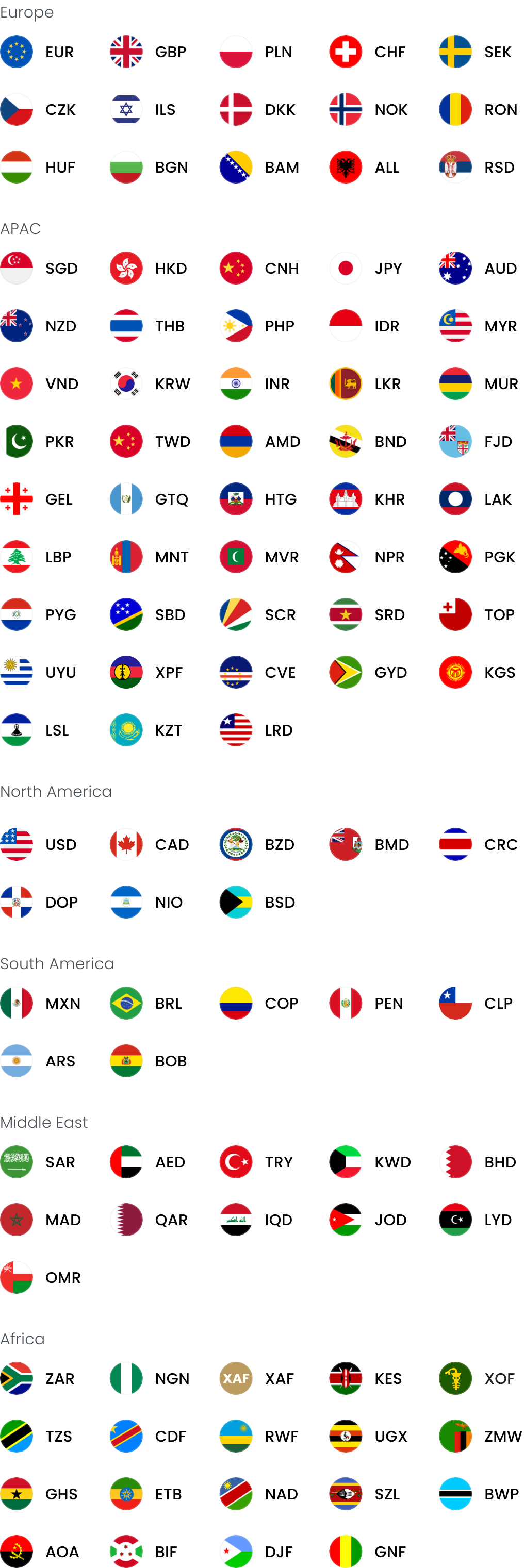
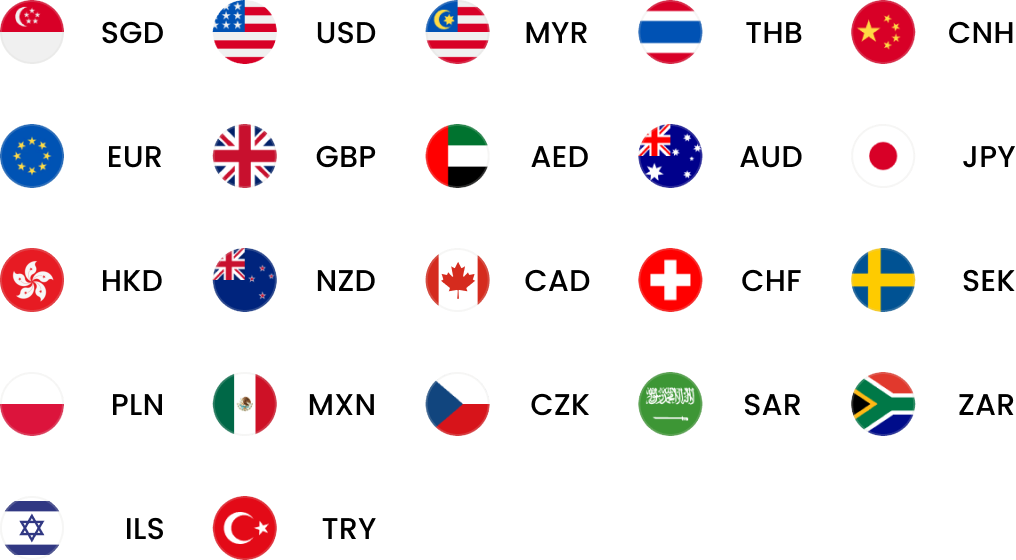
With a World Account, you can hold 20+ different currency balances simultaneously, including SGD, USD, RMB, GBP and JPY, among others. Instead of converting funds back to your home currency, you can use them to make payments.
When you do want to exchange currency, the prices are minimal. For major currencies like SGD and USD, we add a transparent 0.6% markup to the conversion cost. We use the mid-market rate to convert currency, and we’ll always confirm the exact rate with you before converting any funds.
Additionally, you can pay and get paid like a local. WorldFirst gives you unique sets of account details for SGD and each currency you hold – this includes IBANs, bank codes and account numbers. This is helpful if you decide to try natural hedging, since you’ll be able to send your bank details or receive funds without needing to open separate accounts in different countries.
Read more: How businesses can avoid the double conversion trap
Lock in exchange rates for up to 2 years with forward contracts
To help you avoid transaction risk, you can lock in today’s exchange rate for up to 24 months using forward contracts. This keeps your costs predictable, and it allows you to plan for future transactions without worrying about FX volatility.
You can customise your forwards to any amount, currency or end date, and we also allow you to choose which type of contract fits you best. For example, we offer:
- Fixed forwards: These are standard forward contracts, where you agree to buy or sell a predetermined amount of currency on a fixed day in the future.
- Window forwards: Window contracts allow you to exchange your currency on any date within a range of dates.
- Flexible forwards: These contracts allow you to make multiple payments throughout the contract’s duration, rather than having to make a single currency exchange all in one go.
Some providers (such as Wise) will outright cancel your forward contract if the market shifts too much.1 In contrast, WorldFirst will never cancel your agreements unless you breach our terms and conditions.
You’re required to complete the trade regardless of the current exchange rate. However, if the currency market ends up moving positively during the term of your contract, you can still take advantage of better rates with a spot contract. Spot contracts are simple agreements to buy or sell currency at the current market price, and with WorldFirst they’re executed immediately.
Read more: How to make a payment: Secure a spot rate and fund later
Set up rate alerts and firm orders to automatically convert your funds at favourable rates
To protect against underlying FX rate fluctuations without entering a legal agreement, we also offer other advanced FX management tools such as rate alerts and firm orders.
Rate alerts will notify you in real-time once an exchange rate reaches your target, which keeps you informed about price spikes/drops without you needing to constantly monitor the market. We also allow you to track multiple currencies at once so that you can quickly convert funds when rates are most advantageous.
Another option is to set up a firm order, which functions similarly to a rate alert, except that WorldFirst automatically executes the conversion on your behalf (once your desired rate is reached). Our firm orders remain active for one month after you book them, giving you a clear window of time to secure the best rates.
Read more: How to send money abroad (+ How to avoid hidden costs)
Sign up for a World Account and start managing FX risk today
In this guide, we’ve walked through the three types of foreign exchange risk you’re most likely to experience when making cross-border payments from Singapore.
We’ve also shared seven of the best foreign exchange risk management strategies to help you reduce foreign exchange risk, with WorldFirst’s World Account standing out as the best option for businesses and individuals.
For example, with a World Account you can:
- Hold 20+ currencies in your World Account for as long as you like, entirely for free
- Lock in exchange rates for up to 24 months with forward contracts
- Set up rate alerts, spot contracts and firm orders to take advantage of favourable FX rates
To start reducing foreign exchange risk on your international transactions, sign up for a World Account today.
Sources:
- https://wise.com/help/articles/2448203/whats-a-guaranteed-rate


![Revolut Business Card review Singapore [2027]: Features, fees & more](https://mdn.marmot-cloud.com/worldfirst/sites/9/2026/09/20261001002258848-300x200.webp)