






























Home > blog > International Transactions > Paying invoices in foreign currency: A guide for UK businesses
Paying invoices in foreign currency: A guide for UK businesses
Last update:


Paying invoices directly in foreign currency can be a great way to get clearer, more competitive pricing from your international suppliers. It can also strengthen your business relationships, especially if you’re making repeat or high-value transfers.
However, if you do pay suppliers in foreign currency, you’ll typically have to deal with foreign exchange rate fluctuations – which can result in inconsistent invoices costs each month. For instance, if FX rates move against you, you could end up paying more.
In this article, we’ll share when it’s best to pay invoices in foreign currency compared to local currency, as well as four things you should consider when paying international invoices.
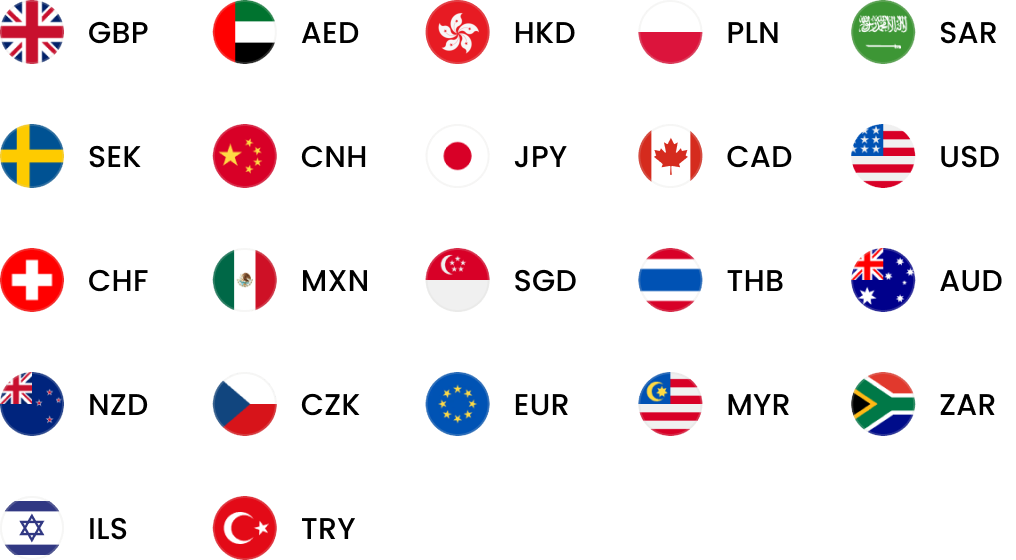
We’ll also introduce you to WorldFirst’s World Account, a multi-currency account that lets you hold balances in 20+ currencies and pay invoices in 100+ currencies. You can schedule or automate payments and even pay up to 200 invoices at once using our batch payment feature.
We cover:
- When should you be paying invoices in foreign currency?
- Four points to consider when paying invoices in foreign currency
- How WorldFirst helps you make business payments in foreign currency
- How to pay invoices in foreign currency with WorldFirst
Want to start paying invoices in foreign currency today? It’s free to sign up for a World Account.
When should you consider paying invoices in foreign currency?
You might believe that by paying foreign invoices in GBP, you’re exposed to less FX fluctuation risk.
That makes sense on the surface. But, in reality, the foreign exchange risk never goes away, and suppliers will often just add an “FX buffer” (an additional amount meant to cover drops in currency value) to your invoice.
What’s more, if you’re working with international contractors, they might charge more for GBP payments because they’d have to absorb all currency conversion fees themselves. As a result, you’ll often save more money by paying invoices in foreign currency.
However, it’s important to note that paying in local currency might not always be your invoicer’s preference. For example, countries like China and Malaysia have heavily regulated currencies, which means these suppliers may prefer to be paid in more global currencies like USD.
In these situations, you might be able to negotiate better pricing for US dollar payments than for payments in local currency. This also makes you an attractive repeat customer, which can lead to stronger relationships with your suppliers and additional perks (such as priority shipping).
Read more: What are the pros and cons of accepting foreign payments in local currency?
4 points to consider when paying invoices in foreign currency
Before sending money overseas, it’s worth being aware of the financial risks that come with paying invoices in a foreign currency:
- Exchange rate volatility: FX rates can fluctuate wildly between the invoice date and payment date, and if the rate becomes unfavourable, you could end up paying more than the invoiced amount. This is especially true for large foreign currency payments.
To avoid cost uncertainty, you can use hedging tools – like forward contracts, currency options or scheduled conversions – to stabilise costs or align payment dates with favourable FX windows.
- Accounting software: Your accounting system needs to be able to handle foreign currency suppliers, with proper FX gain/loss recordings when you make a payment. Without appropriate software, your reported costs, profits and tax position could be completely wrong, which could land you in trouble with HMRC.
- Tax adjustments: Based on UK tax law, if the employee you’re paying isn’t a UK resident or citizen, then you (the business) would only withhold tax on payments made for interest, royalties or live performances. Generally, to maintain international tax compliance, taxes must be withheld from interest payments at a rate of 20%. You don’t need to withhold tax from traditional wage employment.
If you and your supplier are both VAT-registered, make sure that every invoice includes both of your VAT numbers. For invoices issued in foreign currency, HMRC specifies that both the net amount and the VAT paid must be shown in sterling.
Disclaimer: WorldFirst doesn’t provide tax or financial advice and the information is general in nature. Consult a tax professional before proceeding.
- Holding foreign currency: If your main bank doesn’t allow you to hold multiple currencies, you might want to open a separate business account in your payment currency.
This lets you hold foreign currency balances instead of being forced to convert funds into pounds upon receipt, which saves you from unnecessary conversion fees. For example, if your euro payments get auto-converted into GBP, then having to convert to EUR again when you pay European invoices means you’ll be charged FX twice for one payment.
Read more: How to send money overseas? 7 top options for businesses
How WorldFirst helps you make business payments in foreign currency
WorldFirst is a digital payments platform that’s authorised and regulated by the Financial Conduct Authority (FCA) in the UK. Since 2004, we’ve helped over 1.5 million businesses send more than US$500 billion across the globe.
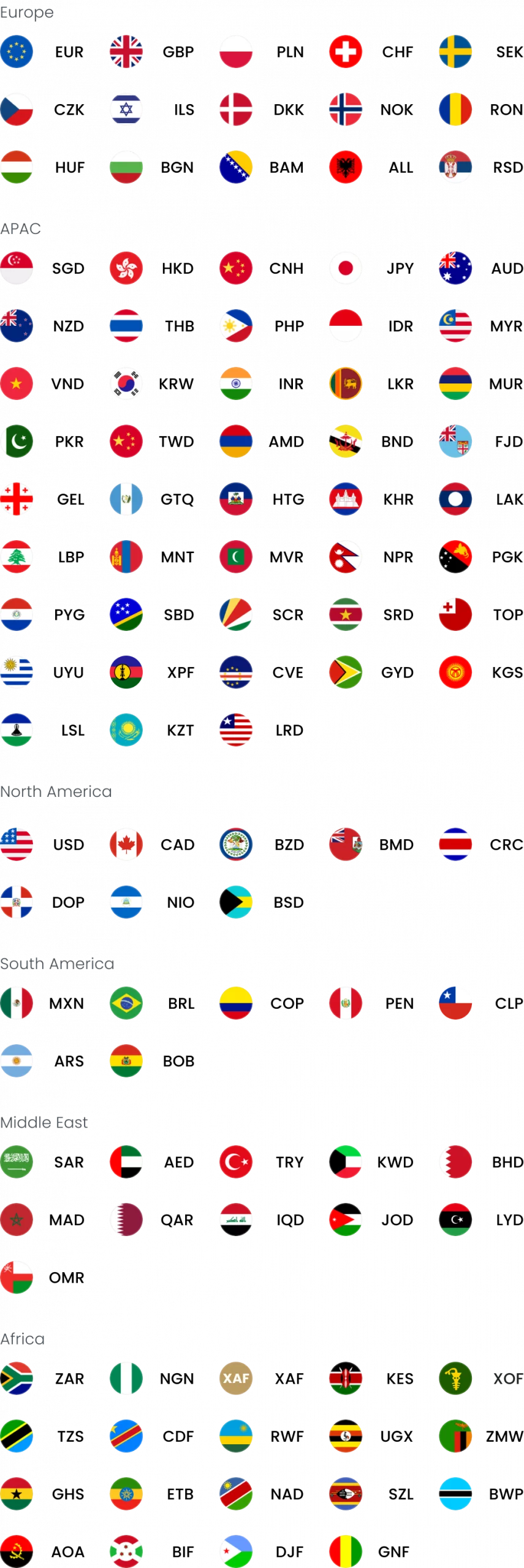
Our World Account lets you make payments in 100+ currencies at low and transparent prices. You can also hold and receive money in 20+ currencies, allowing you to pay invoices directly from those balances and save on FX fees.
The World Account has no maintenance fees, hidden fees, fees for receiving payments, minimum account balances or fall-below fees. This makes it much more affordable to pay invoices via WorldFirst than with a traditional bank.
Here’s what you get when you sign up with WorldFirst:
Pay invoices in 100+ foreign currencies and schedule payments from your balances
WorldFirst lets you pay invoices in 100+ foreign currencies – including EUR, USD, RMB and AUD – all without having to open an overseas bank account. You can also hold funds in 20+ currencies within your World Account for free.
We allow you to automate your invoice payments by setting up regular transfers from any of your multi-currency balances. It’s also free to schedule payments in advance, and you can even pay up to 200 invoices at once using our batch payment feature. This way, you can pay multiple invoices in multiple different currencies, all from the same account.
What’s more, our supplier notifications let them know when your payment’s coming. We also offer real-time payment tracking, so both you and your invoicer know exactly where your payments are at all times.
With WorldFirst, 80% of payments land on the same day, and 90% land by the next day.
Read more: Best business bank accounts for foreign transactions: 9 top options
Lock in exchange rates with forward contracts and save on FX fees
Some high street banks charge up to 5% per transaction for currency conversions, which means for every £10,000 payment, you’ll be surrendering up to £500 in fees.
In contrast, WorldFirst’s FX fees are low and transparent. Our FX markup is capped at 0.5% on top of the mid-market exchange rate for major currencies, and 0.75% for non-major currencies.
Even with these fee caps, the underlying exchange rates can still fluctuate wildly, which is why you can lock in currency exchange rates for 24 months with our forward contracts.
A currency forward is an agreement to exchange currency at a predetermined rate in the future. They ensure your exchange rates stay predictable, giving you price certainty and protecting you from FX risk (especially when making lump-sum transfers).
We also offer rate alerts and firm orders to help you receive a target FX rate without having to constantly watch the market. Firm orders function in a similar way to rate alerts, except that WorldFirst executes the conversion on your behalf once the rate hits your target. We’ll always confirm the exact FX rate with you before carrying out a conversion.
Read more: How to understand the foreign exchange fee structure of WorldFirst
Make payments to Chinese suppliers directly in CNH or USD
WorldFirst allows you to make international payments directly in CNH or USD from your World Account balance.
Transfers to other World Accounts are completely free, which means you can pay the 150,000+ Chinese suppliers who already use WorldFirst without any transfer fees. Our transfer limits allow you to pay up to CN¥1.5 million per supplier per day.
Read more: How to open a Chinese bank account online (as a UK business)
How to pay invoices in foreign currency with WorldFirst
To start paying invoices in foreign currency with WorldFirst, you’ll first need to sign up for a World Account. It’s free to open and maintain, and the application process is entirely online.
Here’s how to sign up:
- Head to our World Account online signup portal and enter your personal details
- Fill in your account information and verify your identity with a passport or driver’s licence
- Upload your business documents, including shareholder IDs, company ownership documents and proof of address (such as a utility bill)
- Once you click ‘Submit’, you’ll receive an acceptance email (usually within 48 hours)
Then, to send money overseas in pound sterling or 100+ other currencies:
- From your World Account dashboard, click ‘Make a payment’ and choose ‘Bank transfer’
- Select your payment currency, then enter your recipient’s bank details (including their full name, IBAN, BIC and bank account number)
- Choose which balance you want to pay from. If you don’t already hold your desired currency, you can convert from GBP or another currency at the displayed exchange rate
- Review the payment details, then click ‘Confirm’ to send
Read more: How to pay overseas contractors safely, quickly and affordably
WorldFirst is the best solution for paying invoices in foreign currency
In this article, we’ve shared key considerations when it comes to paying international invoices in foreign currencies, including tax responsibilities, international supplier payment preferences and currency volatility.
We’ve also shared why WorldFirst’s multi-currency World Account is the easiest way to pay invoices in foreign currency.
With a World Account you can:
- Pay invoices in 100+ foreign currencies, including EUR, USD, CNH and AUD, among others
- Hold 20+ currencies in your account for free
- Lock in exchange rates for up to two years with our forward contracts
- Pay invoices from Chinese suppliers in CNH at low and transparent prices
Ready to start paying invoices in foreign currency with WorldFirst? Sign up for a World Account for free today.
Jennifer Dodd leads marketing for WorldFirst UK, and has over 20 years' experience in financial services and publishing.

Jennifer Dodd
Author
Continue reading


Subscribe
The Weekly Dispatch
Get the latest news and event invites. Signup for our weekly update from the worlds of fashion, design, and tech.
You might also like
Choose a product or service to find out more

E-commerce guides


Doing business with China

Exploring new markets

Business Tips

International transactions
E-commerce expansion guides
Doing business with China