



























Whether you’re an online seller or small-to-medium enterprise (SME), we’ve broken down the main differences between IBANs and SWIFT codes to help you better understand them.
What is a SWIFT code?
A SWIFT code consists of alphanumeric characters and is a format of Business Identifier Codes (BIC). It identifies a bank, for example Barclays or Santander, and is used by banks for international transfers between them. The SWIFT network enables banks anywhere in the world to send and receive information in a standardised and secure environment.
When do I need a SWIFT code?
Your SWIFT code is usually required if someone is sending you an international money transfer as it’s used to identify an individual bank to verify international payments. For example, a company might ask for your SWIFT code if they’re paying your invoice via overseas transfer.
How to find a SWIFT code
It can be found as a set of 8 or 11 digits on your bank statement or you can usually find it via online banking or on your bank’s website. These numbers are used to represent your bank branch and follow an international standard format for financial transactions.
What does a SWIFT code look like?
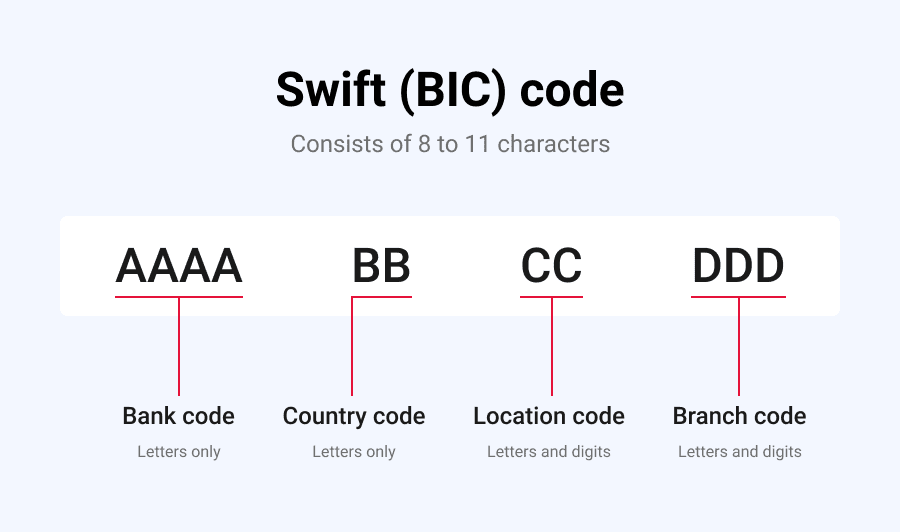
Swift codes denote the bank code, country code, location code, and branch code associated with a transaction.
Take a look at how it is used to identify financial institutions globally.
How does an IBAN differ from a SWIFT code?
Whilst a SWIFT code is used to determine a particular bank, your IBAN identifies the individual bank account you’re using for international bank transfers. IBAN is a standard international numeric system created to identify overseas bank accounts.
An IBAN serves as an International Bank Account Number and is in addition to your sort code and account number. It starts with a two-letter country code in uppercase letters, followed by two numbers. It can be up to 34 characters in length.
The key importance of an IBAN is that it gives extra information that helps in identifying overseas payments, such as wire transfers to European countries.
What do you need an IBAN for?
It is largely used when making or receiving international payments. A financial institution like an FX platform needs to check the accuracy of your IBAN for international transfers and can only make the funds transfer with a correct IBAN.
Do I need IBAN if I have SWIFT?
You might be asked to provide both an IBAN and SWIFT to help a bank identify exactly where the money needs to be sent to. Not all countries support the IBAN system, so if you’re sending money to a country that doesn’t you’ll just need the SWIFT code for the overseas transfer.
The bank or financial institution you’re using for the transfer should be able to tell you which you need. If a company is sending you money, they should contact you to ask for your IBAN, SWIFT code or both.
More information
What is an IBAN? – find out more about IBANs including where to find them, what they look like, and which counties use them.
Next step, transferring money
Now you know how important your IBAN is when transferring funds to a supplier, you’re ready to start sending money today.
Our customer service team can walk you through the process of setting up an account, so contact us today.