



























Tide’s £0 Free plan can make the monthly cost look straightforward when you’re comparing business accounts. But the plan fee is only one part of what your business may pay, especially once transaction volumes increase.
The difference becomes more relevant if you make frequent payments or start moving money internationally, where separate charges can apply depending on your plan and how you use the account.
In this article, you’ll see which Tide business account charges can have the biggest impact on what you actually pay.
Key takeaways:
- Tide’s £0 plan doesn’t make every transaction free: Free includes five qualifying bank transfers per month, after which standard eligible UK transactions can cost 20p each
- Transfer volume alone may not justify a paid Tide plan: At 40 qualifying UK payments in one month, Free still costs less than Smart, Pro or Max in the article’s worked example
- Regular cash deposits can change which Tide plan costs less: Post Office deposits above £500 cost 0.99% on Free and 0.50% on Smart, Pro and Max, so your deposit pattern matters when comparing plans
- International costs depend on more than the payment fee: FX markups, transfer charges and what happens to incoming foreign currencies can all affect what you ultimately pay
- WorldFirst gives you more control over international currency flows: You can hold supported foreign currencies for future supplier payments and choose when you need to convert them
Open a World Account to hold foreign-currency income for future payments and manage overseas supplier costs.
Tide business account charges at a glance
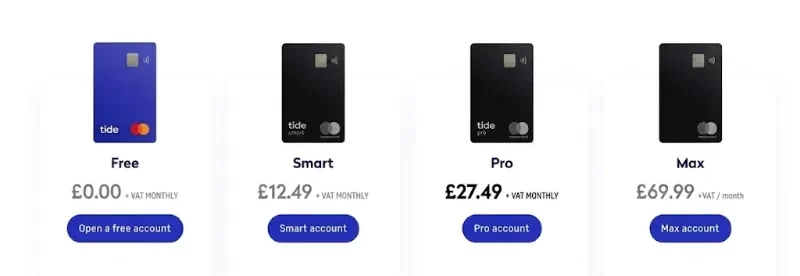
The figures below reflect Tide’s current UK pricing for Free, Smart, Pro and Max:
| Charge | Free | Smart | Pro | Max |
| Monthly plan fee | £0 | £12.49 | £27.49 | £69.99 |
| Included bank transfers | Five/month | 30/month | Unlimited* | Unlimited* |
| Inbound Faster Payments, BACS and CHAPS after allowance | 20p | 20p | Free* | Free* |
| Outbound Faster Payments and Direct Debits after allowance | 20p | 20p | Free* | Free* |
| Outbound CHAPS payments | £15 each | Two free, then £15 each | Two free, then £15 each | Five free, then £15 each |
| Eligible EUR/USD bank payments | £1 + 1.50% FX markup | £0.50 + 1.25% FX markup | 0.75% FX markup | 0.50% FX markup |
| Inbound GBP SWIFT payments | £10 | £7.50 | £5 | £3 |
| Tide FX fee on non-GBP purchases and GBP purchases abroad | 2.75% | 0% | 0% | 0% |
| Post Office cash deposits up to £500 | £2.50 | £2.50 | £2.50 | £2.50 |
| Post Office cash deposits over £500 | 0.99% | 0.50% | 0.50% | 0.50% |
| PayPoint cash deposits | 3% | 3% | 3% | 3% |
| Digital cheque deposits | 90p | 90p | 90p | 90p |
| GBP cash withdrawals in the UK | £1 up to £500; 0.25% over £500** | £1 up to £500; 0.25% over £500** | £1 up to £500; 0.25% over £500** | £1 up to £500; 0.25% over £500** |
| Payments between Tide accounts | Free | Free | Free | Free |
*Unlimited or free qualifying GBP transfers are subject to Tide’s fair use policy.
**UK cash withdrawals over £500 are only available to ClearBank accounts.
Tide currently applies the EUR/USD pricing above to eligible inbound and outbound EUR payments and outbound USD payments. International card pricing is separate: Tide’s card FX fee follows a different structure from its international bank-payment fees.
Information checked on 10 August 2026. Check Tide’s current pricing before applying or switching, as fees and plan terms can change.
How Tide charges for UK payments and transfers
Tide’s monthly transfer allowance can cover both payments you send and money coming into the account.
Which payments count towards the monthly allowance?
Once the Free or Smart allowance is used, Tide charges 20p for:
- Incoming payments: Faster Payments, BACS and CHAPS
- Outgoing payments: Faster Payments and Direct Debits
Pro and Max include qualifying GBP transfers without a per-transaction fee, subject to Tide’s fair use policy. Payments between Tide accounts are also free.
How the 20p charge appears depends on the billing method. For individually billed transactions, Tide adds the fee to outbound payments and deducts it from incoming payments. Some newer members use hybrid billing instead, where Tide tracks eligible transaction fees during the month and collects the total on the second day of the following month.
How CHAPS payments are charged
Incoming CHAPS payments fall within Tide’s standard UK transaction pricing, while outgoing CHAPS payments have a separate allowance and fee.
Free charges £15 for each outbound CHAPS payment. Smart and Pro include two per month before the £15 fee applies, while Max includes five.
Outbound CHAPS doesn’t use the 20p pricing that applies after the Free or Smart standard transfer allowance is used.
Example: 40 UK payments in one month
Assume your business makes 40 payments that fall within Tide’s standard UK transaction pricing during one month, with no outbound CHAPS payments or other chargeable transactions.
| Tide plan | Calculation | Monthly cost from plan and these payments |
| Free | Five included + 35 × 20p | £7 |
| Smart | £12.49 plan fee + 30 included + 10 × 20p | £14.49 |
| Pro | £27.49 plan fee + qualifying transfers included | £27.49 |
| Max | £69.99 plan fee + qualifying transfers included | £69.99 |
At 40 qualifying UK payments, Free costs the least in this example, so transfer volume alone wouldn’t justify moving to a paid plan at that level.
Read more: Tide alternatives
How Tide charges for cash deposits and withdrawals
The Post Office supports much larger cash deposits than PayPoint, so the route you use affects how much you can deposit at once.
Tide allows up to £25,000 in a single Post Office deposit, with the same £25,000 monthly limit and a £300,000 annual limit. Individual branches can set lower limits.
PayPoint has a £10 minimum and £500 daily maximum.
Tide deducts the deposit fee when it processes the transaction, so the amount credited to your account is the cash deposited minus the charge.
Consider a business depositing £1,000 at the Post Office four times in one month:
| Tide plan | Cash-deposit fees | Monthly plan fee | Total from these costs |
| Free | £39.60 | £0 | £39.60 |
| Smart | £20 | £12.49 | £32.49 |
| Pro | £20 | £27.49 | £47.49 |
| Max | £20 | £69.99 | £89.99 |
At that deposit pattern, Smart costs £7.11 less than Free before any other transactions are considered. Pro and Max have the same Post Office deposit rate as Smart, but their higher monthly fees make them more expensive in this example.
Tide ATM withdrawal charges
The £500 withdrawal threshold has an account restriction: UK cash withdrawals above £500 are only available to ClearBank accounts.
An ATM operator can also add its own fee. That charge sits outside Tide’s pricing and can increase the total cost of the withdrawal.
Foreign ATM withdrawals follow a different fee structure, which becomes relevant when you use a Tide card abroad.
What Tide charges when you use your card abroad
A £1,000 card purchase subject to Tide’s 2.75% Free-plan fee would add £27.50 in Tide FX charges. Tide doesn’t add an FX fee to the same purchase on Smart, Pro or Max, although the monthly plan fee still applies.
Foreign ATM withdrawals
Free combines its 2.75% FX fee with the ATM charge when you withdraw cash abroad. For withdrawals up to £500, Tide charges £1 plus the FX fee. Above £500, the ATM charge changes to 0.25% of the withdrawal amount, with the 2.75% FX fee added.
Smart, Pro and Max don’t add Tide’s FX fee to foreign ATM withdrawals. Their standard Tide ATM charge still applies: £1 up to £500 or 0.25% above £500.
How Tide charges for international payments
It currently sends and receives EUR through the Single Euro Payments Area (SEPA), sends USD through the Automated Clearing House (ACH) and uses SWIFT for receiving supported international currencies.
A 2024 Department for Business and Trade survey of 8,396 UK SME employers found that 23% directly imported goods or services. For those importers, the currency and payment route behind a supplier invoice determine which international charges apply.
Sending EUR and USD payments
For EUR and USD payments, you enter the amount you want to send in GBP. Tide shows the converted amount and applicable fees before you confirm the payment. Both payment types are subject to eligibility criteria.
For a £10,000 payment converted to USD, Tide’s published fees would produce the following costs:
| Tide plan | Tide fees |
| Free | £151 |
| Smart | £125.50 |
| Pro | £75 |
| Max | £50 |
The example isolates Tide’s payment fee and FX markup. It doesn’t include the Smart, Pro or Max monthly plan fee, and the final USD amount depends on the interbank exchange rate applied when you make the payment.
Receiving international payments
EUR receipts use Tide’s SEPA details. Incoming EUR is automatically converted to GBP before it reaches the main account balance.
The sender needs to use EUR and the SEPA payment method. Tide states that a EUR payment sent through SWIFT instead will be declined.
For other supported international receipts, Tide provides SWIFT details for currencies including USD, CNY, AUD and CAD. These payments are also automatically converted to GBP before appearing in the main account balance. The amount you can receive depends on your Tide account limits, and international payments remain subject to eligibility criteria.
What automatic GBP conversion means for you
If you receive a foreign currency and later need to pay in that same currency, another conversion may be required.
That means you can end up making more than one FX conversion between receiving the payment and using those funds.
For regular international inflows and outflows, look at the full currency flow rather than the fee attached to one transaction.
Read more: How to mitigate foreign exchange risk
Why WorldFirst is a stronger option for international payments
Say you sell to customers in the US and buy stock from US suppliers. A customer pays you US$20,000, and you have a US$12,000 supplier invoice due later that month.
World Account is a multi-currency account, which allows you to receive the US$20,000 into your USD balance and keep it in USD. When the supplier invoice falls due, you can pay the eligible US$12,000 invoice from that balance. The remaining US$8,000 can stay in USD until you need it for another supplier payment, decide to convert it or withdraw it.
If you’re comparing providers for multi currency payments, WorldFirst lets you receive and hold 20+ currencies and make payments to 200+ countries.
There’s no ongoing World Account fee. Receiving and holding supported currencies is also free. Current UK pricing is £0.30 for local payments in GBP, EUR or USD and £4 for international payments. Major-currency conversion fees are capped at 0.50%, while cross-currency payments above £5,000 don’t carry a separate payment fee.
For regular international inflows and supplier payments, you get more control over which currencies you hold, which you pay out and when you convert.
WorldFirst isn’t a bank. World First UK Limited is authorised by the Financial Conduct Authority as an Electronic Money Institution under the Electronic Money Regulations 2011, with FCA Firm Reference number 900508. Customer funds are safeguarded rather than protected by the Financial Services Compensation Scheme (FSCS).
Open a World Account to manage your foreign-currency balances and international payments.
FAQs
1. Can I downgrade or cancel a paid Tide plan without a fee?
You can downgrade or cancel a paid Tide plan, but charges may still apply for your current billing period. Tide doesn’t list a separate downgrade fee. A downgrade takes effect from the following calendar month, so your existing plan remains active until then.
2. Does Tide charge a fee to close a business account?
Tide’s current guidance doesn’t list a separate account-closure fee. Before closing your account, you’ll need to bring the balance to £0, deal with ongoing payments and pay any outstanding charges.
3. Does Tide charge for additional cards or team members?
It depends on the type of team access you need. View-only access is free, while Tide lists additional Expense Card seats at £5 per calendar month. Smart includes one Expense Card seat, Pro includes two, and Max includes three.
4. Is money in a Tide business account protected by FSCS?
Eligible deposits in Tide Business Current Accounts provided by ClearBank are protected by the FSCS up to £120,000. Protection depends on meeting the FSCS eligibility requirements.
5. Can I switch from Tide to another business account using CASS?
Yes, you can switch an eligible Tide account through the Current Account Switch Service (CASS). A full switch moves your balance and eligible payment arrangements to the new provider and closes your Tide account as part of the process.
Sources:
- https://www.tide.co/pricing/
- https://www.tide.co/help-centre/make-a-payment/
- https://www.tide.co/support/joining/what-is-tide/how-much-does-tide-cost/
- https://www.gov.uk/government/statistics/small-business-survey-2024-businesses-with-employees/longitudinal-small-business-survey-2024-sme-employers-businesses-with-1-to-249-employees