



























To streamline supplier payments in high-volume environments, businesses need clean supplier data, clear approvals, planned payment runs, FX control and simple reconciliation.
When invoice volumes grow, spreadsheets become harder to trust. One wrong bank detail, missed approval or late payment can affect stock, fulfilment, cash flow and supplier relationships.
Supplier payments also become harder to manage as a business grows. From 6 April 2025, the UK payment practices reporting thresholds changed to £54 million in annual turnover, £27 million in balance sheet total and 250 employees, with businesses in scope when they meet two or more of these criteria.
In this guide, we’ll explain how to streamline high-volume supplier payments, making them faster, easier to manage and less prone to errors.
Key takeaways:
- High-volume supplier payments require a single repeatable process: A simple workflow helps teams check suppliers, approve invoices, plan payments and reconcile records with fewer errors
- Teams should verify supplier details before payment: Finance teams should review new suppliers, changed bank details and new payment currencies before money moves
- Approval rules should match payment risk: Routine payments can move faster, while large, unusual or overseas payments get closer checks
- Plan FX before the payment deadline: Planning currency needs earlier helps businesses avoid rushed conversions and forecast supplier costs more clearly
- WorldFirst can help simplify international supplier payments: Once supplier data, approvals and records are under control, World Account can help UK businesses handle international supplier payments across currencies
What does it mean to streamline supplier payments in high-volume environments?
Streamlining supplier payments means moving from an approved invoice to a paid supplier faster, with an accurate record your team can check later.
For a UK business with a growing supplier base, the payment run can cover rent, stock, freight, software, contractors, agencies and overseas partners in different currencies. Streamlining brings those payments into a process your team can trust, instead of handling each one as a separate admin job.
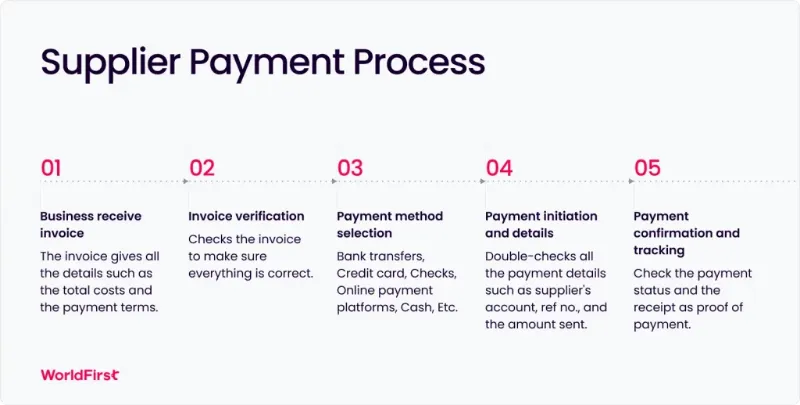
A cleaner supplier payment process helps your team answer five questions faster:
- Are we paying the right supplier?
- Are the bank details correct?
- Has the payment been approved?
- Are the currency costs and timing clear?
- Can we match the payment back to the invoice later?
The real value comes after approval. Once invoices are ready to pay, your team still needs to choose the payment date, currency, route, reference and payment batch.
For overseas suppliers, that may also mean planning around USD, EUR or CNH balances, FX rates and cut-off times.
The aim is simple: fewer failed payments, fewer supplier chasers and less time spent piecing together what happened after money left the account.
Why high-volume supplier payments become hard to manage
1. Supplier records become unreliable
A busy payment run needs accurate supplier details. Your team needs the right supplier name, bank account, payment terms, invoice currency and payment reference before money moves.
Problems often appear when:
- The same supplier has more than one record
- Bank details are old
- Payment terms are missing
- The invoice currency is unclear
- Payment references need to be typed in by hand
2. Approvals delay ready-to-pay invoices
In practice, teams often lose time because invoices arrive without a PO, go to the wrong approver or need extra checks near the due date.
A simple split helps: ready to pay and needs review.
That way, clean invoices can move forward, while the team reviews disputed or incomplete invoices separately.
3. Payments are spread across too many tools
The more places your team needs to check, the harder it becomes to track ready payments, due dates and completed payments.
Cross-border payments make this more difficult. A UK business may pay:
- Local suppliers in GBP
- Manufacturers in China in CNH
- Logistics partners in EUR
- Software providers by card
Without one precise view of payment dates, currencies and references, teams can struggle to track cash flow and match payments back to invoices.
4. FX decisions happen too late
Overseas supplier payments need currency planning before the due date. A UK importer might approve a USD invoice on Monday, wait until Friday to convert GBP to USD, then release the payment.
If the exchange rate moves during that week, the final cost changes.
Better planning helps teams decide when to convert currency, when to hold foreign currency and which payments need closer attention. That makes supplier costs easier to forecast.
5. Reconciliation takes too long
Reconciliation becomes slower when:
- Payment references do not match invoice numbers
- Several invoices get grouped into one payment
- Charges reduce the amount the supplier receives
- Currency conversion changes the final amount
- Teams move CSV files between systems manually
6. Supplier trust depends on reliable payments
Suppliers want precise payment dates, correct references and remittance details they can use.
When payments arrive late or when details are missing, suppliers chase your team and may tighten terms.
The UK’s Fair Payment Code gives businesses a clear benchmark:
- Gold award: Pays at least 95% of invoices within 30 days
- Silver award: Pays at least 95% of invoices within 60 days, including at least 95% of small business invoices within 30 days
- Bronze award: Pays at least 95% of invoices within 60 days
How to streamline supplier payments in high-volume environments
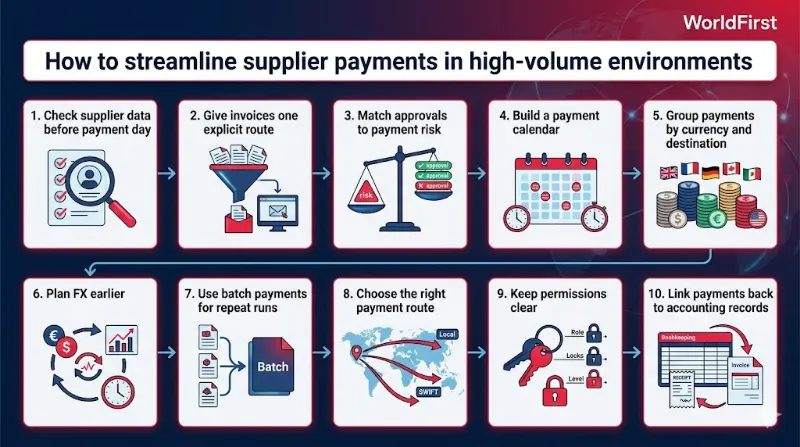
1. Check supplier data before payment day
Start with the details that affect payment:
- Legal name
- Trading name
- Bank details
- Preferred currency
- Payment terms
- Supplier country
- Finance contact
- Standard payment reference
Add an extra review for new suppliers, changed bank details and new payment currencies.
UK Finance reported £19.9 million in invoice and mandate scam losses in H1 2025, with 75% of those losses on non-personal or business accounts. For payment teams, that makes extra checks essential when a supplier is new, bank details change or a new currency gets added.
2. Give invoices one explicit route
Ask suppliers to send invoices through a single agreed route, where possible, such as a finance inbox or supplier portal.
Each invoice should include:
- Invoice number
- PO number
- Supplier name
- Amount
- Currency
- Due date
- Description of goods or services
Sort invoices into simple groups: ready to approve, needs clarification, disputed and approved for payment. Clean invoices can move forward while the team reviews incomplete or disputed invoices separately.
3. Match approvals to payment risk
A small monthly software invoice should not follow the same approval route as a large payment to a new overseas supplier.
Set approval rules around:
- Payment amount
- Supplier type
- Currency
- Destination country
- Payment method
- Bank detail changes
- Urgency
4. Build a payment calendar
A payment calendar helps your team see what needs to move, when and which payments require funding in another currency.
Group payments by due date, currency, supplier priority, payment route and cash-flow needs. That gives the team more control before suppliers start chasing.
Late payment admin can take real time away from the business. Research published by the Small Business Commissioner found that 22% of surveyed businesses spent staff time chasing late payments, averaging 86 hours per affected business per year.
5. Group payments by currency and destination
Currency grouping helps the team see how much money it needs in each currency before the payment date.
For example, a UK business might group supplier payments into:
- GBP for domestic suppliers
- USD for product suppliers
- EUR for logistics partners
- CNH for manufacturers
- Card payments for SaaS, ads or travel
That makes currency planning easier and helps the team avoid last-minute conversions.
6. Plan FX earlier
FX planning should happen before the payment deadline, not during the final payment run.
For overseas suppliers, decide which currency the supplier expects, when to convert, which balance to use and which larger invoices need closer review.
7. Use batch payments for repeat runs
Batch payments help teams avoid paying suppliers one by one when the same types of payments happen every week or month.
Use batches for regular supplier runs, stock purchases, logistics invoices, marketplace costs and recurring services. The team can check the total, review references and release the group together.
8. Choose the right payment route
Different payments need different routes. A large supplier transfer, an urgent stock payment and a recurring SaaS charge may each need a different method.
Before release, check the supplier’s country, invoice currency, payment deadline, cut-off time, cost and reference requirements.
Route choice still matters because international payment timing can vary by currency, destination, provider and receiving bank.
BIS reported in 2025 that only 35% of global cross-border retail payments and 55% of wholesale and remittance payments reached the recipient within one hour, below the 75% target.
9. Keep permissions clear
Payment permissions should make ownership obvious: who can create, approve, release and review payments.
Set limits by role, especially for large payments, new suppliers, changed bank details and overseas transfers. No one needs access to everything.
Transparent permissions help teams move faster while keeping control over sensitive payment actions.
10. Link payments back to accounting records
Once the payment leaves, finance still needs to match it to the right invoice, update the books and handle any supplier questions.
Make that easier before the payment goes out. Use clear invoice references, avoid vague lump-sum payments and include a breakdown when several invoices go out together.
Manual AP work adds up quickly. The 2025 Accounts Payable Automation Trends report found that 63% of AP teams spend more than 10 hours per week processing invoices.
A stronger link between the invoice, payment reference and accounting record helps the team close month-end faster and spend less time chasing missing details.
How to choose the right supplier payment setup
| Stage | What to do | Why it matters |
|---|---|---|
| Supplier setup | Verify supplier name, bank details, currency and payment terms | Reduces failed payments, duplicate records and last-minute checks |
| Invoice intake | Capture invoice number, PO, currency, due date and supplier name | Keeps approval and payment details consistent |
| Approval | Route payments by amount, supplier type, currency and destination | Speeds up routine payments without losing control |
| FX planning | Review currency needs before the payment run | Helps protect margins and avoid rushed conversions |
| Payment preparation | Group payments by due date, currency and route | Makes batch payments easier to manage |
| Payment release | Use approved templates, permissions and final payment checks | Reduces manual entry and payment errors |
| Reconciliation | Match payment data with accounting records | Cuts admin and helps month-end close |
| Review | Track exceptions, delays, fees and supplier queries | Shows where the workflow needs improvement |
Where WorldFirst fits in a high-volume supplier payment setup
A strong supplier payment setup starts with the basics: clean supplier data, clear approval rules, planned payment runs and accurate records. Once those pieces are in place, the next challenge is managing the actual movement of money, especially when suppliers operate across different countries and currencies.
WorldFirst fits into that payment stage. With a multi-currency World Account, UK businesses can pay suppliers, manage currencies, control team access and keep payment records easier to reconcile from one platform.
WorldFirst is an FCA-authorised Electronic Money Institution, not a bank. That means it does not replace every part of a traditional business bank account, such as branch banking, cash deposits or lending. Its role is more focused: helping businesses receive, hold, convert and send money across currencies.
Key features for high-volume supplier payment teams include:
- Multi-currency payments: Send payments to 200+ countries and territories in 100+ currencies
- 20+ currency receiving: Receive business payments in 20+ currencies
- Currency balance control: Hold funds across currencies and use available balances for planned supplier payments
- Team permissions: Control who can create, view, approve or manage payments
- Authorisation rules: Add approval steps for payment actions that need extra review
- Accounting integrations: Connect World Account with Xero and NetSuite to support cleaner reconciliation
World Account can help when your business pays overseas suppliers, logistics partners, manufacturers, agencies, SaaS providers or marketplace costs across several currencies.
Once your payment process is clear, WorldFirst can help reduce the manual work around international supplier payments and give your team a simpler way to manage currency, access and records.
FAQ
1. What supplier payment KPIs should I track?
2. How can I reduce the risk of paying the wrong supplier?
3. How should I handle urgent supplier payments safely?
Sources:
- https://www.gov.uk/government/publications/business-payment-practices-and-performance-reporting-requirements/duty-to-report-guidance-to-reporting-on-payment-practices-and-performance
- https://www.smallbusinesscommissioner.gov.uk/fpc/about/
- https://cdn.prgloo.com/media/77fbf188bb61467cb82fed0e613fc29c.pdf
- https://www.smallbusinesscommissioner.gov.uk/late-payments-research-2/
- https://www.bis.org/publ/bisbull119.pdf
- https://acarp-edu.org/accounts-payable-automation-trends-2025/
- https://www.worldfirst.com/uk/