


























If you’ve been into the dropshipping business, you must have by now explored how AI can do wonders for your store. In case you haven’t, you’re missing out on automating tasks that require minimal manual supervision, and losing time you could otherwise focus on growing your business.
AI can find the product, build the site, write the ads (Meta Ads and Google PPC), answer customer queries, and even count the money you made per day from your ecommerce store. AI dropshipping is all about finding the right balance: automating day-to-day tasks while still keeping control over the priority tasks that need constant supervision, like handling a customer who isn’t satisfied by a chatbot’s response, or deciding whether to bring on a new supplier.
This guide goes through what AI actually does well in a dropshipping business, where it can go wrong, and what it really costs once you strip out the marketing. We also tested AI-recommended products ourselves to see whether the products an AI tool suggests actually turn a profit once real supplier prices, fees, and currency costs are added in.
What Is AI Dropshipping?
AI dropshipping is a system quite popular among dropshippers these days, where AI tools handle parts of the day-to-day work like finding products, writing listings, generating or editing product images, building the store, setting prices, running ads, or answering simple customer queries.
That said, you still need a supplier willing to ship single orders directly to your customer’s doorstep within a reasonable time. You still list those products in your own store, take the customer’s order, pass it to the supplier, and pocket the margin between what the customer paid and what the supplier charged.
So AI dropshipping isn’t a separate business model. It’s the same business, with AI software handling your daily tasks so you can focus more on customer service and improving the quality or range of products in your store. Every AI tool on the market today handles a specific task well and hands the decision-making back to you.
This distinction matters because many people assume “AI dropshipping” means you can set it up once and step away. That’s not the case. You’re still in charge of the store and still the one making every important decision about your business.
What Can AI Automate in Dropshipping?
Product research
Tools like Sell The Trend, Dropship.io, and AutoDS scan thousands of products across marketplaces, ad libraries, and live Shopify stores in minutes, then score them against signals like search volume, competitor ad activity, and review counts.
Store creation
Tools such as Shopify Magic and Storebuild.ai can help you build an ecommerce store. With the right prompts and information, you can generate a theme, page layout, and even a starter set of product listings in a few minutes. This is genuinely useful for getting a store live fast, especially if you’re testing an idea before committing time to a custom build, or working with a lower budget and don’t want to hire support staff right away.
Listings
Writing product titles, descriptions, and bullet points is one of the most reliable AI use cases, because the task is narrow and the output is easy to check. AI can also generate several versions of the same listing for A/B testing far faster than doing it by hand.
Pricing
Rules-based and AI-assisted pricing tools can automatically raise or lower prices based on competitor pricing, demand signals, or your own margin targets. This works well for staying competitive without checking prices manually every day. Just make sure you feed the tool your actual break-even point, so it doesn’t drop below that even if competitors are pricing lower.
Advertising
AI can generate ad copy, image variations, and increasingly video ad formats from a single product photo. Some tools also flag when a specific ad creative is losing performance and alert you accordingly. This saves time on production and testing volume, but it doesn’t replace the judgement needed to spot which creative direction will actually resonate with your target market.
Customer support
AI chatbots handle the repetitive stuff well: order status, shipping timelines, returns policy questions, and basic FAQs. This frees up time for messages that need real human attention, like a customer who received the wrong product, whose order hasn’t arrived despite the delivery window passing, or whose item arrived broken or damaged.
Reporting
Profit-tracking tools (like BeProfit) pull together revenue, ad spend, platform fees, and cost of goods to show real margin per product. This is one of AI’s most useful contributions, because a lot of dropshippers only discover a product wasn’t actually profitable after weeks of running it and spending heavily on marketing.
Open a free World Account today.
Where AI Still Needs a Human
AI can’t verify whether a supplier is reliable. That’s still on you to check. Reviews can be paid for, outdated, or simply wrong, and this is exactly where human judgement matters. AI also can’t judge whether a product will genuinely excite a customer, and it can’t catch a product that looks fine in the listing but arrives damaged or doesn’t match the photos. And it can’t take legal responsibility for an inaccurate claim in a listing it wrote, because that responsibility sits with the seller.
Best AI Dropshipping Tools by Task
Rather than another generic top-10 list where every tool looks equally good, here’s a breakdown by the specific job each tool is built for, based on hands-on testing. We also checked something most guides skip: whether you can actually try each tool without handing over card details first.
We tested Tidio, Shopify, and Minea directly. Two other commonly recommended tools, Sell The Trend (product research) and AutoDS (fulfilment automation), both require card details before you can start a trial, so we’ve noted their pricing from official sources but haven’t included hands-on results for them here.
Customer support: Tidio
Sign-up took under a minute with just an email, no card needed. The core of Tidio is its Lyro AI Agent, which you train by feeding it your own store policies, either typed in manually or uploaded as a CSV. Once it had a returns policy to work from, it answered a test question about returns correctly and specifically, including the detail that an item has to be sent back in its original packaging.
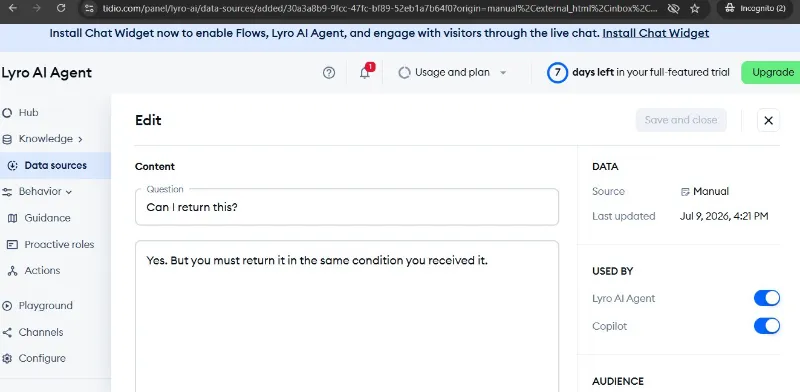
The trade-off: The agent is only as good as what you feed it. Leave the knowledge section empty, and it has nothing useful to say. The interface also has a lot of menus and settings, which can feel like more than a small store needs at first.
Store building: Shopify
The 3-day free trial asked for an email only, no card. Using Shopify Magic, a full product page built around a “UK best shaving cream” test product generated in about three minutes, complete with a grammatically clean title, description, category tags, and image upload slots.
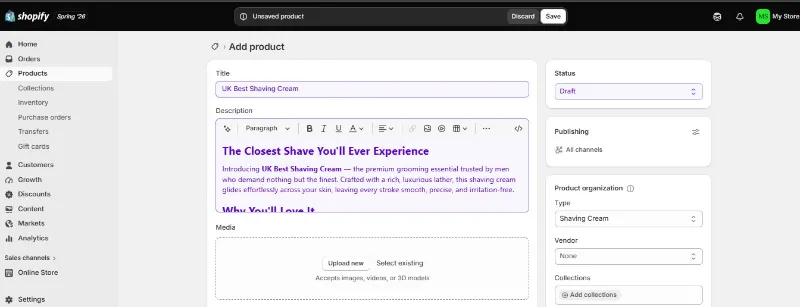
The one gap: Shopify Magic doesn’t generate product images from a text prompt. You still need to source or shoot photos yourself and add them in.
Ad and product research: Minea
Free sign-up, no card. Minea splits its results into TikTok Ads and Meta Ads, and lets you filter by media type, ad date, duration, spend, page reach, region, and more, which is a genuinely deep toolset for a free plan. Searching a general category didn’t surface the same single ad running repeatedly, but the same handful of dropshipping brands, including DeoDap, Susan Pemberton, and Nana Hats, kept reappearing across different searches, which is itself a useful signal for which sellers are actively running paid ads at volume right now.
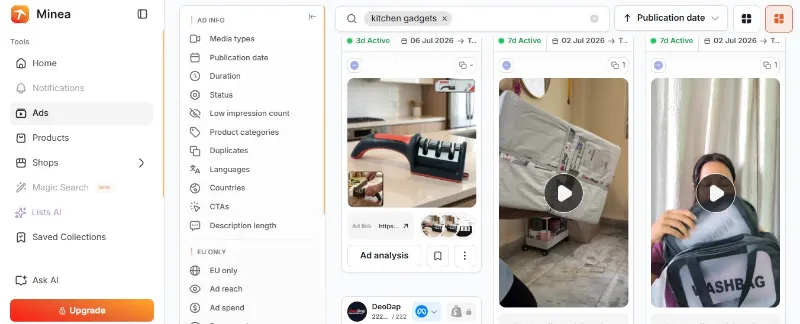
After three searches, Minea starts prompting you to subscribe to a paid plan. Its large number of filters can also feel overwhelming for beginners, so expect to spend some time getting familiar with the tool.
AI Dropshipping Tools at a Glance
| Task | Tool | Card needed to test? | Starting price for UK users | Free plan / Trial | Where it falls short |
| Customer support | Tidio | No | US$29/month (billed in USD for UK customers) | Yes, 7-day free trial (Lyro AI Agent is a separate add-on) | Only as good as the information you feed it. The interface has a lot of menus. (Tidio) |
| Store building | Shopify (Shopify Magic) | No | £19/month (annual billing) or £25/month (monthly billing) | 3-day free trial | Doesn’t generate product images, only text and layout. (Shopify) |
| Ad & product research | Minea | No | US$49/month (or US$34/month billed annually) | Yes, free plan with credits | The large number of filters can feel overwhelming at first. (Sell The Trend) |
| Product research | Sell The Trend | Yes | US$29.97/month (Lite plan) | 14-day trial (card required) | Not tested hands-on for this article. (Sell The Trend) |
| Fulfilment automation | AutoDS | Yes | US$26.90/month (or US$19.90/month billed annually for Shopify stores) | 3-day trial for US$1 (card required) | Not tested hands-on for this article. |
Can You Start AI Dropshipping for Free?
Parts of it, yes, at least to test the idea. But “free” only covers the earliest stage, and it’s worth being precise about where it stops.
What’s genuinely free:
- AI research and writing tools: Most product research tools (Sell The Trend, AutoDS, and similar) offer a free trial or a capped free tier, usually limited to a small number of searches or product imports per month.
- Store builder trials: Shopify and similar platforms offer free trial periods, enough time to build and test a store layout before subscribing to a paid plan.
- Basic customer support bots: Tools like Tidio offer a free tier that covers simple FAQ automation.
Where the costs start:
- Store platform: Once the free trial ends, you’re on a paid Shopify plan, a fixed monthly cost regardless of sales.
- Paid apps and tool subscriptions: Free tiers for research and automation tools cap out fast, usually after a handful of products or searches a month. A working AI tool stack, once you’re past the free stage, typically runs to the low hundreds of pounds a month.
- Product samples: Ordering and physically testing a product before selling it costs real money and shipping time. It’s an easy step to skip, but a risky one.
- Advertising: Usually the single largest cost in a dropshipping business. AI-written ad copy reduces the time it takes to produce ads, not the cost of running them.
- Supplier payments: Paying an overseas supplier involves converting currency, most often into USD or CNY. The rate and fees on that conversion directly affect your margin, and it’s a cost that’s easy to underestimate if you’ve only budgeted for the product price shown by an AI tool.
- Returns and refunds: Every dropshipping store carries a return rate. Budget for it as a normal cost of doing business, not as a rare exception that won’t happen to you.
You can test the idea, build a basic store, and generate a first batch of listings for free. The moment you’re paying for ads, paying suppliers, or handling real order volume, you’re running an actual business with actual monthly costs.
How to Start AI Dropshipping
Pick a niche you can personally judge: AI can shortlist products, but you need enough familiarity with the category to spot a bad recommendation.
Verify each shortlisted product yourself: Check the real supplier price, shipping time to the UK, and reviews on the actual supplier listing, not just the AI tool’s summary of it.
Build the store: An AI store builder can get the basic structure live in minutes.
Adjust the design, policies, and legal pages manually afterwards: Templates rarely include correct UK returns policy wording or accurate shipping-time disclosures out of the box.
Write listings with AI, then edit for accuracy: Overstated claims here create real legal exposure, covered in the legal section below.
Set a real margin target before pricing anything: Factor in platform fees, currency conversion cost, expected ad spend, and expected returns, not just the gap between supplier cost and selling price.
Launch small and track everything with a profit-tracking tool: It helps you look at actual margin per product rather than revenue.
Review pricing and ad performance weekly: Full automation without a regular human check is where most losses in AI dropshipping actually happen.
Can AI Find Profitable Dropshipping Products?
We tested two real dropshipping products: the results
Rather than relying on the profit estimates often shown by AI dropshipping tools, we tested two products using live supplier data from CJdropshipping and compared them with similar products sold by established UK retailers. We then added the operating costs that AI tools often overlook, including platform fees, payment processing, currency conversion, advertising, and returns.
This wasn’t intended to measure how popular the products are. The goal was to see whether products that appear profitable based on supplier pricing still leave a worthwhile margin once the full cost of selling is taken into account.
Product 1: Kitchen knife sharpener
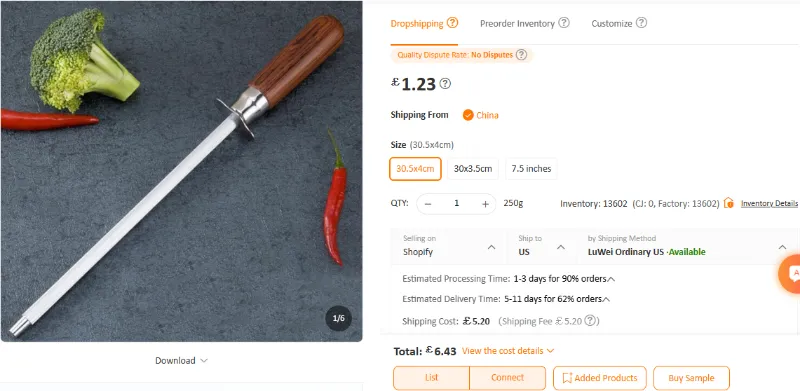
Supplier information
- Supplier: CJdropshipping
- Supplier location: China
- Processing time: 1 to 3 days
- Estimated delivery to the UK: 5 to 11 days
- Product cost: £1.23
- Shipping cost: £5.20
- Total supplier cost: £6.43
Comparable UK retail listing
A similar sharpening steel listed by KitchenKnives.co.uk was priced at approximately £39.00 at the time of writing.
| Cost item | Amount |
| Comparable UK retail price | £39.00* |
| Supplier product cost | £1.23 |
| Shipping | £5.20 |
| Total supplier cost | £6.43 |
| Shopify subscription and payment fees (estimated) | £1.90 |
| Currency conversion (estimated) | £0.10 |
| Advertising allowance (estimated) | £10.00 |
| Returns allowance (estimated) | £2.00 |
| Estimated remaining margin | £18.57 |
*Based on a comparable product available from a UK retailer. This is intended to illustrate potential margins rather than compare identical products.
Although the supplier price is very low, it represents only one part of the total cost of selling. Shipping, payment processing, advertising and returns reduce the estimated margin considerably. The supplier price alone therefore gives an incomplete picture of profitability.
Product 2: Travel bag
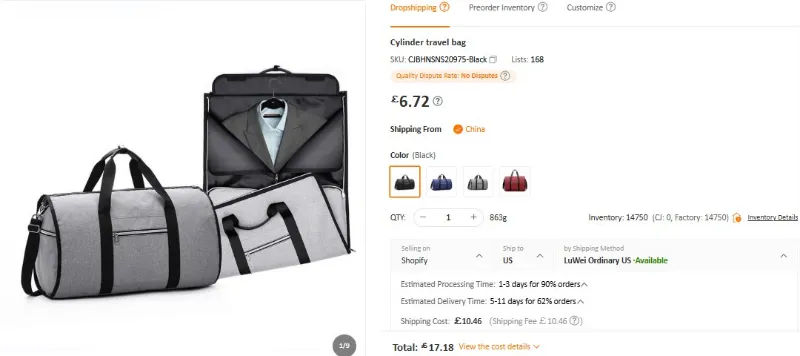
Supplier information
- Supplier: CJdropshipping
- Supplier location: China
- Processing time: 1 to 3 days
- Estimated delivery to the UK: 5 to 11 days
- Product cost: £6.72
- Shipping cost: £10.46
- Total supplier cost: £17.18
Comparable UK retail listing
A similar travel bag listed by Bags.co.uk was priced at approximately £69.95 at the time of writing.
| Cost item | Amount |
| Comparable UK retail price | £69.95* |
| Supplier product cost | £6.72 |
| Shipping | £10.46 |
| Total supplier cost | £17.18 |
| Shopify subscription and payment fees (estimated) | £3.35 |
| Currency conversion (estimated) | £0.20 |
| Advertising allowance (estimated) | £15.00 |
| Returns allowance (estimated) | £3.50 |
| Estimated remaining margin | £30.72 |
*Based on a comparable product available from a UK retailer. This is intended to illustrate potential margins rather than compare identical products.
The travel bag leaves a larger estimated margin than the knife sharpener. Even so, advertising remains one of the largest operating costs after sourcing and shipping.
Looking only at supplier pricing makes the product appear more profitable than it may be in practice.
| Cost item | Kitchen knife sharpener | Travel bag |
| Comparable UK retail price | £39.00 | £69.95 |
| Supplier price | £1.23 | £6.72 |
| Shipping | £5.20 | £10.46 |
| Total supplier cost | £6.43 | £17.18 |
| Shopify and payment fees (estimated) | £1.90 | £3.35 |
| Currency conversion (estimated) | £0.10 | £0.20 |
| Advertising allowance (estimated) | £10.00 | £15.00 |
| Returns allowance (estimated) | £2.00 | £3.50 |
| Estimated remaining margin | £18.57 | £30.72 |
What Did We Learn?
In both cases, the supplier price represented only a small proportion of the total cost of making a sale. The knife sharpener cost £1.23 before shipping, and the travel bag cost £6.72. Those figures initially suggest very high profit margins.
Once shipping, platform fees, payment processing, currency conversion, advertising, and potential returns were included, the estimated margin narrowed significantly. Advertising accounted for the largest operating cost in both examples after sourcing and shipping.
This test also highlights one of the limitations of AI-assisted product research. AI can quickly identify products worth investigating, but it can’t reliably determine whether those products will actually be profitable for your business.
Before listing any product, verify the supplier costs, estimate your operating expenses, and account for international payment costs. For businesses buying inventory from overseas suppliers, even small differences in foreign exchange charges can affect margins across hundreds or thousands of orders.
Methodology: Supplier pricing, processing times, and shipping estimates were taken from CJdropshipping at the time of testing. Comparable UK retail prices were taken from publicly available listings on UK retailer websites. Platform fees, payment processing, advertising, currency conversion, and returns are illustrative estimates only and will vary depending on the selling platform, payment provider, and individual business.
What AI Cannot Fix
- Slow delivery. Long shipping times from overseas suppliers drive returns, cancellations, and bad reviews. No AI tool changes the physical distance a parcel has to travel, which is exactly why logistics plays such a key role in how successful your dropshipping business will be.
- Weak demand. A product can score well on paper, because past search or ad data looked strong, and still not work for you. Demand scoring is built on historical signals, not a guarantee of future buyers.
- Low margins. Costs like currency conversion, fees, ad spend, and returns can reduce your margin to a point that no amount of automation can fix.
- Inaccurate product claims. AI-written descriptions can overstate what a product actually does. If the product doesn’t live up to the claim, it doesn’t just create a bad customer experience, it can invite legal trouble too.
What Dropshippers Are Actually Earning
One small operator we spoke with described margins closer to 2–3% per sale, a long way off any “quick profit” pitch, and a useful reminder that published averages don’t always match what an individual seller actually takes home.
More broadly, net profit margins for dropshipping typically fall between 15% and 25%, based on analysis of over 1,200 active stores. Beginners often run below 10% while they’re still learning what works. Where a seller lands within that range usually comes down to niche, ad spend, and how tightly they control costs. Payment processing and currency conversion are two that many underestimate, and both can eat into margin fast.
Everyone getting into dropshipping is not starting from zero. A fair number are established ecommerce sellers, sometimes running businesses in entirely different categories for years, who use dropshipping to test new products without committing to inventory upfront. For these sellers, dropshipping is not a business model in itself. Instead, it is a low-risk way to validate demand before deciding which products are worth stocking.
Is AI Dropshipping Legal and Legitimate?
Yes. AI dropshipping is in the UK. Using AI tools doesn’t change your legal obligations. You still need to make sure you comply with the relevant rules and laws.
A few specifics worth knowing:
- UK consumer law applies in full, regardless of who wrote the copy. Products must match their description, and statutory return and refund rights aren’t affected by whether a person or an AI tool generated the listing.
- Advertising accuracy is the seller’s responsibility, not the tool’s. If an AI tool writes a description that overstates what a product does, the seller is legally accountable for that.
- Customer data rules apply exactly as normal. Any AI chatbot, CRM, or support tool handling customer data still needs to meet UK GDPR requirements.
Is AI Dropshipping Worth It?
It saves you time: Product research that used to take hours of manual scrolling now takes minutes. Listings, ad copy variations, and basic customer support can be drafted or handled automatically, freeing up time for other important business decisions.
Tool costs are real too: A single free tool might cover early testing, but a working stack across research, store building, and support typically runs into a genuine monthly cost, one that eats into your margins.
Margins don’t improve automatically: AI can help you find and set up a product faster, but the underlying margin still depends on supplier price, currency conversion, platform fees, ad spend, and returns. Our own test of two real products, a kitchen knife sharpener and a travel bag, showed exactly this. Both looked highly profitable based on supplier price alone (£1.23 and £6.72 respectively), but once shipping, platform fees, currency conversion, advertising, and returns were added in, the real margin came down to £18.57 and £30.72.
Still healthy, but a long way from what the raw supplier price suggested on its own, and advertising, not the product itself, turned out to be the biggest cost in both cases.
The fair verdict: AI dropshipping is worth it as a way to run a dropshipping business faster and with less manual admin. It is not a shortcut to a business that’s automatically profitable.
Grow Your AI Dropshipping Business with WorldFirst
As our own product test showed, the numbers that actually decide whether a product is worth selling come down to real costs: supplier price, shipping, fees, advertising, and currency conversion. That last one directly affects how much of your margin you keep.
A World Account from WorldFirst gives you a straightforward way to manage that side of the business. Hold and pay suppliers in 100+ currencies, including CNY for Chinese suppliers, at competitive exchange rates, and collect sales revenue from 130+ marketplaces and payment gateways, including Shopify, Amazon, and Etsy, all in one account. Paying suppliers directly in their local currency cuts out unnecessary conversion markups, so more of the margin you calculate on paper actually reaches your account.
Open a free World Account today.
FAQs
Is AI dropshipping legit?
It’s a legitimate way to run a standard dropshipping business, not a guaranteed money-making system. The legitimacy of any specific store still depends on real suppliers, accurate listings, and fair pricing.
Is AI dropshipping worth it?
Yes. But it’s not a shortcut to guaranteed profit. Our own product test showed that a supplier price that looks highly profitable on paper can shrink a lot once shipping, fees, currency conversion, advertising, and returns are added in.
Can I start AI dropshipping for free?
No. While many AI tools offer free trials or limited free plans, running a real AI dropshipping business involves costs. Once you start paying for ads, subscribe to an ecommerce platform, or send customer orders to suppliers, you’ll likely need paid plans for the AI tools and services you use.
What’s the best AI dropshipping tool for Shopify?
Shopify’s own built-in AI, Shopify Magic, generates a working product page directly inside your store in a few minutes, though it doesn’t create product images from a prompt. Pair it with a research tool like Minea for finding products and a support tool like Tidio for customer queries.
Sources:
- https://www.legislation.gov.uk/ukpga/2015/15/contents
- https://www.gov.uk/government/publications/consumer-rights-act-2015/consumer-rights-act-2015
- https://www.citizensadvice.org.uk/about-us/our-work/citizens-advice-consumer-work/the-consumer-rights-act-2015/
- https://www.shopify.com/pricing
- https://www.tidio.com/pricing/
- https://www.minea.com/pricing
- https://cjdropshipping.com
- https://www.kitchenknives.co.uk/victorinox-23cm-diamond-sharpening-steel-oval-78313/
- https://www.bags.co.uk/Bugatti-Mare-Basic-Weekender-travel-bag-L-70-cm-334348.html
- https://www.worldfirst.com/uk/blog/