





























A business bank account is an account opened in a company’s name to receive, hold and send business funds.
For an importer, the choice becomes especially important when the same setup must cover SGD payroll and local bills alongside overseas supplier invoices, currency conversion and transfer charges.
A current account can support local operations, while another account manages supplier currencies, international payments or customer collections.
In this article, we compare six types of business bank accounts and explain how to choose the right setup for local operations and overseas payments.
Key takeaways:
- Different accounts serve different parts of the business: Current accounts handle regular SGD activity, while multi-currency, foreign currency, merchant and deposit accounts cover specific payment, sales or cash-management needs
- Choose an account based on real transactions: Review your regular supplier currencies, payment routes, order values and approval process instead of relying on account names or headline features
- Compare the full cost of a supplier payment: Exchange-rate margins, transfer fees and deductions from the amount received may matter more than the monthly account fee, especially on larger or repeat orders
- WorldFirst can support the cross-border part of the setup: A World Account can bring overseas supplier payments, currency conversion, approval controls and transaction records into one place alongside your existing SGD account
Business bank account types: six options explained
Business bank account types describe the different accounts companies use for everyday payments, foreign currencies, deposits and customer collections. The label ‘business account’ can refer to a bank deposit account, payment account or merchant service.
Singapore’s Payment Services Act regulates services including account issuance, domestic and cross-border money transfers and merchant acquisition. The provider’s licence affects which services it can offer and the safeguards that apply to relevant customer money.
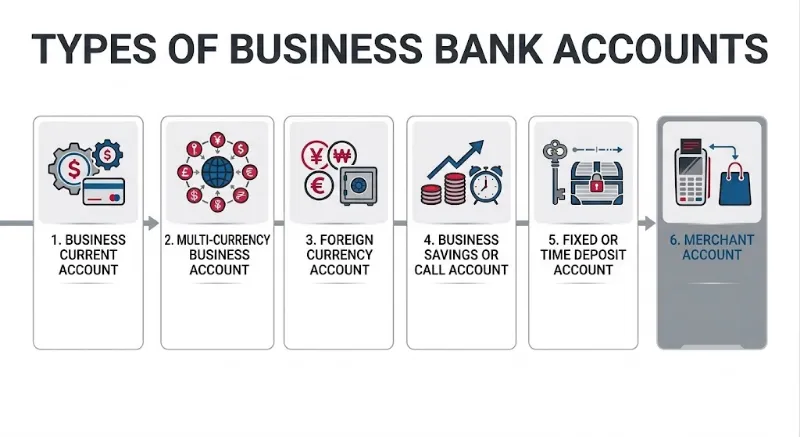
Here’s how the six options compare for a Singapore importer:
| Account type | Main role | Best used when | Main point to compare |
| Business current account | Manages everyday SGD payments and receipts | You need payroll, tax and local payment services | International fees and FX pricing |
| Multi-currency business account | Manages several currencies through one setup | You pay suppliers across multiple markets | Currency coverage for receiving, holding and paying |
| Foreign currency account | Manages one main foreign currency | You pay most supplier invoices in the same currency | Costs of adding more currencies |
| Business savings or call account | Holds accessible funds and may pay interest | You haven’t allocated the money to an upcoming payment | Access rules and notice periods |
| Fixed or time deposit account | Pays interest over an agreed term | You won’t need the money before maturity | Early withdrawal conditions |
| Merchant account | Processes card and digital wallet payments | You sell through your own online or physical store | Processing fees and settlement timing |
1. Business current account
A business current account usually forms the base for SGD payments and receipts, including payroll, CPF, tax, rent and local supplier bills.
FAST sends SGD between participating accounts almost immediately and operates 24 hours a day, 365 days a year. That availability can help when a local invoice or supplier deposit is due outside standard banking hours.
Before sending an overseas supplier payment from the same account, compare:
- FX pricing: Check the exchange rate offered for the invoice currency
- Transfer charges: Include international fees and any agent or intermediary bank costs
- Beneficiary amount: Confirm whether deductions may reduce what reaches the supplier
- Payment controls: Review transaction limits and approval requirements
- Account costs: Compare monthly and fall-below fees with the value of the services used
For regular or high-value supplier invoices, the total payment cost may be more important than the monthly account fee.
2. Multi-currency business account
Several recurring supplier currencies can make a multi-currency account more useful than opening a separate account for every market.
Depending on the provider, the account can let you hold balances, convert funds and pay overseas suppliers through one platform.
Check what each supported currency allows:
- Hold: Currencies you can maintain without conversion
- Receive: Currencies you can collect and the payment routes available
- Pay: Currencies and destinations the provider supports
- Convert: Rates and fees applied between currency balances
- Local details: Markets where the provider offers local receiving details
A provider may support outgoing USD payments without offering local US receiving details. Some providers also let you pay in a currency without letting you hold it as a balance.
Match the account to your regular supplier activity by looking at:
- Invoice requirements: Currency and beneficiary country
- Payment route: Local network or SWIFT
- Total cost: FX margin and transfer fee
- Controls: Payment limits and approval options
- Connections: Xero, NetSuite or other systems already in use
For repeat orders, coverage for the currencies, countries and routes you actually use matters more than a long list of unused options.
3. Foreign currency account
A dedicated foreign currency account becomes relevant when most supplier invoices use the same currency.
For example, a USD account can support recurring invoices in USD, while a CNH account can support eligible cross-border payments to suppliers in Mainland China. CNH refers to renminbi used outside Mainland China. CNY generally refers to onshore renminbi.
Confirm the currency code and beneficiary details on the supplier invoice before making payment.
Base the comparison on how the main supplier corridor operates:
- Ongoing costs: Opening fees, maintenance charges and minimum balance requirements
- Conversion path: The cost of moving between SGD and the foreign currency
- Transfer access: Available incoming and outgoing payment routes
- Access to funds: Withdrawal rules and any interest offered
- Deposit protection: Whether the balance qualifies for deposit insurance
Singapore’s Deposit Insurance Scheme doesn’t cover foreign currency deposits. When additional supplier currencies become regular, separate accounts may add fees and reconciliation work.
4. Business savings or call account
Money reserved for tax, a later stock order or an unconfirmed purchase may need more access than a fixed deposit allows.
A standard savings account may provide regular access, while a call or notice account might require advance notice.
Compare how quickly funds can return to the operating account, along with any withdrawal limits, interest tiers, minimum balance requirements and transaction charges. Also, establish whether the balance qualifies for protection under Singapore’s Deposit Insurance Scheme.
The access terms should match the purchasing schedule. A supplier deadline or newly available production slot may require the money sooner than expected.
5. Fixed or time deposit account
Funds with no expected use before a known date may earn interest in a fixed or time deposit. Money allocated to supplier deposits, final balances, payroll, tax or likely stock orders should remain accessible.
Compare the term, maturity date, minimum placement, renewal settings and consequences of early withdrawal. A foreign currency deposit also introduces exchange-rate exposure, so use a fixed-term account only when the money has no expected use before maturity.
6. Merchant account
A merchant account becomes relevant when imported products are sold through the business’s own e-commerce store, payment links, shop or showroom.
Online transactions made up an estimated 14.4% of Singapore’s total retail sales in January 2026. For importers selling through their own e-commerce stores, checkout costs and payment timing are important parts of the account setup.
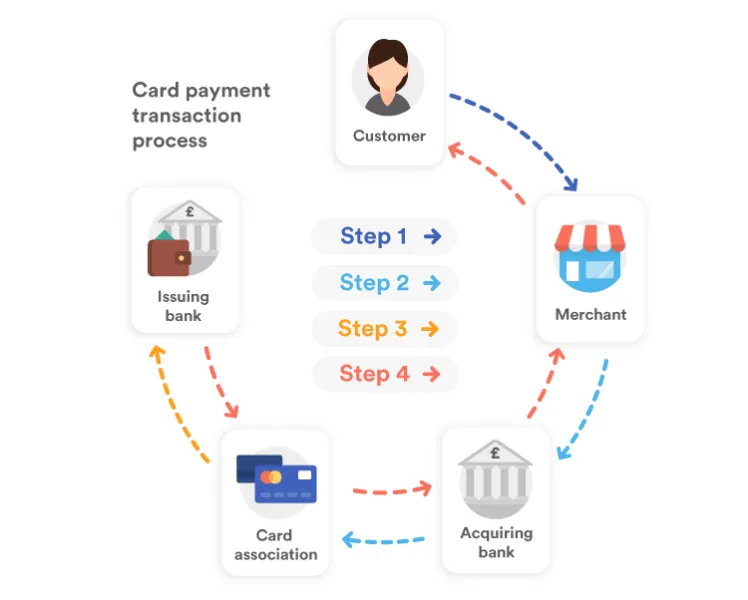
Follow how sales proceeds move from checkout to the business account:
- Processing cost: Card and digital wallet fees
- Settlement timing: How long funds take to become available
- Settlement currency: Which currency reaches the nominated account
- Refund exposure: Chargeback, refund and reserve terms
- Reporting: E-commerce integrations and reconciliation records
Settlement delays or deductions can reduce the funds available for the next inventory order.
How to choose the right business bank account type
Start with the transactions that involve repeated conversions, delays or extra checks. Use your existing payment records to identify where these issues enter the process:
1. Map where each payment starts and ends
List the regular movements across your accounts during a normal month. Record the starting currency, recipient and route for each one.
Group the transactions by their role:
- Incoming funds: SGD customer payments and marketplace or e-commerce receipts
- Supplier payments: Deposits and final invoice balances
- Operating costs: Software and service payments
- Currency movements: Conversions and transfers between your own business accounts
Look for transactions that involve several steps. Sales revenue may arrive in one currency, convert into SGD and later convert again to pay an overseas supplier.
Also note where you copy details between platforms, download separate statements or match one invoice against several transactions.
Those records show which payments could pass through fewer accounts or conversions. Several sourcing currencies may support a multi-currency account, while one regular invoice currency may justify a foreign currency account.
2. Rebuild the cost of one completed supplier payment
Choose a past invoice that reflects the size and currency of your regular orders. A completed transaction provides more useful evidence than a provider’s headline fee.
Break the payment into five parts:
- Invoice amount: The value and currency shown by the supplier
- Account deduction: The total SGD amount taken from your account
- Supplier receipt: The amount that reached the beneficiary
- Conversion cost: The exchange rate and any separately charged fees
- Payment outcome: Delivery time and any follow-up needed to trace or correct the transfer
Start with the supplier’s invoice amount and work backwards to the amount deducted from your account. The difference shows the combined effect of conversion and payment charges.
Use the same invoice when comparing another account to create a like-for-like comparison based on a transaction your business actually makes.
Avoid using a small test transfer as the benchmark, as fixed fees and FX pricing affect a small payment differently than they affect a typical inventory order.
3. Map what already depends on your current account
Before moving any transactions, identify the services already connected to your current account. These may include direct debits, scheduled transfers, payroll, CPF and tax payments, saved beneficiaries, two-step approvals and accounting software connections.
Credit facilities, trade finance, cheque services and cash deposits may also depend on the existing account.
Moving only recurring overseas supplier payments can reduce a specific cost or administrative task without disrupting local instructions that already work as required.
Which business account combination works for an importer?
Account combinations are useful when one account can’t efficiently cover a regular supplier, sales or cash-management activity.
The table matches four setups to the payment patterns of an established small importer or digital sourcer:
| Payment pattern | Account combination | How the setup works |
| You pay repeat suppliers across several currencies | Current account + multi-currency account | The current account covers SGD activity, while the multi-currency account handles overseas payments and supported currency balances |
| You pay most supplier invoices in one foreign currency | Current account + foreign currency account | The current account manages local activity, while the foreign currency account supports one established supplier corridor |
| You import stock and sell through your own e-commerce store or physical checkout | Current account + multi-currency account + merchant account | Each account covers a separate stage: local expenses, overseas supplier payments and direct customer collections |
| You hold money beyond upcoming supplier and operating commitments | Current account + savings or fixed deposit account | Near-term commitments remain funded through the current account, while the deposit account holds money intended for later use |
For businesses with repeat overseas orders, a current account plus one cross-border account often provides the core setup. Add another account only when it serves a clear, regular purpose.
Common mistakes when choosing a business account setup
Avoid problems that can delay supplier payments, disrupt order timelines or make returned funds harder to track, including:
- Opening the account too close to a supplier deadline: Onboarding, verification and beneficiary checks may delay the first transfer and leave less time to correct missing details
- Depending on a single payment approver: A deposit or final balance may remain pending when the only authorised user is unavailable
- Having no backup payment route: A rejected or unavailable transfer route can leave a time-sensitive supplier payment with no approved alternative
- Ignoring where refunds return: Supplier refunds and marketplace reversals may arrive in a different account or currency, making them harder to match with the original transaction
Read more: What are the disadvantages of business bank accounts
Pay overseas suppliers with WorldFirst
WorldFirst offers Singapore businesses a World Account for holding supported currency balances, converting funds and sending international payments.
When comparing business bank account types, the World Account can complement an existing SGD current account by taking on cross-border activity. Local payments can remain with the account already connected to payroll, tax and domestic expenses.
Businesses can use a World Account to pay in 100+ currencies across 210+ countries and territories and track international transactions in one place.
Example: separating local and overseas payments
Imagine a Singapore importer pays CNH 350,000 to manufacturers on 1688 and MYR 45,000 to a packaging supplier each month. Freight, warehousing and other local expenses add another SG$20,000.
Sending every payment from the SGD current account means arranging separate currency conversions while the same account continues handling local instructions and operating expenses.
The current account can retain the SG$20,000 needed locally, while a World Account takes on the CNH and MYR supplier payments where supported. The separation gives recurring overseas invoices a clearer place in the account setup without disrupting payroll, tax or domestic payments.
WorldFirst isn’t a bank. WorldFirst (Singapore) Merchant Services Pte. Ltd. is licensed by the Monetary Authority of Singapore as a Major Payment Institution under the Payment Services Act 2019 to provide account issuance, domestic and cross-border money transfer and e-money issuance services.
FAQ
1. Can I use a payment account instead of a business bank account to pay overseas suppliers?
2. Can a Singapore business have accounts with more than one provider?
3. Should I leave my old business account open when moving payments to a new provider?
4. What happens if a supplier’s name doesn’t match the beneficiary account name?
5. What records should I keep for overseas supplier payments and refunds?
- https://sso.agc.gov.sg/Act/PSA2019
- https://abs.org.sg/docs/library/2026-07-07-fast-fact-sheet.pdf
- https://www.moneysense.gov.sg/understanding-deposit-insurance/
- https://www.straitstimes.com/business/economy/singapore-retail-sales-drop-0-4-in-january-partly-due-to-cny-timing


![Revolut Business Card review Singapore [2027]: Features, fees & more](https://mdn.marmot-cloud.com/worldfirst/sites/9/2026/09/20261001002258848-300x200.webp)