





























Home > blog > International Transactions > International money transfer fees compared (2026 guide)
International money transfer fees compared (2026 guide)
Last update:


For UK businesses operating internationally, the actual cost of moving money rarely shows up at the point of payment. A transfer goes out, the account balance changes and the transaction appears complete.
The real differences only surface later in the settlement amount, the exchange rate applied and deductions taken along the way.
A recent analysis shows that cross-border payments can cost up to 10 times as much as comparable domestic transfers, which helps explain why international payment costs remain a persistent concern for UK finance teams.
In 2026, payment speed has improved, but international payment costs remain complex. Charges vary by payment corridor, currency and method, making side-by-side comparisons difficult without a clear international money transfer fee comparison.
This guide provides a UK-focused international money transfer fees comparison for 2026. It shows how providers apply fees in real business payment flows, compares common transfer options and outlines what UK companies should consider when managing international business payments.
Key takeaways:
- International payment costs often appear after the transfer completes: Exchange rate markups, intermediary deductions, inbound fees and forced conversions usually show up only once the payment settles, which is why international transfers feel unpredictable
- Exchange rate handling matters more than most businesses expect: Without clear visibility into how providers set rates, businesses struggle to understand what they actually pay
- Intermediaries and double conversions quietly increase costs: SWIFT routing and indirect currency paths can reduce the final amount received. Automatic conversions on receipt and again on payment create avoidable losses and complicate cash flow planning
- Holding and using foreign currencies improves control: Receiving funds in the original currency and paying expenses from the same balance avoids unnecessary conversion and reduces reconciliation issues
- WorldFirst’s World Account removes common sources of hidden fees: UK businesses can hold over 20 currencies, receive payments locally, avoid forced conversion and see FX rates upfront, making international money transfer fees easier to understand and control
Open a World Account for free and control when and how currency conversion occurs.
Understanding international money transfer fees
Cross-border transactions involve several potential fees and hidden costs. It’s easy to focus on the upfront transfer fee, but other factors often have a bigger impact on the total cost.
These are the main fee types and how they affect UK businesses:
1. Foreign exchange (FX) markups
When converting currency, most banks and providers do not use the real mid-market rate (the rate you’d find on Google). Instead, they apply a markup or spread on the exchange rate as their profit. Traditional banks typically embed a 2%–5% markup in the rate they offer. This hidden cost can far exceed any flat fees.
Specialist fintech providers tend to offer much tighter spreads. Currency brokers and fintech platforms often charge well under 1% for FX conversion. For instance, some services take as low as a 0.5% margin. And throughout 2026, every new WorldFirst customer can enjoy a 0.3% FX fee for 180 days and unlimited transfers.
On a £100k conversion, that would save thousands compared to a high-street bank. The key is transparency – always ask providers to specify the exact exchange rate and the spread over the market rate.
Even a slight percentage difference can significantly affect costs for businesses handling large volumes or frequent transfers.
2. Transfer fees (outgoing transaction fees)
Most banks charge a flat fee for sending an international payment. In the UK, these outgoing fees typically range from £0 up to around £35 per transfer.
For example, high-street banks often advertise a fee of £20–£25 for a SWIFT payment sent in branch (sometimes up to £40).
However, “no transfer fee” doesn’t mean no cost; it often means the bank is earning more on the exchange rate instead. In 2026, fintech platforms increasingly offer low or zero transfer fees. It’s now common to see specialist providers charging £0–£5 per international payment (or a small percentage fee).
While a £15 or £25 fee might not sound huge, it adds up for SMEs making frequent payments. Twenty overseas payments a month at ~£25 each is £500 in fees – a substantial monthly expense.
Businesses should also watch for initiation or handling fees (some banks charge extra if you set up the transfer in a branch or by phone) and even “tracer” fees (a charge to track a payment’s status). These are generally small, but they add up, especially if your company regularly sends money abroad.
3. Intermediary bank charges (correspondent fees)
When sending money internationally via the SWIFT network, the payment often hops through one or more intermediary banks (also called correspondent banks) before reaching the beneficiary’s bank. Each intermediary can deduct a fee from the amount in transit.
These fees are unpredictable and vary by route and bank. Neither the sender nor the recipient may know in advance how many correspondents will be involved or how much each will take. The result: the recipient might receive less than expected due to these hidden deductions.
UK businesses encounter this problem every day. You send a £10,000 payment expecting the full amount to arrive, only to see £30 or £40 deducted along the way. With shared fees (SHA), intermediary and receiving banks take their cut from the payment. With OUR fees, your bank charges extra upfront to cover those correspondent costs.
Either way, the lack of transparency makes it hard to predict the final cost. As the Bank of England notes, the traditional correspondent chain results in “unpredictable fees deducted along the chain”. It makes it difficult to accurately assess the actual cost of a cross-border payment.
Modern solutions try to minimise this issue. Some fintech providers have built networks of local accounts to avoid using SWIFT for specific routes, thereby eliminating intermediate fees.
When evaluating providers, UK businesses should check if quoted fees guarantee the amount the beneficiary receives or if intermediaries still deduct charges during the transfer.
4. Receiving (inbound) bank fees
Lesser-known but equally important are the fees charged by the receiving bank. When your UK business receives a payment from abroad, your bank might impose an incoming international payment fee.
In the UK, receiving an international SWIFT payment can also trigger a fee at the beneficiary’s bank.
These fees reduce the amount you receive compared with what the sender pays. It can also complicate reconciliation – your customer paid the full invoice amount, but your account shows a shortfall (the fee).
To avoid inbound fees, some businesses try to receive foreign payments into specific currency accounts (e.g., a USD account at their UK bank), but even then, some banks apply a fee for handling the transfer.
An alternative is to use providers that offer local receiving accounts abroad, which can bypass SWIFT entirely for receipt.
5. Forced or double currency conversions
Perhaps the most underhanded cost of all is forced double conversion – when a transaction involves two currency exchanges instead of one.
Many businesses never notice it happening, yet the extra conversions can push costs much higher. Double conversion occurs when the payment route or provider cannot process the origin and destination currencies directly.
If a UK company pays a supplier in a more exotic currency, a bank might first convert GBP to USD (one conversion), then USD to the target currency (a second conversion), because it lacks a direct FX pair.
Similarly, if a foreign client pays you in USD but your GBP business account automatically converts incoming funds to GBP and later you convert GBP back to USD to pay expenses, you’ve done two conversions where one would suffice.
Consider a concrete example:
- A client in the US sends $1,000 to a UK business for services
- The payment provider or marketplace converts USD into an intermediate currency, such as EUR
- The UK bank converts the EUR into GBP when the funds arrive
- The $1,000 effectively went through USD→EUR and EUR→GBP conversions
- Each conversion applies a margin, so the business may receive around $950 in GBP by the time the funds settle
Each step had a commission and a less-than-perfect rate, so by the end, the business might hypothetically get only the equivalent of $950 in GBP.
Double conversions often reside in specific channels, such as online payment gateways and marketplaces. For instance, a buyer pays in one currency, the platform internally settles in another and then you withdraw in GBP – that’s two conversions. Credit card payments can also trigger it (if your card processor converts the charge’s currency before final settlement).
The bottom line: two conversions = two sets of fees and often a worse overall exchange rate, so it’s crucial to structure international flows to convert currencies only one time.
Typical fee structures: UK international payments by provider type
Here is a breakdown of typical costs by provider type, illustrating the real-world fees and margins a UK SME might encounter in 2026:
| Method | Transfer fees | FX margin | Intermediary fees | Approx. cost on £10,000 |
| High-street bank | £0–£25 online (£15–£40 in branch); incoming ~£2–£7 | Often 2%–4% above mid-market (built into rate) | Common (£10–£30 deducted in transit) | ~3%–5% (£300–£500) |
| Fintech FX provider | £0–£5 or small % | ~0.3%–1% (transparent) | Usually none | ~0.5%–1% (£50–£100) |
| Payment gateway / marketplace | No wire fee; platform fees apply | Often 2%–4% (Amazon ~1.5%, Shopify ~2%, PayPal ~3%) | None (fees bundled by platform) | ~4%–6% (£400–£600) |
| Multi-currency account | £0 for local transfers; low flat fees | ~0.5%–0.75% | None when using local accounts | ~0.5%–1% (£50–£100) |
*Sources: Bank fee schedules; fintech provider disclosures; industry reports.
What international transfer fees look like in real UK business scenarios
The examples below show how international transfer fees appear in everyday UK business payments and why the chosen payment route makes such a difference to the final cost:
Scenario 1: Paying overseas suppliers (importers)
A UK-based importer needs to pay an overseas supplier.
This could be a British SME buying stock from Europe, the US or Asia. How do different methods stack up?
Using a bank SWIFT transfer:
- The bank charges a transfer fee
- The FX rate includes a markup
- Intermediary banks may deduct fees in transit
- The supplier often receives less than invoiced, leading to follow-ups or extra charges
In practice, total costs often reach 3–5% once fees and FX margins combine.
Using a specialist FX provider:
- Fees and FX costs appear upfront
- FX rates sit closer to market levels
- Payments move via local networks, avoiding intermediaries
- The supplier receives the full amount
For most UK importers, specialist providers offer lower costs and more predictable payments.
Scenario 2: Receiving international sales (exporters)
A UK business receives payments from international customers or marketplaces.
The aim is to receive those earnings efficiently and with minimal loss.
Via a UK bank:
- Incoming fees may apply
- Currency converts automatically at the bank’s rate
- The final amount received is often lower than expected
Via foreign currency accounts:
- Customers pay locally in their own currency
- Funds arrive without forced conversion
- The business chooses when to convert to GBP
This approach reduces fees and gives exporters more control over FX costs.
Scenario 3: Managing multi-currency cash flow (avoiding double conversion)
A UK business deals in multiple currencies regularly – how can it manage funds to avoid needless fees?
International SMEs often earn and spend in multiple currencies. Without careful management, banks convert the same funds twice, increasing costs.
A common mistake:
- Revenue arrives in EUR or USD
- Funds convert to GBP automatically
- The business converts GBP back to pay foreign suppliers
That round trip creates unnecessary FX costs.
A better approach:
- Hold foreign currency when received
- Pay foreign expenses from the same currency balance
- Convert only what remains
Multi-currency accounts make this simple and help avoid avoidable FX charges.
How to reduce fees and choose the right solution
International payments no longer need to follow the old, expensive routes. For UK SMEs, the focus should be on understanding the true cost of each transfer and choosing options that offer clarity and control.
Here’s a simple way to approach it:
- Break down your costs: Know what you’re paying. Ask your bank for the exchange rate used for your last transfers, then calculate the spread. Identify any mystery deductions on receipts (likely intermediary fees). This clarity will help you decide where to cut costs
- Compare providers and accounts: Don’t assume your bank (or any single provider) is the cheapest. Specialist providers can often save you 50–80% on fees. Look at fintech platforms that publish their fees and FX margins openly. Many have online calculators – use them with your typical transfer amounts to compare
- Use multi-currency accounts to your advantage: Multi-currency accounts can eliminate unnecessary conversions and fees. For example, World Account from WorldFirst allows UK businesses to open local accounts in 20+ currencies. You can collect payments from platforms like Amazon or Shopify or from overseas clients, without forced conversion, then convert only when it suits you. This setup avoids incoming fees, reduces double conversion and gives you more control over FX costs
- Negotiate or tier your FX rates: If you still rely on a bank for some payments, try to negotiate better FX rates, especially if you have large volumes. Banks often have tiers – you might get a 1% margin instead of 3% if you ask and if your volumes justify it
- Plan payments strategically: Whenever possible, batch smaller payments to reduce per-transfer fees (send one monthly payment to a supplier instead of four weekly ones – saving 3 x £25 fees). Also consider forward contracts or rate orders if you have budget rates in mind. Locking in a reasonable rate can save a lot if the market moves against you later
- Stay informed on improvements: The cross-border payments industry is evolving quickly, with initiatives to improve speed, cost and transparency. Keep an eye on new services such as instant FX transfers, local clearing options (e.g., RTP, SEPA Instant) and emerging digital currency solutions, which may further reduce costs in the future. Regulators and the G20 are pushing hard to lower costs, which should benefit SMEs
How the World Account changes international transfer costs
Any international money transfer fees comparison shows that most payment costs come from providers routing money through inefficient paths, including unnecessary conversions, SWIFT intermediaries and unclear FX margins applied by default.
The World Account from WorldFirst changes that structure. While it’s not a bank account, it avoids forcing funds through SWIFT chains and automatic conversions, giving UK businesses direct control over currencies, routes and timing.
What this looks like in practice:
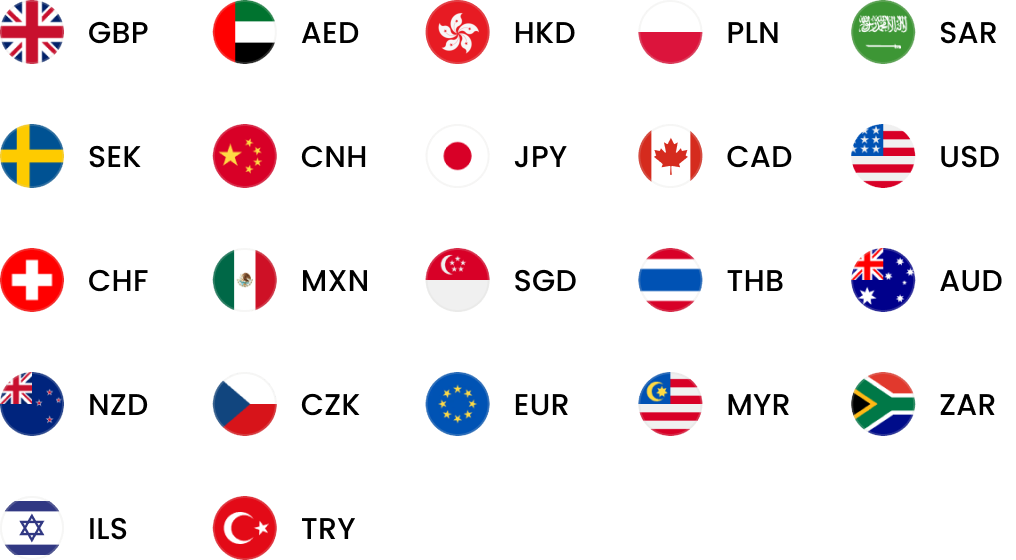
- Hold and manage 20+ currencies: UK businesses can hold balances in major trading currencies, including GBP, USD, EUR, CNH, AUD, CAD and JPY, without automatic conversion back to pounds
- Local account details in key markets: Receive payments using local bank details in the US (USD), UK (GBP), EU (EUR), China (CNH) and other regions
- £0 transfer fees on many routes: WorldFirst charges zero transfer fees on most local payments and on transfers to key destinations, including payments to China. Other international payments typically carry a low fixed fee, not a percentage-based charge
- Transparent FX pricing: FX rates appear upfront before you send or convert funds. Typical FX margins for UK SMEs sit around 0.5%, significantly lower than the 2%–4% often embedded in high-street bank rates
- No forced or double conversion: Funds stay in the original currency until you choose to convert. This avoids common double-conversion scenarios, such as USD→GBP on receipt and GBP→USD when paying suppliers
For UK businesses trading internationally, this replaces uncertainty with control. Instead of paying for hidden FX margins, correspondent bank deductions and automatic conversions, costs become visible, predictable and limited to the conversion you actually choose to make.
Are unnecessary conversions built into your current payment routes?
Open a World Account for free and simplify how your business sends, receives and converts currency.
Sources:
- https://www.worldfirst.com/uk/
- https://www.worldfirst.com/uk/business/world-account/
- https://www.sidekickaccounting.co.uk/post/international-money-transfers-uk-expats-best-options-2025
- https://statrys.com/guides/uk/send-money
- https://www.ofx.com/en-au/blog/international-money-transfer-fees-bank-costs/
- https://www.regencyfx.com/currency-transfer-guides/understanding-the-expenses-of-transferring-money-internationally
- https://www.moneysavingexpert.com/banking/foreign-currency-exchange/
- https://rozeremit.com/blog/complete-guide-for-2025-how-to-transfer-money

Abdul Muhit has 17 years' experience in banking and payments, spanning across regulation, payment networks, acquiring, issuing and treasury. He has served across strategic and delivery roles in product, technology and operations functions at global companies including JP Morgan, KPMG and Visa."

Abdul Muhit
Author
Continue reading


Subscribe
The Weekly Dispatch
Get the latest news and event invites. Signup for our weekly update from the worlds of fashion, design, and tech.
You might also like
Choose a product or service to find out more

E-commerce guides


Doing business with China

Exploring new markets

Business Tips

International transactions
E-commerce expansion guides
Doing business with China
The simpler way to pay and get paid
Save money, time, and have peace of mind when expanding your global business.