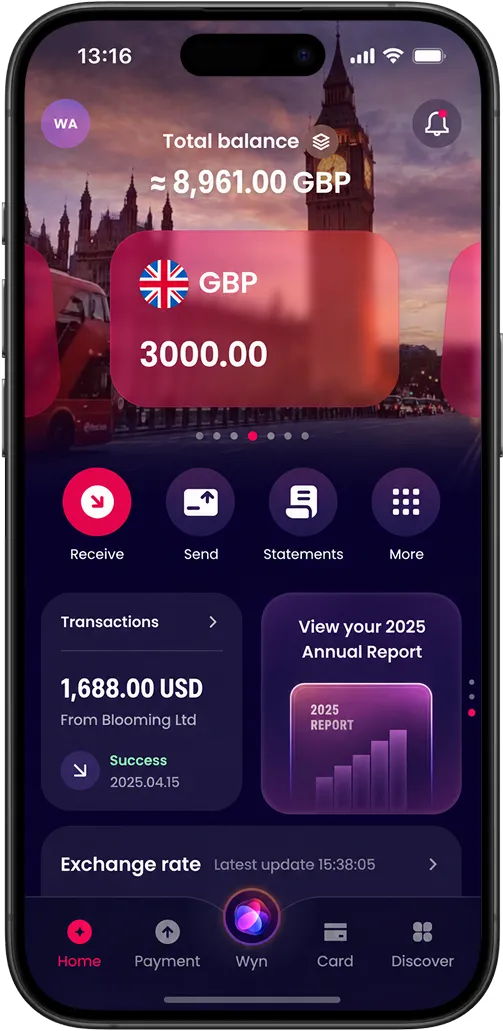
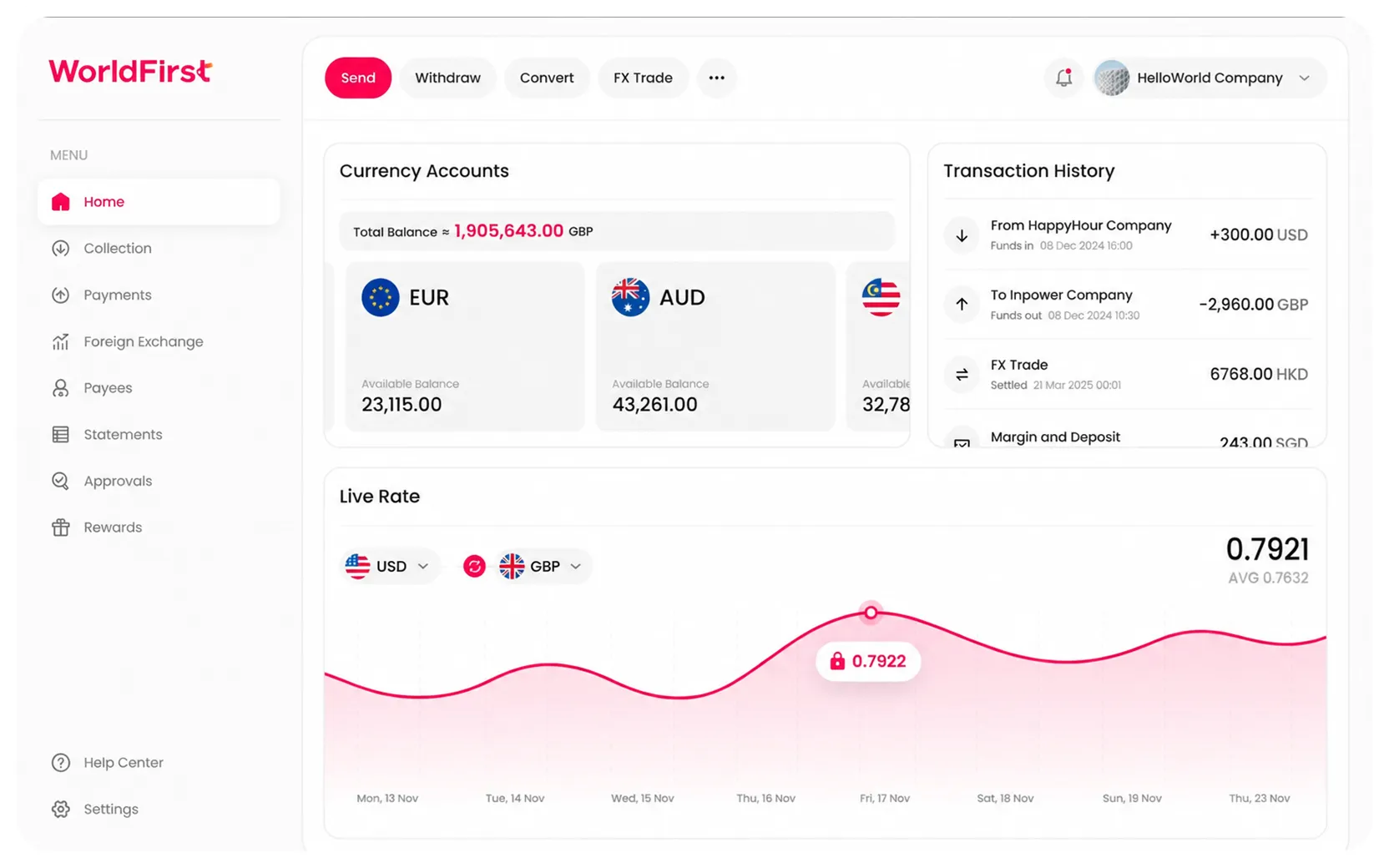
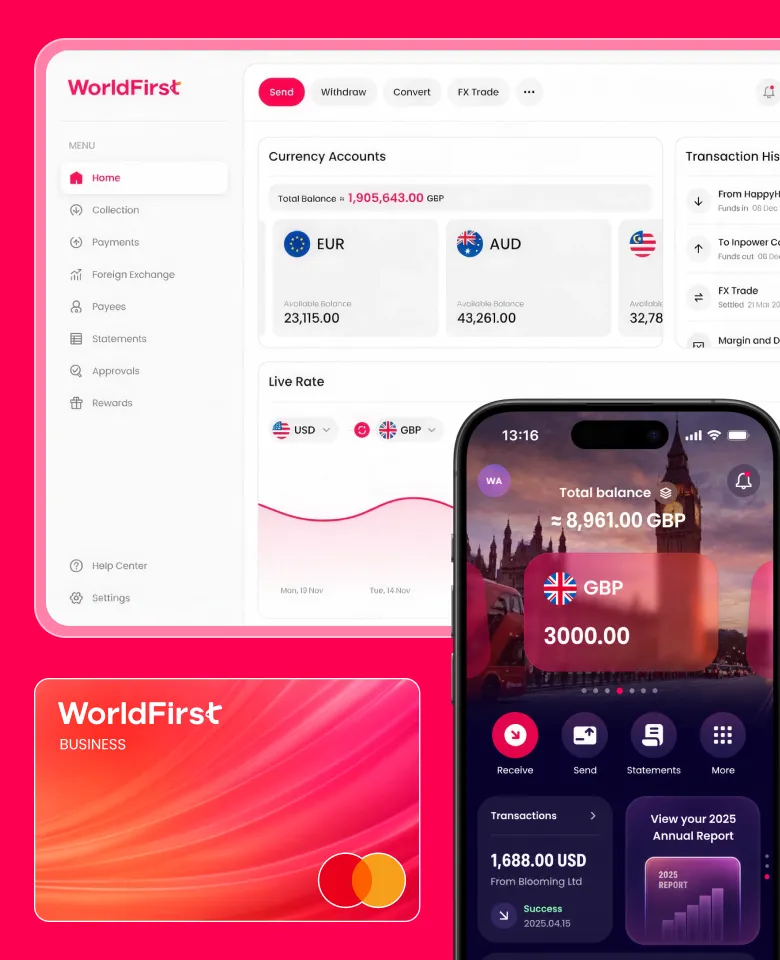
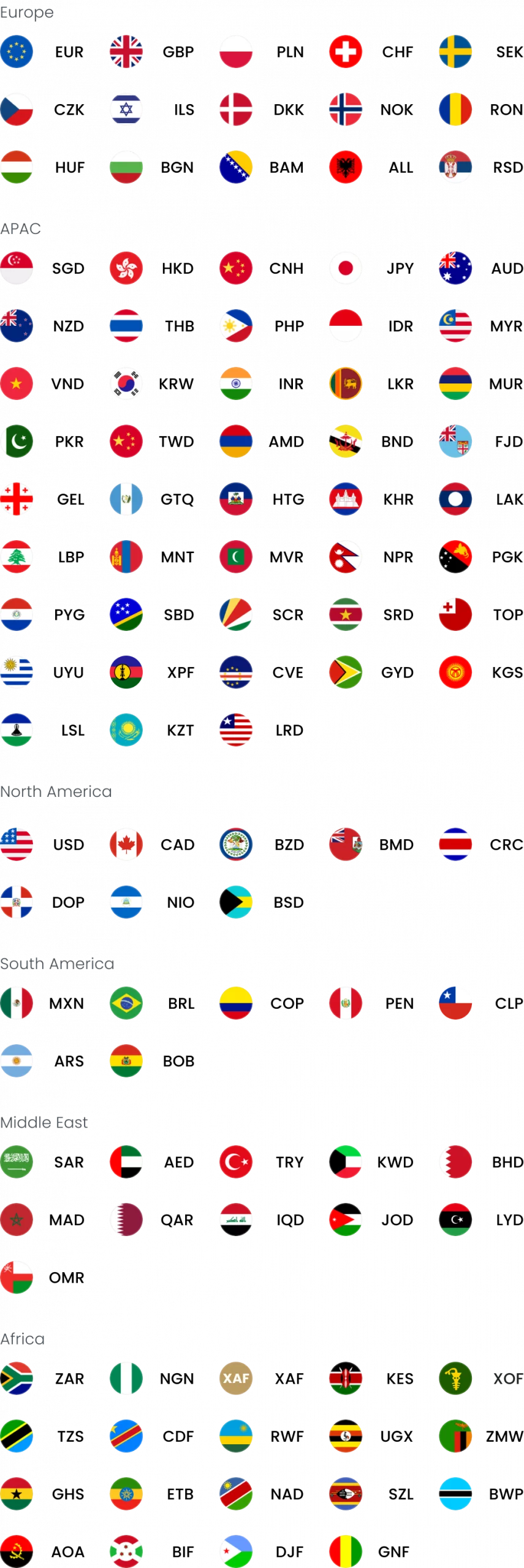
We provide coverage in South Asia and Middle East: servicing 210+ countries and territories.

WorldFirst Home > blog > Global Business Tips > Business account management: a guide for UK SMEs
If you’re running a UK SME that trades internationally, you’ll know the moment: an invoice lands in USD or EUR, your bank quotes a rate that feels off, and you’re left wondering exactly what margin you just paid.
That friction, repeated across dozens of supplier payments and marketplace payouts a month, is usually the real trigger for reviewing how your business account actually manages multi-currency money, not just where it’s held.
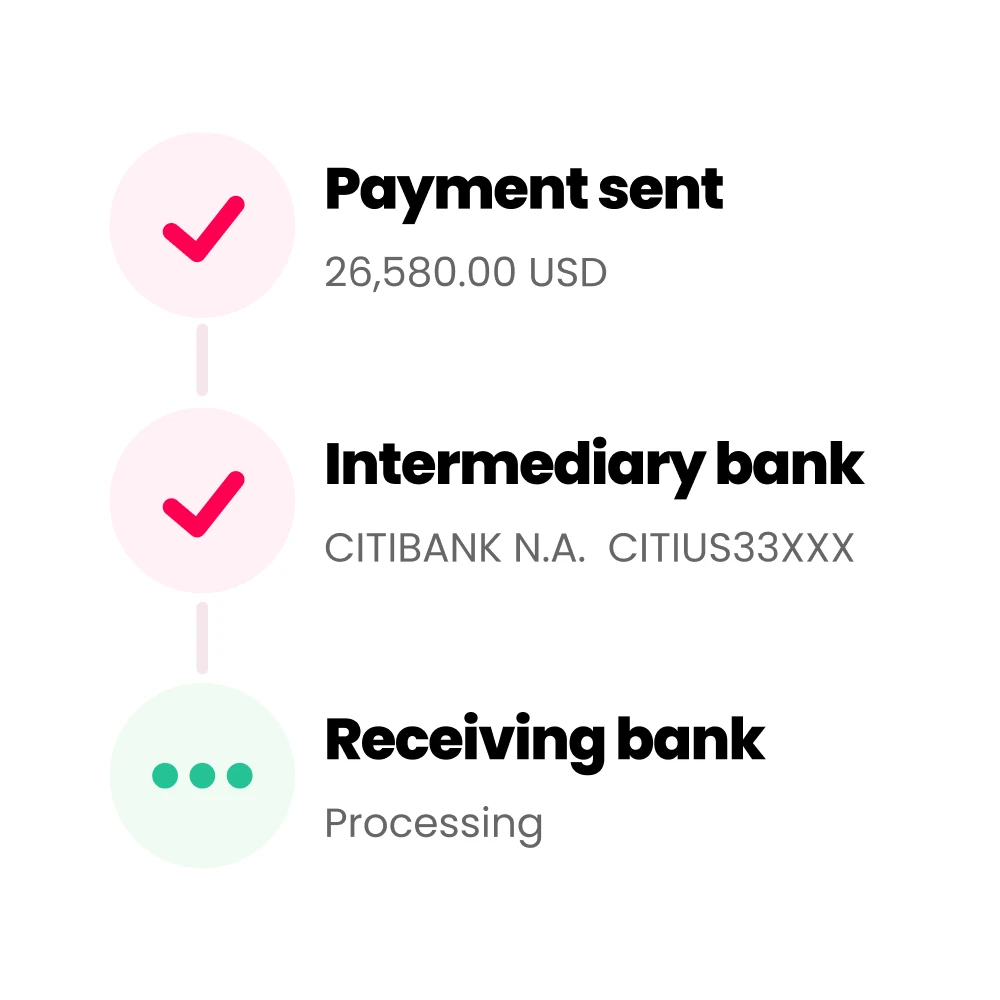
The scale of the problem is well documented. Standard bank telegraphic transfers typically bundle an FX margin that isn’t shown separately, alongside a cable fee and handling commission, with settlement taking one to five business days and correspondent banks sometimes deducting further charges along the way, leaving you short of the amount you expected to land.
For an SME sending tens of thousands of pounds a month to suppliers or paying marketplace ad platforms in a foreign currency, that hidden cost compounds fast.
This guide sets out what good business account management looks like for a UK SME comparing or switching providers, covering the features worth checking, how fees and FX tools stack up, and what to expect when you move to a multi-currency account like the World Account.
Open a World Account to manage multi-currency collections, payments and FX from one dashboard.
Business account management, in the context of cross-border trade, means the full set of tools you use to collect, hold, convert, pay and reconcile money across currencies, plus the controls that govern who in your business can do what with it.
It’s a broader concept than simply ‘having a business bank account’, because for an SME trading with overseas suppliers or marketplaces, the account itself is only useful if it also gives you visibility over FX costs, flexible payment rails and proper internal controls.
If you’re comparing providers, the practical test is whether the account lets you see the true cost of every conversion before you commit to it, move money on the timeline your suppliers expect, and keep a clear audit trail for your bookkeeper.
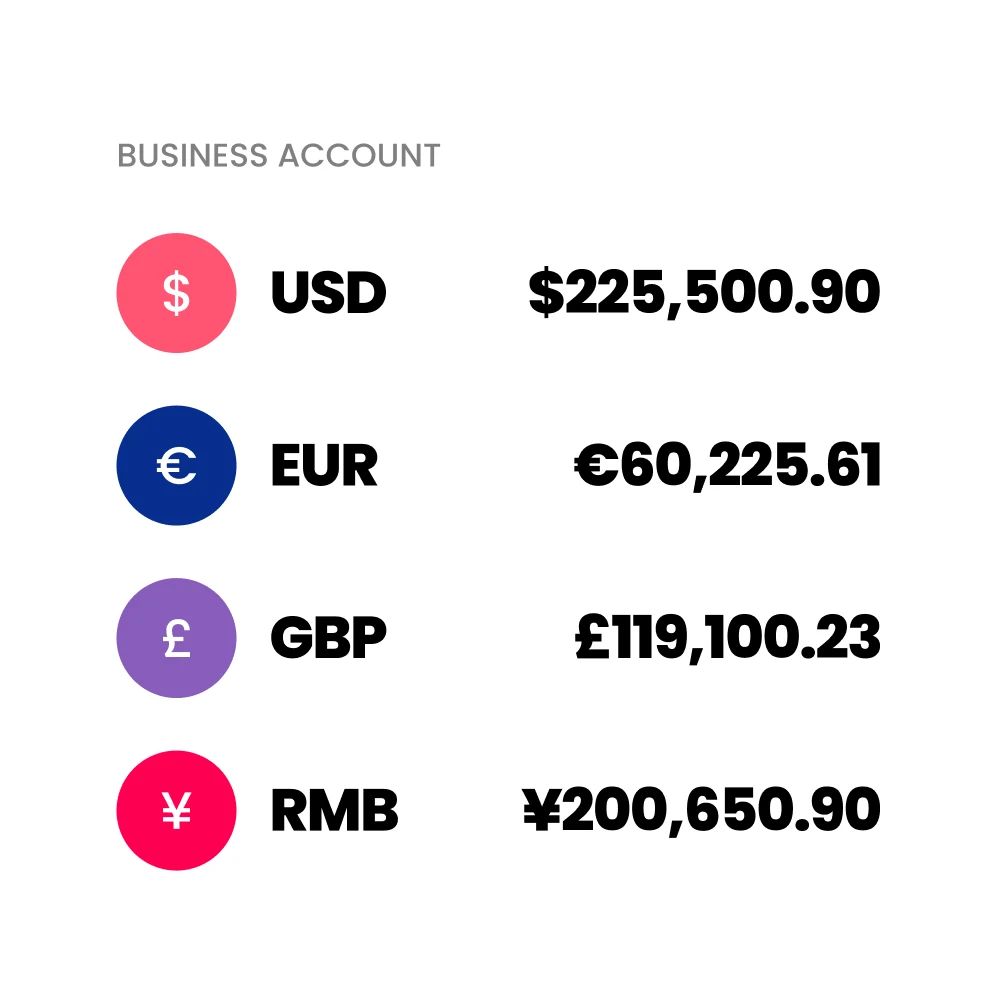
A multi-currency business account built for this purpose, such as WorldFirst’s World Account, is designed to let UK businesses collect in over 20 currencies, hold balances, convert at a visible rate, and pay suppliers in more than 100 currencies from a single login. That’s a materially different proposition to a domestic current account with an international payments bolt-on.
The features that separate a genuinely useful multi-currency account from a basic international transfer service come down to fee transparency, currency coverage, speed and integration depth.
Here’s what to check line by line before switching:
This is also where the ‘hidden FX margin’ problem with traditional banks tends to surface most clearly. Because a bank’s transfer fee is often quoted separately from its exchange rate, it’s easy to compare fees on paper while missing that the real cost sits inside the conversion itself.
The table below compares WorldFirst’s main account, payment and FX costs with a typical UK bank telegraphic transfer:
| Cost component | WorldFirst UK | Typical UK bank TT |
| Account opening | Free | Often free, sometimes tiered |
| Ongoing account fee | None | Varies, sometimes monthly fee |
| Minimum balance | None | Sometimes required |
| Local payment (GBP/EUR/USD) | £0.30 | Often bundled into a wider fee |
| International payment | £4.00 | Cable fee plus handling commission |
| Cross-currency payment above £5,000 | Free | N/A |
| Currency conversion margin | Up to 0.50% (0.3% for new customers) | FX margin not usually shown separately |
| Settlement time | Often same day | 1–5 business days |
Freshness check: pricing verified against WorldFirst UK pricing as at the time of writing; always confirm current rates before switching.
The account itself is free to open, with no ongoing fees and no minimum balance requirement. Local payments in GBP, EUR or USD cost £0.30, while international payments are £4.00, and cross-currency payments above £5,000 are free.
Payments between World Accounts are free and instant. Currency conversion carries a margin of up to 0.50%, with new customers offered an exclusive 0.3% rate, and businesses with £100,000 or more in monthly turnover can access tailored fees.
By contrast, the bundled FX margin and layered fees in a standard bank telegraphic transfer make the total cost far harder to predict. For an SME comparing providers on total cost, that structural difference in transparency is usually the deciding factor, not the headline fee alone.
Good account management for an SME trading internationally hinges on how easily you can collect from customers or marketplaces and pay suppliers without unnecessary conversions or delays.
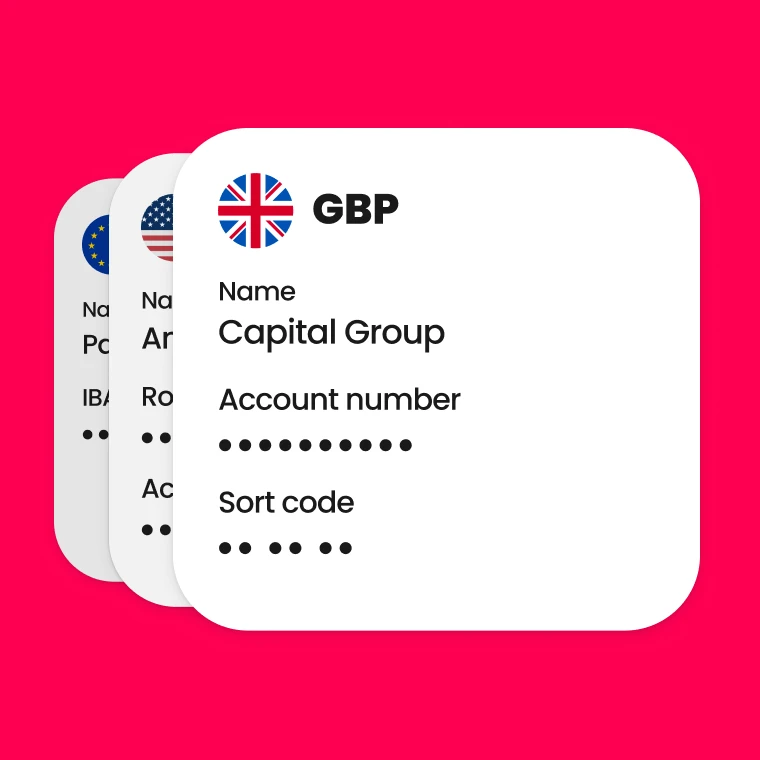
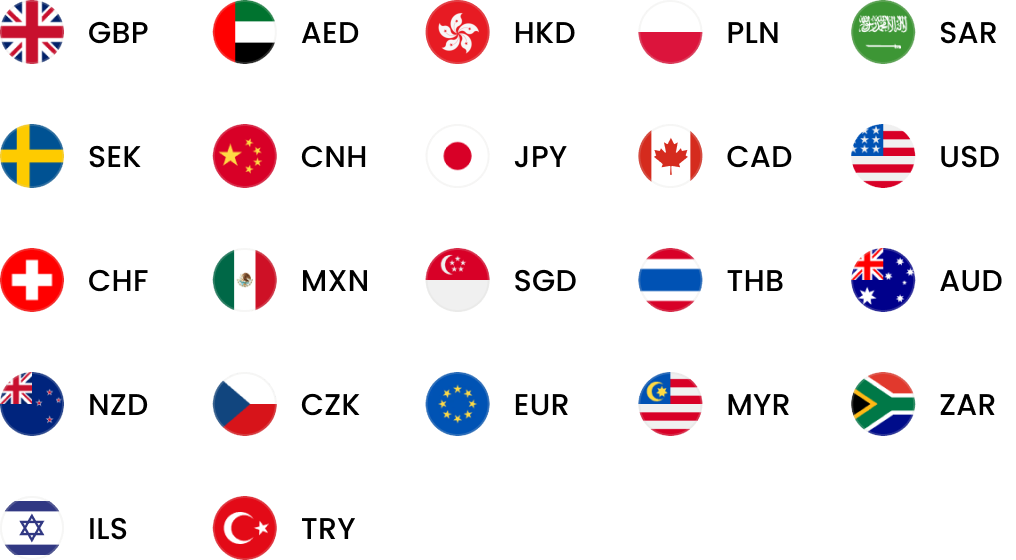
The World Account supports local receiving accounts in over 15 currencies, including USD, GBP, EUR, CAD, AUD and JPY, and lets you hold balances in more than 20 currencies at once.
If you sell through Amazon, Shopee, Shopify, PayPal, Stripe, Etsy, eBay, TikTok Shop or WooCommerce, the account connects to more than 130 marketplaces and payment gateways, which removes a substantial chunk of manual payout reconciliation.
On the payment side, you can send to more than 92 payout currencies, and businesses with recurring China supplier payments benefit from same-day or instant settlement to more than 150,000 Chinese suppliers already set up on WorldFirst, with WorldFirst also acting as the authorised international payment provider for 1688.com via 1688 World Pay.
If you’re sourcing from China, it’s worth noting that suppliers invoice in onshore CNY while international payments typically settle in offshore CNH, a distinction that matters when you’re comparing quoted prices to what actually lands.
Payment timing varies by corridor:
| Corridor | Typical settlement |
| GBP to UK | Same day |
| EUR to Europe | Same day |
| USD to USA | Same day |
| AUD to Australia | Same day |
| SGD to Singapore | Same day |
| HKD/USD to Hong Kong | Same day |
| NZD to New Zealand | Same day |
| Other corridors | 1–2 additional business days |
For businesses managing high payment volumes, you can also schedule, automate or batch up to 200 payments at once, which is a meaningful time saving if you’re processing multiple supplier invoices in the same run.
Read more: Cross-border business payments: everything you need to know
The right FX tool depends on whether you need to move money now or protect against rate movement over the coming weeks or months, and a proper business account should offer both. Spot contracts use the live rate at the time of transaction, and around 80% of payments made this way land the same day.
For businesses that want to lock in a rate ahead of a known future payment, forward contracts are available for up to 24 months, with fixed, window and flexible structures depending on how certain your payment date is. A deposit of 5% of the sell or buy amount typically applies, though no deposit is required for contracts under three days and under £50,000, or under ten days and under £10,000.
Firm orders add a further layer of control by monitoring rates around the clock and automatically executing a conversion once your target rate is reached, with live alerts sent by email or text so you’re never caught off guard by a favourable window closing.
Taken together, these tools give you visibility over FX costs that a standard bank TT simply doesn’t offer, since the rate and any margin are shown before you confirm, rather than being buried inside the transaction.
Once more than one person in your business touches the account, whether that’s a finance manager, a founder and a bookkeeper, or a distributed team across a Manchester warehouse and a London office, permission controls stop being optional.
The World Account offers both predefined and custom roles, letting you define who can authorise or process payments, where those payments can go, and how much any individual is permitted to send.
Instant notifications confirm when a payment has been authorised and when it’s been made, giving you a real-time audit trail rather than discovering discrepancies at month-end.
For businesses structured as parent and subsidiary groups, multi-account management lets you oversee several entities from a single login. Security is reinforced with two-factor authentication via SMS and email at login, at payee creation and on transactions, with the Authy app also supported for businesses that prefer app-based verification.
This level of control matters particularly for SMEs switching from a single shared login on a legacy bank account, where oversight of who actually authorised a payment can be limited.
The most time-consuming part of managing a multi-currency account is often reconciliation, and this is where integration depth genuinely separates providers. The World Account connects directly to Xero, syncing payment data daily and reconciling transactions across more than 20 currencies without manual CSV uploads. NetSuite integration is also available, along with a custom API for businesses with more bespoke accounting setups.
Beyond the live feed, you can download detailed or summary statements for different durations and transaction types, giving your bookkeeper or accountant everything they need without chasing individual transaction records.
For an SME switching providers specifically to reduce admin burden, this automatic reconciliation is often the feature with the clearest, most immediate return on the time invested in moving accounts.
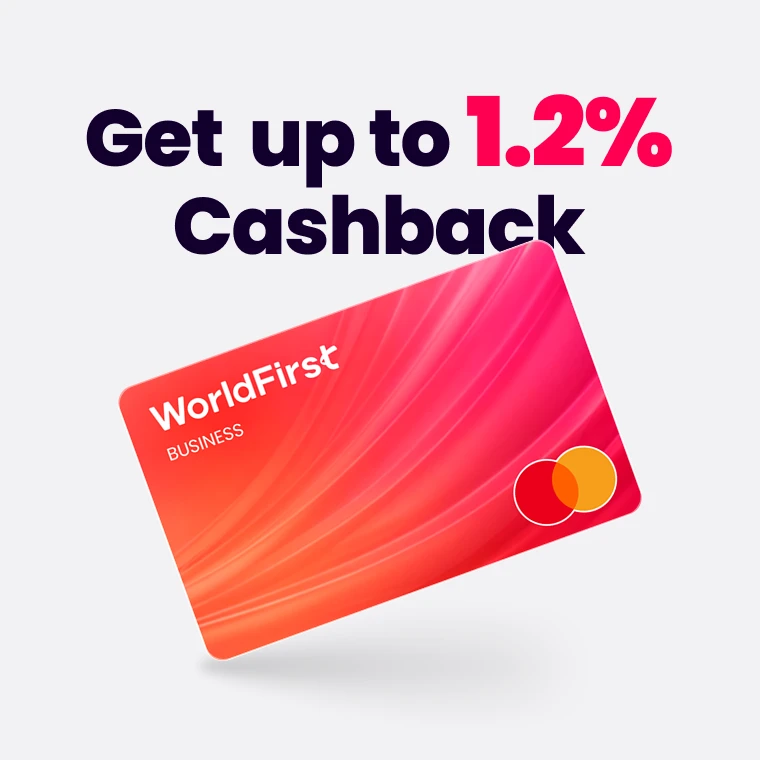
Alongside the core account, the World Card is a virtual Mastercard designed for day-to-day business spend such as marketplace ad platforms, SaaS subscriptions and supplier payments.
It offers up to 1.2% uncapped cashback on eligible spend and zero FX fees when paying from held balances in 15 currencies, including AUD, CAD, CHF, EUR, GBP, HKD, JPY and SGD. The card supports spend in 153 local currencies overall, with GBP as the UK default, and Google Wallet is supported, though Apple Pay and physical cards are listed as coming soon at the time of writing.
For a marketplace seller running ad spend across multiple currencies, this removes a common friction point where paying in a foreign currency on a domestic business card triggers an unfavourable card-network conversion rate on top of the underlying transaction.
WorldFirst isn’t a bank. World First UK Limited is authorised by the FCA as an Electronic Money Institution under the Electronic Money Regulations 2011, with FCA Firm Reference 900508.
This distinction matters practically: client funds are safeguarded with tier-1 partnering banks in accordance with regulatory requirements, and WorldFirst holds more than 60 regulatory licences worldwide, but safeguarded funds are not protected under the Financial Services Compensation Scheme in the way that a traditional bank deposit would be up to the current statutory limit.
An independent review from Finder UK confirms the core commercial terms, no monthly account fee, no fees to collect funds, and payment fees ranging from £0.30 to £4.00, while also flagging the EMI status and the absence of FSCS protection as points UK businesses should weigh before switching, alongside some reported customer service issues.
That’s a fair trade-off to understand rather than a reason to dismiss the account outright: banks offer FSCS-backed deposit protection and full domestic banking services including lending and payroll, which an EMI like WorldFirst does not provide, but in exchange you typically get sharper FX pricing and faster international settlement built specifically for cross-border trade.
Switching providers is often the step SMEs delay longest, usually because they assume it will involve a lengthy paperwork process. In practice, registration for a World Account takes minutes online, with approval typically granted within hours and, at most, within two business days.
Once approved, you can fund the account by connecting marketplace collections, receiving a customer payment into your local currency account, or transferring an existing balance across.
There’s no requirement to close your existing bank account immediately, which means most SMEs run both in parallel for a transition period, moving supplier payments and marketplace collections across gradually while confirming the new account handles their specific payment corridors and currencies as expected.
The decision to switch business account provider ultimately comes down to whether you can see the true cost of moving money, move it at the speed your suppliers and marketplaces require, and control who in your business can authorise what. Business account management done well combines FX margin transparency, predictable payment fees, same-day settlement on major corridors, automatic reconciliation and proper team controls, rather than any single feature in isolation.
If those trade-offs match what your business needs, particularly if you’re already juggling supplier payments to Asia, multi-currency marketplace payouts, or a growing team that needs payment oversight, it’s worth comparing what you currently pay in hidden FX margin against a transparent structure.
Open a World Account to see the fees, rates and controls for yourself before you commit to switching.
Business account management covers how a business collects, holds, converts, pays and reconciles money, as well as the controls governing who can access the account and authorise transactions. For international SMEs, this also includes FX management, multi-currency balances, supplier payments and accounting integrations.
Key features to compare include account and payment fees, FX margin transparency, supported currencies, local receiving accounts, payment speeds, accounting integrations, marketplace connectivity and team permission controls. The total cost of the account matters more than any single advertised fee.
No. According to the pricing information referenced in this guide, the World Account has no ongoing account fee and no minimum balance requirement. Local and international payment fees may still apply depending on the transaction type.
WorldFirst allows businesses to hold balances in more than 20 currencies and provides local receiving account details in over 15 currencies. Businesses can also send payments in more than 92 payout currencies.
Payment speed depends on the currency and destination. Major corridors including GBP to the UK, EUR to Europe and USD to the US can typically settle the same day, while other corridors may require an additional one to two business days.
Yes. WorldFirst integrates directly with Xero and can sync transaction data daily across more than 20 currencies. NetSuite integration and a custom API are also available for businesses with more complex accounting requirements.
No. World First UK Limited is an FCA-authorised Electronic Money Institution rather than a bank. Client funds are safeguarded in accordance with regulatory requirements, but they are not covered by the Financial Services Compensation Scheme in the same way as eligible deposits held with a UK bank.
Sources:
Choose a product or service to find out more
Save money, time, and have peace of mind when expanding your global business.
It looks like you're sending money to family or friends — that's a personal transfer, which is best handled through our app.
Sending money to family or friends? Download our app for the best experience.