




























If you’re running a Tanjong Pagar trading firm or an East Coast e-commerce operation and your current provider keeps surprising you with a SWIFT deduction you didn’t budget for, you’re not alone. 36% of Singapore SMEs report problems with cross-border payments, including delays and failed transfers, according to WorldFirst’s review of SME banking friction in Singapore.
That’s a material share of businesses either absorbing avoidable cost or losing time chasing a supplier payment that should have cleared same-day.
Picking between two MAS-licensed fintechs on headline pricing alone tends to hide the real gap between them.
This article compares Wallex vs Aspire on account fees, FX rates, currency coverage, supplier payment timing, regional collections and reconciliation tools, so you can judge which one actually fits how your business moves money, and where a third option might serve you better.
Key takeaways:
- Wallex offers broader Asian currency coverage: it supports more payment, collection and holding currencies, which can suit businesses paying suppliers across several regional markets
- Aspire goes further on spend management: corporate cards, expense controls, approval workflows and accounting integrations make it better suited to businesses managing payments and internal spend together
- Pricing works differently across the two platforms: Wallex charges per transaction without a monthly subscription, while Aspire combines free and paid plans with different FX and transfer benefits
- Live quotes matter when comparing FX costs: Wallex does not publish a fixed FX margin for every corridor, while Aspire provides more plan-based pricing detail, so total cost should be checked against the currencies you actually use
- Neither platform is a bank: both operate as regulated payment providers, so businesses should compare safeguarding arrangements as well as fees and features
- WorldFirst adds another option for marketplace and China-focused businesses: Singapore SMEs can combine multi-currency collections, 1688 supplier payments and broader cross-border payment tools within one World Account
Open a World Account to compare a marketplace-collection and China-payment alternative before you commit to either platform.
Wallex at a glance: an FX specialist built for Asian corridors
Wallex is a Singapore-founded FX and payments platform, not a card-led finance app, and that focus shapes everything about how it prices and positions itself.

Founded in 2015 by Hiro Kiga, Wallex raised a US$4.87 million Series A in 2020 backed by BAce Capital, before being acquired by M-DAQ in February 2022. M-DAQ counts Ant Group among its investors, and Wallex continues to operate under its own brand.
In Singapore, Wallex is regulated as a Major Payment Institution under licence PS20200433, held by the entity M-DAQ Payment Solutions Pte. Ltd, and it also carries licensing in Hong Kong, Indonesia and Malaysia.
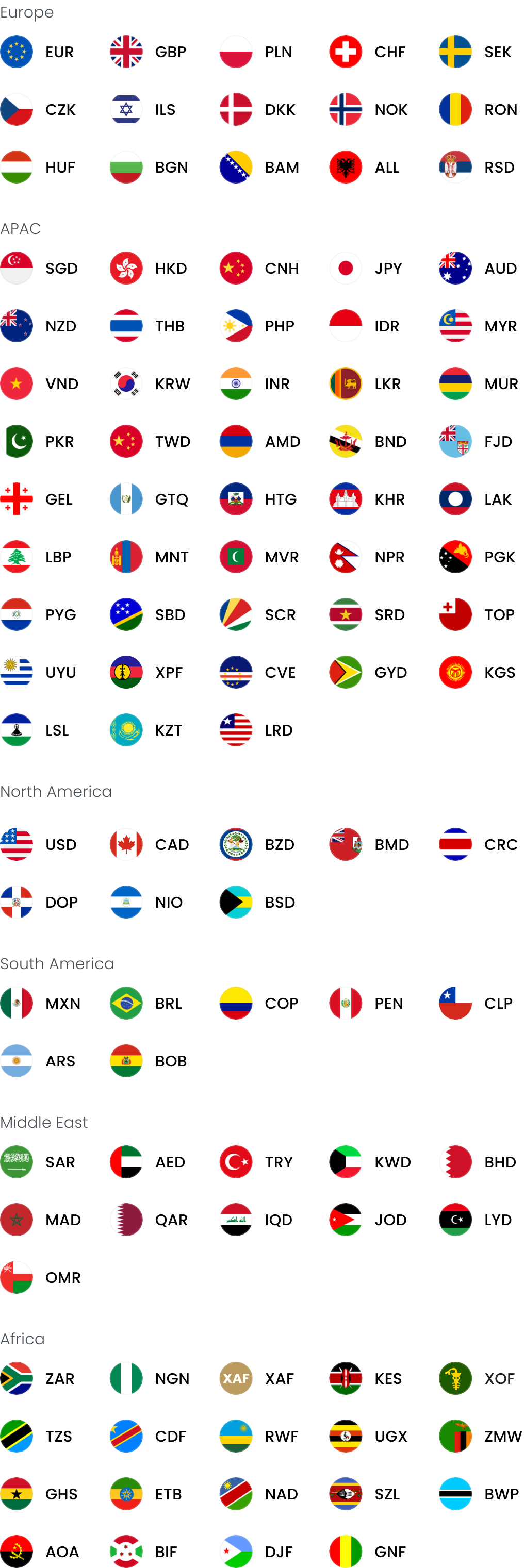
That multi-market footprint lines up with its product: Wallex supports 47 payment currencies, 36 collection currencies via virtual accounts, and 13 hold currencies in its multi-currency account.
Wallex charges no monthly subscription or minimum balance and instead prices per transaction, with volume-based discounts for businesses moving larger amounts.
What it doesn’t do is publish a corporate card, expense management tool, or itemised SWIFT fee schedule on its public pricing page, so if your business needs spend controls alongside payments, you’ll be adding a separate tool.
Read more: Wallex vs Airwallex
Aspire at a glance: an all-in-one finance operating system
Aspire takes a different starting point. Founded in 2018 through Y Combinator’s Winter batch, Aspire built itself around the idea that a Singapore SME shouldn’t need five separate tools for banking, cards, expenses and reconciliation.

The company raised a US$100 million Series C in February 2023, reported profitability that same year, and now serves 50,000+ business customers across nine countries.
Aspire’s regulatory position has moved recently. It received in-principle approval for a Major Payment Institution licence from MAS in October 2024, and secured a separate Capital Markets Services Licence in April 2025 to support its Aspire Yield product. That’s worth noting if you’re comparing regulatory maturity: Wallex has held its MPI licence for longer, while Aspire’s full MPI status followed its in-principle approval.
Aspire holds accounts in eight currencies (SGD, USD, EUR, GBP, MYR, PHP, IDR, VND) and can send or receive in 30+ currencies across 130+ countries.
Pricing runs on two tiers: Basic at SGD 0/month and Premium at SGD 15/month, with Premium unlocking lower FX margins, free outbound SWIFT transfers, and higher card cashback.
Read more:
Fees compared: what actually leaves your account
The direct answer is that Wallex has no tiered account fee at all, while Aspire’s free tier costs nothing monthly but carries higher FX and SWIFT charges than its paid tier. Which one is cheaper for you depends entirely on your transfer volume and whether you need cards.
The table below compares Wallex and Aspire Basic and Premium across account fees, FX pricing, SWIFT charges, local transfers and corporate card benefits:
| Cost item | Wallex | Aspire Basic | Aspire Premium |
| Monthly account fee | SGD 0 | SGD 0 | SGD 15 |
| FX margin | Near mid-market, volume discounts, no published % | From 0.23% send, 0.34% receive | From 0.22%, 0% on first SGD 13,000/month |
| SWIFT receive | Not itemised publicly | SGD 35 (SGD account) / USD 8 (other) | Same, plus free allowance |
| SWIFT send | Not itemised publicly | USD 15 (SHA) / USD 30 (OUR) | 5 free transfers/month (worth up to USD 75) |
| Local transfers (FAST/PayNow/GIRO) | Local channel pricing varies | Free | Free |
| Corporate card | Not offered | 1% cashback, up to 200 virtual cards | 1.2% unlimited cashback, up to 300 virtual cards |
Pricing pages reviewed and current as at the source dates cited above.
The practical takeaway: if you send large, infrequent supplier payments and don’t need cards, Wallex’s per-transaction model with volume discounts can work out competitively, but you won’t know the exact margin until you get a quote.
If you run frequent smaller transfers alongside team spend gives you more certainty upfront, and the Premium tier’s fee waiver on the first SGD 13,000 of monthly FX volume is a real saving if you clear that threshold.
Read more:
FX rates and currency coverage: where the corridor gap shows up
If your payment volume runs through Indonesia, Vietnam, Thailand or Malaysia as much as through the US and Europe, currency depth matters more than the headline FX margin.
This is where Wallex and Aspire diverge most clearly:
- Wallex’s Asian currency bench is deeper: With 47 payment currencies, 36 collection currencies and 13 hold currencies, Wallex covers a wider spread of regional currencies including IDR, THB, MYR, VND and KRW, useful if your supplier or buyer base spans several ASEAN markets rather than sitting concentrated in USD or EUR
- Aspire’s hold currencies are narrower but well-supported: Aspire holds only eight currencies, with full local account functionality concentrated in SGD, USD, EUR and GBP; MYR, PHP, IDR and VND are available with more limited functionality
- Neither publishes a precise FX margin for every corridor: Wallex advertises rates close to mid-market without a stated percentage, while Aspire discloses tiered percentages that vary by plan, so getting a live quote for your specific currency pair before switching is the only reliable way to compare true cost
For an SME whose supplier base sits mostly in China, this comparison also surfaces a gap: neither Wallex nor Aspire markets direct 1688 or Taobao supplier payment tools, an area where a platform like WorldFirst, which supports direct 1688 payments and forward contracts to lock in FX rates, plays a more specific role.
Supplier payment timing: how fast does money actually land
Same-day settlement in your major trading currencies reduces the working capital float you need to hold while a supplier payment clears.
Both platforms offer meaningful speed, but through different mechanisms:
- Wallex advertises same-day settlement in 20+ currencies, including instant transfers for SGD, IDR and HKD, and same-day clearing for THB, MYR, INR, VND and KRW. That’s a strong claim for a business paying suppliers across multiple ASEAN corridors on tight production timelines
- Aspire offers same-day transfers to 15+ major currencies, with standard SWIFT transfers taking the usual one to five business days depending on the corridor and receiving bank.
For businesses paying suppliers in currencies outside Aspire’s fast-transfer list, that timing gap is worth factoring into your production and shipping schedule, particularly if you’re covering a deposit-and-balance payment structure with a supplier who expects the balance cleared before releasing goods.
Regional collections and multi-currency visibility
The direct answer here is that Wallex is built for collecting and reconciling across many currencies at once, while Aspire concentrates its collection strength in four core currencies backed by deeper accounting integration:
- Wallex provides virtual accounts in 36 currencies with consolidated reporting across all of them, useful if you’re collecting from buyers or marketplaces in multiple regional currencies and want a single dashboard rather than juggling separate local bank accounts
- Aspire‘s local collection accounts cover SGD, USD, EUR and GBP, but it pairs that narrower footprint with integrations into Xero, QuickBooks, Oracle NetSuite, Deskera and SAP, which matters if your finance team already reconciles through one of those systems and wants collections to flow straight into existing ledgers without manual re-entry
If your business collects from marketplaces like Amazon, Shopee, Lazada or Etsy specifically, rather than from wholesale buyers paying by wire, neither Wallex nor Aspire is built around direct marketplace payout integration in the way a platform such as WorldFirst is, which collects from 130+ marketplaces and payment gateways directly into a World Account.
Reconciliation and workflow features: payments platform vs finance OS
This is the clearest structural difference between the two, and it should drive your decision more than fee comparisons alone:
- Wallex focuses on payment controls: Maker-checker approval workflows, bulk payments to up to 200 beneficiaries in 48 currencies, and transaction tracking give you control over who authorises what, but stop short of broader expense or budget management
- Aspire builds a full finance stack: Expense management, approval workflows, reimbursements, bill payments, invoicing and budget tracking sit alongside the payment rails, meaning your finance team can run more of its operations inside one platform rather than stitching together separate tools
- Card-linked spend visibility is Aspire-only: Because Wallex doesn’t issue corporate cards, any card spend your team makes elsewhere won’t show up in the same reconciliation view, whereas Aspire’s cards feed directly into its expense dashboard
For a lean SME finance function, this trade-off is really about whether you want a specialist payments tool that does FX and transfers precisely, or a broader system that consolidates more of your financial operations at the cost of narrower currency reach.
Bring marketplace collections and China payments together with WorldFirst
Wallex can make sense when Asian currency coverage and supplier payments are the priority, while Aspire is stronger when cards, expenses and finance automation matter more. A different gap appears when the same business also collects marketplace revenue and pays China suppliers through platforms such as 1688.
Consider a Singapore seller collecting US$30,000 from Amazon and Shopify while preparing a CNH payment to a supplier on 1688. Moving those funds through separate collection, conversion and payment tools can create extra reconciliation work and unnecessary FX steps.
With a World Account, supported marketplace proceeds can be collected and held in multiple currencies, then converted when needed for the next supplier payment.
WorldFirst also supports direct payments to eligible 1688 suppliers, while the World Card can cover eligible business spending from supported currency balances. That gives businesses another option when their workflow extends beyond the payment strengths of Wallex or the spend-management focus of Aspire.
WorldFirst isn’t a bank. WorldFirst (Singapore) Merchant Services Pte. Ltd. is regulated by the Monetary Authority of Singapore as a Major Payment Institution under the Payment Services Act 2019. The World Account can therefore sit alongside an existing bank account for domestic banking, lending or other services WorldFirst does not provide.
Open a World Account to connect marketplace collections, multi-currency balances and China supplier payments in one account.
FAQs
1. Is Wallex or Aspire better for international business payments?
Wallex is generally better suited to businesses making frequent payments across a broad range of Asian currencies, while Aspire is better for companies that want international payments combined with cards, expenses and finance management. The right option depends on whether currency coverage or broader financial operations matter more to your business.
2. Which is cheaper, Wallex or Aspire?
Neither provider is automatically cheaper for every business. Wallex has no monthly account fee but does not publicly disclose a fixed FX margin for every currency pair. Aspire offers a free Basic plan and a SGD 15/month Premium plan with lower FX pricing and some transfer allowances. Comparing a live quote for the currencies and transfer amounts you actually use is the most reliable way to determine total cost.
3. Does Wallex support more currencies than Aspire?
Yes, Wallex offers broader currency coverage. It supports 47 payment currencies, 36 collection currencies and 13 currencies for holding. Aspire supports eight hold currencies and international payments across 30+ currencies.
4. Does Aspire or Wallex offer corporate cards?
Aspire offers corporate cards, while Wallex does not currently position corporate cards as part of its Singapore business offering. Aspire also connects card spending with expense management, approval workflows and reconciliation tools, making it more suitable for businesses managing employee spend.
5. Are Wallex and Aspire banks?
No. Wallex and Aspire are financial technology and payment providers rather than traditional banks. Businesses should therefore review each provider’s regulatory status, safeguarding arrangements and account protections before moving significant working capital onto either platform.
6. Which is better for paying suppliers in Asia: Wallex or Aspire?
Wallex is generally the stronger fit for businesses paying suppliers across several Asian markets because of its wider regional currency coverage and same-day settlement support for multiple currencies. Aspire can still work well for international supplier payments, particularly where the business also needs corporate cards, expense controls and accounting integrations.
7. Can I use Wallex or Aspire for payments to China?
Both platforms support international business payments, but businesses making frequent China supplier payments should compare the specific payment route, supported currency, settlement time and quoted FX rate before choosing a provider. If you regularly pay suppliers through platforms such as 1688, it is also worth comparing providers with dedicated China marketplace payment functionality.
Sources:
- https://software-listing.com/blog/aspire-origin-story-singapore-business-banking-2026
- https://www.pilotoasia.com/guide/cross-border-payments-singapore-smbs-2025
- https://www.businesstimes.com.sg/startups-tech/startups/ant-backed-m-daq-to-acquire-crossborder-payments-provider-wallex
- https://www.wallex.asia/en-sg/licensings
- https://www.wallex.asia/en-sg/business-solutions
- https://www.wallex.asia/en-sg/pricing
- https://aspireapp.com/blog/aspire-receives-in-principle-approval-for-mpi


![AliExpress dropshipping: How to source and pay suppliers from Singapore [2026]](https://mdn.marmot-cloud.com/worldfirst/sites/9/2026/10/20261021131155864-300x200.webp)

![Trust card review [2027]: Features, fees and more](https://mdn.marmot-cloud.com/worldfirst/sites/9/2026/10/20261020214810193-300x200.webp)
![HSBC business account review [2026] Singapore: Features, fees and more](https://mdn.marmot-cloud.com/worldfirst/sites/9/2026/10/20261020213428771-300x200.webp)