




























DBS is best for Singapore SMEs that need comprehensive business banking, financing access and digital tools, while OCBC is best for SMEs that want a straightforward local account, transparent fees and practical cash flow support.
Banking choice matters more when your business trades across markets. Supplier payments, marketplace revenue, FX costs and currency timing can all affect margins and cash flow.
Enterprise Singapore reported SG$1.4 trillion in total merchandise trade for 2025, up 8.7% from 2024. For SMEs, that kind of market activity makes the right banking setup more important for payments, FX costs and day-to-day cash flow.
In this guide, we compare DBS vs OCBC across account fees, local payments, international transfers, multi-currency support, cards, digital tools and SME use cases.
We’ll also show where World Account from WorldFirst can help Singapore businesses manage cross-border payments with more control.
DBS vs OCBC: an overview
Here’s a quick look at DBS and OCBC before we compare their accounts, fees, payments, cards and digital tools in more detail:
DBS overview
DBS started in 1968 as the Development Bank of Singapore. Today, it is one of Singapore’s main business banks, with services covering business accounts, local payments, international transfers, FX, trade finance, lending and digital banking.
For SMEs, DBS brings multiple banking services into one place. A business can open a multi-currency account, manage approvals through DBS IDEAL, send local and overseas payments, use business cards and connect account data with accounting tools.
This setup may work for companies that want local banking, overseas payments and financing under one provider.
Key features:
- Business banking range: Covers accounts, local payments, overseas transfers, trade services, lending and digital banking
- DBS IDEAL: Lets businesses manage transactions, approvals, account information and trade activity online
- SME financing: Offers working capital loans, business loans and government-assisted financing options
- Trade services: Supports importers, exporters and companies that deal with supplier or buyer financing needs
- Regional support: Useful for businesses with customers, suppliers or operations beyond Singapore
OCBC overview
OCBC is Singapore’s longest-established local bank, formed in 1932 through the merger of three local banks. It supports start-ups, SMEs and established companies with business accounts, local and overseas payments, multi-currency banking, digital tools, cards, lending and trade finance.
For SMEs, OCBC keeps the account setup simple. Its business banking range covers simple SGD accounts, a multi-currency account, OCBC Velocity, the OCBC Business app and common payment options for local and overseas transactions.
OCBC gives SMEs a simple, everyday banking setup, with foreign currency and trade tools available when cross-border needs become more important.
Key features:
- Business banking range: Covers SGD accounts, foreign currency accounts, local payments, overseas transfers, lending and trade finance
- OCBC Velocity: Lets businesses manage transactions, approvals, collections and trade activity online
- OCBC Business app: Supports mobile access for selected payments, approvals and account activity
- SME financing: Offers working capital, invoice financing and other business lending options
- Trade support: Helps businesses manage import, export and overseas funding needs
DBS vs OCBC accounts
Your business account affects how you collect revenue, pay suppliers, manage working capital and handle foreign currency. For Singapore SMEs, the best choice depends on how your money moves.
DBS accounts
DBS keeps its SME account range centred on the Business Multi-Currency Account.
Instead of separating everyday banking and foreign currency activity into distinct products, DBS uses a single account structure that supports SGD and 12 foreign currencies.
Account options:
- DBS Business Multi-Currency Account: A business account that lets companies hold SGD and 12 foreign currencies, including USD, EUR, GBP, JPY, HKD, AUD, CAD, CHF, CNH, NOK, NZD and SEK
- DBS Business Multi-Currency Account – Starter Bundle: A version for newer businesses, with no monthly service charge and unlimited free FAST and GIRO payments through DBS IDEAL
- DBS account opening for foreign-owned companies: Guided account opening support for companies with foreign ownership or foreign directors setting up business banking in Singapore
OCBC accounts
OCBC separates its SGD and foreign currency account options more clearly.
A business can start with a local SGD account, then add a Multi-Currency Business Account when overseas transactions become more important.
Account options:
- OCBC Business Growth Account: An SGD account for start-ups and newer businesses that need local payments, FAST and GIRO transfers and everyday business banking
- OCBC Business Entrepreneur Account Plus: An SGD account for expanding or established Singapore-based businesses that want a higher-balance account
- OCBC Multi-Currency Business Account: A foreign currency account for businesses that receive, hold or pay in up to 13 major currencies, including USD, EUR, GBP, JPY, AUD, HKD and CNH
What this means for your business:
- Choose DBS if your SME wants one main account setup for SGD, foreign currency, local payments, overseas transfers and business card access
- Choose OCBC if your SME wants a simple SGD account first, with the option to add multi-currency banking when overseas suppliers, customers or marketplace income become more important
DBS vs OCBC: fees and costs
DBS and OCBC both offer low-cost local digital payments, but their pricing models differ.
DBS fees and costs
DBS pricing depends on which Business Multi-Currency Account package you choose.
Important fees:
- Account fees: The DBS Business Multi-Currency Account Starter Bundle has a SG$10 monthly account fee. The standard Business Multi-Currency Account has a SG$50 annual account fee
- Monthly service charge: The Starter Bundle has no monthly service charge. The standard account has a SG$40 monthly service charge, waived if the average daily balance is at least SG$10,000 or equivalent
- Local transfers: The Starter Bundle includes unlimited free FAST and GIRO payments via DBS IDEAL. The standard account includes 50 free FAST and GIRO payments
- International transfers: DBS charges a SG$30 flat fee for outward telegraphic transfers, excluding agent bank fees
OCBC fees and costs
OCBC has a simpler entry-level cost structure through its Business Growth Account.
Important fees:
- Account fees: OCBC Business Growth Account has a SG$10 monthly account fee, waived for the first two months
- Initial deposit: The account requires an initial deposit of SG$1,000
- Fall-below fee: A SG$20 monthly fall-below fee applies if the monthly average balance drops below SG$1,000
- Local transfers: The account includes 80 free FAST and 80 free GIRO transactions per month
- International transfers: OCBC World Transfer costs SG$30 per outward telegraphic transfer through OCBC Velocity, the OCBC Business app, host-to-host or API channels. Agent fees may apply
What this means for your business:
- Choose DBS for unlimited free FAST and GIRO payments on the Starter Bundle or if you can meet the balance requirement on the standard account
- Choose OCBC for a low-entry account with a fixed monthly fee and 80 free FAST and 80 free GIRO transactions each month
DBS vs OCBC: FX rates
Exchange rates can have a bigger impact than transfer fees when your business pays suppliers, receives foreign currency or moves money between markets.
MAS reported that Singapore’s FX average daily trading volume reached US$1.485 trillion in April 2025, up 60% from April 2022. For SMEs, that makes the quoted exchange rate worth checking before every larger currency conversion.
DBS FX rates
DBS gives SMEs several ways to manage currency conversion through its business banking tools.
FX details:
- Bank-set rates: DBS uses its prevailing exchange rate when it converts currency for a business account
- DBS SecureFX: Lock in rates for five key currency pairs up to one month ahead
- DBS FX Online: Book FX transactions online across over 40 currency pairs
- Multi-currency support: DBS Business Multi-Currency Account supports SGD and 12 foreign currencies
- Rate visibility: DBS does not publish one fixed markup for every business conversion, so check the quoted rate before confirming
OCBC FX rates
OCBC supports currency conversion and FX contract booking through its business banking platforms.
FX details:
- Bank-set rates: OCBC applies its own exchange rates when your business converts currency
- FX Online: Book FX contracts through OCBC Velocity or the OCBC Business app
- FX contracts: Lock in a rate for future payments or currency needs
- Multi-currency support: OCBC Multi-Currency Business Account supports up to 13 major currencies
- Rate visibility: OCBC publishes daily FX rates, but your business should review the final quoted rate before confirming
What this means for your business:
- Choose DBS for regular currency conversions, broader online FX booking and rate-locking on key currency pairs
- Choose OCBC for multi-currency banking with FX contract booking through OCBC Velocity and the OCBC Business app
DBS vs OCBC: cards
Business cards help SMEs track spending on travel, software, ads, supplier costs and recurring bills.
DBS cards
DBS has debit and credit cards for expense control, rewards, travel and cash flow.
Card options:
- DBS Business Advance+ Card: A debit card linked to a multi-currency account, with no annual fee, cashback on selected B2B spend and controls through DBS IDEAL
- DBS Business Advance Debit Card: A debit card for everyday business expenses
- DBS Platinum Business Card: A credit card for recurring payments, expense tracking and up to 55 days of credit terms
- DBS World Business Card: A credit card for travel, rewards and higher-value business spending
OCBC cards
OCBC’s card range covers everyday payments, cashback, deposits and supplier spending.
Card options:
- OCBC Business Debit Card: A no-annual-fee debit card with cashback on selected business spend
- OCBC Business Credit Card: A credit card with rebates on selected merchants, foreign currency transactions and SGD spend
- OCBC Business Deposit Card: A card employees can use to deposit cash without withdrawal access
- OCBC Virtual Purchasing Card: A virtual card for procurement expenses and supplier payments
What this means for your business:
- Choose DBS for a wider card range, digital controls and credit options for larger or recurring expenses
- Choose OCBC for a simpler card setup with cashback, deposit support and virtual cards for procurement spending
DBS vs OCBC: business features and integrations
Business banking becomes easier when payments, collections and bookkeeping connect with the tools your company already uses.
DBS business features and integrations
DBS gives SMEs several tools to reduce manual admin across collections, reconciliation and bookkeeping.
Business tools:
- DBS MAX: Accept payments through options such as QR payments, POS terminals, online checkout, payment links and recurring payments
- DBS MAX Portal: Add collection methods, view transaction insights and reconcile accounts from one merchant portal
- Accounting software integration: Connect DBS business account data with tools such as Xero, QuickBooks and Financio to support daily bank feeds and reconciliation
- Electronic bill collections: Let customers pay bills through DBS digital channels, with reference validation to reduce manual matching errors
- Payment links: Send secure payment links to customers and track payment status through the gateway portal
OCBC business features and integrations
OCBC focuses on digital collections, cash flow visibility and accounting connections for SMEs that want simpler day-to-day admin.
Business tools:
- OCBC OneCollect: Collect payments through QR codes and view real-time transaction notifications and history
- QR payment support: Accept payments through PayNow, Alipay+, WeChat Pay, UnionPay, ShopeePay and DuitNow QR
- Xero integration: Connect an OCBC business account to Xero through OCBC Velocity for daily transaction feeds
- OCBC POS Terminal: Accept payments through major card schemes and QR payment options at checkout
- OCBC APIs: Generate real-time QR codes and receive instant payment notifications through connected business platforms
What this means for your business:
- Choose DBS if you need more ways to collect customer payments, share payment links and connect banking data with accounting tools
- Choose OCBC if QR collections, Xero bank feeds, POS payments and real-time payment notifications matter more to your daily workflow
Which bank is right for your business?
The right choice depends on how your business manages payments, currencies, financing and daily admin.
Choose DBS if:
- You want one account setup for SGD and foreign currency activity
- You need unlimited free FAST and GIRO payments through the Starter Bundle
- You use DBS IDEAL for payments, approvals and trade activity
- You want broader SME financing, trade services and card options
- You need merchant collection tools, payment links and accounting integrations
- You make regular currency conversions and want online FX booking tools
Choose OCBC if:
- You want a simple SGD account for everyday banking
- You value 80 free FAST and 80 free GIRO transactions each month
- You want a separate Multi-Currency Business Account for up to 13 major currencies
- You use OCBC Velocity or the OCBC Business app for payments and approvals
- You collect customer payments through QR codes, POS terminals or Xero bank feeds
- You prefer a simpler card setup with debit, credit, deposit and virtual card options
Where DBS and OCBC fall short for global payments
DBS and OCBC both work well for full-service business banking. The limits become more obvious when your business sends more money overseas, collects revenue from different markets or manages several currencies at once:
- FX rates need close review: Both banks use their own exchange rates, so the quoted rate can affect the total cost
- International payment costs can vary: Telegraphic transfers may include agent or intermediary bank charges, depending on the route
- Payment speed is not always predictable: SWIFT and correspondent banking can affect delivery times, tracking and the final amount received
- Currency workflows can become harder to manage: Growing businesses may need to move between accounts, platforms and approval steps
- Marketplace and supplier payments may need more control: International sellers and importers often need better visibility over currency balances, payment timing and FX exposure
Why World Account is worth considering for global payments
DBS and OCBC can handle core business banking well. They give Singapore SMEs accounts, cards, local payments, digital tools, lending and trade services.
WorldFirst isn’t a bank. In Singapore, WorldFirst operates under MAS licences that cover account issuance, domestic and cross-border money transfers and e-money issuance.
World Account from WorldFirst is a multi-currency account that helps businesses manage international payments, collections and currency balances from one platform. It can work alongside DBS or OCBC, so your bank still handles day-to-day banking while World Account supports more of the cross-border payment layer.
How World Account supports cross-border payments:
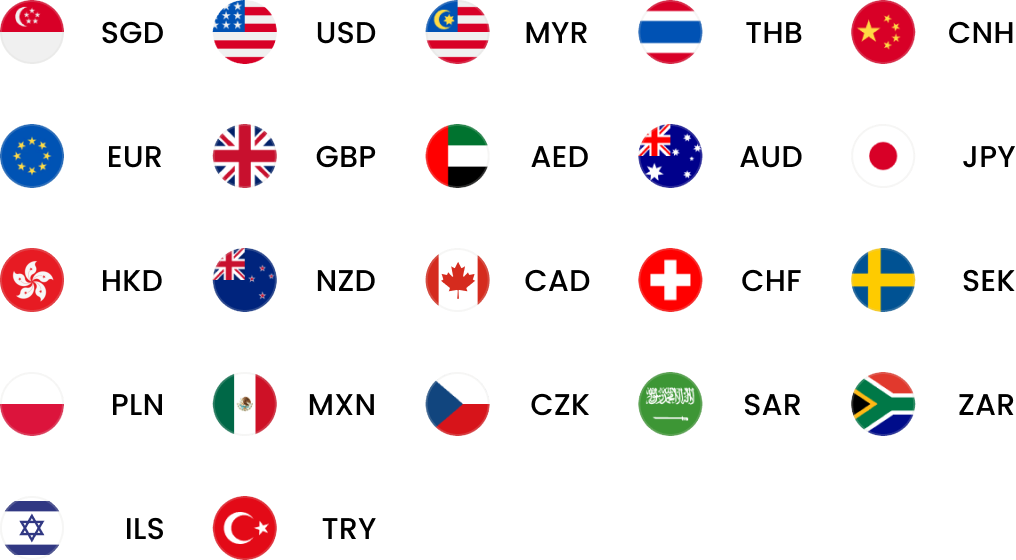
- Receive in 20+ currencies: Collect overseas revenue and marketplace payouts in multiple currencies
- Pay in 100+ currencies: Send supplier payments to 210+ countries and territories
- Connect marketplace revenue: Link with 130+ marketplaces and payment gateways, including Amazon, Shopee, Shopify and PayPal
- Hold before converting: Keep balances in foreign currencies and convert when the timing works for your business
- See costs upfront: Review transfer fees before you pay, with FX markups capped at 0.6% on major currencies
- Manage payment admin: Track payments, assign permissions and connect payment data with accounting tools
Quick comparison: DBS vs OCBC vs World Account
| Feature | DBS | OCBC | World Account |
|---|---|---|---|
| Main role | Full-service business banking | SME banking and local payments | Cross-border payments |
| Currencies | SGD + 12 foreign currencies | Up to 13 major currencies | Receive in 20+ and pay in 100+ currencies |
| Overseas payments | Bank transfer routes | Outward telegraphic transfers | Payments to 210+ countries and territories |
| FX | Bank-set rates | Bank-set rates | Upfront fees and published conversion pricing |
| Marketplace support | Limited | Limited | 130+ marketplaces and payment gateways |
| Best for | Banking, lending and trade tools | Local banking with currency support | Suppliers, payouts and global payment control |
Choose World Account if you:
- Pay overseas suppliers regularly
- Receive revenue in several currencies
- Sell through international marketplaces
- Want more control over when you convert currency
- Need better visibility over FX costs and payment status
- Prefer one place to receive, hold, convert and send money globally
Open a World Account today to manage global payments with more control over currency, payment timing and international supplier costs.
FAQ
1. What documents do I need to open a business bank account in Singapore?
You usually need company registration details, director and shareholder information, ID documents, proof of address and business activity records. Some banks may require board resolutions or additional checks.
2. Can I have more than one business bank account in Singapore?
Yes. Many SMEs use one account for everyday SGD banking and another account for foreign currency, supplier payments, tax reserves or marketplace payouts.
3. Can I use WorldFirst with DBS or OCBC?
Yes. You can use DBS or OCBC as your main business bank and use World Account for supplier payments, foreign-currency collections and marketplace payouts.
Sources:
- https://www.mas.gov.sg/news/media-releases/2025/singapore-strengthens-position-as-third-largest-global-fx-centre
- https://www.enterprisesg.gov.sg/resources/media-centre/media-releases/2026/february/mr00626_review-of-2025-trade-performance
- https://matrixbcg.com/blogs/brief-history/ocbc
- https://matrixbcg.com/blogs/brief-history/dbs?_pos=3&_sid=73a04f450&_ss=r
- https://www.dbs.com.sg/personal/default.page
- https://www.ocbc.com/group/gateway.page
- https://www.worldfirst.com/sg/


![Revolut Business Card review Singapore [2027]: Features, fees & more](https://mdn.marmot-cloud.com/worldfirst/sites/9/2026/09/20261001002258848-300x200.webp)