





























Home > blog > Global Business Tips > Opening a business bank account in Dubai for non-residents: A guide
Opening a business bank account in Dubai for non-residents: A guide
Last update:


It’s typically tough to open a business account in Dubai as a non-resident, due to strict banking regulations and a long list of eligibility requirements. Even with the support of a specialised brokerage service, receiving approval can still take between two and four weeks.
But you don’t actually need to be a United Arab Emirates (UAE) resident to start accepting and receiving payments in AED. And, you don’t even need to open a bank account at all.
Instead of an account with a traditional account, consider opening a business account online with a digital payments platform like WorldFirst.
Our World Account lets you hold, send and receive AED payments like a local, with limited paperwork and no foreign business registration required. It’s free to sign up, and you can typically get approved within 48 hours.
In this guide, we’ll share why a World Account is one of the best alternatives for global businesses that need a business account in Dubai. We’ll also share three alternative bank account options for non-residents, as well as what documentation you’ll need to apply for them.
We’ll cover:
- What non-residents should look for in a Dubai bank account
- How WorldFirst’s World Account simplifies your UAE payments
- How to open a World Account
- Three alternative Dubai business bank accounts to consider
- Documents you’ll need as a non-resident to open a bank account in Dubai
Ready to start holding AED (and 150+ other currencies) with WorldFirst? Sign up for a World Account today.
What non-residents should look for in a Dubai bank account
If you’re interested in a opening a business account in Dubai, these are the key features you should look out for:
- Local account details: Make sure your account comes with full UAE IBAN and BIC details, so you can send and receive international transfers via local payment networks. This speeds up your payments so they land on the same or next day. Without local details, you’ll have to rely on slow and costly SWIFT wires to send money to the UAE.
- Easy setup process for non-residents: While it might sound obvious, look for a bank that’s willing to onboard non-resident shareholders and has a clear statement online about accepting fully foreign-owned companies. This saves you from investing time and money into an application that’s doomed to fail.
Non-resident-friendly banks usually have a fully online application process which you can complete from anywhere in the world. However, it’s worth noting that you may still need to visit a branch in-person to sign documents at least once.
- Minimum balance requirements: Non-resident accounts often have significantly higher minimum balance requirements than regular bank accounts, and UAE banks will often charge you a fall-below fee for failing to meet them. To avoid any surprise charges and to prevent tying up a large amount of your capital, make sure you understand your bank’s rules.
- Clear transfer fees and markups: Check your bank’s FX rate markups, and confirm the cost of inbound and outbound wire transfers. Hidden fees add up over time, and many businesses don’t check this until they’ve already been hit with a charge.
- Advanced FX tools: A good provider should help you manage currency risk by offering products like forward contracts, firm orders and rate alerts. These tools let you lock in exchange rates and reduce cost uncertainty, which is especially valuable if you make frequent AED to GBP conversions.
- Mobile banking access: Your new account should be accessible through online and mobile banking, ideally with features like multi-user access, payment approvals, downloadable statements and bulk uploads. This makes life easier since you won’t have to visit a branch or contact your relationship manager every time you want to check your account balance.
How WorldFirst’s World Account simplifies your UAE payments
Opening a traditional Dubai bank account can take weeks, which is why many businesses choose flexible, non-bank alternatives like WorldFirst that offer setup within minutes.
WorldFirst is a digital payments platform that allows you to hold in 20+ currencies (including AED) and pay in 150+. We’re regulated by the Financial Conduct Authority in the UK, and since 2004 over 1.5 million businesses have trusted us to move US$500 billion worldwide.
Our multi-currency World Account is easy to set up, and you can apply from anywhere in the world without needing proof of UAE business activity.
Here’s what you can do with a World Account:
Easily open a local AED account and pay zero account fees
With WorldFirst, you can easily open a Dubai account without needing a foreign business entity or local address. It’s free to apply online: simply submit your application and receive approval within 48 hours. This is just one of the benefits to WorldFirst not being a bank.
In contrast to traditional Dubai banks, we don’t charge account opening fees, monthly maintenance fees, hidden fees or fees for receiving payments. You also aren’t subject to any minimum balance requirements or fall-below fees, which almost all traditional Dubai banks charge.
Our standard exchange rate markup is locked at 0.5% for major currencies like GBP, AED and 13+ others, and for all non-major currencies our markup will never exceed 0.75%.
Read more about our clear, competitive pricing.
Get local Dubai account details and make same-day payments to the UAE
Just like a traditional Dubai bank account, WorldFirst gives you unique local bank account details that are separate from your main World Account details. These include UAE IBANs and BICs that make it easier to send money internationally.
This information allows you to access the UAE’s payment rails, Aani and UAEFTS, which means your transfers are processed locally rather than internationally. It also cuts out intermediary banks (and intermediary bank fees) from your transfer, which results in a faster and cheaper transaction.
As a result, with WorldFirst, 80% of payments arrive on the same day, and 90% arrive on the next day.
Lock in favourable FX rates for up to 24 months and benefit from cost certainty
If you make regular conversions between AED and GBP, you might be concerned that exchange rate fluctuations are making it difficult for you to accurately forecast your costs.
To help you mitigate this risk, WorldFirst allows you to lock in a favourable FX rate for up to 24 months with forward contracts. This works well if you have a one‑off payment or a series of regular transfers coming up, for example, if you’re ordering inventory or paying a lump sum for a subscription service.
Alternatively, you can target a specific exchange rate with a firm order. A firm order is a bit like a rate alert, except that WorldFirst will convert your funds on your behalf. It’ll execute your conversion without you having to watch the markets constantly or quickly react to a rate alert.
For day-to-day spending, you can also reduce FX risk by avoiding currency conversion altogether. When you use your World Card to pay from your existing AED balance, you’ll pay zero FX fees while also earning up to 1.2% cashback on a wide range of business expenses, including payroll, client entertainment and digital advertising, among others.
Read more: What is a forward contract and why should you use one?
How to open a World Account
To start holding AED with WorldFirst, you’ll first need to sign up for our multi-currency World Account. It’s completely free to open and maintain, and the application process is entirely online.
Here’s how to sign up:
- Head to our World Account signup portal and enter your personal details
- Fill in your account information and verify your identity with a passport or drivers licence
- Upload your business documents, including your certificate of incorporation, proof of address and director/shareholder ID for KYC verification
- Once you click ‘Submit’, you’ll receive an acceptance email (usually within 48 hours)
Then, to open a local AED currency account:
- From your World Account dashboard, click ‘Shortcuts’ and then ‘Manage accounts’
- Click the ‘Add a new receiving account’ button on the top right of your screen
- Choose AED as your currency and give your account a nickname, then click ‘Confirm’.
- Your local AED account will be created instantly
For more information, read: How to open a local currency account
3 alternative Dubai business bank accounts to consider
If WorldFirst isn’t the right option for you, here are three alternative Dubai business bank accounts to consider:
| WorldFirst’s World Account | Emirates NBD Business Account | First Abu Dhabi Bank’s Business Basic Account | RAKBANK’s Business Current Account | |
|---|---|---|---|---|
| Best for | Cross-border businesses, SMEs and freelancers that want to hold multiple currencies | Serves businesses of all sizes and offers different ‘packages’ depending on your business type | Smaller businesses that need a simple banking setup | Businesses of all sizes that want to hold multiple currencies |
| Monthly fee | Free | AED 249 | AED 250 | No mention for this account |
| Minimum balance requirement | None | For ‘Connect’ accounts, there’s no minimum balance requirements | AED 10,000 | AED 25,000 |
| Fall-below fee | None | For ‘Connect’ accounts, there’s no fall-below fee | AED 100 | AED 52.5 |
Here’s a more in-depth look at each account:
1. Emirates NBD Business Account
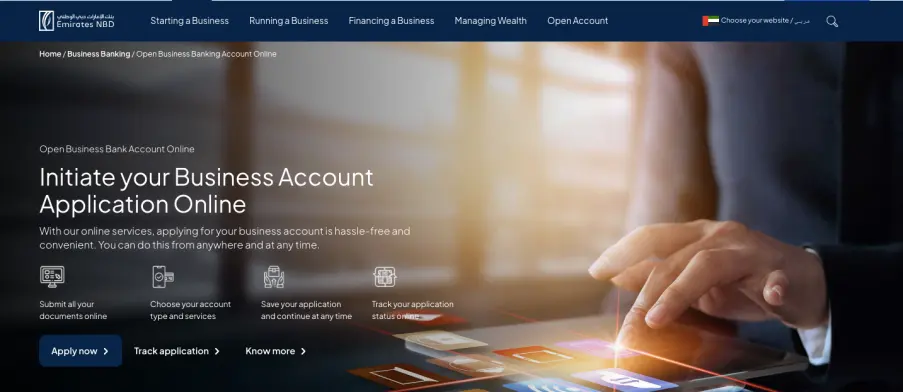
Emirates NBD is a well-known UAE bank that serves businesses of all sizes with their Business Account. They offer seven different ‘packages’ for this account, which means your banking experience will vary greatly depending on the package you choose.
For example, with basic Connect accounts, you’ll pay a monthly maintenance fee of AED 249 (about £50) and in return you’ll receive online banking access, a Visa Business Debit Card and a business bank account.
Connect accounts are best for startups and businesses with Professional Licences that are simply looking for online access to banking services. This account package has limited branch access with higher transactional fees and no dedicated Relationship Manager. You’ll also pay Standard Foreign Exchange rates on your transfers, which can get costly if you make frequent GBP and AED conversions.
At the higher end, the Platinum package costs AED 1,500 per month (roughly £300) and offers a more premium service, including better transactional terms and access to a Relationship Manager.
How to open this account as a non-resident
To apply for this account digitally, you must be a UAE-registered business operating in trading, manufacturing, contracting, transportation or any other service sector in the UAE.
At least one signatory must be a UAE resident, and you’ll need to have a valid Board Resolution. You’ll also need a valid Trade Licence (or Certificate of Incorporation) from any of the UAE issuing authorities.
Here’s how to apply:
- Begin your application by clicking “Apply now”
- Add your business and financial details
- Add shareholder and/or POA details, and set their account management rights
- Select your banking package
- Select the currency you wish to open your account in
2. First Abu Dhabi Bank’s Business Basic Account
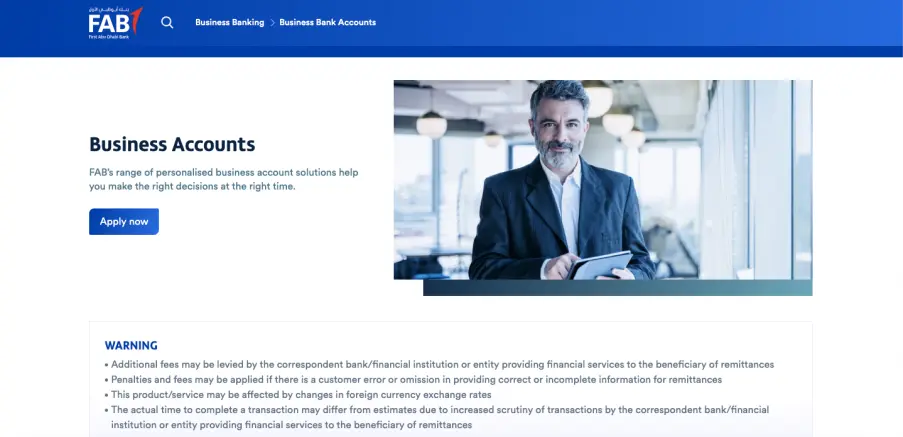
This Business Basic Account from First Abu Dhabi Bank (FAB)3 is designed for businesses which need a simple banking setup. It comes with free comprehensive online business banking services and supports multiple currencies, including AED, USD, GBP, JPY, CNY and EUR.
There’s a monthly maintenance fee of AED 250 (about £50), plus an AED 100 fee for failing to meet their average minimum balance requirement of AED 10,000 (around £2,000). It’s free to receive both domestic and foreign transfers, though outgoing transfers cost AED 50 to other central UAE banks and AED 70 to international banks.
FAB lets you view, download and export statements in various formats, including bank statements, online statements, cheque book services and MT940 online reporting. You can also contact support via email or phone, with both UAE and international numbers available to help with any account queries.
How to open this account as a non-resident
You must register your company in the UAE and hold a valid trade licence, otherwise FAB won’t allow you to open a business account. FAB strongly prefers that at least one signatory or main shareholder be a UAE resident, and you may need to show proof of business presence, such as an office or lease.
If you meet the eligibility criteria, here’s how to apply:
- Go to the FAB online website or the FAB mobile app and click ‘Apply’, or visit a branch in-person
- Verify your contact information, including your email address and phone number
- Submit your personal and business verification documents, including your ID, passport information and Trade Licence documentation
- Expect a detailed KYC compliance check
- If you’ve applied online, you’ll typically need to visit a branch at least once to sign forms and complete in‑person verification
3. RAKBANK Business Current Account
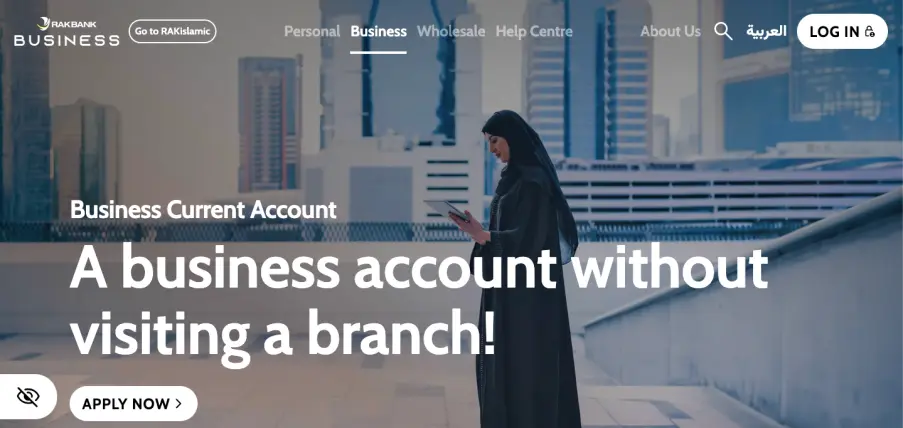
The Business Current Account from RAKBANK is aimed at businesses of all sizes that want a simple way to manage day-to-day transactions (such as salary payments). It’s available in AED, USD, EUR, and GBP, making it convenient for businesses that operate both in Dubai and internationally.
Account holders are required to hold an average minimum monthly balance of AED 25,000 (about £5,000), though you’ll be charged AED 52.5 for each month that your balance falls below this. There’s also a fee of AED 210 (£40) if you decide to close your account within six months of opening it.
In terms of features, you’ll get a complimentary bank card with your account that you can use at over one million ATM locations worldwide. Balances of AED 500,000+ (or US$500,000+) qualify for 0.10% annual interest. You’ll also gain access to traditional bank lending, although unarranged overdrafts are subject to high interest rates of 18% per year.
It’s worth noting that while RAKBANK does have a Non-Resident bank account, it’s for personal banking and is aimed at very wealthy customers.
How to open this account as a non-resident
You must be 18 years old and above, with a valid trade licence to operate within the UAE.
Your company must be fully incorporated in the UAE, and all documents must be up to date and in English (or officially translated).
RAKBANK will look at your business model, expected turnover, main markets, and source of funds to assess risk, especially for non‑resident ownership, so it’s best to prepare a short business profile detailing these points.
Here’s how to apply:
- Start application (online or through a partner) by going to RAKBANK’s “Quick Apply”
- Fill in company and owner details and upload documents.
- If you’d like additional help, many UAE business setup or banking consultants can pre‑screen your case and arrange a RAKBANK relationship manager, which is often helpful for non‑residents.
- Expect follow‑up calls/emails requesting more information on your business model, transaction patterns, and links between shareholders and the UAE company.
- You or a representative may be asked to visit a branch in the UAE for in‑person verification, even if you applied online.
The typical processing time is around two to four weeks, though it may be longer for fully non‑resident businesses.
Documents you’ll need as a non-resident to open a bank account in Dubai
If you’re a non-resident applying for any of the above bank accounts, you’ll need to meet the UAE’s strict banking regulations. To help make the application process easier and give you a higher chance of approval, it’s best to prepare all the required documents in advance.
For most Dubai banks, here’s what you’ll need to prepare:
Business documents
- A valid Trade Licence or Certificate of Incorporation from any of the UAE issuing authorities
- A company bank statement that covers six months’ history
- A board resolution document with signatures from all your partners
- Proof of business activity (this could include contracts, invoices or letters of intent from clients/suppliers)
- Company business plan or short business profile with basic financial projections
- Articles of Association that show shareholder ownership
- Proof of UAE business address
Individual documents
- Copies of passports (with at least six months left) and Emirates IDs for all partners
- Recent proof of address for the past three months (such as a utility bill)
- A personal bank statement that covers six months of financial history
- A short CV or professional profile for each shareholder / authorised signatory, highlighting their role and source of wealth
Open an AED business account with WorldFirst and get set up within minutes
In this guide, we’ve shared how non-residents can open a business bank account in Dubai, covering the documents you’ll need, what to watch out for and how to apply.
With WorldFirst, you can open a local AED receiving account online and typically get approved within 48 hours. You’ll get local UAE account details instantly, benefit from low FX fees and even lock in favourable exchange rates for up to two years.
Ready to start sending and receiving payments in AED (and 150+ other currencies)? Sign up for a World Account for free.
FAQs:
What’s the best Dubai business account for non-residents?
For non-residents, the “best” Dubai business accounts are ones that give you transparent fees, fast onboarding and the ability to apply online without needing a UAE business presence.
WorldFirst’s World Account is a popular option for many UK businesses, since you don’t need a Dubai trade licence, a local office address or a UAE residency visa to get started. The entire application is completed online with zero in-person visits required.
What documents do I need to open a business bank account in Dubai?
For most Dubai business bank accounts, here’s what documents non-residents will need to prepare:
- A valid Trade Licence or Certificate of Incorporation from any of the UAE issuing authorities
- A company bank statement that covers six months’ history
- A board resolution document with signatures from all your partners
- Proof of business activity (this could include contracts, invoices or letters of intent from clients/suppliers)
- Company business plan or short business profile with basic financial projections
- Articles of Association that show shareholder ownership
- Proof of UAE business address
- Valid passports (with at least six months left) and Emirates IDs for all partners
- Proof of address
- A personal bank statement that covers six months of financial history
- A short CV or professional profile for each shareholder / authorised signatory
How much does it cost to open a business bank account in Dubai as a non-resident?
Opening a UAE business bank account as a non-resident can be expensive, with opening fees stretching as high as AED 5,000 for some banks. Minimum balance requirements can go even higher (often between AED 10,000 and AED 50,000) and falling below them can trigger monthly penalty fees.
Plus you’ll likely need to pay to register your company in the UAE, which typically costs upwards of AED 20,000.
In contrast, opening a Dubai business account from a fintech provider rather than a bank is a much more cost-effective option. With WorldFirst, for example, you’ll pay no account opening fees, no ongoing monthly fees and no fall-below fees since there’s no minimum balance requirements. You also aren’t required to register your business overseas in order to open an account.
Is it illegal to use a personal bank account for business in Dubai?
Using a personal bank account for business transactions in the UAE is illegal.
The UAE Central Bank requires that all business transactions are processed through a corporate bank account. UAE banks monitor transactions closely, and if a personal account shows patterns consistent with business activity, then your account may be suspended while the bank investigates.
- https://www.sovereigngroup.com/dubai/offshore-bank-account-opening-in-dubai/
- https://www.emiratesnbd.com/en/business-banking/open-business-bank-account-online
- https://www.bankfab.com/en-ae/business-banking/accounts
- https://www.rakbank.ae/en/business/everyday-banking/accounts/business-current-account

Abdul Muhit has 17 years' experience in banking and payments, spanning across regulation, payment networks, acquiring, issuing and treasury. He has served across strategic and delivery roles in product, technology and operations functions at global companies including JP Morgan, KPMG and Visa."

Abdul Muhit
Author
Continue reading


Subscribe
The Weekly Dispatch
Get the latest news and event invites. Signup for our weekly update from the worlds of fashion, design, and tech.
You might also like
Choose a product or service to find out more

E-commerce guides


Doing business with China

Exploring new markets

Business Tips

International transactions
E-commerce expansion guides
Doing business with China
The simpler way to pay and get paid
Save money, time, and have peace of mind when expanding your global business.