




























Singapore’s GDP from manufacturing recorded 34,063.90 SGD Million in the second quarter of 2026, according to official statistics reported by Trading Economics.The same report further states that exports of machinery and equipment alone account for 43% of Singapore’s total export value, with China, Hong Kong, and Malaysia being three of the country’s largest trading partners.
The use of foreign exchange and currency conversions in any manufacturing business, especially one with multiple overseas suppliers for ancillary parts, is indispensable. For a manufacturer, that conversion is often the difference between a profitable order and a break-even one. Because of this, manufacturers closely watch any rise or fall in the value of the Singapore dollar (SGD).
This guide covers what FX risk actually means for a manufacturing business in Singapore, why manufacturers specifically carry more of it than most other industries, the tools available to manage it, and how WorldFirst can help Singapore-based SMEs minimize their revenue losses using them.
Key Takeaways
- The Inherent Risk of International Trade: For manufacturers in Singapore, currency risk comes into play in the normal course of business. Usually, these manufacturers pay their suppliers for raw materials in one currency while invoicing customers in another.
- The Danger of Currency Volatility: Unmanaged currency volatility is a silent killer for companies over the long run. Even if your first few years of sales go well, the hidden costs of volatility can make cash flow forecasting impossible.
- Understanding Basic Hedging Toolkit: Basic treasury operations rely on foundational strategies like multi-currency pricing, which helps you keep more of your revenues and costs aligned in the same currency.
- Why Moving From Reactive to Proactive Matters: Without a close watch and proper FX management, FX risk is often handled poorly in the early stages. Implementing a formal FX policy helps your FX management move from a reactive, ad-hoc approach to being managed proactively.
- Smarten Up Your Payment Infrastructure: Avoid paying double conversion fees by paying suppliers directly in the currency they accept (whether SGD or foreign currency)—giving SMEs access to efficient tools once reserved for large corporations.

What Exactly Is FX Risk?
Foreign exchange risk, or currency risk, is the term that refers to financial loss caused by swings in exchange rates between the time a transaction is agreed upon and the time it is actually settled.
If you’re a Singapore-based manufacturer importing raw materials from Europe or the US, the cost of those materials rises and falls with the SGD’s strength against the EUR or USD.
For example, if you’re paying a Malaysian supplier in MYR or a Chinese factory in CNY, the same principle applies throughout your global business operations. Even a slight deviation in the value of the SGD compared to the USD or CNY means you might be losing a portion of your revenue when you account for these small currency conversion swings, which are out of your control. They can add up to a huge sum of money that is irrecoverable by the end of your financial year. Thus, if you don’t take a careful approach, you are losing revenue with every cross-border transaction you make.
Why Manufacturers Specifically Carry More FX Risk
Manufacturers are frequently exposed on both sides of the transaction in their day-to-day business dealings. For instance, they buy raw materials and components in one currency, but sell their finished goods in another, and the two rarely match up.
Between February and September 2024, the SGD/MYR exchange rate shifted notably. This had a significant impact on Singaporean manufacturers.
For example, suppose a manufacturer had to pay a Malaysian supplier MYR 500,000 for a piece of machinery. One manufacturer converted early, in February, and paid SGD 142,857 based on the exchange rate at the time.
If another manufacturer had to pay for the exact same consignment in September, they ended up paying SGD 155,763 for the exact same machine. Thus, the second manufacturer paid nearly SGD 13,000 more, without any change in the machine or equipment.
Thus, when a manufacturer runs monthly supplier payments, quarterly bulk orders, and export invoices in three or four currencies simultaneously, it becomes a structural cost that the business has to bear every single month.
Many manufacturers fail to treat currency movement with the attention it deserves, leading to serious issues that they only realize later:
| Risk | What It Looks Like |
| Reduced profit margins | Invoicing in a foreign currency carries risks. If it depreciates before payment arrives, the actual SGD value you receive drops. |
| Cash flow issues | Unpredictable exchange rate movements make budgeting more difficult, especially when working with tight production schedules and supplier payment terms. |
| Balance sheet problems | Assets or liabilities held in foreign currencies are revalued as exchange rates change, affecting the financial ratios that lenders and investors monitor. |
| Drop in stakeholder confidence | Investors, lenders, and long-term customers may lose confidence when a business appears heavily exposed to currency fluctuations. |
Currency swings and crashes don’t happen all at once. They usually start with ordinary movements that many manufacturers fail to notice or pay attention to. Over time, however, these small shifts compound into a much larger gap between your domestic currency and the currency you use for payments. Gradually, it erodes your business margins before you realize it.
Why Should You Know About the FX Maturity Curve?
PwC’s research into corporate treasury practices offers a useful way to self-assess before diving into specific tools. Based on conversations with more than a dozen treasury and finance executives, PwC identified a rough maturity curve that applies to a Singapore manufacturing SME as well as it does to a global software company:
- Emerging stage: The business trades primarily in one currency and hasn’t yet established any real FX strategy, governance, or policy. Exposure grows quietly as international trade increases.
- Middle stage: Some governance and policy exist, and the business handles a very few currencies, but processes struggle to scale when the business is set for expansion.
- Mature stage: The business has tailored strategy, governance, and pricing policies that turn FX management into a genuine competitive advantage.
Most Singapore manufacturers are positioned somewhere between the emerging and middle stages. Their FX risk exposure tends to grow gradually alongside export volume rather than suddenly appearing as a risk on one single day.
Knowing which stage your business is currently functioning at helps you decide which tools can actually help, rather than choosing a tool which might not be suitable for you at your current stage.
How Can Manufacturers Manage FX Risk in Singapore: Key Strategies
There’s no one-size-fits-all formula to manage FX risks. The right approach and appropriate risk management strategy for your manufacturing business will be based on your exposure size, frequency, and risk tolerance.
Here are some key FX Risk management strategies that manufacturers should know:
Natural Hedging
Natural hedging means structuring your cash flows so income and expenditures land in the same currency wherever possible. If your business imports from Malaysia but also exports products there, using MYR revenue to directly offset MYR supplier costs means only the leftover, unmatched portion carries any real currency risk. It’s often the cheapest form of protection available.
Forward Contracts
A forward contract lets you lock in an exchange rate today for a payment you will actually make at a future date. For instance, an apparel firm ordering fabric from a Spanish supplier for delivery six months out can lock in today’s rate for that future payment.
Now, if the FX rate moves against them in the meantime, they still pay the exact same price irrespective of what the current FX value stands at between the SGD and the Euro, because the price is already fixed.
Also, even if the rate moves in their favour, they simply do not benefit from that upside. You trade potential gains for total cost certainty.
FX Options
FX options work differently. They give you the right to exchange currency at an agreed rate before a set date.
For example, a Singapore manufacturer expects to receive a large order from a US buyer in six months, but the timing or exact revenue amount is still uncertain. In such a situation, the manufacturer can buy an FX option that sets a floor on the US Dollar exchange rate.
If the US Dollar weakens significantly before the due date, the manufacturer can exercise the option and trade at the pre-agreed protected rate. Thereby, it helps them avoid the loss.
On the other hand, if the market moves favourably and the US Dollar strengthens, the manufacturer can simply let the option lapse and convert their money at the much better spot rate in the open market.
For the FX option, you pay an upfront fee called a premium to purchase it. This is the main trade-off compared to a forward contract, which has no upfront cost but locks you in permanently whether the market goes up or down.
FX options let a business manage FX risk while still keeping the door open for upside gains. This is especially useful for manufacturers dealing with fluctuating order volumes or timelines.
Forward Contract Vs FX Option
| Feature | Forward Contract | FX Option |
| Upfront cost | None | Premium payable |
| Obligation | Locked in. You must complete the transaction at the agreed exchange rate. | Gives you the right, but not the obligation, to complete the transaction. |
| Best for | Known, scheduled payments | Uncertain transactions, such as tenders or unconfirmed orders |
| Upside if the market moves in your favour | None. The exchange rate is fixed. | Yes. You can let the option expire and use the prevailing spot rate instead. |
| Ideal user | Manufacturers with confirmed supplier payment dates | Manufacturers with variable order timing or order volume |
Diversification and Multi-Currency Pricing
Spreading exposure across multiple currencies, rather than concentrating risk in one, reduces how much a single adverse currency swing can hurt your business. For manufacturers dealing with several suppliers across different regions, negotiating multi-currency pricing or holding a mix of currencies rather than converting everything back to SGD immediately can spread that risk meaningfully.
Establish Clear FX Risk Policies
A written FX risk policy sets exposure limits per currency and establishes a regular review cadence. It helps turn currency management from a reactive scramble into a deliberate business process. Without a policy, decisions tend to be made ad hoc and under time pressure right when a payment is due, which is certainly not the right moment to think clearly about currency exposure. Having clear guidelines ensures your team follows a consistent, disciplined approach rather than guessing when the market moves.
Regular Tracking and Rate Alerts
Setting up rate alerts or dashboards that flag favourable conversion windows means you’re acting on real information rather than guessing when to convert. This is a low-effort habit that pairs well with any of the strategies above.
How WorldFirst Helps Singapore Manufacturers Manage Currency Risk
Strategy and tools only go so far without the right account infrastructure behind them. Here’s where WorldFirst actually changes the equation for a Singapore manufacturer, across three genuinely different parts of the problem.
Bypassing Intermediary Fees with Local Clearing Networks
A lot of Singapore manufacturers unknowingly pay twice for the same currency conversion. Converting SGD to USD, only for a Chinese supplier to then convert that USD into RMB on their end, means two conversion costs are being paid on a single transaction, and that cost is quietly eating into your margin without ever appearing as a single line item you’d notice.
WorldFirst’s MYR and CNH-holding accounts let you pay Chinese and Malaysian suppliers directly in their local currency, with local bank details on your end, which removes that second conversion entirely. WorldFirst is also the official payment partner to 1688.com, letting Singapore manufacturers pay suppliers there in CNY instantly, without the tedious documentation a bank transfer usually demands.
The 1688.com Advantage for Sourcing from China
If your manufacturing business relies on parts, components, or machinery from mainland China, cross-border payments can often become a bottleneck filled with heavy bank paperwork and documentation processes. Because WorldFirst is part of Ant International, it serves as the official payment partner for 1688.com. It helps Singapore manufacturers pay suppliers on 1688.com directly in CNY, removing the time-consuming documentation and delays that are inevitable in traditional bank transfers.
Capturing Hidden Savings with the World Card
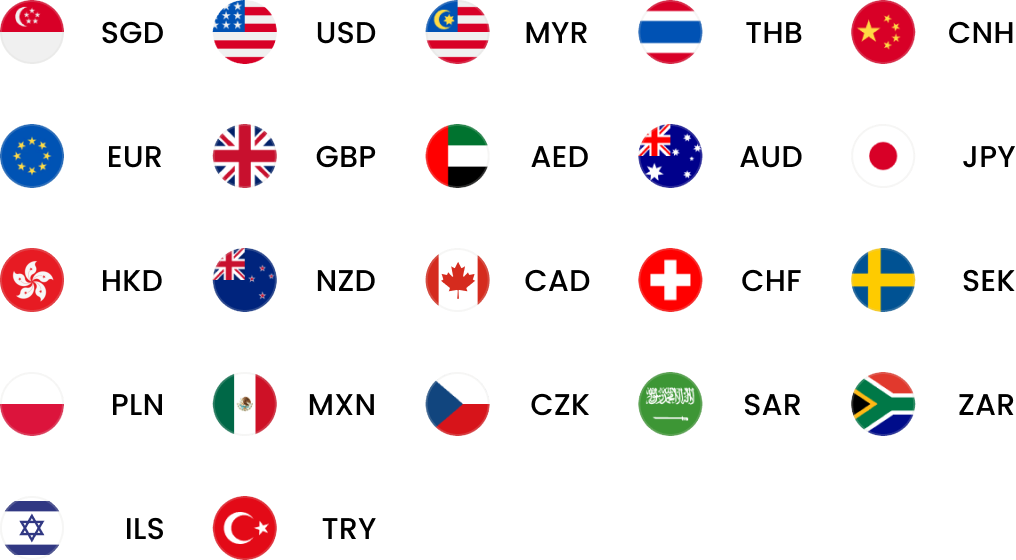
FX risk management usually focuses on supplier payments, but a manufacturer’s currency exposure doesn’t stop there. Ad spend, software subscriptions, and travel for supplier visits all carry their own foreign transaction costs if paid on a standard card. WorldFirst’s World Card charges zero FX fees across 16 major currencies and pays up to 1.2% uncapped monthly cashback on eligible spend, turning a cost centre most manufacturers don’t think to hedge into a small, ongoing return instead.
Locking in Rates Before You Need To
For manufacturers planning bulk orders, WorldFirst’s forward contracts let you lock in today’s rate for a payment you’ll make later. Spot contracts cover the opposite need, converting immediately at the live rate when a payment can’t wait, and firm orders let you set a target rate and have the transaction trigger automatically the moment the market reaches it, useful for a manufacturer watching for a favourable window without needing to check rates manually every day.
Building a Practical FX Risk Framework for Your Manufacturing Business
- Map your currency exposure: List every currency you pay suppliers in and every currency you invoice customers in. Most manufacturers are surprised by how many currencies show up once this is written down properly.
- Identify natural hedges first: Where do your inflows and outflows already overlap in the same currency? Structure around that before reaching for any paid instrument.
- Match the tool to the transaction: Use forward contracts for known, scheduled payments. Consider options where the transaction itself is uncertain (a tender you might not win, an order that might not materialise). Use spot conversion for anything immediate.
- Set exposure limits in writing: Even a simple policy, “we hedge any single supplier payment over SGD X,” removes the need to make a judgement call under time pressure every time.
- Consolidate your payment infrastructure: Paying suppliers in their local currency through one multi-currency account, rather than converting through SGD multiple times across different providers, removes cost without requiring any hedging sophistication at all.
- Review quarterly, not annually: Currency exposure shifts as your supplier base and customer mix change. A policy set once and never revisited stops matching your actual risk within a year or two.
Grow Your Manufacturing Business in Singapore with WorldFirst
WorldFirst is regulated as a Major Payment Institution under Singapore’s Payment Services Act 2019 by the Monetary Authority of Singapore, and operates as part of Ant International, having supported over 1.5 million businesses globally since 2004. For a manufacturer trusting a provider with regular, sizeable supplier payments, that regulatory standing matters as much as the rate on any given transfer.
Power your global growth with one account
To manage overseas supplier payments, currency balances and business transfers from one platform.
FAQs
1. What is FX risk management for manufacturers?
It’s the practice of identifying and reducing the financial impact of currency fluctuations on a manufacturing business’s supplier payments, customer invoices, and overall margins.
2. Why are manufacturers more exposed to FX risk than other businesses?
Manufacturers frequently buy raw materials in one currency and sell finished goods in another, creating exposure on both sides of the transaction simultaneously.
3. What’s the difference between a forward contract and an FX option?
A forward contract locks in a rate for a future payment with no upfront cost, but both parties are obligated to complete the transaction at that rate. An FX option costs a premium upfront but gives the buyer the right, not the obligation, to exercise it, offering more flexibility.
4. Can small manufacturers use the same FX tools as large companies?
Yes. Forward contracts, spot conversion, and multi-currency accounts are all accessible to SMEs, not just large corporates, particularly through providers like WorldFirst that build these tools into a standard business account rather than requiring a separate treasury relationship.
5. Does WorldFirst offer FX hedging tools for Singapore SMEs?
Yes. WorldFirst offers forward contracts, spot contracts, and firm orders, alongside multi-currency accounts that let Singapore manufacturers hold and pay in currencies like MYR and CNH directly, avoiding the double conversion cost that erodes margin on cross-border supplier payments.
Sources
- https://www.oaktreesolutions.com.sg/post/foreign-exchange-risk-faced-by-local-smes-navigating-the-challenges-and-mitigating-risks
- https://www.pwc.com/us/en/industries/financial-services/library/managing-global-pricing-and-fx-risk.html
- https://wise.com/us/blog/how-to-manage-fx-risk
- https://convera.com/blog/cross-border-payments/fx-options-currency-risk-management/
- https://tradingeconomics.com/singapore/gdp-from-manufacturing
- https://www.edb.gov.sg/en/about-edb/media-releases-publications/monthly-manufacturing-performance.html
- https://www.mas.gov.sg/

![Revolut Business Card review Singapore [2027]: Features, fees & more](https://mdn.marmot-cloud.com/worldfirst/sites/9/2026/09/20261001002258848-300x200.webp)