




























New to shipping from China to Singapore for your business? Here’s everything you should know about handling freight options, customs and duties, key documentation, and CNH payments to shipping partners
Key takeaways
- China and Singapore have one of Southeast Asia’s most established trade corridors, supported by the China-Singapore Free Trade Agreement (CSFTA) and the Regional Comprehensive Economic Partnership
- Sea freight is the most common shipping method from China to Singapore, with LCL and FCL options for different order sizes.
- Air freight and express courier work for faster or smaller shipments compared to sea freight
- Customs clearance in Singapore is handled through Singapore Customs. Most goods entering Singapore are subject to Goods and Services Tax (GST) with some categories duty-free under FTAs
- Paying Chinese suppliers, freight forwarders and shipping partners in CNH directly (rather than converting SGD through USD) removes double conversion costs and gives buyers more control
China is Singapore’s largest trading partner, and the trade volume keeps growing. In June 2026, China exported US$10.3 billion to Singapore, up 32.8% from the same month a year earlier when the figure sat at US$7.76 billion. For Singapore-based importers, retailers and e-commerce sellers, China is often the primary sourcing market. It’s close enough for reasonable shipping times, deep enough on manufacturing capacity to cover almost any category, and connected to Singapore through some of the most active trade corridors in the region.
The trade relationship is supported by three main agreements that reduce tariffs and simplify customs procedures for eligible goods:
- ASEAN-China Free Trade Agreement (ACFTA) covers trade between ASEAN member states (including Singapore) and China. [Add backing URL to MTI Singapore ACFTA page]
- China-Singapore Free Trade Agreement (CSFTA) is a bilateral agreement providing preferential tariff treatment on eligible goods.
- Regional Comprehensive Economic Partnership (RCEP) is the multilateral agreement covering China, Singapore, other ASEAN countries, Japan, South Korea, Australia and New Zealand. [Add backing URL to RCEP page]
Shipping from China to Singapore isn’t just about picking a supplier and waiting for the goods to arrive. There are freight decisions, customs procedures, duties and taxes, documentation requirements and payment logistics to plan around. This guide walks through what Singapore importers need to know at each stage.
Shipping methods from China to Singapore
Three main shipping methods to handle China to Singapore imports, each suited to different order sizes and timelines.
Sea freight (LCL and FCL)
Sea freight is the most common method for larger shipments. Two main options:
- LCL (Less than Container Load) consolidates your shipment with cargo from other importers in the same container. Suitable for orders that don’t fill a full container. Costs are calculated by cubic metre (CBM) or by weight (whichever is higher).
- FCL (Full Container Load) dedicates a full container (either a 20-foot or 40-foot container) to a single shipment. Typically the more cost-efficient option per unit once your order volume approaches the capacity of a container. Also faster than LCL because it doesn’t need consolidation or deconsolidation at each end.
Shanghai, Shenzhen, Ningbo and Guangzhou are the primary origin ports for Singapore-bound cargo.
Air freight
Air freight is significantly faster than sea freight but costs more per kilogram. Transit times are typically 2 to 5 days, depending on the airline and airport pair.
Air freight suits high-value goods, urgent restocking situations, and products where the value-to-weight ratio justifies the higher shipping cost. Common airport pairs include Shanghai Pudong, Shenzhen Bao’an and Guangzhou Baiyun on the China side, with Singapore Changi as the destination.
Express courier
Express courier services (DHL, FedEx, UPS, SF Express) handle smaller, time-sensitive shipments end-to-end. Transit times are the fastest, typically 1 to 3 days from China to Singapore for standard express services. Costs are the highest per unit weight, making express courier best suited to samples, small parcels or urgent one-off shipments rather than regular commercial imports.
Customs, duties and taxes in Singapore
All goods entering Singapore go through clearance with [Singapore Customs (add backing URL)]. The main costs and requirements at the Singapore side include:
- Goods and Services Tax (GST) applies to most imported goods. The current rate is [9% (add backing URL to IRAS)]. GST is calculated on the CIF value (cost, insurance, freight) plus any customs duty.
- Customs duty applies only to specific categories in Singapore: intoxicating liquors, tobacco products, motor vehicles and petroleum products. Most other goods enter Singapore duty-free.
- Preferential tariff treatment under ACFTA, CSFTA or RCEP can reduce or eliminate duties on eligible goods. Importers need to present a valid Certificate of Origin from the exporter to claim the preference.
- GST registration is required for Businesses with taxable turnover above SGD 1 million. Registered businesses can claim GST paid on imports as input tax against their output GST.
Documentation required
Every China-Singapore shipment needs a standard set of documents:
- Commercial invoice from the Chinese supplier, showing the goods, quantities and values
- Packing list detailing what’s in each carton or container
- Bill of Lading (for sea freight) or Air Waybill (for air freight) as proof of shipment
- Certificate of Origin to claim any FTA preferences
- Import Permit from Singapore Customs (typically arranged by the freight forwarder or customs broker)
- Any category-specific licences or permits for regulated goods (electronics with wireless functions, food products, chemicals, etc.)
Missing or incorrect documentation is the most common cause of clearance delays at Singapore Customs, so working with an experienced freight forwarder helps.
Managing payments to suppliers and shipping partners with a World Account
The World Account is a multi-currency account from WorldFirst, an international payments provider for cross-border businesses. Singapore importers use it as a single account for paying Chinese suppliers and shipping partners, receiving international customer payments, and managing spending across currencies.
Local currency accounts in 20+ currencies
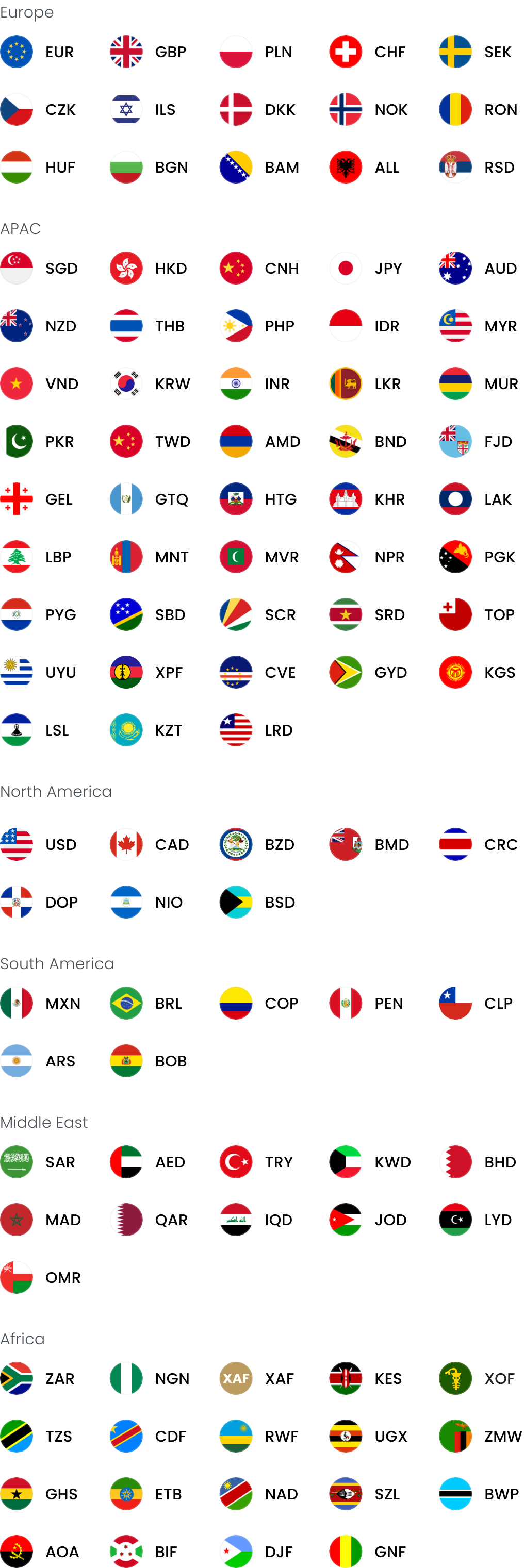
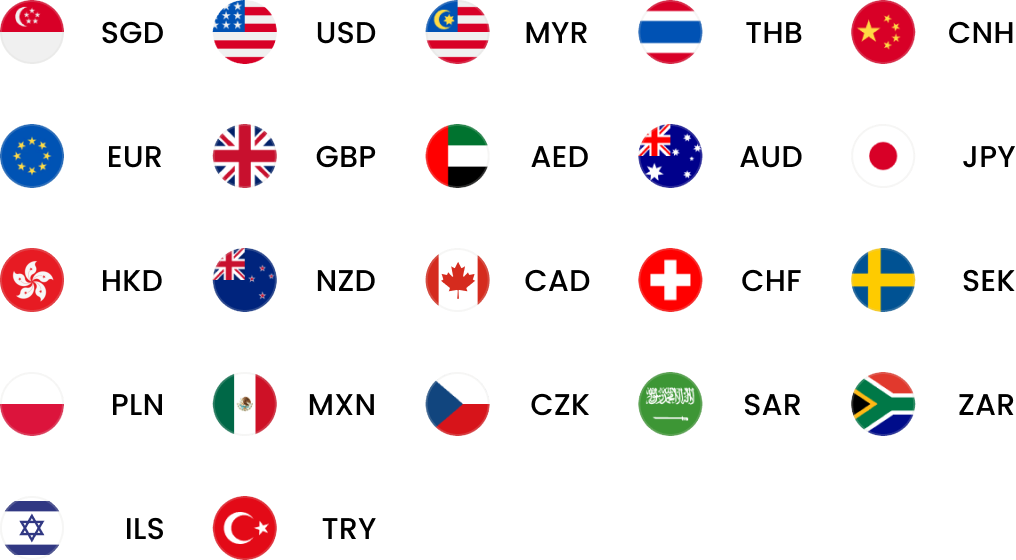
The World Account provides local receiving details in 20+ currencies, including SGD, USD, GBP, EUR and CNH. Singapore importers can hold balances in each currency, receive payments from international customers and marketplaces in matching currencies, and convert between currencies when the timing suits–all from one account.
Pay Chinese suppliers directly in CNH
Sending SGD to a Chinese supplier through a standard bank typically involves converting SGD to USD, then having the supplier’s bank convert USD to CNH on arrival. Two currency conversions, two sets of fees. The World Account holds CNH balances and sends CNH directly to suppliers, freight forwarders and shipping partners in China, without the double conversion.
Hold CNH when rates are favourable
Buyers with recurring supplier payments can convert SGD to CNH when the exchange rate suits, then hold the CNH balance to pay suppliers over the following weeks. This makes payment budgeting more predictable and reduces exposure to rate movements between order placement and payment.
Pay 1688.com suppliers through World Pay
WorldFirst is the authorised international payment provider for 1688.com. For Singapore importers sourcing directly from the wholesale platform, World Pay handles supplier payments in CNH from the same World Account.
Forward contracts for future payments
For known future payments where budget certainty matters, forward contracts lock in an exchange rate today for a currency conversion that settles later. Useful when large supplier payments are booked in advance.
Collect international customer payments in the original currency
Importers who also sell internationally can receive USD, GBP, EUR and other currency payouts from customers, marketplaces (Amazon, Shopify, Etsy, Stripe and 130+ others) and payment gateways directly into matching-currency balances. No forced conversion to SGD at receipt.
Spend directly with the World Card
The World Card is a multi-currency card linked to the World Account. Singapore importers use it for shipping quotes, freight forwarder fees, customs broker charges, sample orders and other ad hoc payments related to their China trade. The card supports payments in 150+ currencies with no fees when paying in any of the 15 supported currencies (with sufficient balance held in that currency). Up to 20 virtual cards are available at no extra cost, useful for assigning cards to different team members or spending categories. Cashback is available on eligible spending (Terms and Conditions Apply).
FAQs
1. How long does shipping from China to Singapore take?
Sea freight typically takes 5 to 14 days between major Chinese ports and Singapore. Air freight takes 2 to 5 days. Express courier services like DHL, FedEx and UPS can deliver in 1 to 3 days for standard express shipments.
2. Do I need to pay import duties on goods from China to Singapore?
Singapore imposes customs duty only on specific categories (intoxicating liquors, tobacco, motor vehicles and petroleum products). Most other goods enter Singapore duty-free. GST at 9% applies to most imported goods, calculated on the CIF value plus any customs duty.
3. How to pay Chinese shipping partners and freight forwarders from Singapore?
For regular payments to Chinese suppliers, paying in CNH directly (rather than converting SGD through USD) reduces conversion costs. A multi-currency account like the World Account holds CNH balances and sends payments directly to Chinese suppliers, freight forwarders and shipping partners.
This article is intended for informational purposes only and does not constitute legal advice or professional advice. This article should not be regarded as constituting an offer or a solicitation to buy or sell any regulated or financial products or services. WorldFirst makes no representations or warranties regarding the accuracy, completeness, or applicability of the content, and readers are encouraged to consult with legal professionals or other professionals for advice tailored to their specific situation. WorldFirst does not guarantee the accuracy and completeness of this article and expressly disclaims any and all liability to any person in respect of the consequences of anything done or omitted to be done wholly or partly in reliance on this article.
![Revolut Business Card review Singapore [2027]: Features, fees & more](https://mdn.marmot-cloud.com/worldfirst/sites/9/2026/09/20261001002258848-300x200.webp)




![Sole proprietorship Singapore bank account: A guide [2027]](https://mdn.marmot-cloud.com/worldfirst/sites/9/2026/09/20260930221048974-300x200.webp)