





























Learn how businesses in Singapore can transfer funds efficiently to suppliers, freight forwarders and other partners
Key takeaways
- Singapore businesses have several routes to send money to China: SWIFT bank transfers, remittance providers, digital wallet-based transfers and multi-currency accounts
- Sending SGD to a Chinese supplier through a traditional bank typically involves two currency conversions (SGD to USD, then USD to CNH), each carrying its own FX cost and fee
- Multi-currency accounts that support CNH sending remove the double conversion, holding CNH balances that can be sent directly to Chinese bank accounts
- Chinese banks require supporting documentation (invoice, contract, shipping paperwork) for larger business transfers before releasing funds to the recipient
- The World Account from WorldFirst supports outbound CNH payments to China, with the transfer initiated online after the recipient has been added and verified
Singapore is one of China’s largest trading partners in Southeast Asia, and for Singapore businesses across e-commerce, manufacturing, wholesale, tech and services, paying Chinese suppliers, freight forwarders or business partners is a recurring operational task.
That said, not every option to transfer money to China from Singapore costs the same, moves at the same speed, or handles the underlying SGD to CNH conversion in the same way.
This guide covers the main methods Singapore businesses use to send money to China, what each one involves, and how to structure payments so the process runs cleanly.
Payment methods for sending money to China from Singapore
Singapore businesses use a mix of methods to move funds to China, each with different trade-offs on cost, speed and complexity.
SWIFT bank transfers
SWIFT is the international payment network used by most banks worldwide, including Singapore banks like DBS, OCBC and UOB. It moves funds between the sender’s bank and the recipient’s bank through a chain of correspondent banks that route the payment across borders.
Pros
- Universal acceptance across virtually every Chinese bank, including smaller and regional ones
- No transaction size caps, making it viable for high-value payments
- Well-established process that most Singapore banks handle directly through existing business accounts
Cons
- Multiple correspondent banks can each deduct intermediary fees
- Sending bank’s exchange rate typically includes a spread above the mid-market rate
- Processing takes three to seven business days, or even longer
Online transfer services
Payment providers route transfers through their own payment networks rather than SWIFT, using local rails on both ends to move funds more directly. They publish exchange rates and fees upfront before the transfer is initiated.
Pros
- Fees are stated upfront rather than deducted along the way
- Settlement often takes hours rather than days, but it still depends on the provider
Cons
- Coverage of Chinese banks varies by provider
- Some providers apply caps on individual transaction sizes
- Fee structures can differ depending on the corridor and payout method
Multi-currency accounts
A multi-currency account like the World Account holds balances in multiple currencies, including CNH (though CNH availability depends on the account provider), and sends payments to Chinese bank accounts directly from the CNH balance. This removes the double conversion (SGD → USD → CNH) that typically applies to standard bank transfers between Singapore and China.
Pros
- Converts SGD to CNH once, rather than at every transaction
- CNH balances can be held until needed, giving control over conversion timing
- Cost efficiency increases with regular payment volume
Cons
- Requires initial account setup and verification
How WorldFirst supports Singapore businesses paying China
The World Account is designed for Singapore businesses handling cross-border payments as an ongoing part of operations. For businesses paying Chinese suppliers, freight forwarders and shipping partners, the account provides:
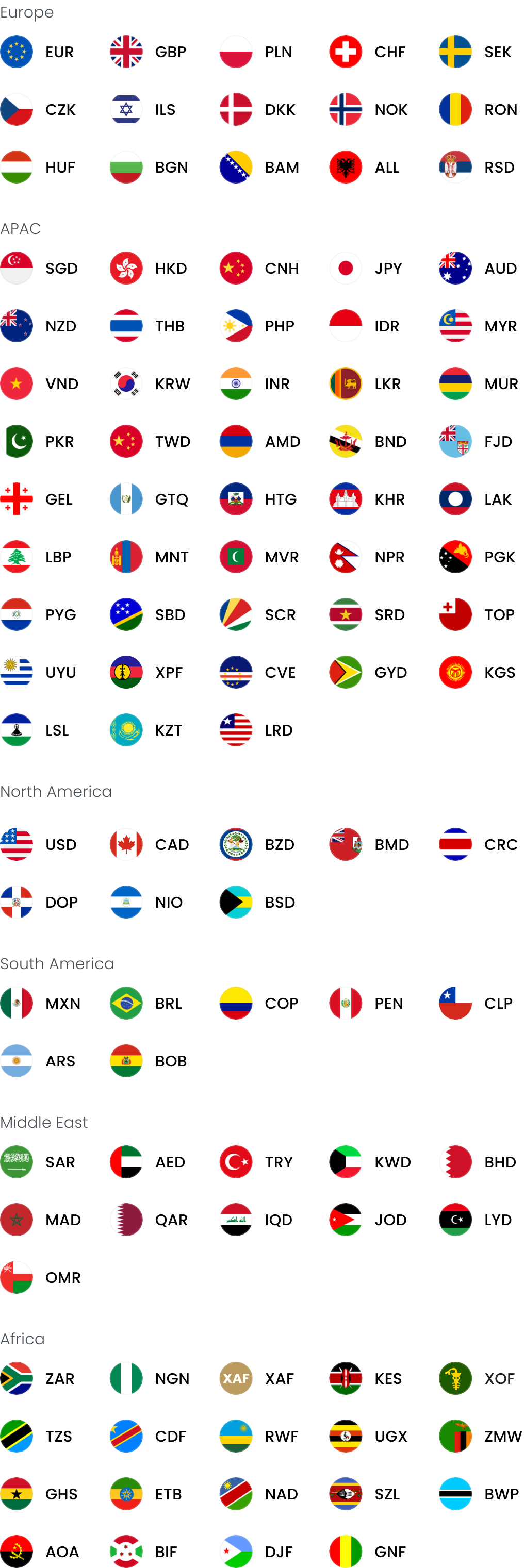
- Local receiving details in 22 currencies, including SGD, USD, GBP, EUR, CNH and others, for collecting international income alongside sending payments.
- Direct CNH payments to Chinese bank accounts, avoiding double conversions
- World Pay for 1688.com, the authorised international payment provider for 1688.com, for Singapore businesses sourcing from the wholesale platform
- Forward contracts for locking in exchange rates on future CNH conversions, useful when a supplier payment is scheduled weeks or months ahead
- The World Card, a Mastercard-powered business payment card supporting payments in 150+ currencies with zero FX fees on 15 supported currencies when sufficient balance is held (Terms and Conditions apply for cashback on eligible spending).
- Fully online setup with no branch visit required
How to send money to China with a World Account
The World Account is a multi-currency account from WorldFirst, an international payments provider for cross-border businesses. For Singapore businesses paying Chinese suppliers, the account supports CNH sending directly to Chinese bank accounts. Here’s how the transfer works.
Step 1: Add the recipient as a payee
Before sending funds, the Chinese bank account needs to be added and verified inside the World Account dashboard.
- Log in to the WorldFirst dashboard and go to Payees.
- Click Add a new payee in the top-right corner.
- Select Single payee.
- Choose Third-party account and select the appropriate account type.
- Enter the recipient’s country (China) and the sending currency (CNH).
- Fill in the recipient’s bank details, including account number, SWIFT/BIC code and bank branch information.
- Complete verification through the Authy app or by SMS.
After verification, the payee is either approved immediately or flagged for a compliance review that WorldFirst completes within 24 hours. Any additional documents requested will appear under Payees > Third-party account > Actions.
Step 2: Send the payment
Once the payee is approved, the actual transfer takes just a few steps.
- Open Payments and click Send & withdraw.
- Select Single payee and pick the Chinese bank recipient from your payee list.
- Enter the amount, either in your sending currency (SGD or another funding currency) or in CNH (the receiving currency).
- Choose whether to send now or schedule the payment for a future date. Scheduled payments settle at the applicable spot conversion rate at the time of transfer, or a forward contract rate if one has been set up for a supported currency pair.
- Verify the transaction through the Authy app or SMS.
- Review the transaction summary and click Confirm payment.
CNH transfers through the World Account typically arrive in the recipient’s Chinese bank account within 1 to 2 business days.
FAQs
1. Can I send SGD directly to a Chinese supplier?
Most Chinese suppliers prefer to be paid in CNH (or in USD, which then gets converted to CNH on their side). Sending SGD directly is possible in principle, but the Chinese recipient’s bank would need to convert it to CNY at whatever rate they apply, usually with a wider spread than if you’d sent CNH directly. For that reason, most Singapore businesses paying Chinese suppliers use CNH or USD.
2. Do I need a Chinese bank account to pay Chinese suppliers?
No. Singapore businesses can pay Chinese suppliers without holding a Chinese bank account. Opening a Chinese bank account requires a registered legal entity in China, which usually isn’t practical unless you’re operating on the ground. A multi-currency account that supports CNH sending achieves the same result without the local entity requirement.
This article is intended for informational purposes only and does not constitute legal advice or professional advice. This article should not be regarded as constituting an offer or a solicitation to buy or sell any regulated or financial products or services. WorldFirst makes no representations or warranties regarding the accuracy, completeness, or applicability of the content, and readers are encouraged to consult with legal professionals or other professionals for advice tailored to their specific situation. WorldFirst does not guarantee the accuracy and completeness of this article and expressly disclaims any and all liability to any person in respect of the consequences of anything done or omitted to be done wholly or partly in reliance on this article.

![Trust card review [2027]: Features, fees and more](https://mdn.marmot-cloud.com/worldfirst/sites/9/2026/10/20261020214810193-300x200.webp)
![HSBC business account review [2026] Singapore: Features, fees and more](https://mdn.marmot-cloud.com/worldfirst/sites/9/2026/10/20261020213428771-300x200.webp)

![Revolut Business Card review Singapore [2027]: Features, fees & more](https://mdn.marmot-cloud.com/worldfirst/sites/9/2026/09/20261001002258848-300x200.webp)