


















Products
About WorldFirst
Resources
More brands of Ant International
This country is supported by WorldFirst affiliates, Zyla
We provide coverage in South Asia and Middle East: servicing 210+ countries and territories.
WorldFirst Home > blog > International Transactions > SWIFT/BIC codes Singapore: bank codes, format and how to find them
You’ve just agreed a deposit with a supplier in Shenzhen, and your bank’s transfer form is asking for a ‘SWIFT/BIC code’ you don’t have. It’s a familiar snag for a new importer sourcing through Alibaba, 1688 or Taobao: the goods are ready to ship, but the payment form won’t let you proceed without a code you’ve never had to use before.
This isn’t a rare hiccup. Singapore processed US$1.2 trillion in cross-border payments in recent years as a regional trade and re-export hub, and a large share of that volume moves through telegraphic transfers that depend on accurate SWIFT/BIC codes to reach the right bank. Get the code wrong and your payment can bounce back, get delayed by days, or get routed through extra correspondent banks that each take a cut.
This article explains exactly what a SWIFT/BIC code is, breaks down its structure, shows you where to find your own and your supplier’s code, and covers what changes when you route supplier payments through a provider like WorldFirst instead of a traditional bank.
Open a World Account to send supplier payments with local receiving details in multiple currencies, cutting your reliance on SWIFT for routine transfers.
A SWIFT/BIC code is an 8- or 11-character identifier that tells the global banking network exactly which bank, and often which branch, should receive a payment instruction.
SWIFT and BIC describe the same code: SWIFT is the messaging network that carries the instruction, and BIC (Business Identifier Code) is the formal name for the code itself under ISO 9362, the international standard SWIFT administers as the registration authority.
The distinction matters for a Singapore importer because your bank, your supplier’s bank, and any correspondent bank in between all rely on this single code to route your payment correctly.
A single wrong character can send your deposit to the wrong branch or trigger a return, which is exactly why getting the format right before you submit a transfer to a China-based manufacturing supplier saves you a delay you don’t want mid-shipment.
SWIFT itself is a member-owned cooperative founded in 1973 and headquartered in Belgium, connecting more than 11,500 financial institutions across over 200 countries and territories. Crucially, SWIFT operates as a messaging system, not a payment rail.
It carries the instruction that says “pay this beneficiary this amount,” but the actual movement of funds happens through the correspondent banking relationships between the institutions involved.
A SWIFT/BIC code breaks down into four distinct segments, and understanding each one helps you spot a valid code from an invalid one before you submit a payment.
Take DBSSSGSG, the SWIFT code for DBS Bank in Singapore, as a worked example:
| Position | Characters | Meaning | DBS example |
| 1-4 | Bank code | Identifies the institution | DBSS |
| 5-6 | Country code | ISO 3166-1 two-letter country code | SG |
| 7-8 | Location code | Identifies the city or region | SG |
| 9-11 (optional) | Branch code | Identifies a specific branch; “XXX” denotes the primary office | XXX (often omitted) |
An 8-character code like DBSSSGSG refers to a bank’s primary or head office, while an 11-character code adds a branch identifier for a specific location.
According to ISO 9362 standards the second character of the location code can also carry special meaning: a ‘0’ marks a test BIC, a ‘1’ marks a passive participant, and a ‘2’ indicates a reverse billing BIC. In practice, most everyday supplier and business payments just need the standard 8-character format.
A bank SWIFT code in Singapore is the 8- or 11-character BIC that identifies a specific Singapore bank for international transfers, used instead of an IBAN because Singapore doesn’t use the IBAN system.

Local domestic transfers instead rely on a four-digit bank code, a three-digit branch code, and a seven- to eleven-digit account number, a completely separate system from the SWIFT code you’d give an overseas supplier or client.

Here’s how the SWIFT codes for Singapore’s major banks compare:
| Bank | SWIFT/BIC code | Notes |
| DBS / POSB | DBSSSGSG | No IBAN, routing number, or sort code used |
| OCBC | OCBCSGSG | Also listed as OCBCSGSGXXX for the primary office |
| UOB | UOVBSGSG | Standard 8-character format |
| HSBC | HSBCSGS2 | HSBCSGSG is reserved for corporate accounts only; using the wrong variant can trigger rejection and extra charges, per HSBC Singapore’s own guidance |
Table checked against official bank pages; SWIFT codes verified as current.
For domestic Singapore-to-Singapore payments, you wouldn’t use a SWIFT code at all.
FAST offers real-time transfers up to S$200,000, and PayNow Corporate lets you pay using a UEN or QR code. SWIFT only comes into play once a payment crosses a border, and it’s worth noting that PayNow and FAST are domestic-only rails; neither substitutes for SWIFT on an international supplier payment.
You can find your own SWIFT code through your bank statement, your banking app, or by contacting your bank directly, and cross-checking against the bank’s official website confirms you have the current, correct version.
Here’s the practical sequence recommended by payments researchers:
That last point matters more than it seems. Third-party directories occasionally list codes for entities that turn out to be different legal registrations of a similar-sounding company name, which is exactly the kind of mismatch that causes a rejected transfer. Always confirm against the bank’s or provider’s own official page before sending money.
Your SWIFT code and your supplier’s SWIFT code serve two different jobs, and confusing them is one of the most common mistakes new importers make on a first international payment. Here’s the distinction:
Before you confirm any transfer, run a quick verification step: match the bank name on the SWIFT code to the beneficiary bank named on the invoice, and confirm the country code within the code matches the country where that bank actually operates. This two-second check catches typos and outdated codes before they cost you a delayed shipment.
SWIFT matters whenever you’re sending or receiving money across a border and no local payment rail connects the two countries directly; it doesn’t matter for domestic transfers within Singapore, where FAST and PayNow handle same-day settlement without any SWIFT code involved.
The practical test is simple: if the payment crosses a currency and a border with no local equivalent account on the receiving end, SWIFT is doing the work behind the scenes even if you never see the code again after you submit the transfer.
For a new importer, this plays out differently depending on the corridor:
Understanding which of these three scenarios applies to your next payment tells you whether a SWIFT code is even the right question to be asking, or whether a local receiving account would get the job done faster and cheaper.
Read more: How to send money abroad and avoid hidden costs
Because WorldFirst isn’t a bank itself, its World Account receiving accounts run through partner banks such as OCBC and Citibank rather than carrying a single WorldFirst-branded SWIFT code for Singapore.
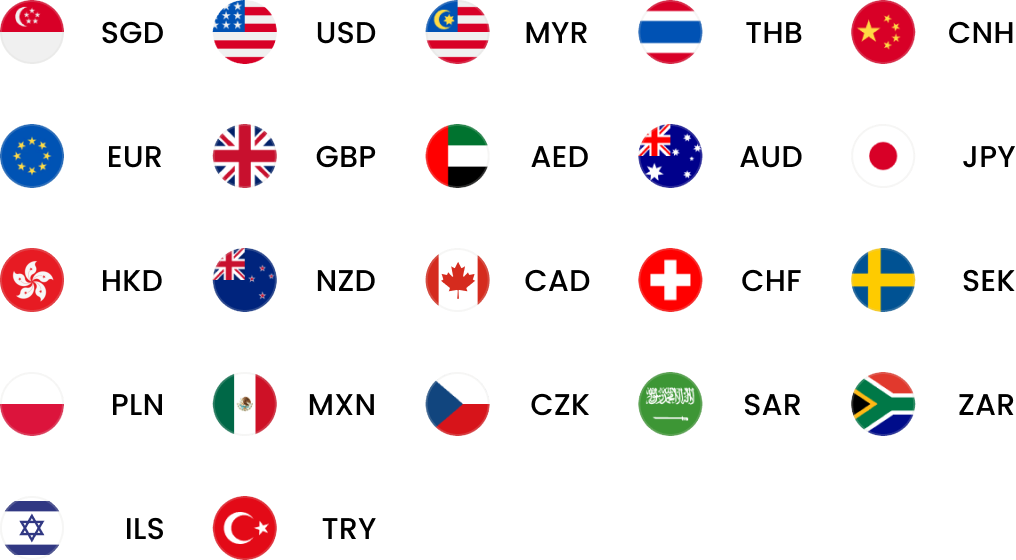
Multi-currency receiving accounts via OCBC support 14 currencies, including SGD, USD, CNH, EUR and GBP, while the Citibank option covers 10 currencies. In some cases, receiving accounts are held under the WorldFirst or Alipay name due to local regulatory requirements, so the account name on your receiving details may not always match “your” company name exactly, which is worth explaining to a supplier or platform the first time you use it.
Here’s what this changes for a typical deposit-and-balance supplier payment: rather than routing every payment through SWIFT, a World Account can give you local receiving details in the destination currency for many corridors, which reduces how often you need a SWIFT code at all for collections.
For payments you send, SWIFT transfers through the World Account start from US$5, and local non-SWIFT routes are available from US$1 where supported, with an FX margin of up to 0.6% on major currencies. Compare that against a typical bank inward TT handling commission of around S$10 plus separate cable charges, and the total cost difference on a routine supplier payment becomes clearer once you add up every fee line rather than just the headline transfer charge.
One honest limitation: WorldFirst doesn’t offer lending, payroll, or full domestic banking services, so if your business needs a working capital facility alongside your payment rails, you’ll still need a banking relationship alongside your World Account. And on the UK side specifically, World First UK Ltd’s own BIC is listed as WFSTGB2LXXX by third-party directories; if you’re receiving a UK-currency payment through that entity, confirm the exact code against WorldFirst’s own account details or help centre rather than a directory listing alone.
WorldFirst isn’t a bank. It’s a regulated payments provider, and WorldFirst entities in Singapore hold MAS licences for services including account issuance, domestic and cross-border money transfers and e-money issuance. The Singapore entity, WorldFirst (Singapore) Merchant Services Pte. Ltd., is licensed as a Major Payment Institution under the Payment Services Act 2019.
Open a World Account to manage supplier payments across multiple currencies and use local payment routes where available instead of relying on SWIFT for every transfer.
Yes. SWIFT code and BIC code refer to the same bank identifier. BIC stands for Business Identifier Code, while SWIFT is the financial messaging network associated with the system. The code normally contains 8 or 11 characters and identifies a bank and, where relevant, a specific branch.
No. Singapore does not use the IBAN system for bank accounts. For international transfers, Singapore banks generally use a SWIFT/BIC code together with the beneficiary’s account number and other payment details requested by the sending bank.
A SWIFT/BIC code contains either 8 or 11 characters. The first four identify the bank, the next two identify the country, the following two identify the location, and the optional final three characters identify a specific branch.
An incorrect SWIFT code can cause an international payment to be delayed, rejected or returned. In some cases, the transfer may also pass through additional intermediary banks. Before sending money, check that the SWIFT code matches the beneficiary bank and the payment instructions provided by your supplier or recipient.
Not always. Traditional international bank transfers commonly use SWIFT, but some payment providers offer local payment rails or local account details in supported countries and currencies. In those cases, the transfer may be processed locally without requiring a SWIFT code.
A SWIFT code alone is usually not enough. You may also need the beneficiary’s name, account number, bank name, bank address and payment reference. The exact requirements depend on the destination country, currency and financial institution handling the transfer.
A SWIFT code identifies the bank or financial institution receiving the payment, while an account number identifies the individual or business account within that institution. International transfers generally require both pieces of information.
Sources:
© WorldFirst 2026, All rights reserved.
How to redeem:
How to redeem:
How to redeem:
How to redeem: