


























If you’re a cross-border e-commerce company researching US tariffs, you’re probably worried about how the newly introduced tariffs could impact your business.
You might be concerned about:
- Reduced demand: If you sell to the US, tariffs could increase the cost of your products for US customers. But general economic uncertainty is also likely to lead to tighter belts and decreased spending globally. You could be forced to choose between thinner margins or additional costs for customers.
- Currency fluctuations: Market volatility could hurt GBP (or other currencies you deal in), adding to the potential impact on your margins and buying power.
- Supply chain disruptions: Tariffs could impact how and where you source your products. You may need to plan for possible price increases, goods shortages and supply chain bottlenecks – even if you’re not trading directly with the US.
It’s an uncertain time for cross-border businesses. But below, we’ll share some strategies for weathering the storm – including how we can help at WorldFirst.
In this article, we’ll cover:
- The current state of the US tariffs
- What the US tariffs could mean for cross-border businesses
- How WorldFirst can help your business navigate the US tariffs
WorldFirst helps online sellers protect their margins with competitive FX rates, multi-currency accounts and access to over 100 global marketplaces. Open a World Account for free to save on the costs of cross-border trade.
The current state of the US tariffs
On 2 April, US President Donald Trump announced a series of sweeping tariffs on US imports from about 90 countries.
A tariff is a tax imposed by the government on businesses that import goods into the country. They make it more expensive for importers to bring in those goods. The intent of these tariffs is to boost the US economy by encouraging American consumers to shift their spending toward US goods.
The Trump tariffs have since “thrown the world economy into chaos”, to quote the BBC. If you’re a business engaged in global trade, anywhere in the world, you’re likely already facing some serious uncertainty.
As of this writing, the Trump administration has agreed to an international trade deal that could reduce some of the burden on the UK, and President Trump has proposed reducing tariffs on China. But new announcements about the tariffs are made roughly once a week, meaning there could still be many changes ahead for businesses to navigate.
Some of the potential tariff rates that have been floated over the last several months include:
- 145% on most Chinese imports (with exceptions like smartphones at 20%)
- 25% on imported vehicles, car parts and steel and aluminum imports from all countries
- Multiple tariffs on Mexican and Canadian imports
- 10% baseline tariff on almost all imports
- A 100% tariff on movies produced in other countries
- A tariff of up to more than 3500% on most solar cells from Cambodia, Malaysia, Thailand and Vietnam
Plus, many countries have already placed retaliatory or reciprocal tariffs on the US, which could change in response to US actions.
Currently, many of the US tariffs are also approaching the end of a 90-day pause, so global markets are volatile as the whole world waits to see what happens.
What the US tariffs could mean for cross-border businesses
As a cross-border business, you’ll need to plan for a handful of potential outcomes, depending which tariffs make the final cut.
Here are some of the possible impacts of US tariffs on international e-commerce sellers:
1. Higher prices in the US and globally
As a cross-border business, one of the main concerns regarding the tariffs is that they will result in higher prices both in the US and globally.
If you sell to the US, to offset the impact of tariffs, you may need to pass some of the costs along to your customers – especially if you operate on thinner margins. For example, if you manufacture in China and ship to 3PLs, customers, or Amazon FBA warehouses in the US, you’re subject to the tariffs. But even if you don’t sell in the US, you might still be affected by additional costs on any products or raw materials that pass through the US.
The potential impact on the global economy may lower consumer demand outside of the US too. The EU has been forecast to see a drop in GDP, which might be exacerbated by an increase in Chinese exports (diverted from the US). The IMF has also warned that the tariffs could jeopardise global economic growth and even spark all-out trade wars.
The most likely consequence for e-commerce sellers across the board is a reduction in demand: you’re forced to raise prices, your customers buy less, and your revenue takes a hit.
To keep demand steady, you may have to find a way to reduce your operational costs, or operate on thinner margins.
Some US businesses are also adopting another strategy – raising their prices, but asking customers for understanding. For instance, mountaineering company Black Diamond reached out to its customers to explain its price increases, while footwear brand Yami Dance Shoes sent out an email urging price-sensitive customers to buy before the tariffs took effect.
The strategy you choose will depend on your business model, supply chain and personal choices. But we’d recommend you remain flexible to changing trade conditions.
2. Fluctuating currencies and exchange rates
Another likely consequence of Donald Trump’s tariffs is the potential for unpredictable currency fluctuations. Currency markets are especially sensitive to economic and trade policy announcements, so any new tariff policy could cause certain currencies to weaken or become unstable.
For example, economists cited by the World Economic Forum worry that tariffs and other US economic policy decisions could “erode the dollar’s role at the center of the global financial system.” This could lead to currency crises in emerging markets, and long-term economic and currency instability.
Additionally, as we saw in 2015 and 2018, China could allow the yuan to depreciate as a result of the tariffs. Other countries might devalue their own currencies to stay competitive, destabilizing currencies especially in emerging markets.
In any case, you could end up paying a lot more for some of the currencies you use, or receiving less when converting sales. This puts additional strain on your profit margins, while you’re already struggling with increased import costs.
Retaliatory tariffs could also create inflationary pressure, weakening the currencies of the countries you sell from. So if you sell from the UK and hold GBP, this could decrease the value of your earnings, and inflate your costs for materials and inventory.
And if you hold a lot of funds in any given currency at the wrong moment, its value can drop, taking your cash flow and buying power.
Regardless of the specific outcome, currency destabilization makes it harder to forecast your costs and plan for a profitable future. In order to stay resilient, you need a multi-currency strategy that buffers your business against fluctuating FX rates.
Find out more: Foreign exchange risk management: How to make international business more affordable
3. Supply chain instability
Besides impacting FX rates, tariffs and other major economic policy announcements also tend to destabilize the supply chain. This, in turn, can impact your costs, supplier relationships and inventory management.
For example, those businesses sourcing from US suppliers may need to seek more affordable suppliers in order to manage their costs. They might look to other countries, like India, Thailand and Mexico, to minimize their costs.
Meanwhile, e-commerce businesses selling into the US may be forced to explore lower-cost markets and rethink their business strategies. In fact, several companies have even announced that they will be pausing US sales entirely.
All this rearrangement creates a sort of ripple effect, where multiple businesses scramble to diversify markets and suppliers all at once. The resulting instability can lead to:
- More demand for fewer suppliers
- Increased demand and higher costs for raw materials
- Materials shortages or delays in getting the materials you want
Tariff-related policy changes can also mean increased customs checks, port congestion and ultimately longer lead times for inventory. The resulting supply chain delays can lead businesses to experiment even more with their supplier strategy, causing further instability and uncertainty across the supply chain.
Regardless of whether or not you adjust your own supplier relationships, it becomes much harder to avoid stockouts and overstocks. You could be left with tons of orders and no product to sell, or wind up paying a fortune in storage for excess inventory.
How WorldFirst can help your business navigate the US tariffs
As an international e-commerce seller, you need ways to bolster your business against all this uncertainty. A good place to start is by improving the way you manage your cross-border payments.
At WorldFirst, we offer a suite of simplified and secure solutions to help you keep your cash flow stable, get the best FX rates and source products across borders for less.
Founded in the UK in 2024, WorldFirst has managed over $300 billion in global payments in 210+ countries. We service over a million business customers and partner with leading banks like J.P. Morgan, Barclays and HSBC to keep your funds secure.
With WorldFirst, you can:
1. Collect and hold funds in 20+ currencies to navigate fluctuating markets
You can use your multi-currency WorldFirst account to mitigate the impact of currency fluctuations on your cash flow.
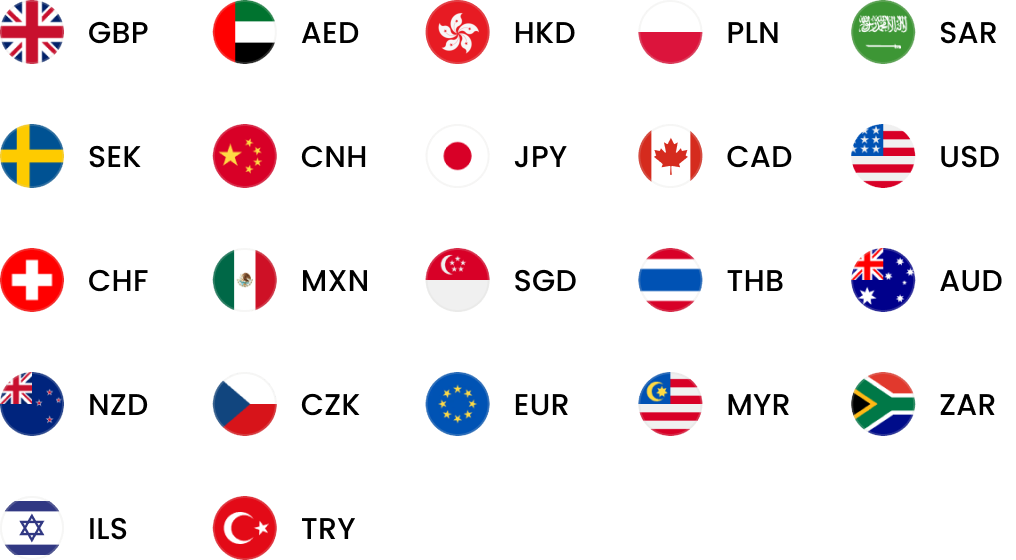
With a World Account, you can collect and hold funds in 20+ currencies, including GBP, USD, EUR and CNH. You’ll receive separate currency accounts for each currency you want to hold.
This makes it really easy to accept payment in whichever country you sell in. But it also means you don’t have to convert your payments into your local currency right away. Instead, you can:
- Wait for more favourable FX rates before you convert
- Make payments in whichever local currency you hold and avoid the cost of international transaction fees (for example, you can pay your suppliers in their currency using local payment networks)
Our unified platform lets you see all your account balances with a single login and move money between currency accounts when it makes sense for you. You can also transfer funds between different WorldFirst currency accounts for free, saving you even more money on conversions.
With WorldFirst, you get local bank account details to receive funds in over 20 currencies. You can also get paid directly from 130+ marketplaces, all through one account. It’s a faster, easier way to expand into new markets, since you don’t need a physical presence or to set up separate bank accounts to receive e-commerce payments.
With local account details, WorldFirst also lets you pay suppliers fast in their currency, using local payment networks – rather than international networks such as SWIFT. This can give you leverage to negotiate better rates with existing suppliers and help you form relationships with new suppliers.
2. Future-proof your business with forward contracts
WorldFirst empowers you to ride out currency fluctuations and future-proof your plans with forward contracts.
Forward contracts let you lock in an exchange rate over a set period of time, on a predetermined volume of currency, regardless of market FX fluctuations. This way, you can better forecast your costs, keeping your plans on track even when the markets are volatile.
You can secure the rate you want for up to 24 months, and choose between three types of forward contracts.
- Fixed forward contracts lets you set a date in the future – known as the value date or the maturity date. When that date arrives, you’ll exchange a predetermined amount of currency at a predetermined rate, no matter what the market FX rate is. For example, you might agree to buy £100,000 EUR for $120,000 USD in 180 days.
- Flexible forward contracts also let you lock in an exchange rate and amount, but with more freedom. You can draw funds all at once or make multiple payments. It’s up to you how and when you want to manage your funds, as long as the predetermined amount is settled by the maturity date.
- Window forward contracts are a type of flexible forward contract where the full amount of funds are exchanged in one go during a “window” of time. You can choose to settle on any date, as long as it’s within the window.
Forward contracts can help you:
- Cover a future invoice payment
- Protect future revenue from currency fluctuations
- Hedge rates for project work or future currency needs, and more
While there’s always a small risk of being locked into a rate that’s less desirable (i.e. if the market improves), forward contracts give you the certainty and peace of mind to plan ahead and know you’ll have the cash flow you’ll need.
3. Let us find you the best exchange rates with firm orders
If you’re flexible on when you want to exchange your currency, but have your sights set on a specific exchange rate, a firm order might be a better option.
With firm orders, you let us know your target exchange rate and expiry time, and authorise us to conduct the transaction for you. When and if the market reaches the FX rate you set, we exchange the funds on your behalf. In other words, we watch the market for you, so you get preferable exchange rates without having to monitor them yourself.
With firm orders, the transfer is usually processed on the same day or next working day. Call, email or chat live with our team during business hours for personalised assistance.
4. Build better supplier relationships with fast payments
With WorldFirst, you can pay suppliers in 200+ countries fast, in 100+ currencies. That makes it easier to build relationships and diversify suppliers in case tariffs disrupt the supply chain.
With faster payments, it’s easier to lock in deals, nurture relationships and negotiate discounts with local and regional suppliers. You can choose between SWIFT or local options for same- and next-day payments, or set scheduled invoice and batch payments for future dates.
WorldFirst also provides supplier notifications and real-time payment tracking, so your suppliers know exactly when to expect their payments. And if your recipient is also a WorldFirst customer, you can pay them instantly, for free.
5. Tap into China to diversify your supply chain
If you’re looking to find suppliers overseas, WorldFirst can help too.
WorldFirst is the only way to source directly from 1688.com without opening a Chinese bank account. As the leading Chinese B2B wholesale marketplace, 1688.com gives you access to over 10 million suppliers across 1,700 product categories.
With your World Account, you can connect directly to the platform to source products and send instant payments. When you use the World Account’s World Pay feature to pay 1688.com, there are no hidden supplier costs.
To sourcing directly from 1688.com, simply link your World Account and you can start shopping immediately at lower cost.
Want to diversify into new markets to make up for any potential lost sales? Our direct integration with 1688.com helps you source from verified Chinese suppliers and pay them in their local currency – securely and efficiently. From there, your suppliers can deliver straight to the warehouses of global marketplaces like AliExpress, Lazada, Shopee and Amazon China, streamlining your fulfilment process.
Find out more: How to source wholesale using 1688.com outside China
How to set up a World Account
To get started with multi-currency payments, 1688.com and more, simply follow these steps to set up your World Account now:
- Visit our Sign up page to get started
- Fill out some basic details about you and your company
- Provide the necessary verification documents and wait for verification (this usually takes about one business day)
- Once verification is complete, you can open receiving accounts in the currencies you need
Note: You can use our official Help Centre guide to navigate the process.
Case Study: How Fresh4U saved on the costs of global trade with WorldFirst
Fresh4U Produce began as a humble side hustle. While studying at university, Danial Paisawala started sourcing fresh Kenyan vegetables to sell in London’s local markets, delivering crates of okra and chillies from the back of his car.
As demand grew, Danial and co-founder Hatim Raja began importing produce from across Africa, then Asia and beyond—transforming Fresh4U into a global operation.
But with international trade came a new set of challenges. Dealing with suppliers in multiple countries meant making payments in different currencies, and exchange rate fluctuations quickly turned into a financial headache. A small shift in the pound could make or break a shipment’s margin overnight.
That’s when Fresh4U turned to WorldFirst. With access to bank-beating FX rates and a dedicated currency specialist, they were finally able to plan international payments with confidence. No surprises, no last-minute panic. Just transparent rates and tailored support.
Today, Fresh4U trades across continents with ease—bringing niche fruits like baby bananas and banana passionfruit to UK shelves—all while keeping their costs under control.
Read the case study: Fresh4U savours the success of global trade
Protect your e-commerce profits from the unpredictable
Navigating volatile markets can be challenging, especially when you’re paying international suppliers or collecting sales in multiple currencies. WorldFirst equips your business to handle the uncertainty. Stay resilient with multi-currency accounts and better exchange rates – all while keeping full visibility over your cash flow from one account.
Sign up for a free World Account today and see how we can help you save on the cost of cross-border payment, no matter what comes next.