



























You’ve got products ready to sell, you’ve seen competitors running slick Shopify storefronts, and you’re wondering whether the same platform makes sense for your marketplace business. If you’re already selling on Amazon or eBay and juggling currency payouts from three different marketplaces, adding a Shopify store might feel like one more thing to manage rather than a growth lever.
The UK ecommerce market keeps expanding, and Shopify processes a huge share of it, with the platform itself claiming its checkout converts up to 15% better than the industry average.
For a marketplace seller already stretched across multiple sales channels, that kind of conversion uplift matters when you’re deciding where to put your next store.
This article walks you through setting up a Shopify store in the UK step by step, what it actually costs once card fees and currency conversion are factored in, and where a multi-currency account fits if you plan to sell beyond the UK.
Key takeaways:
- Shopify Basic covers the essentials: it gives most new sellers a full storefront at the lowest full-store plan price, but processing fees are higher than on more expensive tiers
- Multi-currency payouts require a higher plan: Basic and Grow sellers can sell internationally, but payouts are converted to GBP rather than held in the original currency
- VAT remains the seller’s responsibility: Shopify can calculate tax at checkout, but registration, filing and payment obligations still sit with the business
- International selling adds several cost layers: card surcharges, currency conversion and Managed Markets fees can all affect the margin on an overseas order
- Payout structure matters as much as checkout pricing: sellers need to compare what happens after the sale, especially when revenue and supplier costs are in different currencies
- WorldFirst can add more control over international proceeds: sellers can receive supported Shopify payouts in multiple currencies, hold balances and use them for FX or overseas supplier payments
Open a World Account to collect Shopify sales proceeds in the currency your customer paid in, rather than converting automatically at Shopify’s rate.
What is Shopify and why marketplace sellers add it
Shopify is a hosted ecommerce platform that lets you run your own branded storefront without managing servers, security patches or hosting infrastructure yourself.
For a seller already established on Amazon, eBay or Etsy, it’s the tool most commonly used to build a direct-to-consumer channel that you control end to end, from branding to customer data to checkout experience.
The appeal for marketplace sellers is specific: marketplaces own the customer relationship, the search ranking rules and, often, a cut of your margin.
A Shopify store gives you a channel where you set the rules, plus native connections to Google Shopping, Meta, TikTok Shop and eBay so you can still reach the same audiences without losing the direct customer relationship. That combination, marketplace reach plus owned-channel control, is why sellers layer Shopify on top of an existing marketplace business rather than choosing one or the other.
Shopify at a glance
The table below compares Shopify’s main UK plans, monthly costs, card processing rates, staff access and multi-currency payout support:
| Plan | Monthly cost (annual billing) | Card processing rate | Staff accounts | Multi-Currency Payouts |
| Starter | £5 | N/A (social/link selling only) | Limited | No |
| Basic | £19 | 2% + 25p | 2 | No |
| Grow | £49 | 1.7% + 25p | 5 | No |
| Advanced | £259 | 1.5% + 25p | 15 | Yes |
| Plus | From £1,800 | From 1.3% + 25p | Unlimited | Yes |
Prices and rates checked against Shopify’s UK pricing page and current at the time of writing.
How to sell on Shopify in 6 steps
Setting up a Shopify store comes down to six core steps, from choosing the right plan and adding products to configuring payments, shipping, taxes and sales channels before launch.
Step 1: Sign up and choose your Shopify plan
The fastest way to test whether Shopify suits your business is Shopify’s own trial: three days free, then £1 a month for the first three months. That’s enough runway to build a basic store and list products before committing to a paid tier.
For most marketplace sellers opening a first Shopify store, Basic at £19 a month on annual billing is the sensible starting point. It gives you a full standalone storefront, two staff accounts and ten inventory locations, which is more than enough for a single-brand operation.
The Starter plan at £5 a month is worth ruling out early if you want an actual store front, since it’s built for selling through social links and existing audiences rather than hosting a browsable catalogue, per Shopify’s own plan breakdown.
Where the plan choice really bites is card processing. Basic charges 2% + 25p per domestic transaction, Grow drops to 1.7% + 25p, and Advanced falls further to 1.5% + 25p, confirmed by Blubolt’s Shopify cost analysis.
Blubolt’s modelling suggests Grow becomes the more cost-effective choice once you’re processing roughly £10,000 a month, and Advanced pays for itself above roughly £45,000 to £50,000 a month in sales, purely on the processing-rate savings. If you’re already running that volume through a marketplace, it’s worth running the same maths against your Shopify store from day one rather than defaulting to Basic indefinitely.
One quirk worth knowing before you commit: annual billing is meaningfully cheaper than monthly across every plan, roughly £6 a month cheaper on Basic for example, so if you’re confident you’ll stick with Shopify past the trial, annual billing is the better economic choice.
Step 2: Add products and source your inventory
Every product listing needs a title, description, price, variants (size, colour, material) and a SKU for stock tracking, and getting these fields right from the outset saves reconciliation headaches later, particularly if you’re syncing the same catalogue across a marketplace and your own store.
How you source that inventory shapes your entire cost structure and cash-flow timing:
- Wholesale buying: you purchase finished stock upfront from a supplier, giving you full margin control but tying up cash before you’ve made a single sale
- Manufacturing to spec: you commission custom production, usually requiring a deposit before the run starts and a balance payment before dispatch, which is common for sellers sourcing from Asia
- Dropshipping: a third party holds and ships stock on your behalf, reducing upfront cash commitment but usually compressing your margin per unit
- Shopify Collective: you sell products from other Shopify merchants directly through your own store without holding inventory yourself
Whichever method you use, the critical field to get right is cost per item in your product settings, since Shopify uses it to calculate your margin automatically. If you’re paying an overseas supplier in a foreign currency for wholesale or manufactured stock, the exchange rate you pay on that transaction directly affects the true cost per item you should be entering, not just the invoice total in the supplier’s currency.
Step 3: Choose a theme and design your store
Shopify’s Theme Store offers over 100 free and paid themes, with Dawn as the current default. Free themes are a reasonable starting point for testing your concept, while premium themes typically cost £150 to £350 as a one-time purchase.
The theme editor lets you customise colours, fonts, layout blocks and imagery without touching code, which matters if brand consistency across your marketplace listings and your Shopify store is part of your positioning. If your marketplace storefronts already carry a distinct visual identity, replicating that on Shopify reinforces recognition for customers who encounter your brand across channels.
Step 4: Set up Shopify Payments
Activating Shopify Payments is the default route to accepting cards, and it’s the setting that determines how much of every sale you keep. Domestic online card rates run from 2% + 25p on Basic down to 1.5% + 25p on Advanced and from 1.3% + 25p on Plus.
If you choose not to use Shopify Payments and route card processing through a third-party gateway instead, Shopify adds its own transaction fee on top, 2% on Basic, 1% on Grow, 0.6% on Advanced. That penalty makes Shopify Payments the more economical default for most UK sellers unless you have a specific reason to use an alternative gateway.
A few other rates worth budgeting for: Amex transactions cost 3.1% + 25p across every plan, Klarna charges 4.99% + 30p, and a chargeback costs £15 per dispute. None of these are dealbreakers individually, but they add up on a store with a meaningful Klarna or buy-now-pay-later mix.
Step 5: Configure shipping and taxes
UK Shopify stores typically connect to Royal Mail, DPD and Evri for shipping labels and rate calculation at checkout. Once shipping is configured, check the tax rules that apply to your store:
- Set up VAT collection: once registered, go to Settings > Taxes and duties > United Kingdom > Collect VAT. Shopify can calculate VAT at checkout, but it does not file returns for you
- Watch the VAT threshold: you must register once taxable turnover exceeds £90,000 in a rolling 12-month period and complete registration within 30 days of crossing the threshold
- Prepare for Making Tax Digital: VAT-registered businesses must submit returns through compatible software
- Check EU obligations: sellers shipping to EU customers may need the Import One-Stop Shop (IOSS) for eligible orders up to €150 or the Non-Union OSS for certain digital sales
Shopify can automate parts of the calculation, but registration, reporting and payment remain your responsibility.
Step 6: Launch and sell across channels
Before you launch, Shopify lets you connect sales channels directly from the admin: Google Shopping, Meta (Facebook and Instagram), TikTok Shop and eBay are all native integrations, meaning your inventory syncs automatically rather than requiring manual updates across platforms.
If you’re syncing orders from an existing marketplace into Shopify for unified fulfilment and reporting, the first 50 synced orders each month are free, after which Shopify charges 1% up to a cap of £99 a month, per Shopify’s published pricing. For a seller processing a high order volume across marketplaces, that cap is worth checking against your actual monthly order count before you assume the sync is free.
Once shipping, tax and payments are configured and your products are live, removing the storefront password is the final step that makes your store publicly visible.
Read more: 10 best small business payment processing systems in the UK
Where the multi-currency problem hits UK Shopify sellers
How to sell on Shopify internationally is straightforward to set up but expensive to run if you’re on Basic or Grow, because Shopify’s payout structure wasn’t built with lower-tier international sellers front of mind.
Shopify Markets lets you price products in local currencies for international customers, but the payout side tells a different story. If a customer pays in USD or EUR and your payout currency is GBP, Shopify applies a 2% currency conversion fee on that transaction, a charge that applies to every UK store outside the US and France.
Here’s the part that catches sellers out: Multi-Currency Payouts, the feature that lets you receive settlement in the currency your customer actually paid in, is only available on Advanced or Plus plans.
If you’re on Basic or Grow, every international sale gets converted to GBP automatically, with no way to opt out, regardless of whether you have upcoming USD or EUR expenses that could have used that currency directly.
Even upgrading to Advanced doesn’t eliminate the cost, it just changes its shape.
Multi-Currency Payouts on Advanced carry a 1.5% fee, dropping to 1% on Plus, and you need one dedicated bank account per non-domestic currency you want to receive, with GBP payouts restricted to UK-based accounts specifically. Adding or replacing a payout bank account also pauses all payouts for three to five business days, a timing risk worth planning around if you’re mid-way through a busy sales period.
International cards add a further 2% surcharge on top of your base processing rate, so a Basic-plan seller taking an international card payment is looking at 4% + 25p before currency conversion is even factored in. And if you’re using Shopify’s Managed Markets service to handle international duties and taxes automatically, that adds another 3.5% fee on Basic, Grow and Advanced, or 3.25% on Plus.
Stack the international card surcharge, the currency conversion fee and the Managed Markets fee together, and a single cross-border order can carry several percentage points of cost before you’ve paid a supplier or moved a penny into your business account.
How a World Account changes the payout picture
The friction described above is structural: Shopify Payments is built to settle in your home currency by default unless you’re paying for Advanced or Plus specifically to unlock multi-currency payouts. For a marketplace seller who’s used to holding USD or EUR balances from Amazon or eBay collections, that’s a step backwards, not an upgrade.
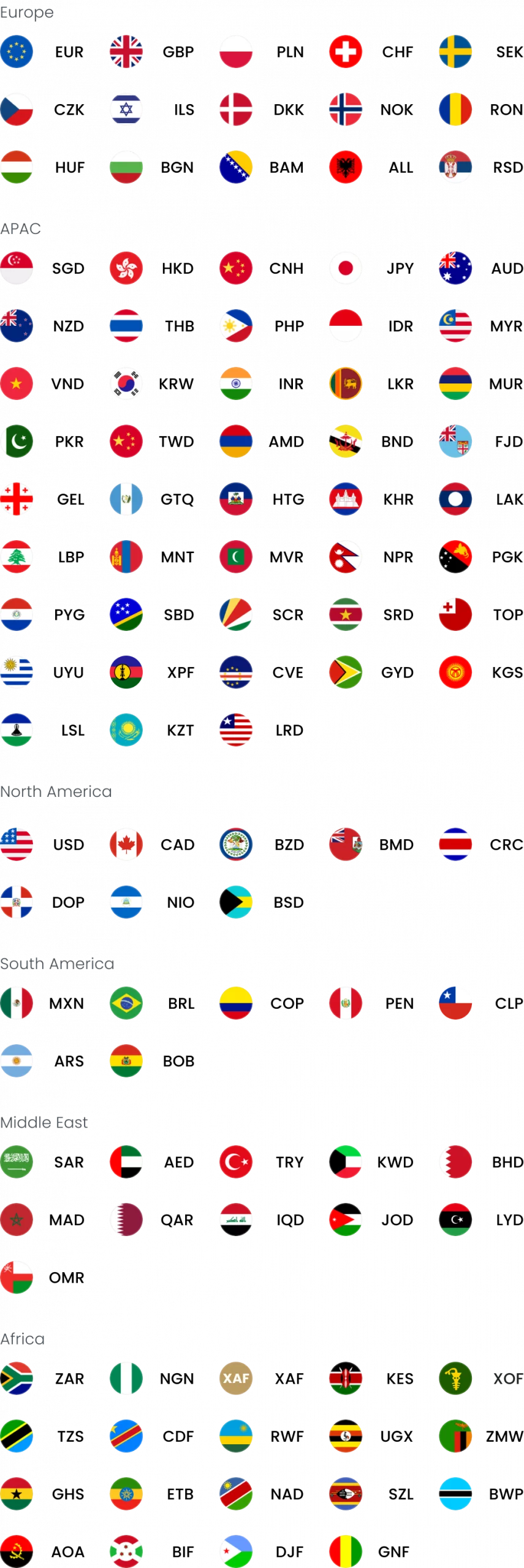
WorldFirst’s World Account is a multi-currency account that integrates with Shopify alongside over 130 other marketplaces and payment gateways, including Amazon, eBay, Etsy, Shopee and Lazada, letting you collect proceeds without Shopify’s automatic conversion forcing every payout into GBP. The account gives you local receiving details in 20+ currencies, including USD, EUR, AUD, GBP and CNH, so a USD sale can sit in a USD balance rather than converting the moment it lands.
That distinction matters most if you’re also paying an overseas supplier. If you’re sourcing stock from a manufacturer who invoices in CNY onshore, note that international payments to China typically settle in CNH, the offshore version of the currency, and holding USD or EUR from your Shopify and marketplace sales gives you a natural way to fund that supplier payment without converting GBP to CNH and back through two separate conversion spreads.
WorldFirst shows the exchange rate before you confirm a transfer, and the account carries no setup fees, no monthly fees and no minimum balance requirement, with Xero and NetSuite integration for reconciling multi-currency sales against your accounts.
Consider a seller running a homeware brand who takes deposit and balance payments to a China-based supplier alongside processing USD and EUR sales through Shopify and a marketplace storefront. Instead of every currency touching GBP twice, once on the way in from Shopify and again on the way out to the supplier, holding the USD or EUR balance directly and converting on your own schedule removes one layer of conversion cost and gives you visibility over the rate before you commit to a transfer.
The table below compares how Shopify Basic and Grow handle international payouts with the World Account’s multi-currency setup:
| Shopify Basic/Grow payout | World Account | |
| International sale currency | Converted to GBP automatically | Held in original currency (20+ available) |
| Currency conversion fee | 2% per transaction | Rate shown before confirmation |
| Multi-currency access | Advanced/Plus plan required | Available regardless of Shopify plan |
| Monthly account fee | N/A (bundled in plan cost) | None |
Figures checked against Shopify’s payout documentation and WorldFirst’s published account terms at the time of writing.
WorldFirst isn’t a bank. It’s authorised and regulated by the FCA as an electronic money institution, and safeguarded client funds don’t carry FSCS deposit protection the way a UK bank account does. It also doesn’t offer lending, payroll or full domestic banking services, so it sits alongside your existing bank account as a cross-border payments and FX tool rather than replacing it entirely.
Open a World Account to collect Shopify proceeds in multiple currencies, hold balances and use them for overseas supplier payments without converting everything into GBP first.
FAQs
1. How do I sell on Shopify for beginners?
Start with Shopify’s three-day free trial, which then rolls into £1 a month for the first three months.
From there, follow the core setup sequence: create your account, add your products with accurate cost and pricing data, choose a theme (the free Dawn theme is a solid starting point), customise the storefront to match your brand, activate Shopify Payments, configure shipping through a carrier like Royal Mail or DPD, set up UK VAT collection if you’re registered, and remove the storefront password to go live. Most first-time UK sellers choose the Basic plan at £19 a month on annual billing as the entry point for a full standalone store.
2. How much does it cost to sell on Shopify?
The minimum functional plan is Basic at £19 a month on annual billing, with card processing at 2% + 25p per domestic transaction. If you skip Shopify Payments for a third-party gateway, you’ll pay an additional 2% transaction fee on Basic (dropping to 1% on Grow and 0.6% on Advanced). International cards add a 2% surcharge, and currency conversion costs a further 2% if your payout currency differs from the customer’s payment currency.
Beyond the core plan, budget for premium themes at £150 to £350 one-time and apps ranging from £5 to £100 a month each. Grow’s lower processing rate tends to pay for itself once you’re processing roughly £10,000 a month, with Advanced becoming worthwhile above roughly £45,000 to £50,000 a month.
3. Is it worth it to sell on Shopify?
For most marketplace sellers, yes, provided you treat it as an addition to your existing channels rather than a replacement. Shopify gives you hosted infrastructure with no server management, built-in payment processing, native connections to Google, Meta, TikTok Shop and eBay, and Shopify’s own claim of a 15% better-converting checkout than the industry average.
The trade-offs are real too: transaction fees stack if you avoid Shopify Payments, app costs accumulate quickly, multi-currency payouts require the £259-a-month Advanced plan at minimum, and VAT compliance sits entirely with you rather than the platform. If you’re already selling on Amazon or eBay, Shopify’s main value is the direct-to-consumer channel and brand control it adds, not a replacement for marketplace reach.
4. Does Shopify declare to HMRC?
No. Shopify is an ecommerce platform, not a marketplace, so it doesn’t collect, charge or remit VAT on your behalf the way a deemed-supplier marketplace like Amazon can in certain circumstances.
You’re responsible for registering for VAT once your taxable turnover exceeds £90,000 in a rolling 12-month period, charging the correct VAT rate at checkout, filing returns through Making Tax Digital, and keeping accurate records. Shopify’s tax settings automate the VAT calculation once you’ve entered your VAT number, but the registration, filing and payment obligations remain yours. HMRC does check data from digital platforms to identify sellers who should be registered but aren’t, so treating VAT as optional until you’re caught isn’t a workable strategy.
Sources:
- https://www.shopify.com/uk/pricing
- https://profiletree.com/shopify-for-e-commerce/
- https://blubolt.com/insights/shopify-costs-pricing
- https://help.shopify.com/en/manual/online-store/setting-up
- https://www.expertsure.com/uk/web-design/shopify-pricing-uk/
- https://help.shopify.com/en/manual/taxes/uk/uk-tax-migrate
- https://help.shopify.com/en/manual/international/managed-markets/shopify-payments