



























Singapore remains a critically open trading economy with deep links into global supply chains.
In 2024, total merchandise trade reached SG$1,285.9 billion, reflecting the scale and consistency of goods moving through the country. That volume supports a dense network of distributors, trading companies and export-focused manufacturers serving markets across Asia, Europe and the US.
For buyers, this means clear expectations around documentation, payment terms and multi-currency payments. Verification still matters, comparisons go beyond price alone, so how to find a supplier in Singapore that fits long-term needs?
This guide is for e-commerce sellers, importers, exporters, manufacturers and wholesalers who want a clear, practical approach to finding a supplier in Singapore. It covers evaluating and comparing suppliers and structuring payments to keep cash flow predictable as trading volumes increase.
Key takeaways:
- Singapore rewards prepared buyers, not rushed ones: Buyers who define requirements clearly, understand supplier models and align payment expectations early get faster responses, cleaner quotes and more reliable long-term partners
- Verification and credibility checks are non-negotiable: The strongest suppliers are comfortable sharing registration details, licences, references and operational information
- The best suppliers are often regional operators, not just local producers: Many Singapore-based suppliers coordinate contracts, quality control and payments from Singapore while manufacturing elsewhere in the region
- Comparing suppliers goes far beyond price: Headline pricing rarely reflects total cost. Communication quality, flexibility under pressure, delivery reliability and currency terms often matter more to margins and timelines than a lower unit price
- Multi-currency payments are essential for scaling supplier relationships: A multi-currency setup like the World Account helps businesses pay suppliers in their preferred currency, manage FX timing and keep cash flow predictable as volumes grow, without relying on rigid single-currency banking
Open a World Account for free and support supplier relationships with flexible multi-currency payments.
Why Singapore is a strategic place to source suppliers
Singapore’s role in global sourcing comes from the way trade, regulation and payments intersect in one place.
Goods and services moving across borders account for around three times the country’s GDP, placing Singapore among the most trade-exposed economies in the world. That level of openness shapes how suppliers operate, contract and interact with overseas buyers.
The country is also one of the most connected trade jurisdictions globally, with extensive free and digital trade agreements spanning Asia-Pacific, Europe and North America.
In practice, many Singapore-based suppliers act as regional operators. Suppliers often manufacture in neighbouring countries while managing contracts, quality oversight, invoicing and payments from Singapore.
This structure is typical in electronics, industrial supply chains and regulated sectors where buyers need a single accountable counterparty rather than fragmented relationships across borders.
From a payments perspective, Singapore suppliers are accustomed to operating in multiple currencies, working with overseas settlement timelines and managing FX exposure as part of normal operations.
Payment terms are formal, expectations are clear and delays are less tolerated than in informal sourcing markets. For buyers, that makes cash flow planning and supplier trust easier to manage once the right setup is in place.
What businesses commonly source from Singapore
Sourcing from Singapore tends to prioritise control and continuity rather than lowest-cost production. Common categories include:
- Electronics and advanced components, including semiconductors and precision assemblies
- Precision manufacturing and industrial goods, often linked to aerospace, medical and engineering sectors
- Chemicals and pharmaceuticals, where regulatory compliance and traceability are essential
- FMCG distribution and regional re-export, supporting multi-market inventory strategies
- Specialised professional and technical services, tied to sourcing coordination, testing and logistics
Compared with lower-cost sourcing locations, Singapore suppliers generally operate with tighter commercial discipline. Documentation is standardised, contracts are enforceable and payment schedules are clearly defined. While unit prices may be higher, many businesses find that fewer disputes, faster settlement and reduced FX friction lower total operating costs over time.
For companies sourcing at scale, Singapore often becomes the point where supplier relationships shift from transactional buying to structured, repeatable operations designed to grow across regions without introducing unnecessary risk.
How to find a supplier in Singapore: a step-by-step approach that works in 2026
The Singapore sourcing market rewards preparation, clarity and follow-through. Suppliers are used to working with international buyers, formal documentation and structured payment terms. The upside is reliability and predictability. The downside is that vague queries and improvised processes tend to fail quickly.
The steps below reflect how experienced buyers approach sourcing in Singapore today: narrowing the field early, properly validating credibility and aligning commercial and payment decisions before committing capital at volume.
Step 1: Define what you need before you start searching
Most sourcing failures happen before buyers contact a single supplier. The issue is rarely supplier availability. It is usually unclear what the requirements are.
Singapore suppliers generally expect buyers to arrive prepared. Clear inputs lead to clearer quotes, faster responses and fewer misunderstandings later.
Clarify your requirements internally
Before searching, document:
- Product or service specifications, including versions and tolerances
- Expected order volumes, frequency and ramp-up plans
- Target pricing range and acceptable variance
- Quality standards, testing requirements or certifications
- Delivery timelines and fulfilment expectations
These details do not need to be perfect, but they need to be consistent. Changing requirements mid-conversation is one of the fastest ways to lose supplier interest.
Decide what type of supplier you actually need
Knowing which model fits your operation avoids weeks of unproductive conversations.
Singapore supports several supplier models, each suited to different buying strategies:
- Manufacturers, when production control and traceability matter
- Distributors or wholesalers, when speed, stock availability or branded goods matter
- Trading companies, when you want one counterparty to manage the regional supply
Align sourcing decisions with payment realities
This step is often skipped and paid for later. Decide early:
- Which currencies are you willing to settle invoices in?
- What payment terms can you support without straining cash flow?
- How do FX costs and conversion timing affect margins?
Step 2: Use multiple channels to find suppliers in Singapore
There is no single directory that captures the full market. Strong results usually come from combining two or three sources.
Government and trade bodies
Singapore’s public trade institutions are a reliable starting point:
- Enterprise Singapore provides sector guidance, market resources and trade programmes that support locally based suppliers
- Singapore Business Federation connects tens of thousands of companies across industries and frequently facilitates introductions
These sources reduce the risk of dealing with shell entities or short-lived operations.
Government supplier listings
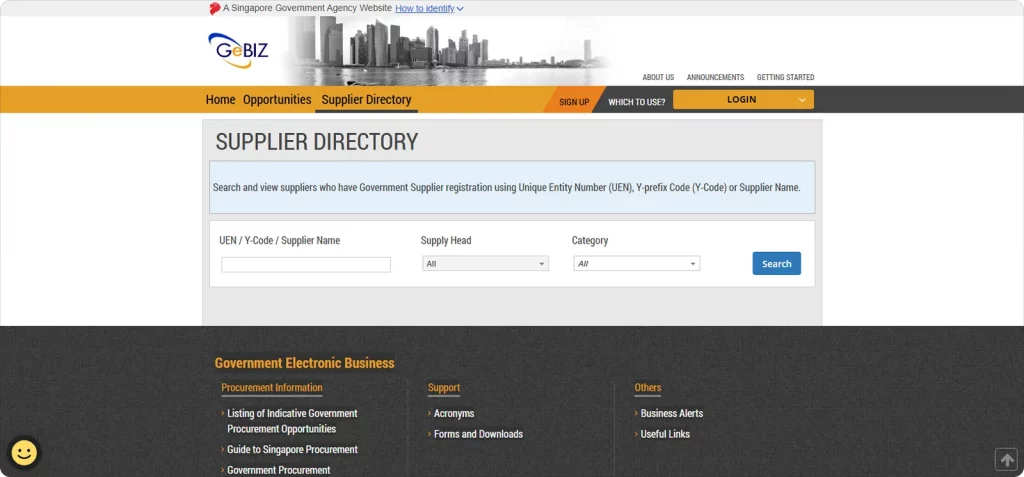
For service providers and established vendors, the GeBIZ Supplier Directory lets you search for companies that have registered to supply the Singapore government. Registration is not a guarantee of fit, but it is a strong credibility signal.
How to use the GeBIZ Supplier Directory:
- Go to the GeBIZ Supplier Directory page
- Search for suppliers using one of the official identifiers:
- Unique Entity Number (UEN)
- Y-prefix Code (Y-Code), used for registered government suppliers
- Supplier name
- Confirm the legal entity details, including registered name and UEN, match what the supplier has shared
- Check the supplier’s registration status and approved supplier categories
Use GeBIZ registration as a baseline credibility check, then follow up with commercial, operational and payment verification
B2B directories and marketplaces
Local and regional B2B platforms can be helpful in early discovery, especially when you want a broad view of what is available in the Singapore market.
Platforms such as Obbo.SG position themselves as dedicated B2B marketplaces for Singapore-based suppliers. Businesses can browse thousands of local suppliers across categories, with an emphasis on “quality assured” products and a one-stop ordering experience.
Another option is SJN.sg, a global industrial B2B portal with a dedicated Singapore section. The platform allows buyers to search a large nationwide supplier database and send RFQs directly to listed companies, making it useful for industrial goods and components where specification-based enquiries matter.
These platforms function much like localised versions of Alibaba or ThomasNet. They are effective for:
- Scanning the supplier landscape by category
- Identifying potential vendors you may not find through referrals
- Building an initial longlist quickly
Trade shows and industry events
Singapore hosts major regional trade events across electronics, manufacturing, food and beverage, logistics, life sciences and industrial services. These events work best for buyers who want to move beyond online listings and assess suppliers in a more structured, in-person setting.
Trade shows are particularly valuable when:
- Products require physical inspection or technical evaluation
- Compliance, certification or regulatory alignment matters
- The goal is to build long-term supplier relationships rather than place one-off orders
Alongside trade events, The Singapore Exporters Directory, published by Singapore International Chamber of Commerce, covers categories such as electronics, food and beverage and machinery and provides another starting point for supplier discovery.
Step 3: Shortlist suppliers objectively
Once you have a longlist, the goal is to narrow it quickly and methodically. This stage is about filtering for credibility and fit, not negotiating terms or chasing the lowest price.
At this point, focus on fundamentals:
- Legal entity name and registration details you can verify independently
- Years in operation and a clear trading footprint
- Core markets served, including export experience relevant to your destination markets
- Responsiveness, clarity and consistency in communication
Early interactions are often a reliable indicator of how a supplier will behave once orders are live. Slow replies, vague answers or shifting explanations tend to persist rather than improve.
Watch for red flags
Take caution if you encounter:
- Reluctance to share registration details, certifications or customer references
- Inconsistent explanations around pricing, lead times or production capacity
- Unclear ownership structure, contact details or operating location
Singapore’s regulatory environment sets a high bar for transparency. Legitimate suppliers are usually comfortable sharing basic corporate and operational information. Resistance at this stage is a signal worth taking seriously.
Aim to shortlist three to five suppliers that meet your criteria. This keeps comparisons manageable and allows for deeper evaluation without spreading time and attention too thin.
Step 4: Verify and validate suppliers properly
Verification protects margins, delivery timelines and brand reputation. In Singapore, where corporate and regulatory information is readily available, incomplete disclosure deserves scrutiny rather than the benefit of the doubt.
Start by verifying the supplier’s legal status through the Accounting and Corporate Regulatory Authority (ACRA). Check that the registered entity name, UEN and operating status match the details shared during discussions.
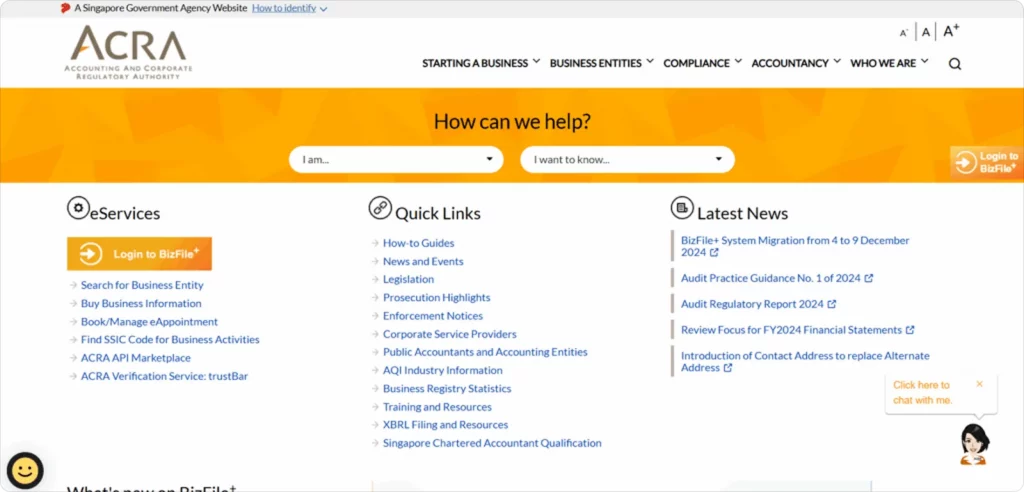
Where relevant, confirm that the supplier holds the licences or permits required for its sector, especially in regulated industries such as food, chemicals, medical devices or logistics.
Move beyond brochures and pricing tables. Ask direct questions about:
- Production or service capacity at the volumes you plan to order
- Quality control, inspection routines and documentation
- Use of subcontractors and where each part of the work takes place
For higher-risk categories or long-term commitments, request supporting documentation or a virtual walkthrough. In some cases, a third-party audit offers a faster, more objective view.
Ask to speak with customers placing similar orders and when products are involved, test samples or run a small trial order before scaling. These checks often surface quality or communication issues early, when they are easier to resolve.
Step 5: Request quotes and compare offers fairly
A usable quote should give you a complete picture, not just a price. At a minimum, it should clearly state:
- Unit pricing and minimum order quantities
- Lead times and delivery schedules
- Incoterms and responsibility for logistics
- Payment terms and invoicing currency
When comparing offers, factor in how the supplier operates day to day:
- The quality and consistency of communication
- Willingness to adapt as volumes change
- Reliability when timelines tighten or issues arise
Understand the currency impact:
Singapore suppliers may quote in SGD, USD or another currency. That choice directly affects FX costs, conversion spreads, cash flow timing and margin stability. This is often the point at which payment infrastructure becomes critical, especially as order volumes increase.
Step 6: Negotiate terms and finalise agreements
Negotiations with Singapore suppliers are structured and business-focused. Clear preparation usually matters more than hard pressure. Approach discussions with precise data and well-defined expectations.
Key terms to review carefully include:
- Pricing structure and review mechanisms
- Delivery commitments and remedies for delays
- Payment timelines and settlement terms
- Dispute resolution and governing law
For long-term or high-value relationships, a legal review often provides clarity and protection that far outweighs the cost.
Step 7: Set up payments to support multi-currency supplier relationships
Knowing how to find a supplier in Singapore is only half of the equation. The other half is setting up payments to support long-term relationships, predictable cash flow and international growth.
Payment setup often determines how smoothly a supplier relationship runs over time. Problems rarely surface on the first transfer. They emerge as order volumes grow, payment frequency increases and cash flow stretches across currencies.
Single-currency banking setups introduce avoidable friction. They force conversions earlier than necessary, slow down international transfers and make FX costs harder to track. Over time, these inefficiencies affect margins and can strain otherwise strong supplier relationships.
A multi-currency setup gives businesses more control over how and when money moves.
At a minimum, it should allow you to:
- Pay suppliers in their preferred currency without adding manual steps
- Hold funds in multiple currencies instead of converting immediately
- Time currency conversions around cash flow needs rather than bank constraints
Getting this right early keeps payments predictable, reduces unnecessary FX costs and helps supplier relationships scale smoothly as sourcing volumes increase.
How the World Account supports supplier payments
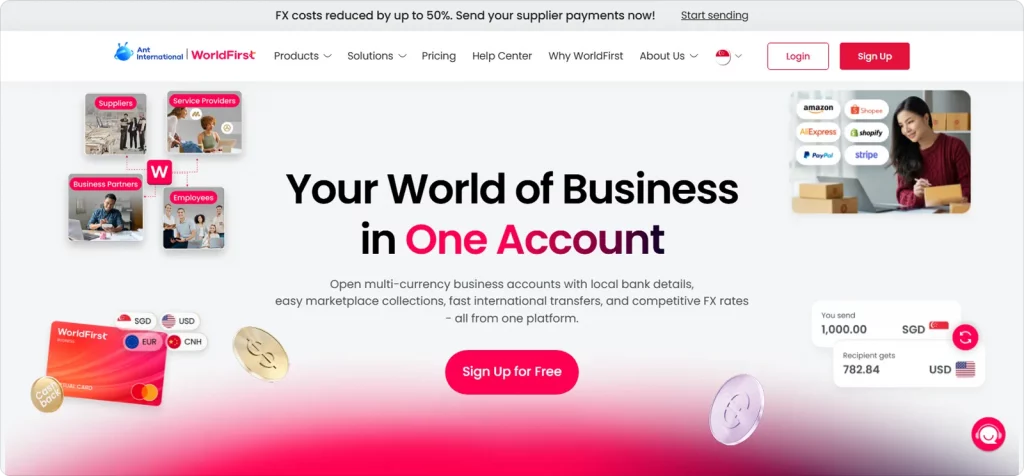
WorldFirst designed the World Account for businesses that trade internationally and manage suppliers across borders.
It’s not a bank account, but a multi-currency payments platform that gives businesses greater control over how money moves in and out of their operations.
From a single platform, businesses can:
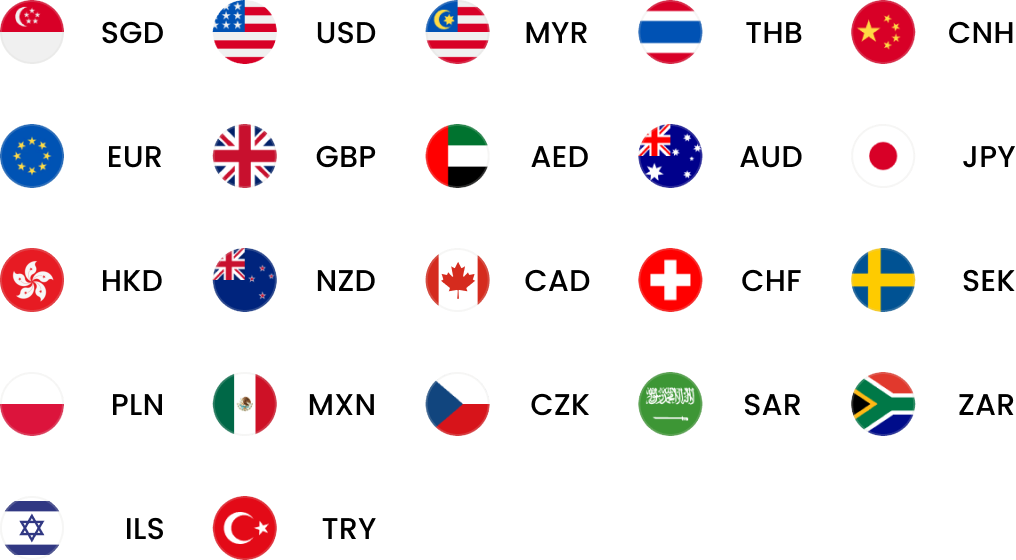
- Receive and hold funds in 20+ currencies using local account details
- Pay suppliers in 100+ currencies across 200+ countries and regions
- Convert currencies when it suits their cash flow strategy rather than fixed bank schedules
- Withdraw funds to their own bank accounts at any time
For businesses sourcing from Singapore while selling into multiple markets, this setup improves visibility across currencies, reduces unnecessary FX conversions and removes common payment bottlenecks that slow supplier relationships as volumes increase.
Trying to figure out how to find a supplier in Singapore that works long-term?
Open a World Account for free and pay suppliers in multiple currencies through one platform designed for international trade.
Sources:
- https://www.enterprisesg.gov.sg/
- https://www.bizfile.gov.sg/
- https://www.sbf.org.sg/
- https://www.gobusiness.gov.sg/
- https://www.gebiz.gov.sg/
- https://www.semiconsea.org/
- https://www.industrial-transformation.com/
- https://www.fhafnb.com/
- https://nrfbigshowapac.nrf.com/
- https://www.buildtechasia.com/
- https://www.obbo.sg/
- https://www.sjn.sg/
- https://sg.kompass.com/
- https://www.yellowpages.com.sg/
- https://www.tradekey.sg/
- https://www.uen.gov.sg/
- https://www.customs.gov.sg/businesses/strategic-goods-control
- https://www.mti.gov.sg/


![Revolut Business Card review Singapore [2027]: Features, fees & more](https://mdn.marmot-cloud.com/worldfirst/sites/9/2026/09/20261001002258848-300x200.webp)