




























Find out how foreign companies can open a business bank account in Hong Kong
Key takeaways
- Hong Kong allows non-resident foreign companies to open business bank accounts, but traditional banks apply strict documentation, in-person meetings and long approval timelines.
- Three main provider types are available: traditional banks (HSBC, DBS, Bank of China), digital banks (ZA Bank, WeLab Bank, ANEXT Bank) and multi-currency accounts (like WorldFirst’s World Account).
- Traditional banks typically take 4 to 12 weeks to open an account, require a Hong Kong director in some cases, and impose minimum deposit requirements.
- Digital banks streamline the process, with faster approvals and lower fees, but eligibility can vary by applicant nationality and business type.
- A multi-currency account offers a faster alternative for foreign companies that primarily need HKD (and other currencies) for cross-border payments, without the overhead of a traditional Hong Kong bank account.

Hong Kong is one of Asia’s most established international financial centres, and for Singapore-based businesses trading with Chinese or Hong Kong partners, having HKD banking capability often becomes a practical need. Whether it’s paying suppliers in Hong Kong, receiving revenue from Hong Kong customers, or holding HKD balances for foreign exchange purposes, the question of how to actually open a Hong Kong business account is where the friction starts.
Non-resident foreign companies can open Hong Kong business bank accounts, but the process is significantly heavier than what most Singapore businesses are used to at home. This guide covers what’s available, how the process actually works, and the alternatives that can deliver HKD capability without the traditional bank overhead.
Can I open a business bank account in Hong Kong for a foreign company?
Yes. Hong Kong banks accept business account applications from foreign companies, including Singapore-registered entities. However, the acceptance criteria and process differ significantly depending on the applicant’s structure, industry, business model and expected transaction volume.
Non-Hong Kong companies typically need to demonstrate:
- A legitimate business rationale for a Hong Kong bank account (trade with Hong Kong or Chinese counterparties, regional treasury operations, investment holding)
- Full corporate documentation from the home jurisdiction, often certified by a Hong Kong-registered lawyer or notary
- Beneficial ownership details for all shareholders holding 25% or more of the company
- Detailed information on expected transaction patterns, counterparties and source of funds
Some Hong Kong banks require at least one director to attend an in-person meeting in Hong Kong. Others accept video interviews. All of them apply KYC and anti-money laundering checks that go beyond what’s typical for domestic Singapore banking.
→ Take a look at the best business bank accounts in Singapore
Which type of provider is right for you to open a business account in Hong Kong?
Foreign companies opening a Hong Kong business account have three main provider types to consider
Traditional banks
Traditional Hong Kong banks include HSBC, DBS Hong Kong, Standard Chartered, Bank of China (Hong Kong) and Hang Seng Bank. These are the established options and offer the broadest range of services, including trade finance, letters of credit, HKD and multi-currency accounts, and integration with existing corporate banking relationships.
Application processes are documentation-heavy, approval times can stretch from 4 to 12 weeks, and some banks require an in-person visit to Hong Kong. Minimum deposit requirements can start from HKD 10,000 and go significantly higher for premium services. Monthly account fees and transaction charges add up over time.
Digital banks
Hong Kong’s digital-first banks include ZA Bank, WeLab Bank and ANEXT Bank. These are licensed under the Hong Kong Monetary Authority (HKMA) and operate entirely online.
For foreign companies, digital banks offer faster onboarding (often 1 to 3 weeks), lower fees, and no requirement for in-person meetings. Some digital banks primarily accept Hong Kong-incorporated companies. Others accept foreign companies but restrict the accepted jurisdictions or business categories. Available services can also be narrower than a traditional bank, especially for trade finance and treasury products.
Multi-currency accounts
A multi-currency account offers a different structural approach. Rather than a Hong Kong bank account tied to a Hong Kong branch, a multi-currency account from a payments provider gives businesses local HKD bank details as one of several supported currencies inside a single online account.
For a Singapore business that primarily needs HKD for cross-border payments (paying Hong Kong suppliers, receiving HKD payments from customers, holding HKD balances), a multi-currency account provides that capability without needing to go through the full Hong Kong banking application process. Setup is faster (often days rather than weeks), and there’s no need for a Hong Kong director or an in-person meeting.
| Feature | Traditional bank | Digital bank | Multi-currency account |
| Typical time to open | 4 to 12 weeks | 1 to 3 weeks | A few business days |
| In-person meeting | Often required | Not usually required | Not required |
| Minimum deposit | HKD 10,000+ | Varies | Zero |
| Monthly fees | Yes | Lower or none | Often zero |
| Service breadth | Trade finance, letters of credit, treasury | Basic banking, some digital-first features | Multi-currency payments and holdings |
| Best for | Businesses with substantial Hong Kong operations | Startups and SMEs prioritising speed | Businesses primarily needing HKD for cross-border payments |
4 top business bank accounts in Hong Kong
| Provider | Account opening fees | Monthly fees | Account opening procedures for foreigners |
| HSBC Hong Kong | HKD 1,300–1,600 account opening fee, plus HKD 11,000 fee for overseas companies | Waived with HKD 50,000–500,000 balance | Complex and expensive for overseas companies, with extra levels of screening. May require overseas HSBC branch involvement. |
| DBS Hong Kong | HKD 10,000 for overseas account opening, plus HKD 5,000 administrative fee | HKD 250 if balance is below HKD 50,000 | Remote opening is not allowed for overseas companies. Foreign companies must apply in person |
| BOC Hong Kong (BOCHK) | Not clearly stated | HKD 120–200 | Remote opening limited to HK-incorporated firms. Many must still visit a branch. |
| Hang Seng Bank | HKD 1,300 account opening fee, plus up to HKD 10,000 due-diligence and HKD 8,000 fee for special companies | HKD 200 waived with HKD 50,000–100,000 balance | Strict HK-ID rules and high due-diligence costs. Remote opening only available for eligible applicants. |
Note: All information on costs and features at the time of writing (July 2026). Please be aware that all details are subject to change.
1. HSBC Hong Kong
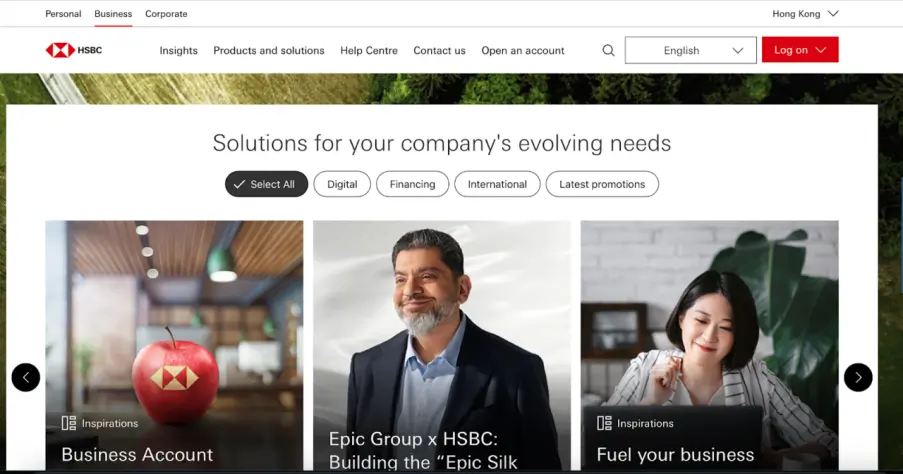
HSBC commercial banking offers several different tiers of accounts, each built for businesses of different sizes and growth stages. Several options let you hold HKD, Renminbi and other foreign currencies (including USD, GBP, CAD, EUR, AUD, JPY and others) all under the same account.
The standard account application fee is HKD1,300 online or HKD1,600 on paper, plus a HK$11,000 overseas company account opening fee per account for foreign-incorporated companies.
Additional account opening fees may apply when an overseas HSBC branch is involved (HK$2,250 per service transaction), plus a HK$11,000 fee per account if your company has three or more layers in its structure, and other fees for additional services.
Monthly service fees are waived if you meet minimum balance requirements ranging from HK $50,000 to $500,000 depending on account type. Accounts may also come with mobile management features and a credit card with a cashback option.
2. DBS Bank Hong Kong
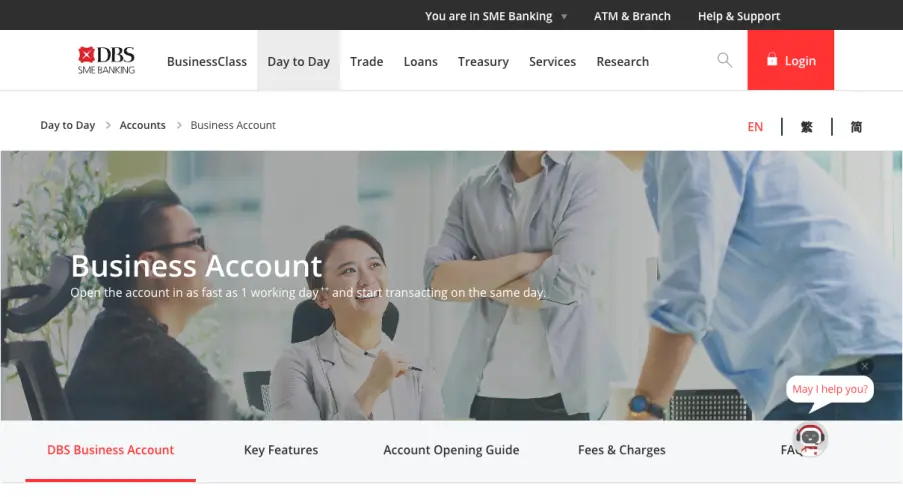
DBS offers at least three different business account types, including a Multi-Currency Savings Account and separate HKD, RMB and USD Current Accounts. Applications from customers in Hong Kong and Mainland China may be completed online in 15 minutes, and customers can verify their identity over the phone with no in-person visit, with approval as fast as one working day.
However, companies that wish to open an account remotely must be incorporated in Hong Kong and hold an HK Permanent ID Card or People’s Republic of China Resident Identity Card. All other applicants must make an appointment to complete their applications at DBS’ SME Center, even if they initiate the application online.
Overseas applicants must also pay a minimum HK$10,000 overseas company account opening fee, as well as an annual minimum HK$5,000 administration fee. Special companies must pay additional fees of HK$10,000 for account opening and HK$5,000 for annual administration.
You’ll also need to pay a monthly service fee of HK$250 per month any time the Average Total Deposit Balance over the month falls below HK$50,000 or the equivalent in foreign currency. Currency conversion fees, wire transfer fees and other additional service fees are available here.
3. Bank of China Hong Kong
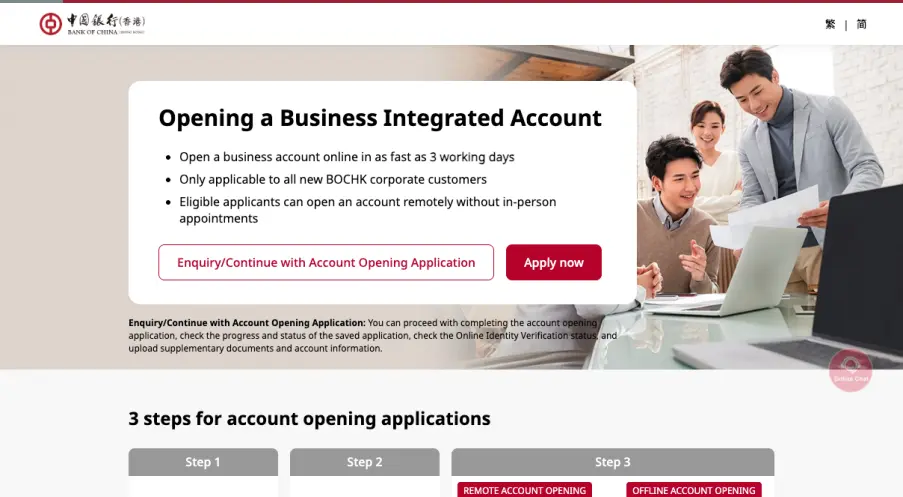
Bank of China Hong Kong (BOCHK) offers three different business account types:
- Business Integrated Account
- Business Integrated Account Plus
- Business Integrated Account Elite
Monthly service fees range from HK$120 to 200 for a maximum transaction limit of 30 to 50 monthly transactions depending on the account type.
Additional transactions are subject to a service fee of HK$20 per transaction. BOCHK also offers an “auto-sweeping service” where funds are automatically deducted from your other linked account(s) in order to avoid overdraft charges and bounced payments.
Outgoing telegraphic transfers (international wire payments) start at HK$60–120 per transfer, not including correspondent bank fees and additional fees. There may also be currency exchange fees, setup fees and other unspecified service charges associated with different types of transactions.
BOCHK also offers a number of cross-border cash management services, including Renminbi remittance for making payments into China. It’s also possible to open separate current accounts in HKD, RMB and USD.
Eligible applicants can open a BOCHK business account remotely if their business is registered or incorporated in Hong Kong and meets annual sales turnover requirements. Some applicants may need to visit a bank branch in person even if they meet all of these requirements.
4. Hang Seng
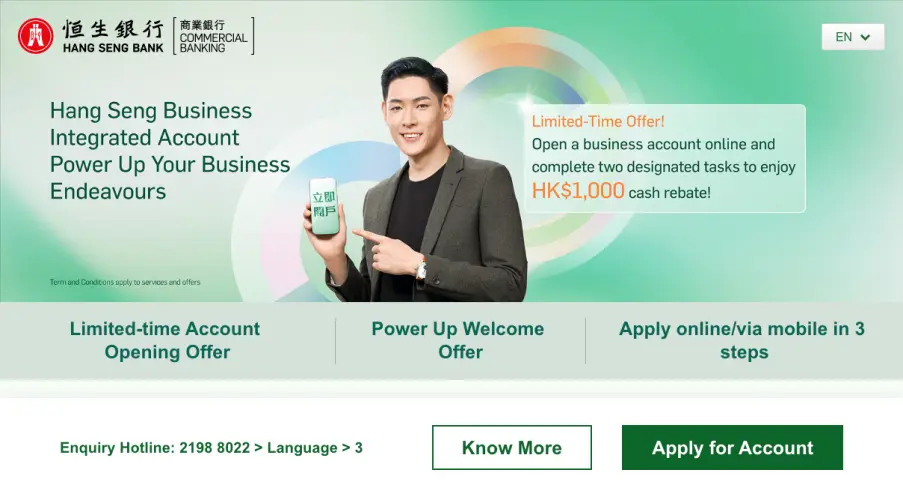
Hang Seng Bank offers a Biz Virtual+ Account that caters specifically to startups and local SMEs, as well as an Integrated Business Solutions Account for other SMEs and established corporations. All online applicants and connected parties must be Hong Kong ID holders located in Hong Kong, with a single layer of ownership.
Accounts are subject to a monthly fee of HK$200 which is waived with a balance of HK$50,000-100,000 depending on account type. There may also be a Company Search Fee (to cover due diligence costs) of up to HK$10,000 for overseas companies.
Accounts can be opened remotely in 3–5 business days by businesses that meet eligibility requirements. However, to open an account remotely without an in-person interview, applicants must pay an HK$1,000 administrative fee, plus an additional HK$300 account opening fee. Special companies must pay an additional fee of HK$8,000.
Outgoing payments are affordable, at HK$2.50-10 and CNY2.5-10 depending on amount and account type. At present, fees are waived for receiving funds via Faster Payment System, though this may be subject to change.
Hang Seng also offers current accounts in USD and Renminbi, though these appear to be designed for individual use. No business option is clearly advertised.
How to open a business bank account in Hong Kong as a foreigner: complete steps
For a foreign company applying to a traditional or digital Hong Kong bank, the process typically follows these steps.
1. Prepare the documentation
Hong Kong banks require a comprehensive documentation package for foreign company applications, typically including:
- Certificate of incorporation from the home jurisdiction
- Business registration documents
- Company constitution or articles of association
- Director and shareholder identification (passports, proof of address)
- Beneficial ownership declarations
- Recent audited financial statements
- Proof of business address and operations in the home country
- Business plan or explanation of the intended use of the Hong Kong account
Documents in languages other than English or Chinese usually need to be translated and certified.
2. Choose the bank and submit the application
Different banks have different appetites for foreign company clients. Some focus on Hong Kong-linked businesses, others accept broader international applicants. Speaking to the bank’s business banking team before submitting the full application helps confirm eligibility and requirements.
Most traditional banks require an in-person meeting in Hong Kong with at least one director. Digital banks typically handle the application entirely online, though they may request video verification calls.
3. Wait for KYC and compliance review
Hong Kong banks conduct extensive Know Your Customer (KYC) and anti-money laundering (AML) checks on foreign company applications. This involves verifying beneficial ownership, source of funds, expected transaction patterns and business legitimacy. For non-standard applications, the bank may request additional documentation during this stage.
This is where timelines usually stretch. Traditional banks typically take 4 to 8 weeks for KYC review on foreign company applications. Digital banks can be faster, often 1 to 3 weeks.
4. Fund the account and activate
Once approved, the bank confirms the account details and typically requires an initial deposit before full account features are activated. Minimum deposits vary by bank and account type but often start from HKD 10,000 for traditional banks.
How to open a virtual HKD local currency account with WorldFirst
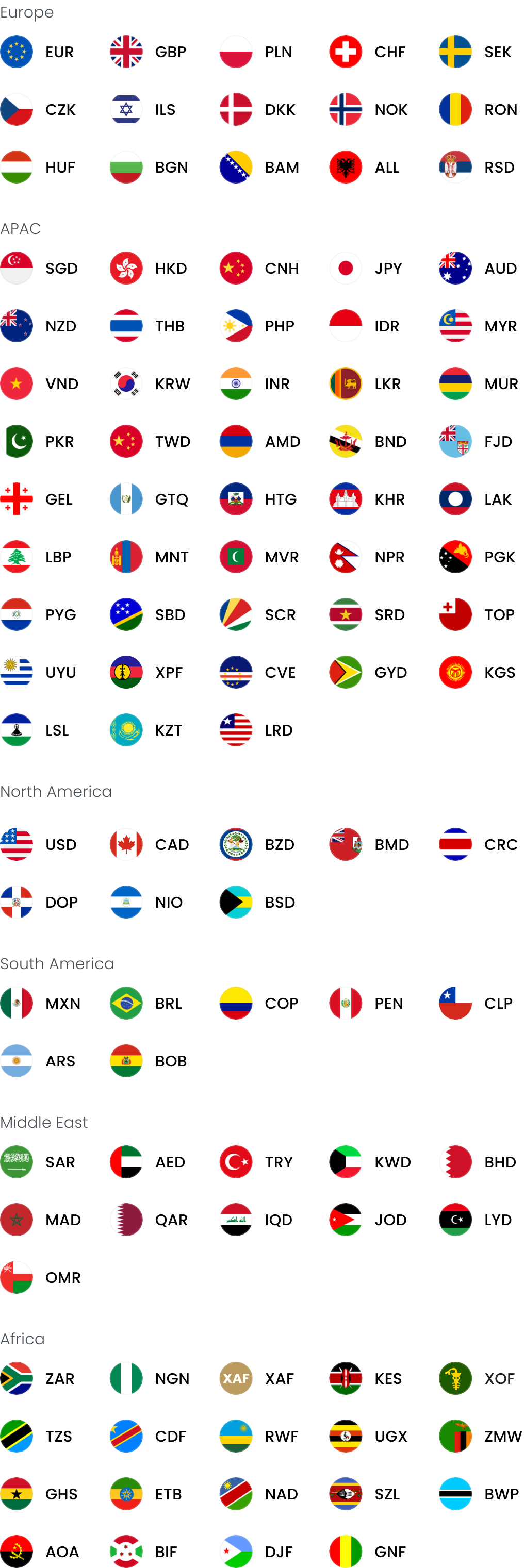
The World Account is a multi-currency account from WorldFirst, an international payments provider for cross-border businesses. For Singapore-based businesses that primarily need HKD for cross-border payments, the World Account provides local HKD bank details alongside 21 other supported currencies, all managed from a single online account.
1. Register online
Sign up on the WorldFirst website with basic business details, contact information and information about the beneficial ownership structure.
2. Submit documentation
WorldFirst verification typically requires proof of business registration, identity documents for directors and beneficial owners, and any additional documents relevant to the applicant’s business.
3. Complete verification
The WorldFirst team reviews the submitted documents. Verification typically takes a few business days.
4. Open an HKD receiving account
Once verified, log in to the World Account dashboard, go to the Collections tab, and add a new HKD receiving account. Local HKD bank details are generated on the spot and can be used to receive HKD payments from Hong Kong customers, marketplaces or payment platforms.
5. Start using the account
- Receive HKD payments directly into the HKD account without conversion into SGD.
- Hold HKD balances until conversion suits or the funds are needed.
- Send HKD payments to Hong Kong suppliers or partners directly.
- Convert HKD to SGD (or any of the other 22 supported currencies) at competitive FX rates when it suits the business.
What does it cost to set up a HKD account with WorldFirst?
The World Account has zero fees for opening or maintaining the account. There are no minimum balance requirements. Fees apply on outbound payments and currency conversions, and are transparent in the WorldFirst dashboard before each transaction is confirmed.
FAQs
1. Can I open a Hong Kong business account without visiting Hong Kong?
With traditional banks, an in-person meeting in Hong Kong is often required for foreign company applications. With digital banks, applications are usually handled remotely, though eligibility varies. A multi-currency account like the World Account is fully remote and doesn’t require any Hong Kong presence.
2. What documents do I need to open a business account in Hong Kong?
Standard requirements include certificate of incorporation from the home jurisdiction, business registration documents, director and beneficial owner identification, proof of business address, and often audited financial statements and a business plan. Traditional banks typically require certified copies. Multi-currency account providers usually accept clear digital copies.
3. How long does it take to open a business bank account in Hong Kong?
Traditional banks typically take 4 to 12 weeks for foreign company applications, driven by KYC review timelines. Digital banks can complete the process in 1 to 3 weeks. A multi-currency account like the World Account can be opened in a few business days.
This article is intended for informational purposes only and does not constitute legal advice or professional advice. This article should not be regarded as constituting an offer or a solicitation to buy or sell any regulated or financial products or services. WorldFirst makes no representations or warranties regarding the accuracy, completeness, or applicability of the content, and readers are encouraged to consult with legal professionals or other professionals for advice tailored to their specific situation. WorldFirst does not guarantee the accuracy and completeness of this article and expressly disclaims any and all liability to any person in respect of the consequences of anything done or omitted to be done wholly or partly in reliance on this article.
Sources
- https://www.business.hsbc.com.hk/en-gb/products/business-integrated-account
- https://www.business.hsbc.com.hk/en-gb/regulations/compare-accounts
- https://www.dbs.com.hk/sme/day-to-day/accounts/business-account
- https://www.dbs.com.hk/sme/day-to-day/accounts/business-account
- https://www.bochk.com/dam/corporatebanking/BIA_Insert_en.pdf
- https://www.bochk.com/en/corporate/servicecharge/remittance.html
- https://transaction.bochk.com/igtb/html/aop/gib_aopMainPage.html?lang=en_US
- https://cms.hangseng.com/cms/emkt/pmo/grp02/p03/eng/index.html
- https://www.hangseng.com/content/dam/hase/en_hk/business/bank-accounts/PDF/Service%20Charges_existing.pdf
![Revolut Business Card review Singapore [2027]: Features, fees & more](https://mdn.marmot-cloud.com/worldfirst/sites/9/2026/09/20261001002258848-300x200.webp)