





























Home > How do small businesses manage invoices and payments in multiple currencies?
How do small businesses manage invoices and payments in multiple currencies?
Last update:


Small businesses can manage invoices and payments in multiple currencies by:
- Setting up a non-bank, multi-currency business account, such as the World Account by WorldFirst
- Using invoicing or accounting software that can manage multiple currencies
- Following best practices when bookkeeping and managing exchange rates
Below, we cover some of the top options to help you get started.
1. Set up a multi-currency business account
The foundation of smooth cross-border finance is a multi-currency business account. Instead of opening separate bank accounts in every country where you operate, these accounts let you hold, receive and send funds in multiple currencies from a single dashboard. You can also:
- Avoid forced conversions and unnecessary FX fees
- Receive international payments like a local business
- Pay suppliers in their currency without delays
- Keep foreign currency balances for future use
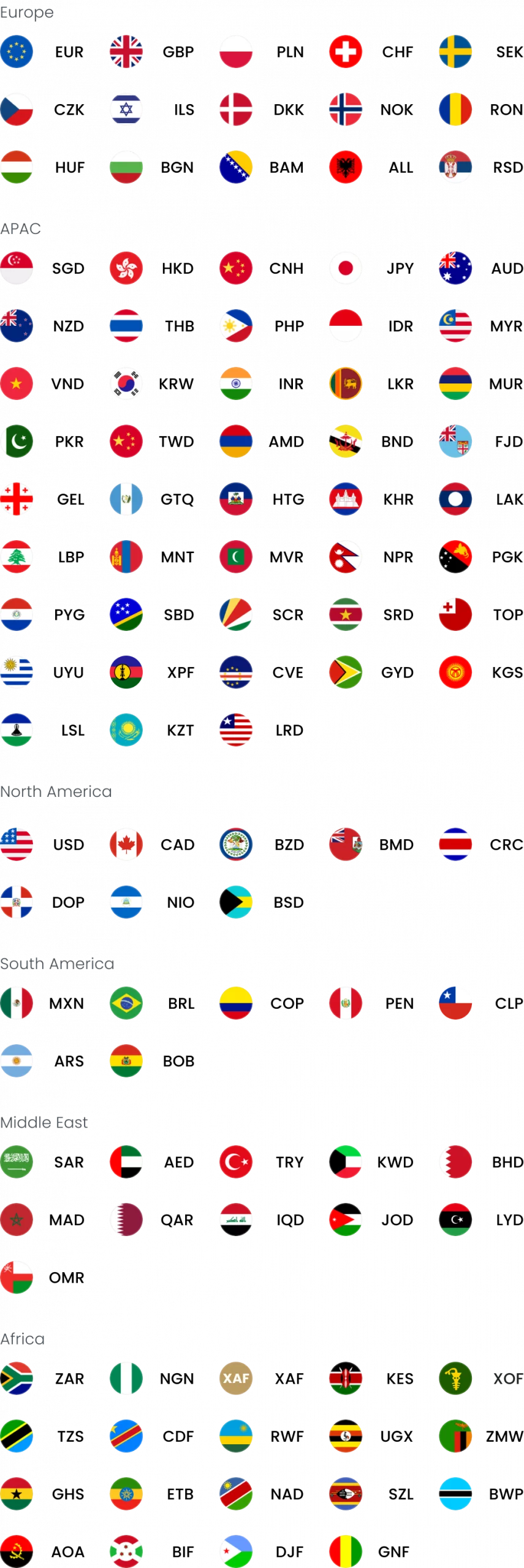
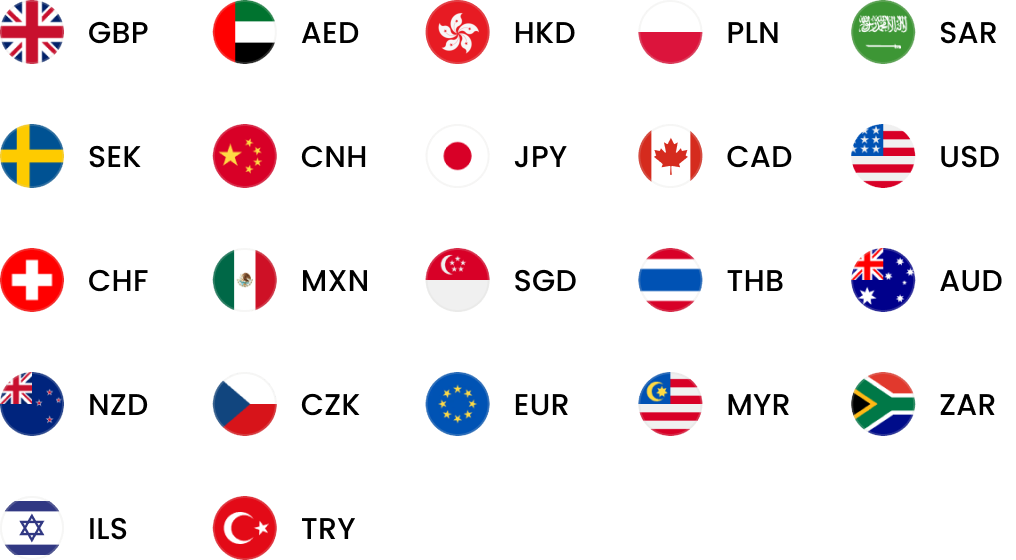
For example, the World Account by WorldFirst allows businesses to hold 20+ currencies – including USD, GBP, EUR, CNH, AUD and JPY – while giving them local receiving account details such as US routing numbers, UK sort codes and EU IBANs. This eliminates the need to register entities or visit banks in each region.
The World Account also supports payments in 100+ currencies to over 200 countries, using local payment rails to ensure that around 90% of transfers arrive the same day without intermediary bank deductions. For businesses working with China, its Pay-On-Behalf-Of (POBO) service and deep integrations with Alibaba and 1688.com make it one of the most efficient tools for paying Chinese suppliers.
Other popular options include HSBC Global Wallet, Payoneer and Airwallex, each offering variations of
local-currency accounts, fast conversions and international payment capabilities.
2. Use accounting or invoicing software with multi-currency support
Multi-currency accounting software is essential for keeping clean, compliant books. Tools like QuickBooks Online, Xero, Zoho Books, FreshBooks, and Wave automate much of the heavy lifting.
What these tools can do:
- Create invoices in the customer’s local currency
- Automatically apply the correct exchange rate
- Record gains and losses from currency fluctuations
- Accept payments in multiple currencies
- Match foreign payments to invoices for easy reconciliation
For most small companies, this is the simplest way to stay organised. The software updates FX rates daily, converts foreign transactions into your reporting currency, and avoids the messy calculations that come with manual currency conversion.
In accounting terms, each foreign currency account functions as a separate ledger. Businesses record invoices and payments in the original currency, convert amounts for financial statements and periodically revalue balances – usually monthly or quarterly. This keeps reporting consistent, transparent, and audit-ready.
3. Follow basic best practices for multi-currency bookkeeping
Beyond tools, small businesses often set up internal rules to maintain clarity and consistency. Common best practices include:
- Choosing a home currency for financial reporting
- Setting policies on currency conversion, such as when to convert foreign balances
- Using trusted FX rate sources (e.g., XE, central bank rates, software defaults)
- Deciding who bears FX fees – the business or the customer
- Scheduling periodic revaluations to track unrealised gains or losses
These simple rules help keep multi-currency accounting compliant while preventing surprises at year-end.
Top multi-currency business account options
Here’s a brief overview of leading platforms that help small businesses manage international payments efficiently.
Why the World Account by WorldFirst stands out for multi-currency business banking
The World Account by WorldFirst is purpose-built for businesses that need to make international business payments , offering a level of speed, flexibility and cost efficiency that traditional banks rarely match. With over 20 years of experience and more than $500 billion in processed payments, WorldFirst has become a trusted partner for over 1.5 million global businesses.
With a single account, you can hold and manage 20+ currencies, receive payments with local account details (such as US routing numbers and EU IBANs), and pay suppliers worldwide without forced conversions.
Key benefits include:
- Same-day payments in 90% of cases using local payment rails
- FX markups capped at 0.50% on major currencies
- Forward contracts and firm orders to manage FX risk
- POBO payments to China for fast, compliant settlement
- Zero-FX-fee virtual cards in 15 major currencies
- Integrations with 130+ global marketplaces, including Amazon and 1688.com
This combination of speed, cost savings, and global reach makes the World Account one of the strongest solutions for managing international payments at scale.
HSBC Global Wallet
Ideal for established businesses wanting bank-grade infrastructure.
- Hold and send several major currencies within HSBCnet
- Transparent FX margins displayed before transactions
- £5 transfer fee for currency payments
- Integrated with HSBC’s broader cash-management tools
Payoneer
Popular with freelancers, online sellers, and global service businesses.
- Local receiving accounts in USD, GBP, EUR, AUD, CAD, JPY, HKD, SGD, and more
- Low-cost conversions and free VAT payments in the EU/UK
- Supports multiple payment methods including cards, ACH, and PayPal
- Batch payments for suppliers and contractors
Airwallex
A strong choice for digital-first companies scaling internationally.
- Open global accounts online in minutes
- No account or maintenance fees
- Interbank FX rates and fast transfers
- Integrations with accounting software and marketplaces
- API options for advanced automation
| Feature / Provider | WorldFirst (World Account) | HSBC Global Wallet | Payoneer | Airwallex |
|---|---|---|---|---|
| Best for | SMEs and e-commerce businesses needing fast, low-cost global payments | Established firms wanting bank-grade infrastructure | Freelancers, sellers, and service businesses | Digital-first companies scaling globally |
| Supported currencies | Hold 20+; send 100+ | Major global currencies (not fully published) | 10+ local receiving currencies | Wide range of global currencies depending on region |
| Local receiving account details | Yes – includes USD routing, UK sort code, EU IBAN, CNH, etc. | Yes – via HSBCnet wallets | Yes – local accounts in USD, GBP, EUR, AUD, CAD, JPY, HKD, SG | Yes – local account details across many countries |
| FX fees / rates | Major currencies capped at 0.50%; competitive business FX tools | Bank FX margins; usually higher than fintech providers | Competitive rates with no hidden fees | Interbank rates or close to interbank, low markups |
| Payment speed | 80% same-day via local rails; instant between World Accounts | Standard bank timelines; not guaranteed same-day | Fast transfers; varies by corridor | 1–2 business days; often faster for popular corridors |
| Special features | Forward contracts, firm orders, POBO China payments, multi-currency virtual cards, marketplace integrations | Integrated cash-management tools, £5 flat transaction fee | Batch payments, global billing, marketplace payouts | API automation, batch transfers, accounting integrations |
| Marketplace integrations | 130+ global platforms (Amazon PSPP, 1688.com, Etsy, TikTok, etc.) | Limited marketplace focus | Strong marketplace support for freelancers and sellers | Integrates with major e-commerce tools |
| Ideal use cases | Cross-border supplier payments, e-commerce payouts, multi-currency treasury management | Multi-entity or enterprise-level cash management | Getting paid by global clients or marketplaces | Fast global expansion without local banking setup |
| Account opening and fees | Free to open; no monthly fees | Bank fees apply; £5 per transaction | Free account; fees apply on some transfers | No monthly fees; no minimums |
The bottom line
Small businesses no longer need complex banking setups to operate internationally. By combining a modern multi-currency account with good accounting software and simple bookkeeping rules, companies can manage foreign invoices and payments confidently — all while reducing fees, improving accuracy, and protecting their profit margins.
If you want a streamlined way to start managing money across borders, opening a multi-currency account like the World Account is typically the fastest and most cost-effective first step.
FAQs
1. Do I need separate bank accounts for every currency?
No. Multi-currency business accounts let you hold, receive, and send different currencies from one platform, reducing admin, avoiding forced conversions, and simplifying international operations significantly.
2. How do accounting tools manage exchange rates automatically?
Modern accounting software updates exchange rates daily, converts foreign transactions into your reporting currency, and records FX gains or losses, helping you stay compliant without manual calculations or spreadsheets.
3. What’s the easiest way to reduce currency conversion fees?
Using a multi-currency account helps you avoid unnecessary conversions and access more competitive FX rates than traditional banks, which often add large markups that erode your margins.
Sources
https://www.business.hsbc.uk/en-gb/products/hsbc-global-wallet
https://www.payoneer.com/multi-currency-account/
https://www.payoneer.com/get-paid-by-clients/
https://www.payoneer.com/get-paid-by-clients/payment-request/
https://www.airwallex.com/business-account/transfers
Continue reading


Subscribe
The Weekly Dispatch
Get the latest news and event invites. Signup for our weekly update from the worlds of fashion, design, and tech.
You might also like
Choose a product or service to find out more

E-commerce guides


Doing business with China

Exploring new markets

Business Tips

International transactions
E-commerce expansion guides
Doing business with China