





























Home > blog > International Transactions > How do businesses manage overseas supplier payments at scale?
How do businesses manage overseas supplier payments at scale?
Last update:


When companies start paying lots of overseas suppliers, the challenge shifts from “How do I send a wire?” to “How do I do this reliably, cheaply, and without losing my mind?”.
At scale, businesses can no longer rely on ad-hoc international transfers. Instead, you need to build a repeatable global payments system, with centralised processes, FX controls and specialist platforms.
Here’s how most companies manage overseas supplier payments efficiently as they grow.
1. Centralise your payment operations
Instead of different teams paying suppliers independently, payments should be centralised within treasury or finance.
That means:
- Supplier details live in one system
- Approval workflows are standardised
- Payments are managed consistently across regions
It helps to reduce errors, duplicate payments and fraud risk – all of which become more costly at volume.
2. Open a multi-currency account and wallet
Large businesses avoid converting currency for every single supplier payment. Instead, they hold balances in multiple currencies by using:
- Multi-currency bank accounts
- Digital wallets (USD, EUR, GBP, CNY, etc.)
Multi-currency accounts typically offer local clearing access in multiple countries, batch payout systems and automated currency conversion.
This approach helps reduce FX conversions, access better exchange rates and speed up settlement. It’s especially useful for companies paying hundreds or thousands of suppliers monthly.
3. Consider your FX management and hedging strategies
Currency risk becomes real once payments scale internationally.
Businesses manage exposure by:
- Locking in FX rates in advance
- Offsetting payables and receivables through FX netting
- Centralising FX decisions instead of leaving conversions to individual teams
In many organisations, “FX strategy” and “payment execution” become separate functions.
4. Integrate your payments with your ERP and accounting tools
Payments don’t exist in isolation. At scale, businesses integrate international payments directly into:
- ERP systems (SAP, Oracle, NetSuite)
- Accounts payable automation tools
- Reconciliation and reporting workflows
This enables straight-through processing, automatic invoice matching and clean audit trails. It helps to automate this country-specific reporting and sanctions screening too, for easier compliance.
5. Use tiered payment methods
Not every supplier is paid the same way.
Typical setups include:
- High-value, low-volume → bank wires
- Low-value, high-volume → local transfers or payout platforms
- Contractors/marketplaces → mass payout APIs
This keeps payment costs proportional to transaction value.
6. Set up a dedicated treasury function
Once payment volumes reach a certain threshold, companies often build a treasury team responsible for:
- Liquidity planning
- Provider and bank relationships
- FX optimisation
- Payment performance and cost reduction
At this stage, payments stop being an operational headache and become a strategic function.
How the right platform can help businesses pay suppliers at scale
As businesses grow, many rely on multi-currency platforms that combine payments, FX tools, automation, and compliance features.
Below are three common solutions.
1. WorldFirst multi-currency account (best for scaling global supplier payments)
One of the most versatile ways to manage overseas supplier payments at scale is through a multi-currency provider like WorldFirst.
Since 2004, WorldFirst has helped over 1.5 million businesses send payments worldwide, supporting transaction volumes of more than USD$500 billion. With a World Account, businesses can make fast, secure payments in 100+ currencies across 210+ countries, often using local payment rails instead of expensive international wires.
WorldFirst is designed for high-volume supplier operations. Companies can:
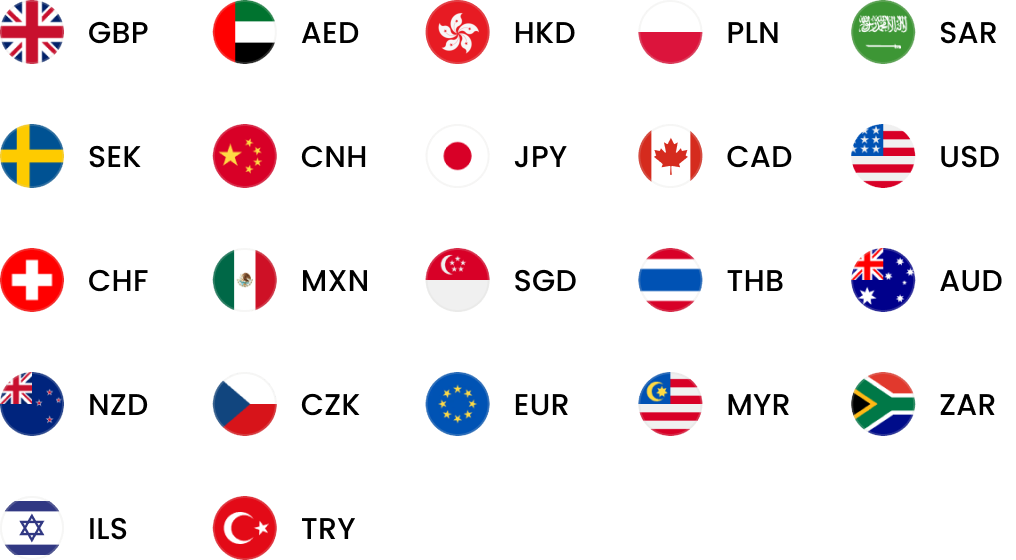
- Access local account details in 20+ currencies
- Reduce conversion costs with transparent FX pricing (often below 0.50% for major currencies)
- Send up to 200 payments at once through mass payment functionality.
For added flexibility, businesses can lock in exchange rates for up to 24 months using forward contracts, helping stabilise cash flow and protect margins. WorldFirst also offers the World Card – a multi-currency virtual card for instant supplier and operational payments, with zero FX fees in selected currencies.
For businesses sourcing internationally, WorldFirst also integrates directly with 1688.com, enabling faster supplier discovery and instant CNH payments from one dashboard.
2. Wise Business multi-currency account
Wise Business allows companies to hold and manage funds in 40+ currencies within one account.
It provides local account details in major markets so suppliers can be paid “like a local,” helping businesses avoid repeated conversions and expensive wire fees. Wise uses the mid-market exchange rate with transparent pricing, and supports batch payments for sending up to 1,000 supplier transfers at once.
It’s a popular option for SMEs handling recurring invoices across multiple countries, with additional tools like payment scheduling and API-based automation for higher-volume payouts.
3. Revolut Business multi-currency account
Revolut Business supports holding and exchanging 25+ currencies in one platform, with global transfers to 150+ destinations.
It’s often used by high-growth companies that want multi-currency payments alongside spend controls, business cards, and integrated expense management. Revolut also offers accounting integrations (Xero, Sage, QuickBooks) and tools for managing currency risk through forward contracts and limit orders.
For businesses that want payments plus broader finance automation in one app, Revolut can be a strong operational hub.
WorldFirst vs Wise vs Revolut (Multi-Currency Business Accounts)
| Feature | WorldFirst | Wise Business | Revolut Business |
|---|---|---|---|
| Best for | Scaling global supplier payments at high volume | SMEs paying recurring invoices internationally | High-growth companies needing payments + finance automation |
| Currencies supported | 100+ currencies | 40+ currencies | 25+ currencies |
| Local account details | Available in 20+ currencies | Available in major markets | Not specifically highlighted |
| Batch / mass payments | Up to 200 payments at once | Up to 1,000 transfers at once | Not specifically highlighted |
| FX + risk management tools | Transparent FX pricing (capped at 0.50% for major currencies); forward contracts up to 24 months; World Card with zero FX fees in selected currencies | Mid-market exchange rate with transparent fees | Forward contracts + limit orders; business cards and expense tools |
In summary
At scale, businesses don’t simply send international payments – they run a global supplier payments infrastructure:
- Centralised
- Automated
- Multi-currency
- Compliance-ready
- Optimised for cost, speed and control
The right combination of treasury processes and specialist platforms can turn overseas supplier payments from a bottleneck into a competitive advantage.
Ready for a better way to handle multi-currency supplier payments? Open a World Account for free today.
Sources:
https://wise.com/gb/business/payouts
https://www.airwallex.com/uk/solutions/wholesale
Shawn Ma leads business development at WorldFirst UK, with a deep expertise in fintech, risk management and cross-border commerce.

Shawn Ma
Author
Continue reading


Subscribe
The Weekly Dispatch
Get the latest news and event invites. Signup for our weekly update from the worlds of fashion, design, and tech.