
























Take a look at how businesses can handle supplier payments and shipping fees when buying from Africa
Key takeaways
- Alibaba is a global B2B marketplace that connects international buyers with Chinese manufacturers, wholesalers and suppliers
- African businesses can buy from Alibaba, but currency conversion, card restrictions and international shipping can add complexity if not handled correctly
- Alibaba ships to Nigeria, Kenya, Ghana and Morocco. The shipping methods, timelines and fees can vary by supplier, product and freight method
- A multi-currency card like the World Card makes paying Alibaba suppliers in USD or CNH simpler than routing payments through local currency conversions
If you’re buying from Alibaba in Nigeria, Kenya, Ghana or Morocco, there are three main challenges you will likely face: international payments, cross-border shipping, and vetting suppliers you have never met.
Once you get them right, Alibaba can become a serious growth lever for your business because of its bulk pricing, wide product range, and direct access to Chinese manufacturers. Get them wrong and your profit margins can take a hit from high FX rates, card fees and shipping costs.
This guide walks through how to buy from Alibaba from Africa, from finding and vetting suppliers to handling payments without your profit margins getting impacted.
What is Alibaba?
Alibaba is a global B2B e-commerce platform that connects buyers with Chinese manufacturers, wholesalers and suppliers. Buyers can browse listings across dozens of categories including electronics, fashion, beauty, home goods, packaging, accessories. Alibaba lets you compare prices, contact suppliers directly, negotiate terms, place orders and track shipments through the same platform.
Note: Alibaba is different from 1688.com which is also a B2B marketplace. While Alibaba is built for international buyers, 1688 caters to domestic Chinese buyers and is primarily in Mandarin. Take a look at our complete guide to buying from 1688.
Is Alibaba safe to buy from?
Alibaba has been operating for more than two decades and runs several buyer protection features, including:
Verification badges
Suppliers carry verification badges and you can use them to vet suppliers quickly. Here are the main types of badges you will see on the marketplace
- Verified Supplier: Vetted by third-party agencies for production capability and business registration
- Gold Supplier: Paid members with verified registration
- Trade Assurance: Suppliers who accept payments through Alibaba’s escrow service, with refund protection if the order is late or undelivered
That said, vet every new supplier before placing a serious order. Ask for documentation such as business licence, factory inspection reports, compliance certificates, and order a sample before committing to bulk.
How to buy from Alibaba: Step-by-step guide
Step 1: Create an account
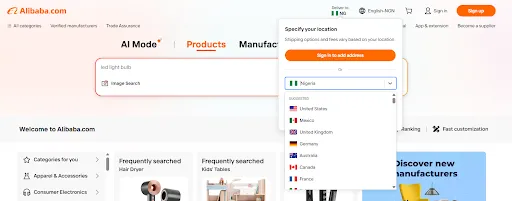
Sign up at alibaba.com using a business email address. This is needed to contact suppliers, place orders and track shipments. Make sure to change the delivery location to your country so you can see local pricing and accurate shipping information.
Step 2: Search for products and find suppliers
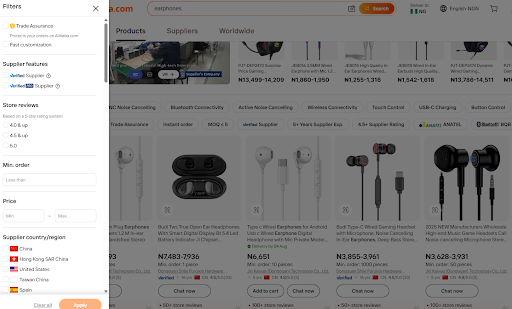
Use Alibaba’s search bar with detailed keywords for the products you want. Filter by minimum order quantity (MOQ), supplier badge (Verified, Gold, Trade Assurance), country of origin and certifications.
Image search is also available where you click the camera icon on the search bar to upload a reference photo and find similar products. This feature can be useful when the product name is unclear or the listing language is technical.
Step 3: Contact suppliers and negotiate
Shortlist two or three suppliers and reach out to them directly through Alibaba’s contact feature. Introduce your business briefly, share what you’re looking for (specifications, quantity, customisation, branding), and ask for their best price per unit. Listing prices are rarely final and most suppliers expect negotiation, particularly at higher MOQs.
But before committing to bulk, ask for samples and keep in mind that sample prices are usually higher per unit, but the cost is minor compared to discovering quality issues on a full order.
Step 4: Place the order and pay
Once terms are agreed, place the order through the supplier’s product page. Alibaba supports several payment methods for international buyers:
- Telegraphic transfer (T/T) / international wire
- Credit or debit card
- PayPal: where the supplier accepts it
- Apple Pay, Google Pay, ClearPay, AfterPay
For Trade Assurance suppliers, the payment is held in escrow until the buyer confirms receipt. Depending on supplier terms, a deposit (30-50%) is typically required upfront with the balance paid on delivery or shipping.
Step 5: Manage shipping
Alibaba suppliers usually ship internationally, including to African markets. Shipping methods vary by supplier and product:
- Air freight: Faster (5–10 working days) but more expensive per kg, suitable for low-volume, high-value goods
- Sea freight: Cheaper for bulk shipments but slower (25-45 days to most African ports), with additional customs clearance time
- Express courier: Fast but expensive, used for samples and small shipments
Shipping fees are usually quoted by the supplier or visible on the product page. Alibaba’s “free shipping” listings typically apply only to specific products.
There can be customs duties, VAT and local clearance fees applied at the destination so make sure to verify these with the local customs authority before placing the order.
Paying Alibaba suppliers with the World Card
The World Card is a Mastercard-powered business payment card that works on Alibaba checkout, supporting transactions in over 150 currencies. It’s linked to the World Account, a multi-currency account from WorldFirst that lets businesses hold funds in 15+ currencies, including USD and CNH.
When you pay for an Alibaba order, the card draws from the matching currency balance in the World Account, so an Alibaba USD invoice comes out of your USD balance, and a CNH invoice comes out of your CNH balance. No separate wire transfer per order, and no fees when paying in any of the 15 supported currencies (with sufficient balance held in that currency).
Here’s how it works for Alibaba buyers:
- Pay Alibaba listings directly with the World Card wherever the supplier accepts card payment. Issue up to 20 cards at no extra cost, with no fees when paying in any of the 15 supported currencies (with sufficient balance held in that currency)
- Hold USD or CNH in the World Account so the card always has the right currency to draw from — and avoid double conversion when paying CNH-priced suppliers
- Pay larger orders by T/T (international wire) directly from a USD or CNH balance, when the supplier requires it
- Fund Alibaba purchases from marketplace proceeds. Receive USD, GBP and EUR payments from Amazon, Etsy and Shopify into the same account, and use them to pay suppliers — useful for resellers who source on Alibaba and sell on global marketplaces
For businesses also sourcing from 1688.com (the domestic Chinese version of Alibaba), the World Account links to World Pay — the authorised international payment provider for 1688.com.
FAQs
Does Alibaba ship to Nigeria, Kenya, Ghana and Morocco?
Yes. Most suppliers on Alibaba ship internationally, including to major African destinations. The available shipping methods, timelines and fees vary by supplier and product
Does Alibaba offer free shipping?
Free shipping on Alibaba is available but a default for all products. Some specific listings, usually samples or small low-weight items on certain shipping routes, may be offered with free shipping by the supplier. For most bulk B2B orders, shipping is quoted separately and depends on the freight method, weight, volume and destination.
This article is intended for informational purposes only and does not constitute legal advice or professional advice. This article should not be regarded as constituting an offer or a solicitation to buy or sell any regulated or financial products or services. WorldFirst makes no representations or warranties regarding the accuracy, completeness, or applicability of the content, and readers are encouraged to consult with legal professionals or other professionals for advice tailored to their specific situation. WorldFirst does not guarantee the accuracy and completeness of this article and expressly disclaims any and all liability to any person in respect of the consequences of anything done or omitted to be done wholly or partly in reliance on this article.