





























Home > blog > Global Business Tips > Gross profit formula: How to measure your business profitability
Gross profit formula: How to measure your business profitability
Last update:


Gross profit is one of the most important metrics in your business. It shows how efficiently you turn sales into profit – and whether your pricing, sourcing and production costs actually make sense.
But once you start operating internationally, gross profit becomes more complex.
On paper, the formula is simple: revenue minus cost of goods sold (COGS). But global businesses also have to deal with currency fluctuations and cross-border payments – all of which can quietly chip away at margins if you’re not careful.
In this guide, we’ll walk through the gross profit calculation and the difference between gross profit and gross profit margin.
We’ll also explain how a multi-currency account like WorldFirst’s World Account can help you control costs and protect your margins as you grow globally.
Want to simplify your global finances? Open a World Account for free.
What is gross profit? (And how to calculate it)
Gross profit is the amount of money your business keeps after paying the direct costs of producing your goods or delivering your services. It’s calculated before you factor in indirect costs like marketing spend, office rent or admin salaries. You might also hear it called gross income or sales profit.
It’s important not to confuse gross profit with net profit. Gross profit only considers costs directly tied to producing what you sell. In contrast, net profit (also called net income) includes all expenses, from advertising and software subscriptions to insurance and office salaries. Think of it this way:
- Gross profit focuses on production efficiency
- Net profit reflects your overall operational efficiency and profitability
If gross profit is weak, cutting overhead costs won’t fix the problem. It usually means your pricing, sourcing or production costs need attention.
Gross profit formula: The step-by-step guide
The basic gross profit formula is simple:
Gross profit = Revenue – Cost of goods sold (COGS)
That doesn’t change just because you operate internationally. What does change is how you calculate each part of the equation. To get an accurate picture of your company’s gross profit, both revenue and COGS need to be converted consistently into your base currency.
Let’s break it down step by step.
Step 1: Calculate your sales revenue
Start by adding up all the income your business earned during a specific period, whether that’s monthly, quarterly or annually. This can include product sales, service fees, subscriptions and any other core revenue streams. This is your total revenue.
Any sales made in foreign currencies should be converted into your base currency using the exchange rate at the time of sale.
Do not include any foreign exchange (FX) gains from delayed conversions or interest income. For example, if you invoiced a client €10,000 in November and received it in December when the exchange rate to GBP improved, the extra money gained from that change shouldn’t be counted as revenue. It’s an FX gain.
Finally, subtract returns, refunds and allowances to arrive at net revenue (or net sales).
In short: Net revenue = Sales income – Returns, refunds, sales allowances
Step 2: Determine your cost of goods sold
Next, you need to work out how much it actually costs to produce what you sold.
COGS includes all direct costs required to produce your goods or services, such as:
- Direct materials (raw materials, components, packaging)
- Direct labour (production or manufacturing wages)
- Production overheads (factory utilities, equipment depreciation, production facilities)
For international businesses, supplier payments and production costs should be converted into your base currency using the exchange rate at the time of payment.
Do not include indirect costs like:
- Office rent or utilities
- Marketing and advertising spend
- Sales or admin salaries
- Insurance or professional fees
Be aware that banking fees, transfer costs and FX charges and losses do not belong in COGS. Those sit under operating expenses and aren’t reflected in your gross profit.
Step 3: Apply the gross profit formula
The final step is to subtract COGS from revenue:
Gross profit = Net revenue – COGS
For example: £500,000 revenue – £300,000 COGS = £200,000 gross profit
This figure shows how much your business earns from production before overheads – and will be used to calculate your gross profit margins.
Gross profit vs. gross profit margin
While gross profit is an absolute number, your gross profit margin puts that number into context by showing how much gross profit you keep from each pound of revenue. The formula is:
Gross profit margin = (Gross profit ÷ Revenue) × 100
So, if your gross profit is £200,000 on £500,000 in revenue:
£200,000 ÷ £500,000 × 100 = 40% gross margin
This means your business keeps 40 pence of gross profit for every £1 of sales.
It’s important to note that you can grow both revenue and gross profit at the same time and still see your gross profit margin shrink. This happens when production or delivery costs rise faster than your prices. Over time, declining margins can quietly put serious pressure on your business.
How WorldFirst helps international businesses lower COGS and optimise gross profit
When you operate across borders, small inefficiencies add up quickly. Unfavourable exchange rates, forced conversions and slow international transfers can all increase COGS without you noticing – until margins start to slide.
The World Account from WorldFirst is a multi-currency business account designed to help international businesses collect, hold, convert and pay money more efficiently.
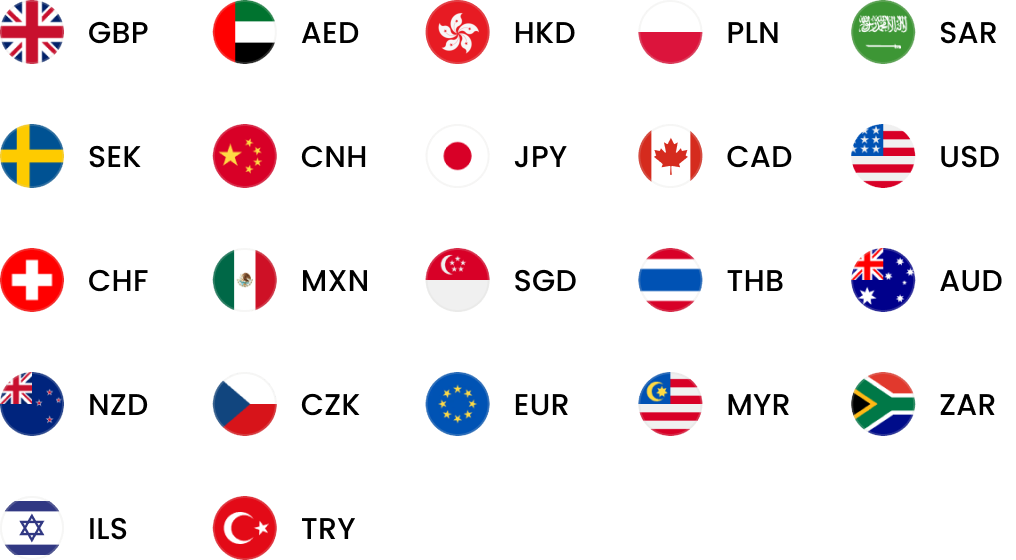
With a World Account, you can hold and receive funds in over 20 currencies, collect revenue in your customers’ local currencies and pay suppliers in more than 100 currencies worldwide — all from one single platform.
Here’s how you can use it to protect your gross profit:
Lock in lower costs and reduce FX-driven changes in COGS
When you pay overseas suppliers, exchange rate movements can make your costs feel unpredictable. One month, a standard order costs £100. The next, it’s £120 – not because your supplier raised prices, but because the exchange rate changed.
While FX gains and losses shouldn’t be included in revenue or COGS calculations, the exchange rate you use at the time of the transaction absolutely affects what your costs are in pounds. If you don’t control that rate, your cost of goods sold can swing from one period to the next, making margins harder to forecast and budgets harder to trust.
WorldFirst helps take the guesswork out of international business payments by giving you more control over payment costs. You can send money in 100+ currencies to 200+ countries and territories, with transparent, low fees that make costs easier to predict. Currency conversion fees are capped at 0.50%, payment fees are low and flat and payments to other World Accounts are completely free.
Even better, you can hold funds in 20+ currencies. This means you can convert money into a supplier’s currency when the rate works for you, then pay later without reconverting at a potentially worse rate. The rate is locked in at the point of conversion – not at the point of payment.
For more control, WorldFirst also offers advanced FX tools:
- Forward contracts to lock in rates for up to 24 months
- Firm orders that convert automatically once the exchange rate hits your target rate
- Spot contracts for immediate conversions at live market rates
These tools help you choose and fix the exchange rate at the time of the transaction, reducing volatility and making costs more predictable.
Read more: Foreign exchange risk management: How to make international business more affordable
Strengthen supplier relationships with faster international payments
If you’ve ever dealt with slow, costly SWIFT transfers, you know how quickly they can become a bottleneck. Delayed payments can stall production, create uncertainty for suppliers and even weaken your negotiating power when it comes to pricing or terms.
With WorldFirst, you can pay suppliers in their preferred currency using local payment rails, with 80% of transfers arriving the same day. Transfers between WorldFirst accounts are also instant, which is especially powerful if you have partners in China, where more than 150,000 suppliers already use WorldFirst.
Plus, with our direct integration with 1688.com – one of China’s largest wholesale marketplaces – you can pay suppliers instantly from your World Account.
Why does this matter? Faster, more reliable payments strengthen supplier relationships. And stronger relationships often mean better pricing and terms, which can lower COGS and improve gross margins for your business.
Read more: How to make same-day international money transfers as a cross-border business
Increase financial visibility to protect margins and forecast gross profit accurately
Juggling multiple currencies across different banks makes it difficult to keep a clear picture of your financial health. Balances live in different places, cash flow forecasts feel like educated guesses and calculating gross profit takes longer than it should. All of that slows decision-making and increases the risk of budgeting mistakes.
With WorldFirst, instead of hopping between accounts, you get real-time visibility into all your currency balances from one online dashboard. This makes it much easier to track performance and understand your true gross profit.
Our platform also integrates with accounting tools like Xero and NetSuite, automatically syncing transactions so your reports stay accurate without extra manual work. On top of that, shorter settlement cycles mean fewer outstanding invoices, smoother reconciliation and less room for errors.
When money moves faster and data is cleaner, cash flow becomes easier to forecast and budgets become more reliable. That helps you avoid surprises and keep your business running smoothly.
Read more: How to pick the best online business bank account (12 options)
Take control of your gross profit in global markets
Calculating gross profit is simple on paper – but managing it across borders requires the right tools. By reducing FX risk, simplifying international payments and improving financial visibility, a World Account helps international businesses protect margins and scale with confidence.
Whether you’re sourcing overseas, selling globally or doing both, WorldFirst helps ensure you keep more of what you earn, so your business can scale without leaving profit behind.
Continue reading


Subscribe
The Weekly Dispatch
Get the latest news and event invites. Signup for our weekly update from the worlds of fashion, design, and tech.