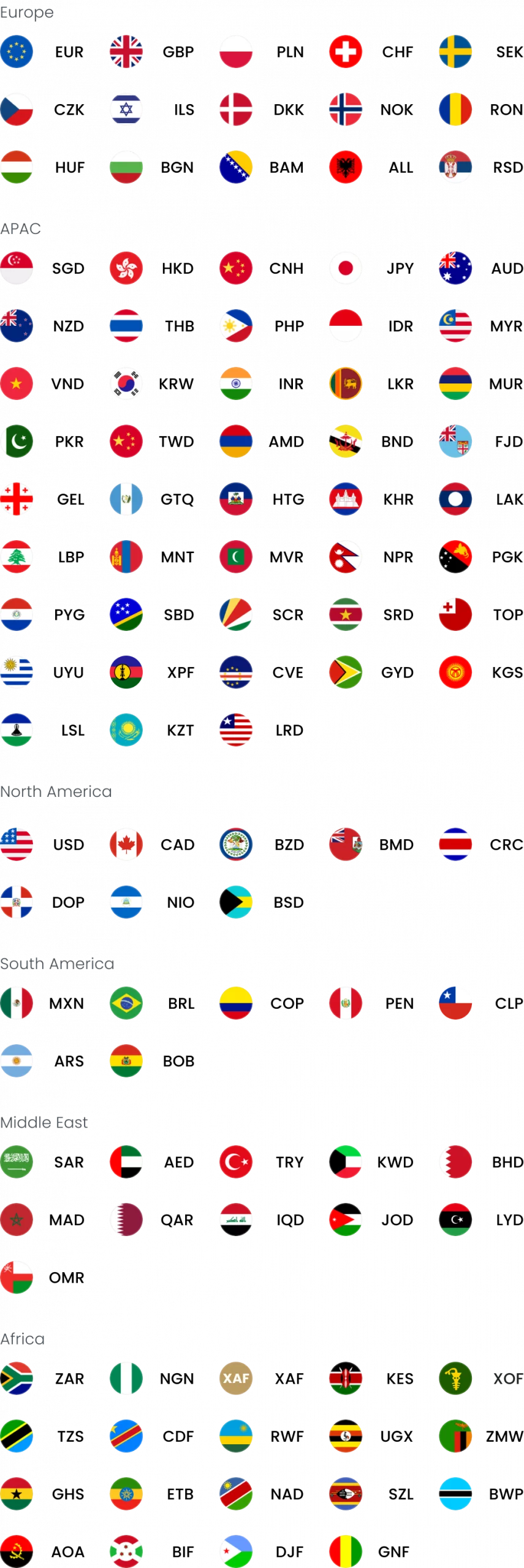
We provide coverage in South Asia and Middle East: servicing 210+ countries and territories.

WorldFirst Home > blog > Global Business Tips > Wise vs Revolut: Fees, FX rates and features compared
Wise vs Revolut differs in how each platform prices international payments, applies FX rates and handles ongoing business usage.
Wise uses the mid-market rate with a transparent transfer fee, while Revolut applies a plan-based structure in which costs vary by limits, markups and timing. For UK businesses, these differences directly impact margins, cash flow and cost predictability.

This guide compares Wise vs Revolut across fees, FX rates and key features, showing how each option performs in real business payment scenarios.
It also explains how WorldFirst fits into this conversation as a trusted provider for multi-currency accounts and international business payments in the UK.
Here’s how Wise and Revolut compare across the features that matter most:

Wise is a London-based company founded in 2011, built to make international payments simpler and more transparent for businesses.
Wise is listed on the London Stock Exchange and serves millions of customers globally, which shows how widely it’s used for international payments.
Key features:
Considering other options similar to Wise? Check out our full guide to the best Wise alternatives and find the right fit.
Revolut is a London-based company founded in 2015 that aims to combine international payments with a wider set of financial tools.
Revolut serves tens of millions of customers globally and operates with banking licenses in multiple regions, which support its expanded financial offering.
Key features:
Read more:
While both Wise and Revolut offer multi-currency accounts, the difference is in how you hold, receive and manage currencies in daily business operations
Wise provides a multi-currency account built for international payments.
You can:
Revolut also offers a multi-currency account, with a wider set of financial features inside one platform.
You can:
The UK aligns with the G20 target to reduce cross-border payment costs to below 3%. However, current averages remain higher, making the fee structure a key factor in choosing a provider.
Wise uses a pay-per-transfer model.
You pay a fixed fee plus a variable percentage based on the currency and amount, with pricing starting from around 0.41% of the transfer value for some routes.
The exchange rate is the mid-market rate with no markup and you always see the full cost before sending.
Revolut takes a different approach. Pricing depends on your plan and how much you use it.
Transfers can include a percentage-based fee that, in some cases, reaches up to 5% of the transfer amount or a fixed fee (up to about US$10 for smaller transfers), whichever is higher.
Exchange rates drive most of your total cost, often more than fees.
Data from the World Bank shows that cross-border payments cost around 6% on average globally, with a large share coming from FX margins built into the exchange rate rather than shown separately.
Wise uses the mid-market exchange rate, the same rate you see on Google or other public sources, with no markup added.
Instead, Wise charges a separate, clearly stated fee, so the exchange rate itself stays transparent.
What matters most:
Revolut uses its own exchange rate structure, which can include markups depending on your plan, usage and timing.
For currency exchanges within the app:
If your business pays overseas suppliers, receives revenue in foreign currencies or regularly converts money, even small differences in exchange rates can affect your margins.
Example:
According to the Bank for International Settlements, only around 35% of global cross-border payments are credited within one hour, showing how delays still affect many international transfers.
Wise often avoids traditional SWIFT routing by using local settlement systems where possible.
Typical transfer times:
Revolut uses a mix of local payment networks and SWIFT, depending on the route.
Typical transfer times:
Cards are increasingly used for everyday international spending, making their FX handling and withdrawal terms important for businesses.
Wise offers the Wise Multi-Currency Card, linked directly to your account balances.
What to expect:
ATM structure:
Revolut offers a range of cards depending on your plan.
Available options:
Higher-tier plans (like Premium and Metal) include additional card features and higher usage limits.
ATM structure:
Both Wise and Revolut provide secure, regulated environments for international payments.
According to the Association for Financial Professionals, 79% of organisations report payment fraud attempts, which shows how exposed businesses can be when sending money internationally.
Wise focuses on safeguarding customer funds and securing transfers.
Wise does not lend your money. It keeps customer funds with established banking partners such as Barclays and JPMorgan Chase, in accordance with safeguarding requirements.
Revolut combines bank-level protection with app-based security controls.
Revolut stores customer funds with partner banks such as Lead Bank and Sutton Bank and provides FDIC insurance up to US$250,000 per bank, per applicable region.
For your business, both are secure, but Wise focuses on protecting your funds, while Revolut gives you more control through app features and real-time alerts.
As your business grows, these limitations become more noticeable:
You may need:
Wise works well for businesses that want transparent pricing and straightforward international transfers. Revolut works best for companies that want payments combined with cards, spending tools and additional account features.
Both cover the basics. A WorldFirst goes further.
WorldFirst is not a bank but a regulated payments provider that offers a multi-currency World Account and international payment solutions for businesses operating across markets.
It supports businesses that regularly operate internationally and need control, consistency and a clear structure for managing payments and currencies.
How a World Account supports your business:
| Feature / capability | Wise | Revolut | World Account |
|---|---|---|---|
| Currencies you can hold | 40+ | Multiple | 20+ with full control over conversion timing |
| Currencies you can pay | 160+ countries | 140+ countries | 100+ currencies to 200+ countries |
| FX structure | Mid-market + fee | Plan-based with limits | Clear, consistent FX margins |
| FX control | Limited (convert at transaction) | Limited (depends on plan) | Full control over when to convert |
| Local receiving accounts | Yes (major currencies) | Available, varies | Major markets (UK, US, EU, AU and more) |
| Transfer routing | Often local rails | Local + SWIFT mix | Global network with predictable delivery |
| Best for | Transparent transfers | Flexible account features | Businesses scaling internationally |
In conclusion, choose a World Account if you:
Open a World Account today for free and simplify how your business handles global payments, currencies and costs.
It depends on how you use them. Wise offers more predictable pricing on every transfer, while Revolut can be cheaper within plan limits but may cost more once you go over them.
Wise uses the mid-market rate with no markup and adds a clear fee. Revolut offers competitive rates within its limits, but applies markups once you exceed them or convert at certain times.
No. Both are regulated financial institutions, but neither is a traditional bank. They focus on payments and currency services rather than lending.
Sources:
Jennifer Dodd leads marketing for WorldFirst UK, and has over 20 years' experience in financial services and publishing.
Jennifer Dodd
Author
Choose a product or service to find out more
Save money, time, and have peace of mind when expanding your global business.
© 2026, Ant International or its affiliates
It looks like you're sending money to family or friends — that's a personal transfer, which is best handled through our app.
Sending money to family or friends? Download our app for the best experience.