



























While cross-border trade opens growth opportunities, expanding internationally creates a compounded financial drag through invisible payment friction.
UOB’s 2026 Malaysia study found that rising operating expenses affected nearly 3 in 10 businesses, while one in three were taking steps to reduce costs. For an established importer, reducing FX costs starts with identifying which parts of the payment flow add cost and which can be changed.
This article explains how to reduce FX costs on international supplier payments through clearer pricing, fewer conversions, better route selection and planned conversion timing.
Key takeaways
- Foreign‑exchange costs are more than a single transfer fee: They combine exchange‑rate margins with layered bank and platform charges that affect every cross‑border payment a Malaysian SME makes
- Understanding each fee component in your total FX rate is essential for control: Markups, transfer fees, intermediary bank charges, receiving fees and multi‑conversion markups can all be measured, challenged and optimised once they are visible
- Practical operational changes can reduce FX costs: Auditing payment flows, avoiding unnecessary conversions, matching foreign inflows and outflows, using local clearing systems, and planning conversion timing all help protect margins
- WorldFirst World Account increases control over cross‑border payments: Malaysian importers can review FX rates and fees in one place, hold and convert multiple currencies as needed, and manage international supplier payouts through faster local payment routes where available
Open a World Account to gain clearer FX pricing and better control across every international transaction.
What are FX costs?
Foreign exchange (FX) costs are the amounts your business pays when converting one currency into another. Whether you’re paying an overseas vendor, making purchases with a credit card abroad, or transferring money internationally, FX costs are rarely just a single flat fee.
In practice, FX costs combine the exchange rate margin embedded in the quoted rate and all associated conversion and payment charges, including transfer fees, intermediary bank fees, and beneficiary receiving fees.
How do FX costs affect businesses?
Higher FX costs increase the MYR amount needed for supplier deposits, production balances and final settlement. That can reduce the margin on imported stock or create an additional cash requirement before the payment date.
Exchange-rate changes can also make order costs harder to forecast. If the final balance costs more than expected, you may need to absorb the difference or adjust the selling price after the goods arrive.
Which costs make up an international FX payment?
Most supplier payments combine a currency-conversion cost with charges linked to the payment route. Review each component separately rather than relying on the transfer fee alone.
| Cost component | How it appears | Effect on your supplier payment | What to check |
| FX margin | Included in the quoted exchange rate | Increases the MYR needed to buy the supplier’s currency | Compare the quoted rate and total MYR debit |
| Transfer fee | Added before you approve the payment | Increases the amount paid by your business | Check whether the charge is fixed or percentage-based |
| Intermediary charge | May be deducted as the payment passes through correspondent banks | Can reduce the amount reaching the supplier | Check the charge instruction and expected received amount |
| Receiving-bank charge | May be deducted by the supplier’s bank | Can leave part of the invoice unpaid | Ask the supplier about possible recipient-side charges |
| Repeated conversion | Applies when funds move through unnecessary currencies | Adds another FX margin to the payment flow | Map every conversion from receipt to supplier settlement |
The total cost is the MYR amount debited from your account compared with the amount credited to your supplier. Use that comparison when reviewing providers or payment routes.
How to reduce FX costs for your SME: step-by-step guide
The following seven steps outline the key parts of your payment process that directly influence the total FX cost your business actually pays.
Step 1: Audit how you currently pay and receive in foreign currencies
Before changing providers or products, you need a clear picture of how FX shows up in your current operations. To gain that clarity, you should:
- Map your main currencies: which ones you pay suppliers in (USD, CNY/CNH, EUR, etc.) and which ones you receive in
- List payment methods: local bank transfers via SWIFT, card payments, marketplace payouts, wallets, etc.
- Capture real costs: for a few recent payments, note the rate used, transfer fee, any intermediary/receiving bank fees, and the final amount the supplier received
- Identify patterns: look for repeated “short‑payments”, automatic conversions into MYR, or corridors that are consistently more expensive
This audit becomes your baseline for measuring any improvement in FX costs.
Step 2: Reduce automatic and repeated currency conversions
Many importers lose money because funds are converted multiple times without anyone actively deciding when or how. To avoid that mistake:
- Receive payments and hold funds in the original currency when you know you will pay suppliers in that same currency.
- Avoid auto‑conversion where possible (for example, marketplace payouts that immediately convert everything into MYR).
- Review flows where revenue is converted into MYR and then back into USD/CNY for supplier payments, and remove this double‑conversion loop.
- Ask providers to explain any default conversion rules applied to your account and how to change them.
Step 3: Match foreign inflows with foreign outflows
Established importers often have natural hedges they are not using: foreign‑currency income that could fund foreign‑currency expenses. To make better use of foreign-currency inflows, you should:
- Identify any foreign‑currency receivables (for example, export sales or marketplace payouts) that can be left in their original currency.
- Use foreign‑currency balances to pay overseas suppliers in the same currency instead of converting to MYR and back again.
- Align payment terms and invoicing currency, if possible, so that major outflows match major inflows.
- Monitor net positions by currency (USD, EUR, CNH) to avoid holding more than you realistically need.
This reduces the number of conversions and helps stabilise the effective FX cost on your trade cycle.
Step 4: Route payments through local clearing systems over standard SWIFT
Relying only on SWIFT can add intermediary bank fees and make delivery less predictable. You can reduce unnecessary fees and delays if you:
- Use local clearing systems for major trade corridors (for example, ACH in the US or SEPA in Europe) via a multi‑currency account.
- Reserve SWIFT for corridors where no local alternative exists or where specific delivery requirements apply.
Using domestic rails where possible reduces layered fees and can improve supplier experience.
Step 5: Require upfront rate transparency before trade execution
Importers often accept FX pricing without seeing how the rate and fees are built up. To make FX costs easier to understand:
- Ask the provider to show the FX margin to a recognised market rate, not just the final rate.
- Request a clear quote that includes: the rate, all sending fees, expected intermediary charges (if known), and any receiving fees.
- Compare quotes for a few standard payment sizes (for example, US10,000) across providers, not just one‑off transfers.
Step 6: Move from reactive to planned conversion timing
Last-minute conversions can make the final MYR cost harder to forecast. Review your supplier payment calendar and identify confirmed deposits and balances before they fall due.
A few details you should pay attention to include:
- Rate alerts: Be notified when a selected currency pair reaches your target level. You still decide whether to convert.
- Firm orders: Where available, instruct the provider to execute the conversion if the selected rate is reached before the order expires.
- Forward contracts: Where available and subject to eligibility, secure a rate for a confirmed future payment amount and date.
Use these tools for known supplier obligations rather than trying to predict the market’s best point. The goal is a more reliable cost for the order, not a guaranteed saving.
In the video below, we explain how to get a better FX rate with rate alert and firm order:
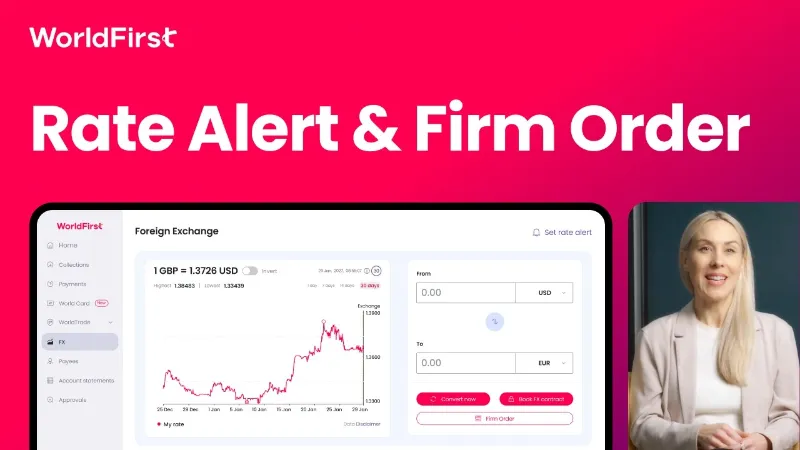
How to Get a Better FX Rate with Rate Alert and Firm Order | WorldFirst Tutorial
Step 7: Use multi‑currency platforms built for international commerce
A multi-currency account can bring currency balances, conversions and supplier payments into the same workflow. When comparing your options, you should:
- Choose providers that show the FX rate and margin clearly before you confirm each conversion or payment. This allows you to compare pricing, apply internal approval rules, and avoid accepting unfavourable rates by default.
- Choose a platform that shows the full conversion cost in real time, including the exchange rate used and any transaction fees. Clear, on‑screen visibility makes it easier for finance teams to monitor trends and challenge unexpected charges.
- Use solutions that integrate with your accounting or ERP tools so that FX conversions, payments and balances flow directly into your existing processes. This reduces manual reconciliation work and helps your team track currency exposure and costs at a glance.
A multi‑currency platform with these capabilities allows established importers to manage FX as an integrated, well‑governed part of their international payment and cash‑flow process, rather than as a set of ad‑hoc decisions.
How the World Account can reduce unnecessary FX conversions
You have a US$50,000 supplier order. The US$15,000 deposit has already been paid, and the remaining US$35,000 is due in 60 days before shipment.
Your business also holds US$12,000 from marketplace sales. Converting that income into MYR and later buying USD for the supplier would create two separate FX transactions.
With a World Account, you can keep the US$12,000 in USD and put it towards the supplier balance. You then need to convert only the remaining US$23,000, reducing the amount exposed to another FX margin.
Before approving the conversion and payment, review:
- The exchange rate for the remaining US$23,000
- The total MYR debit
- The payment charge
- The amount intended for the supplier
- The expected delivery date
Depending on availability and eligibility, you can compare the spot rate with other FX tools for the confirmed balance. The World Account supports international payments in 100+ currencies to 210+ countries and territories.
WorldFirst isn’t a bank. Ant International has received approval from Bank Negara Malaysia to operate WorldFirst in Malaysia under a Class A Money Services Business licence. WorldFirst provides cross-border payment and multi-currency account services for businesses.
Open a World Account to put foreign-currency income towards supplier costs and convert only the balance your next order requires.
FAQs
1. What is the difference between the mid-market rate and the rate the bank offers?
The mid-market rate (also known as the interbank rate) is the real-time midpoint between global buy and sell prices for a currency—the rate you see on financial news sites or Google.
Consumer banks and traditional providers rarely offer this rate to SMEs. Instead, they add a percentage markup (often 1% to 3%+) to the exchange rate. This markup represents a hidden fee that directly increases your conversion cost.
2. Why can SWIFT transfers cost more than local payment routes?
SWIFT transfers travel through a network of international correspondent banks. Each bank handling the transfer along the route may deduct its own intermediary processing fee from the principal amount, causing unpredictable total costs and delays.
3. How does Dynamic Currency Conversion (DCC) work, and why should businesses avoid it?
Dynamic Currency Conversion occurs when a credit card terminal or foreign e-commerce checkout offers to charge you in your home currency rather than the local currency of the seller. While it may seem convenient to see the price in your domestic currency, the merchant’s point-of-sale system applies its own inflated exchange-rate markup—frequently between 3% and 7%.
4. How should an importer record FX costs on supplier payments?
Keep the supplier invoice, provider quote, payment confirmation, amount credited and any realised exchange-rate difference. These records give your accountant the information needed to classify the cost correctly.
Disclaimer:
This article is intended for general informational purposes only and does not constitute legal or professional advice. WorldFirst makes no representations or warranties regarding the accuracy, completeness, or applicability of the content, and readers are encouraged to consult with legal professionals or other professionals for advice tailored to their specific situation. WorldFirst does not guarantee the accuracy and completeness of this article and expressly disclaims any and all liability to any person in respect of the consequences of anything done or omitted to be done wholly or partly in reliance on this article.
Sources:
- https://www.uobgroup.com/asean-insights/articles/uob-business-outlook-study-2026-malaysia-h1.page
- https://www.thestar.com.my/business/business-news/2026/06/24/malaysia039s-onshore-fx-market-remains-healthy-daily-turnover-rises-to-us213bil
![TIN number (Tax Identification Number) in Malaysia [2026]: A guide](https://mdn.marmot-cloud.com/worldfirst/sites/10/2026/10/20261022193456868-300x206.webp)

![Public Bank USD account review [2026] Malaysia: Features, fees and more](https://mdn.marmot-cloud.com/worldfirst/sites/10/2026/10/20261021125931797-300x200.webp)
![CIMB USD account review [2026] Malaysia: Features, fees and more](https://mdn.marmot-cloud.com/worldfirst/sites/10/2026/10/20261021124553858-300x200.webp)
![Maybank USD account review [2026] Malaysia: Features, fees and more](https://mdn.marmot-cloud.com/worldfirst/sites/10/2026/10/20261021122232497-300x200.webp)