





























A China supplier invoice rarely shows the full cost of your order. By the time you compare USD, CNH, transfer fees, FX margins and recipient charges, the MYR amount you need to send to Chinese suppliers can move beyond the price you first agreed on.
That matters when you are placing an early China order from Selangor, testing products for a KL ecommerce store or sourcing 1688 items for customers in Johor.
You need to know which currency to use, which payment route fits the invoice and how to keep records clear if anything changes.
China already plays a major role in Malaysia’s import activity. MATRADE reported that Malaysia’s trade with China reached RM49.04 billion in March 2026, while imports from China increased to RM31.79 billion that month.
Here’s how to pay China suppliers from Malaysia, what to check before sending money and how WorldFirst can help you manage supplier payments from one multi-currency account.
Key takeaways:
- Check the supplier before you send money: Match the supplier name, invoice details, business licence and bank account information so you know you are paying the right business for the right order
- Choose the payment route based on order size and trust level: Alibaba orders, 1688 purchases, bank transfers, cards and multi-currency accounts each suit different situations
- CNH, CNY, USD and MYR do not work the same way: CNH can support cross-border RMB payments, mainland China uses CNY for domestic payments, USD is common on export invoices and MYR quotes may already include conversion costs
- Compare the final MYR cost before paying: A cheaper invoice can become more expensive once FX rates, transfer fees, recipient charges and supplier pricing buffers affect the final amount
- WorldFirst can help Malaysian importers manage China supplier payments from one place: With World Account, Malaysian businesses can manage supported China supplier payments in one place, from currency conversion and eligible supplier transfers to 1688 World Pay purchases and payment records
What to check before paying a China supplier
Before sending money, make sure the supplier details, invoice and order terms all match.
The goal is to confirm that you are paying the right business for the right order. Check these details first:
- Supplier legal name: The company name should match across the invoice, business licence, platform profile or contract. If the bank account uses a different name, ask for a written explanation before paying.
- Business licence and Unified Social Credit Code: Ask for the supplier’s business licence and Unified Social Credit Code. New importers do not need to review every legal detail, but the company name, registration details and invoice name should look consistent.
- Invoice details: Check the product description, quantity, unit price, total amount, payment terms, delivery terms and order reference. These should match what you agreed in chat, email or the platform order.
- Bank account details: Confirm the bank account through a trusted channel. If the supplier sends new payment details by email, check them through the original platform chat or your usual contact before sending money.
- Unclear or missing information: Pause if anything looks suspicious. A genuine supplier should be able to explain company details, invoice information and order terms before requesting payment.
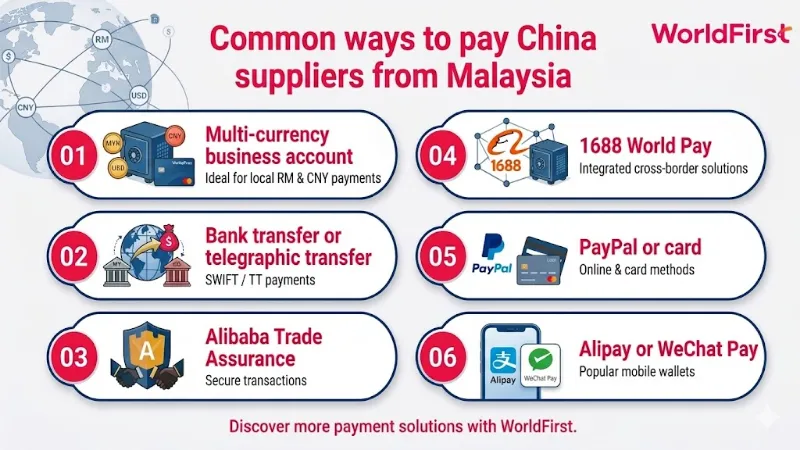
Common ways to pay China suppliers from Malaysia
New Malaysian importers and dropshippers do not need every payment route. The right choice depends on the platform, supplier relationship and order size.
1. Multi-currency business account
A multi-currency business account works well when sourcing from China becomes more frequent. It lets you hold balances, convert funds and pay suppliers from one place instead of handling every invoice as a separate bank transfer.
With WorldFirst’s World Account, Malaysian businesses can collect in 20+ currencies, send payments in 100+ currencies to 210+ countries and territories and keep supplier payments in one dashboard.
When to use:
It is most suitable for repeat supplier payments, e-commerce sourcing, dropshipping and testing several China suppliers.
2. Bank transfer or telegraphic transfer
A bank transfer, also called a telegraphic transfer, is a familiar route for larger supplier invoices. It gives both sides a clear banking record and works well when the supplier issues formal trade documents.
The main trade-off is cost visibility. Transfer fees, FX margins and intermediary bank charges can change the final amount your supplier receives.
When to use:
Use for larger supplier invoices, verified suppliers and orders where you need a clear banking record.
3. Alibaba Trade Assurance
Alibaba Trade Assurance can help when you buy through Alibaba.com, especially on your first order. Alibaba states that Trade Assurance provides secure payment methods and can help protect eligible orders in cases such as shipping or product quality issues.
Keep the order, product specs, messages and payment inside Alibaba’s process where possible. That gives you a cleaner platform record if the order is delayed or disputed.
When to use:
It is best for first Alibaba orders, sample orders and suppliers you have not worked with before.
4. 1688 World Pay
1688 can give Malaysian dropshippers and small importers access to China’s domestic wholesale market. The challenge is that many 1688 payment flows are built around China-based accounts and wallets, so overseas buyers may need a supported cross-border payment route before they can complete checkout.
WorldFirst’s 1688 World Pay lets you connect your World Account to 1688 and check out using your WorldFirst balance. That can make 1688 sourcing easier without relying on a sourcing agent or mainland partner.
When to use:
Use for 1688 sourcing, product testing, dropshipping and repeat purchases from China.
5. Limited-use options: PayPal, cards, Alipay and WeChat Pay
PayPal and card payments may work for low-value or one-off purchases if the supplier accepts them, but they are usually less practical for regular supplier invoices. Fees can be higher, supplier acceptance varies and the payment record may not match the invoice as clearly as a business transfer.
Alipay and WeChat Pay are widely used in China, but Malaysian importers should be careful when a supplier asks for wallet or personal-account payment.
When to use:
Use this route only when the supplier clearly documents how the account links to the business, invoice and order.
Read more: Top Chinese B2B marketplaces
Which currency should you use to pay China suppliers?
Currency choice can change the real cost of your order. A supplier may quote the same product in USD and RMB, but your final MYR cost can differ once FX rates, fees and supplier pricing buffers apply.
New Malaysian importers and dropshippers often compare CNH, CNY, USD and MYR before agreeing to a China supplier invoice:
1. CNH
CNH is an offshore RMB used for cross-border payments. It can work well when your supplier quotes in RMB and can receive CNH through a supported route.
RMB now plays a larger role in global payments, but it still requires the right account setup. SWIFT’s January 2026 RMB Tracker ranked RMB 6th globally by value in December 2025, with a 2.73% share.
If your supplier can receive CNH, compare that quote against the USD quote before you pay.
2. CNY
CNY is the onshore yuan used inside mainland China.
It typically applies to domestic transactions in China, but foreign buyers cannot always pay directly into domestic CNY accounts via standard international channels.
WorldFirst MY states that Malaysian customers can pay suppliers’ CNH bank accounts in Mainland China through the World Account, but cannot pay direct domestic CNY accounts in Mainland China.
3. USD
Many China suppliers quote overseas buyers in USD because international trade still relies heavily on the dollar.
Your final MYR cost still matters. A supplier may add a buffer to the USD quote, and your payment provider may apply an FX margin when you convert MYR to USD.
4. MYR
A MYR quote is easy to read, but it might already include a conversion from USD, CNH or CNY. That can make the price look simpler without making it cheaper.
Here’s a quick way to compare the main currency options before you agree to the invoice:
| Currency | When it makes sense | What to check |
| CNH | Supplier can receive offshore RMB | Confirm the supplier has a CNH account |
| CNY | Supplier mainly sells inside mainland China | Do not assume you can pay directly into a supplier’s domestic CNY account from Malaysia. |
| USD | Supplier quotes export orders in USD | Compare the total MYR cost after FX and fees |
| MYR | You want a simple ringgit price | Check if the quote includes a currency buffer |
The best currency is the one your supplier can receive and your business can price accurately in MYR before paying.
How to reduce FX costs when paying China suppliers
FX costs do not stop at the exchange rate. Bank Negara Malaysia reported daily FX turnover of US$17.81 billion on 5 June 2026, which shows how active Malaysia’s currency market is.
To keep costs under control:
- Ask for USD and CNH quotes: Compare the same product, quantity and delivery terms in both currencies before agreeing to the invoice
- Compare the total MYR cost: Check the exchange rate, transfer fee and amount your supplier should receive
- Avoid extra currency conversions: If your supplier can receive CNH through a supported route, compare that against paying in USD and leaving the supplier to manage another conversion
- Check fees before sending: Review transfer fees, conversion costs and any payment charges before you confirm the transaction
- Watch repeat orders closely: Small FX differences can matter when you reorder stock or test products with tight margins
- Confirm recipient-side charges: Ask if the supplier’s bank deducts incoming fees, so the supplier does not receive less than the invoice amount
How to pay China suppliers with WorldFirst
Once you have checked the supplier details and agreed on the invoice, you can make the payment through your World Account:
- Add the supplier as a payee: Go to Payees, select Add a new payee, choose Add a single payee and then choose Third-party account. Select a personal or corporate account based on the supplier’s account type
- Select the receiving currency: Choose CNH as the receiving currency for eligible supplier payments to Mainland China, then enter the supplier’s account details
- Add the payment purpose: Select the nature of services your supplier provided. Match this to the invoice, such as goods, manufacturing or OEM production
- Complete verification: Complete the Authy or SMS verification step to add the supplier as a payee
- Send the payment: Go to Payments > Send & Withdraw, choose the payee, enter the amount and select the payment purpose based on the trade with your supplier
- Confirm or schedule the transfer: Review the payment details, then send the payment right away or schedule it for later
How to pay suppliers on 1688 from Malaysia
To use World Pay on 1688, follow these steps:
- Set up your Alipay personal account: You need an Alipay personal account to verify your 1688 account opening
- Create a 1688 personal account: Register for a personal account on 1688.com. International buyers should choose 个人账户注册, which means personal account registration
- Verify your 1688 account with Alipay: Once the 1688 account shows the authenticated status, you can authorise it with WorldFirst
- Authorise 1688 inside WorldFirst: In your WorldFirst portal, go to Payments > World Pay, choose 1688, then select Authorise your 1688 ID. Enter the six-digit code sent to your mobile number
- Check your CNH balance: Open World Pay / 跨境宝 and check your available CNH balance. Top up from an external bank account or convert another currency balance into CNH if needed
- Choose World Pay at 1688 checkout: On 1688.com, select 担保交易 (secured transaction), then choose 跨境宝 / World Pay. WorldFirst will redirect you to its checkout page to complete the payment with your WorldFirst balance
The video below shows how to pay your 1688 supplier through World Pay:
Common payment mistakes when paying China suppliers
Payment mistakes usually happen when invoice details, supplier records or currency choices do not match before money leaves your account.
The most common mistakes include:
- Paying before checking the supplier name: Match the supplier name, invoice name and bank account name before sending money.
- Treating CNH and CNY as the same: Both relate to RMB, but they work differently for cross-border payments.
- Comparing only the invoice amount: A cheaper quote can end up costing more once FX, transfer fees and recipient charges apply.
- Moving payment records away from the order: Keep supplier messages, invoices, order terms and payment confirmations in one place whenever possible.
- Paying a personal wallet for a business order: Ask for paperwork that links the wallet to the supplier and the order.
- Ignoring sudden account changes: Confirm any last-minute bank detail changes through the original platform chat or your usual supplier contact.
- Paying more upfront than the order justifies: Match deposit amounts to the supplier relationship, order value and production stage, especially when working with a newer factory or product line.
When these mistakes happen, your payment can be delayed, returned or matched to the wrong order. That can slow down production, create extra supplier follow-ups and make a dispute harder to support later.
Pay China suppliers with WorldFirst from Malaysia
Paying China suppliers gets easier when you can see the currency, cost and payment details before money leaves your account. That matters most when you are placing an early China order, testing products from 1688 or Alibaba or trying to protect margin before you reorder stock.
WorldFirst isn’t a bank. It is a regulated financial services provider that helps businesses manage multi-currency accounts, international payments and FX.
With a World Account, Malaysian businesses can manage supported supplier payments, compare currency options and use 1688 World Pay for eligible 1688 purchases.
FAQ
1. How much deposit should I pay a China supplier?
2. What should I do if my China supplier changes bank details before payment?
3. Can I get my money back if a China supplier does not ship my order?
Sources:
- https://www.matrade.gov.my/en/about-matrade/press-release/trade-exports-and-imports-in-the-first-quarter-q1-of-2026-remained-on-an-upward-trajectory-registering-highest-value-ever-for-q1-despite-ongoing-global-uncertainties
- https://www.swift.com/sites/default/files/files/rmb-tracker_january-2026.pdf
- https://financialmarkets.bnm.gov.my/data-download-daily-fx-turnover