























We provide coverage in South Asia and Middle East: servicing 210+ countries and territories.
Home > blog > Global Business Tips > What Is a Bank Routing Number? Everything You Need Before Sending Money to the US
A clear guide to US routing numbers for businesses paying suppliers, marketplaces, and service providers in USD.
Key Takeaways
A bank routing number is a nine-digit code that identifies a US bank when money moves between accounts inside the United States. If you pay US suppliers, software providers, freight companies, or marketplaces, you will meet this term the moment you set up a payment. This guide explains what routing numbers are, when you need one, and how they differ from SWIFT and IBAN.
A bank routing number is a nine-digit code that identifies the specific US financial institution responsible for moving money between accounts inside the United States.¹ It works like an address for your payment, directing funds to the correct bank before they reach the individual account number.² Every bank or credit union in the US holds at least one routing number.
The system dates back to 1910, when the American Bankers Association created it to sort and route paper cheques between banks.³ Because of that origin, routing numbers are also called ABA routing numbers or routing transit numbers (RTN). Today around 22,000 active routing numbers are in use, all managed within the US Federal Reserve system.⁴
Larger banks often hold several routing numbers. A single bank may use one number for a given region and another for a different transfer type, so the correct number depends on both where the account sits and how the payment is sent.⁵
Businesses need a routing number whenever they send money to, or receive money into, a US bank account through domestic payment rails. Without the correct nine-digit code, a US-side payment cannot be routed and will either bounce back or stall.
For an importer in Lagos paying a US freight forwarder, or a Casablanca exporter settling a US software subscription, the routing number is the piece of information the US bank asks for first. A wrong routing number is one of the most common causes of failed or delayed US payments, which is why suppliers usually send it alongside their account number on an invoice.
If you regularly pay US companies, you can avoid the friction of international wires by using local US account details of your own. A multi-currency business account gives you a way to hold and move USD, so you pay through US domestic rails rather than routing every payment through the SWIFT network.
A routing number is required for any transaction that travels through the US domestic banking system. Common situations include direct deposits, recurring bill payments, and both ACH and wire transfers between US accounts.⁶
There are two main US-domestic methods, and they behave differently:
| Transfer method | Typical use | Speed | Routing number type |
| ACH | Recurring payments, marketplace payouts, direct deposits | 0 to 3 working days | ACH routing number |
| Wire (Fedwire) | Urgent or high-value one-off payments | Same day or next working day | Wire routing number |
| SWIFT / international wire | Cross-border payments in or out of the US | 1 to 6 working days | SWIFT code (not a routing number) |
| Cheque | Paper payment, increasingly rare for trade | Several days | ABA routing number |
This table is for general guidance only and does not reflect any single provider’s service. ACH is the lower-cost domestic route and suits marketplace withdrawals and scheduled payments, while wires settle faster for time-sensitive transfers.⁶ Note that some banks issue a separate routing number for wires, so confirm which one your recipient needs before you send.⁷
A routing number and a SWIFT code do the same basic job, identifying a bank, but they operate in different worlds. A routing number moves money inside the US only, while a SWIFT code (also called a BIC) moves money across borders between banks in different countries.
SWIFT is short for the Society for Worldwide Interbank Financial Telecommunication, the messaging network most international bank transfers rely on. If you send money from a Nigerian or Moroccan bank straight into a US account, that payment usually travels over SWIFT, not the domestic routing system.
The practical difference matters for cost. A SWIFT transfer can pass through one or more intermediary banks, each able to deduct a handling fee, and those deductions plus FX markups can absorb a meaningful slice of the amount you send. Paying through US domestic rails with a local routing number avoids the intermediary chain entirely, which is why many trading businesses prefer to hold US account details. You can read more on the difference between SWIFT codes and IBANs if you handle both.
A routing number is not the same as an IBAN, and the two are never interchangeable. An IBAN (International Bank Account Number) is a standardised format used across Europe and many other regions to identify an individual account for cross-border payments. The US does not use IBANs at all.
So if a US supplier asks for your routing number, do not send an IBAN, and if a European supplier asks for an IBAN, a US routing number will not work. The US relies on routing numbers plus account numbers, while much of the rest of the world relies on IBANs plus SWIFT codes. Knowing which system a counterparty uses saves you from rejected payments and repeated back-and-forth over invoice details.
Routing numbers, in the nine-digit ABA form described here, are specific to the United States.⁸ Other countries use their own domestic codes for the same purpose. The UK uses sort codes, Canada uses transit and institution numbers, and much of Europe uses the IBAN system.
The confusion is common because “routing number” sounds generic, but the US ABA number is a distinct national standard. When you trade internationally, expect to encounter a different local identifier in each market, alongside the SWIFT code that links them for cross-border transfers. If you are paid by, or pay into, several countries, holding local account details in each currency removes the guesswork.
You can find a US routing number in three reliable ways, and you should always confirm you have the right one for the transaction type before paying.
For verification, the American Bankers Association maintains an official routing number lookup, which is the authoritative source if you need to check a number.¹⁰ Avoid relying on third-party lists, as an outdated number can misdirect a payment.
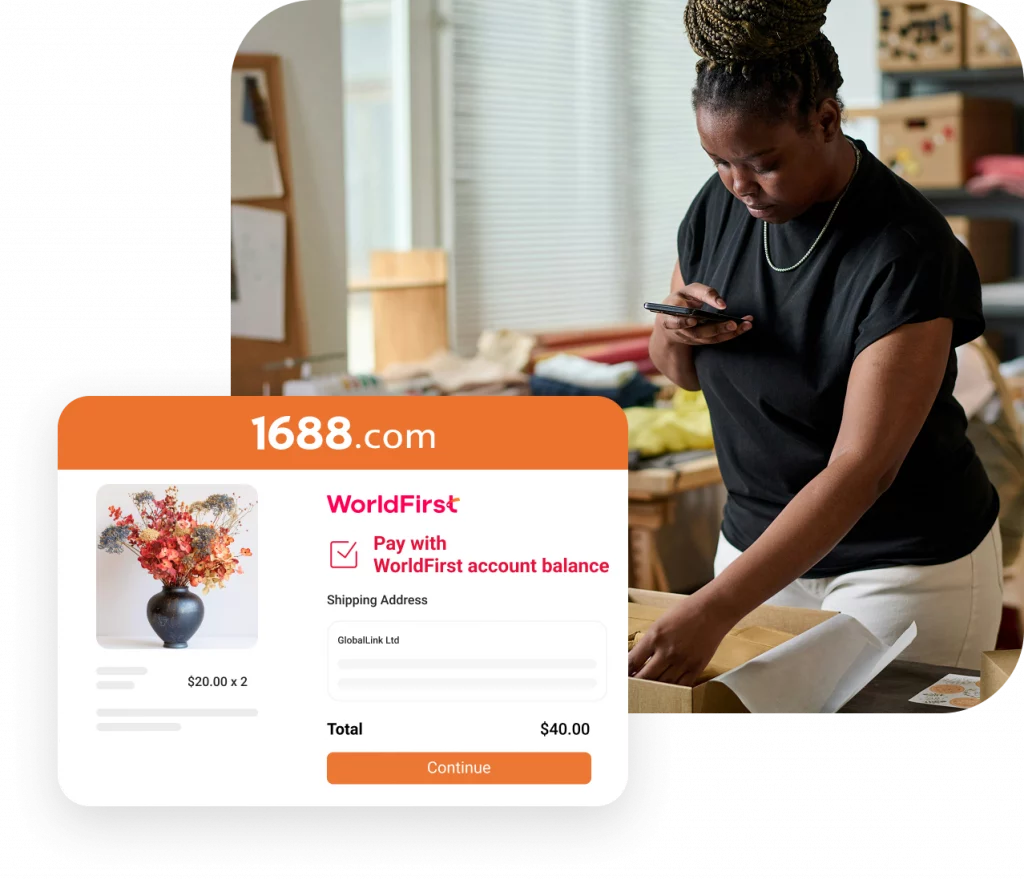
Businesses trading from Africa can pay US companies without ever handling a routing number themselves, provided they use a payments provider that manages the US-side details for them. You supply the recipient information, and the provider routes the payment through the correct domestic or international rail.
The heavier friction comes from relying only on traditional international wires, where SWIFT delays, intermediary deductions, and transaction limits stack up. Holding your own USD account details changes the equation: you can pay business partners and settle US invoices as domestic payments. Note that several cross-border providers common elsewhere, such as Wise, do not open USD receiving accounts for African-registered businesses, so check eligibility for your country of registration before choosing a tool.
WorldFirst is a payments provider that gives businesses a multi-currency account for holding and moving money across currencies, including USD. Instead of sending every US payment as an international wire, you can hold USD in your account and pay US companies through more direct rails, reducing reliance on the SWIFT chain and its intermediary costs.
WorldFirst is backed by Ant International (part of the Ant Group), supports payments to 200+ countries and regions, and lets you hold 20+ currencies and send 100+.¹¹ You can also pay Chinese suppliers directly if you source from China as well as trade with the US, keeping supplier and US payments in one account.
Opening an account is free, and to register you should prepare your business registration documents, director identification, proof of business ownership, and standard verification documents. Fees, availability, and product features vary and are not guaranteed; always confirm current details before relying on them.
It depends on how the payment is sent. Use the ACH routing number for recurring payments, direct deposits, and marketplace payouts that are not urgent. Use the wire routing number when a payment must arrive the same day. If you are unsure, ask the recipient or the bank which routing number applies to your specific payment.
Not directly. A routing number works for payments inside the US only. Money coming from a bank outside the US usually arrives through the SWIFT network using a SWIFT code, not a routing number. Some providers give you local US account details so US-based payers can still pay you domestically using a routing number.
The payment may be rejected and returned, or in some cases delayed while the banks investigate. A wrong routing number is a frequent cause of failed US transfers. Always double-check the nine digits against the invoice or the recipient’s confirmed details, and confirm you are using the correct number for ACH or wire.
Yes. You can pay a US supplier through a payments provider that holds the US-side details for you, so you do not need to open a US bank account yourself. You provide the supplier’s routing and account numbers, and the provider processes the payment through the appropriate domestic or international rail.
A US routing number is always nine digits. The first digits identify the Federal Reserve region and the processing bank, and the final digit is a check digit used to validate the number. If a code you have been given is not nine digits, it is not a valid US routing number and the payment will not process.
A bank routing number is simply the nine-digit code that gets a payment to the right US bank, and understanding it removes one of the most common sources of failed or costly US transfers. For businesses paying US suppliers, marketplaces, or service providers, the bigger opportunity is holding your own USD account details so payments run on domestic rails rather than expensive international wires. If that fits how you trade, opening a multi-currency account is a sensible next step.
Sources
This article is intended for informational purposes only and does not constitute legal advice or professional advice. This article should not be regarded as constituting an offer or a solicitation to buy or sell any regulated or financial products or services. WorldFirst makes no representations or warranties regarding the accuracy, completeness, or applicability of the content, and readers are encouraged to consult with legal professionals or other professionals for advice tailored to their specific situation. WorldFirst does not guarantee the accuracy and completeness of this article and expressly disclaims any and all liability to any person in respect of the consequences of anything done or omitted to be done wholly or partly in reliance on this article.
Linna is a Senior Content Strategy Manager specializing in fintech, cross-border payments, and global ecommerce. With extensive experience in international B2B growth content, and global market expansion, she leads content initiatives that help businesses navigate cross-border trade, international payments, and digital commerce at scale.
Choose a product or service to find out more
Save money, time, and have peace of mind when expanding your global business.

© 2026, Ant International or its affiliates