






















We provide coverage in South Asia and Middle East: servicing 210+ countries and territories.
Home > blog > Marketplaces & Platforms > AliExpress Payment Methods in Africa: Best Ways to Pay Suppliers
You know the feeling when your Nigerian debit card gets declined mid-checkout on AliExpress, right after you’ve filled your cart? Learning the right AliExpress payment methods saves you from that frustration and the wasted time that follows. So which payment routes actually work for Nigerian buyers sourcing from Chinese suppliers, and which ones quietly fail you at the worst moment?
Key Takeaways
When your NGN card keeps failing at checkout, holding USD directly gives you a steadier way to pay Chinese suppliers. A WorldFirst Africa Business Account lets you hold USD, manage currency conversion on your own terms, and pay suppliers on AliExpress and beyond, all as a compliant cross-border payment route. All foreign exchange transactions are subject to Central Bank of Nigeria (CBN) regulations, and setup starts with your CAC E-status report.
AliExpress accepts credit and debit cards from Visa and Mastercard, Alipay, direct bank transfer, wallet balance, and regional channels like Western Union and WebMoney. Buyer protection covers most card and Alipay payments, so these tend to be the safest routes for Nigerian buyers sourcing from Chinese suppliers.
Cards are the default choice for most buyers. AliExpress takes Visa, Mastercard, Maestro, and other major credit card and debit card networks, and payments made this way usually qualify for buyer protection and dispute resolution.
Alipay sits at the centre of the Chinese payment ecosystem. It works as a digital wallet linked to your funds, and AliExpress uses it to hold your payment until you confirm delivery. That escrow-style step, where a third party holds the money until both sides meet their end of the deal, is part of what makes it dependable for cross-border orders. If you’re new to it, our guide on using Alipay as a foreigner walks through the setup.
Bank transfer is also available in some markets, though it settles slower and sits outside instant checkout. It typically takes 1 to 3 days to clear, which suits larger orders where a card limit might get in the way.
| Card acceptance varies by region. Visa and Mastercard are widely accepted across most buyer countries. Local debit schemes, Maestro, and co-branded cards may work in some regions but fail in others, which is why your checkout screen shows a different mix of options depending on where your account is registered. |
For buyers without a working standard card, AliExpress offers a few backup routes. Western Union is supported in select markets and suits people who prefer settling through a physical agent or an established money transfer network.
WebMoney also appears as an option in certain regions, mainly serving buyers in Eastern Europe and parts of Asia where the wallet already has strong adoption. It rarely applies to Nigerian buyers, but it’s worth knowing it exists.
AliExpress accepts payment from your wallet balance too, which works like stored credit you top up in advance. You can load it and pay directly from it, which speeds up repeat orders once the funds sit there.
Local payment methods also appear depending on your country, and the full list of accepted payment methods¹ shifts based on your buyer country, since AliExpress tailors the available options to local banking rules and partner coverage. That’s also why your checkout screen looks different from someone shopping in another country.
The safest payment methods on AliExpress are credit card, debit card, and Alipay, because they sit inside the Buyer Protection program² and give you a clear path to dispute resolution. When you pay this way, your money stays covered until the order is confirmed as delivered and matching what you ordered.
Buyer protection is your safety net when an order goes wrong. It covers three main situations: items that never arrive, items that arrive damaged, and items that differ from the seller’s description. If any of these happen, you open a dispute and AliExpress steps in to review the case.
The protection only holds when you pay through official channels. Card payments and Alipay both feed into this system, which is why they stay the most dependable routes for Nigerian buyers sourcing from Chinese suppliers. Alipay’s escrow step adds a second layer, since it holds your payment until you confirm you’re satisfied.
Saving your card details on AliExpress is safe as long as you do it through the official app or website rather than a third-party link, since stored payment data only connects through those official channels. Doing this also speeds up repeat checkouts. If your card gets declined during payment, that’s usually a foreign exchange or bank-side block rather than a fault with the platform, and it does not affect your protection on completed orders.
Buyer protection ends the moment you step outside the platform. It does not cover payments made directly to a seller through bank transfer, chat apps, or any off-platform method. It also does not cover disputes you raise after the protection window closes, so track your delivery dates.
| Warning: If a seller asks you to pay outside AliExpress, stop. Paying a seller off-platform voids all your buyer protection rights, and you lose any claim if the goods never show up. Security specialists offer similar cybersecurity guidance³ on avoiding off-platform payment requests. |
Keep every transaction on AliExpress. That single habit protects your money more than any other step you take, and it keeps the dispute route open if an order goes wrong.
Nigerian cards get declined at AliExpress checkout mainly because of foreign exchange restrictions and low international spending limits on NGN accounts. Your bank caps how much you can spend abroad, and CBN foreign exchange controls tighten the pool of USD available for international card transactions.
Most local debit card declines come down to the international spending cap your bank sets. Many Nigerian banks limit monthly foreign transactions to a small USD figure, or block them entirely when USD liquidity is tight.
Even when your card is a Visa or Mastercard, the issuing bank still controls whether the transaction clears. Currency conversion happens at your bank’s rate, and foreign exchange fees stack on top, so an order that looked affordable in USD lands heavier in NGN. When the bank has no USD to allocate, the payment simply fails, no matter how much you have in your account.
A USD virtual card is the practical route when your local card keeps failing. It lets you hold and spend in USD directly, so your AliExpress payment clears in the same currency the platform charges, sidestepping the international block on your NGN card.
Because a virtual card runs on Visa or Mastercard rails, it works at checkout the same way a physical card does. You control the currency conversion and see the foreign exchange fees upfront, rather than discovering them after your bank settles. Compare USD virtual card options to see which fits your order volume.
| Pro tip: A USD virtual card is a compliant cross-border payment tool, not a way around CBN rules. Fund it through CBN-regulated providers⁴ and all foreign exchange transactions stay subject to Central Bank of Nigeria (CBN) regulations. Our guide to the best virtual dollar cards for Nigerian buyers breaks down the tradeoffs. |
Work through these steps when your card fails at checkout:
Paying in USD rather than NGN usually gives you a cleaner total, because you skip your Nigerian bank’s currency conversion and the foreign exchange fees stacked on top. When AliExpress converts your NGN card charge, the rate and markup fall outside your control, which quietly erodes the margin on every supplier order.
The currency you pick at checkout decides how many hands touch your money before it reaches the supplier. Pay in USD from a USD-funded card, and one conversion happens on your terms. Pay in NGN, and your bank applies its own rate plus a foreign exchange markup, often 2% to 4% above the interbank rate.
Paying on AliExpress is not always strictly in US dollars from where you sit, but the underlying transaction is generally calculated in USD before your bank steps in. Checkout may show an estimated NGN price, yet the actual charge that reaches your card is typically billed in USD, and your Nigerian bank converts that amount to NGN at its own exchange rate when the transaction posts. That is why the NGN figure on your bank statement rarely matches the price you saw at checkout.
That markup is invisible on the checkout screen. You only feel it when the NGN charge lands heavier than the USD price suggested. For sellers importing regularly, those small gaps compound across dozens of orders and thin out your working capital.
Each route carries a different mix of transaction fees, FX (foreign exchange) cost, speed, and buyer protection. AliExpress itself does not add a separate platform fee for choosing one payment method over another; the cost differences you feel come from each method’s own transaction fee and FX handling, such as your card issuer’s foreign transaction charge, a bank’s transfer fee, or the exchange rate applied by whichever service converts your NGN to USD.
Alipay usually works out lowest among the options here, since it typically charges little to no fee of its own on top of your funding source, while card networks and bank transfers add issuer or bank charges. That also means Alipay does not tack on a separate international payment fee either; the real cost depends on whichever card or bank account funds your Alipay wallet. The table below shows how the main options compare for Nigerian buyers.
| Payment Method | Transaction Fees | FX Cost | Speed | Buyer Protection |
|---|---|---|---|---|
| Credit card (Visa / Mastercard) | Card issuer fee applies | Bank rate plus markup | Instant checkout | Covered |
| USD virtual card | Provider dependent | You control conversion | Instant checkout | Covered |
| Alipay | Low or none | Depends on funding source | Fast, escrow held | Covered |
| Bank transfer | Bank charge applies | Bank rate plus markup | Slower, 1 to 3 days | Not always covered |
Fees checked in July 2026. Pricing, eligibility, and product features may change over time. Always confirm the latest information directly with the provider. Rates are indicative and subject to change.
For orders over $1,000, a USD-funded route usually serves you best. A USD virtual card or bank transfer sidesteps the low international caps that block large NGN card charges within Nigeria’s payment landscape⁵. If you handle regular high-value imports, comparing multi-currency accounts in Africa shows which setup keeps your FX cost lowest.
Sellers outgrow AliExpress checkout once their order volumes climb and per-unit margins get tight. That’s usually the point to move onto Alibaba or 1688, where you deal with factories and wholesalers directly, negotiate bulk pricing, and pay suppliers straight rather than through a retail marketplace layer.
Alibaba and 1688 are built for wholesale buying, not one-off retail orders. When you place large or repeat orders, sourcing at that level gives you factory pricing that AliExpress rarely matches.
The tradeoff is that these platforms shift more responsibility onto you. AliExpress buyer protection covers your retail checkout, but wholesale deals often settle through bank transfer, where that safety net thins out. So you vet suppliers carefully, confirm samples first, and keep records of every agreement.
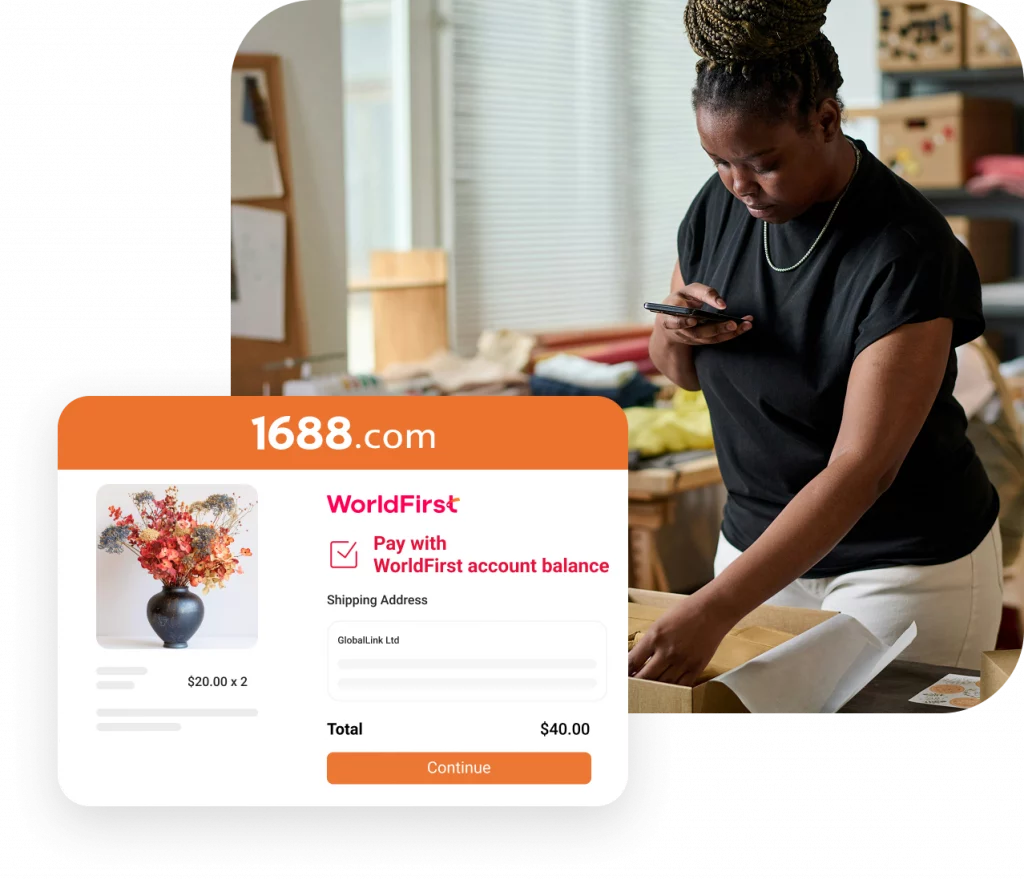
For growing Nigerian sellers, making 1688 payments to suppliers directly is often the practical next move once your monthly volumes justify it.
As your order volume rises, paying suppliers directly in CNH (offshore Chinese yuan) or USD replaces the retail card model. A business account that holds both currencies lets you pay in the currency your supplier prefers, control the currency conversion yourself, and keep transaction fees visible before money leaves your account.
Chinese factories quote in RMB (renminbi, the Chinese currency), but many accept USD. Holding both means you avoid double conversion and the foreign exchange markup a bank transfer through NGN would stack on. A WorldFirst Africa Business Account also lets you collect overseas revenue from Amazon, eBay, and Shopify in the same place.
That single setup ties your supplier payments and your marketplace earnings together, which keeps your cost control tight as you scale. Sellers who want to pay Chinese suppliers quickly can settle directly, while paying suppliers directly in China stays a compliant cross-border route under CBN rules.
AliExpress accepts credit card and debit card payments from Visa, Mastercard, and Maestro, plus Alipay, direct bank transfer, wallet balance, and regional channels like Western Union and WebMoney. The exact mix on your checkout screen depends on your buyer country, since AliExpress tailors options to local banking rules and partner coverage.
You add a payment method at checkout, select your currency, and confirm the order. The most reliable route for Nigerian buyers is a USD virtual card, because it clears in the same currency AliExpress charges and sidesteps the international spending caps that block many NGN debit card transactions during checkout.
You have several card-free routes. Alipay works as a digital wallet with an escrow step, your AliExpress wallet balance lets you pay from pre-loaded funds, and bank transfer suits larger orders. A debit card or USD virtual card also works well when a credit card is not an option for you.
The main difference is escrow protection versus checkout speed. Alipay holds your payment in escrow until you confirm delivery, adding a second protection layer on top of buyer protection coverage⁶, and it typically carries little or no fee of its own beyond whatever funds the wallet. A local card payment clears instantly and needs no extra setup, but your Nigerian issuer controls the currency conversion, foreign exchange markup, and whether the transaction is approved at all, which is the main tradeoff against Alipay’s steadier approval path.
Any Nigerian Visa or Mastercard enabled for international transactions can work on AliExpress. In practice, many local debit cards get declined because of tight foreign exchange limits and USD scarcity. A USD virtual card is the more dependable option, since it clears in USD directly and avoids those bank-side blocks.
OPay is not listed as a direct payment method on AliExpress. You can, however, use an OPay-linked virtual card if it runs on Visa or Mastercard rails and is enabled for international spending. For consistent results on larger orders, a dedicated USD virtual card remains the steadier choice.
The right AliExpress payment methods come down to two things: staying tied to buyer protection and keeping your currency conversion cost in view. Cards and Alipay keep your money covered until delivery, while a USD-funded route sidesteps the NGN declines that block so many orders.
As your volumes grow, the same discipline carries you from AliExpress into Alibaba and 1688, where you pay factories directly and margins matter more. A WorldFirst Africa Business Account holds USD and CNH, ties your supplier payments to your marketplace earnings, and keeps funds safeguarded with G-SIBs (Global Systemically Important Banks), all under CBN regulations. Backed by Ant International, it gives you a compliant route to scale.
When you’re ready to pay suppliers on your own terms, opening an account is a straightforward next step.
Sources
This article is intended for informational purposes only and does not constitute legal advice or professional advice. This article should not be regarded as constituting an offer or a solicitation to buy or sell any regulated or financial products or services. WorldFirst makes no representations or warranties regarding the accuracy, completeness, or applicability of the content, and readers are encouraged to consult with legal professionals or other professionals for advice tailored to their specific situation. WorldFirst does not guarantee the accuracy and completeness of this article and expressly disclaims any and all liability to any person in respect of the consequences of anything done or omitted to be done wholly or partly in reliance on this article.
Linna is a Senior Content Strategy Manager specializing in fintech, cross-border payments, and global ecommerce. With extensive experience in international B2B growth content, and global market expansion, she leads content initiatives that help businesses navigate cross-border trade, international payments, and digital commerce at scale.
Choose a product or service to find out more
Save money, time, and have peace of mind when expanding your global business.

© 2026, Ant International or its affiliates