






















We provide coverage in South Asia and Middle East: servicing 210+ countries and territories.
Home > blog > Marketplaces & Platforms > What Currency Does 1688 Use? A Guide to Paying Chinese Suppliers [2026]
1688 lists and settles prices in Chinese yuan, so here is what that means for buyers sourcing from abroad, and how to pay suppliers in RMB.
What currency does 1688 use? 1688.com uses Chinese yuan (CNY), also called renminbi (RMB), for every listing and transaction. This guide explains the currency behind the platform, the difference between CNY and CNH, why paying suppliers from outside China is difficult, and the practical routes available to sellers sourcing wholesale stock for resale.
Key Takeaways
1688.com uses Chinese yuan (CNY), also written as RMB, for all pricing and payment. Because the platform was built for China’s domestic wholesale market, suppliers quote in yuan and expect settlement in yuan, a currency overseas businesses rarely hold. If you plan to source from 1688, you need a way to hold or convert to yuan before you can pay a supplier. WorldFirst’s guide on how to source from 1688 covers this from the buyer’s side.
For buyers based abroad, this is the core practical point. A supplier quotes a price in yuan, expects to be paid in yuan, and usually cannot accept a card or transfer in your local currency. The currency itself, not product discovery, is often the real barrier to completing a 1688 order. That is why sellers sourcing from China spend so much time working out payment before they place an order.
The 1688 app and website both use Chinese yuan. You will see prices displayed as amounts like CNY 500, and suppliers expect settlement in that same currency. There is no built-in option to pay in USD, NGN, or any other currency at checkout.
Three terms cause confusion, so it helps to separate them. Renminbi (RMB) is the official name of China’s currency, and yuan is the unit, similar to how “dollar” is the unit of “US dollar”.³ The codes CNY and CNH then split that currency by where it trades. CNY refers to the onshore renminbi traded within mainland China, where the People’s Bank of China sets a daily reference rate and allows trading within a controlled band.⁴ By contrast, CNH is a market term for renminbi traded offshore, in centres such as Hong Kong, London, and Singapore, and its rate is set by market forces rather than daily central-bank intervention.⁴ Statrys + 2
For a fuller breakdown, WorldFirst has a dedicated explainer on the difference between CNY and CNH. The short version for buyers: a 1688 supplier is paid in yuan, and if you are funding that payment from outside China, you will usually be working with the offshore version, CNH.
1688.com is based in China and is owned by Alibaba Group. It is the group’s domestic wholesale marketplace, distinct from the international Alibaba.com that most overseas buyers know first. The platform is largely in Chinese, and most suppliers primarily serve local customers rather than exporting.
Despite that domestic focus, sellers across Africa use 1688 to source stock. A Nigerian online seller might buy phone accessories, fashion items, or homeware in small quantities to test demand before scaling. The appeal is direct factory access: buyers can reach manufacturers rather than layers of middlemen, which is why the platform features in so many import sourcing plans. If you want a side-by-side view of the two marketplaces, WorldFirst’s 1688 vs Alibaba comparison breaks down the differences.
1688 is built around domestic Chinese payment rails. Suppliers typically accept Alipay balance or a bound Chinese bank card, and unlike Alibaba.com, 1688 has no PayPal integration, with most suppliers only accepting RMB.¹ That design works smoothly for buyers inside China and creates friction for everyone else. Extentage
The practical result is that overseas buyers cannot usually complete a standard 1688 checkout the way a local buyer would. Most payment methods on 1688 are designed for domestic users, so overseas buyers often rely on sourcing agents, offline payments, or cross-border payment tools to complete transactions.² Each of those routes carries trade-offs in cost, speed, and how clearly you can track the payment, which the next sections cover. Supplyia
Sourcing from 1688 appeals to sellers for reasons beyond price. The platform connects buyers to manufacturers directly, which can widen product choice and support smaller test orders before a full commitment.
These advantages only matter once you can actually pay. That is the point where many first-time buyers stall, and where a reliable payment route makes the difference between browsing and buying.
Because 1688 runs on domestic payment methods, buyers abroad have a few established options, each with different costs and risks.
| Payment route | How it works | Key considerations |
| Sourcing agent | An agent pays the supplier in RMB and you reimburse them in your currency | Common for first orders, but adds a service fee and a middleman to trust |
| Alipay International | Overseas users register an Alipay account to pay | Functionality is limited without a linked mainland Chinese bank card |
| Bank wire (T/T) | Direct international transfer to the supplier’s bank | Slower, and traditional routes can carry high costs and limited status visibility |
| Cross-border payment tool | A platform funds an offshore RMB balance to pay suppliers | Requires setup and RMB funding; not every supplier is supported |
This table is for general guidance only and does not constitute financial advice. The routes above reflect widely reported buyer experiences, where direct checkout is not straightforward for international buyers and options include cross-border business payment solutions, Alipay International, and paying via a sourcing agent.⁵ Even with cross-border tools, buyers still typically need to fund an RMB (CNH) balance first, and the tools are not supported by every supplier or order.² Traditional bank transfers remain an option, but sending money to China via older correspondent-banking routes can be slow and hard to track, which is why many sellers look for a payment method built specifically for the platform. Union HomeSupplyia
When you do pay, apply the same fraud care you would with any new supplier: verify the supplier’s details, keep communication and payment on record, and avoid informal payment agents you cannot check. WorldFirst’s guide to paying overseas suppliers safely covers practical verification steps.
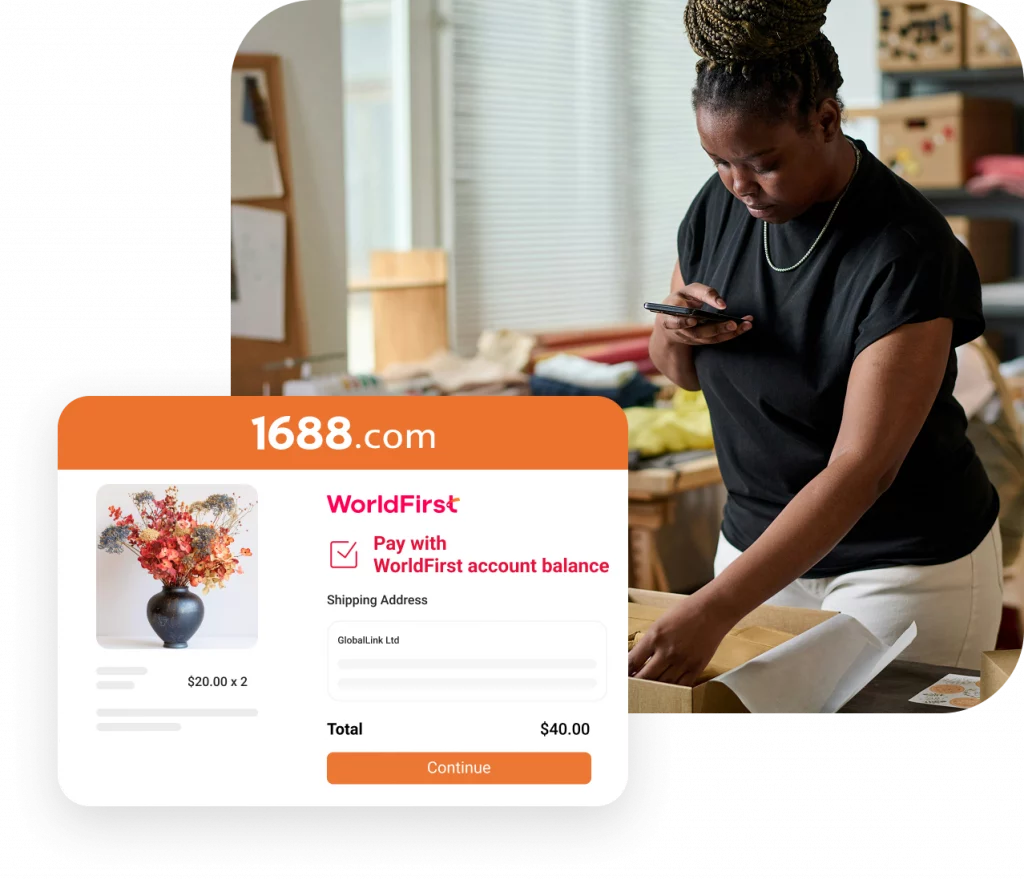
One route built specifically for the platform is World Pay. World Pay is the official payment solution provided by 1688.com and WorldFirst, letting you purchase directly using your World Account balance without a sourcing agent or a Chinese bank account. WorldFirst is a payments provider backed by Ant International (Ant Group), the same group connected to the Alibaba ecosystem, which is why the integration sits natively inside 1688.
The mechanism is straightforward: you hold or convert to an offshore RMB (CNH) balance, then pay suppliers directly at checkout. A tiered service fee of up to 0.2% applies based on your average monthly transaction volume on 1688.com, alongside a standard rate for auto-debit transactions [fees – confirm with editor]. You can open a multi-currency business account to hold funds in 20+ currencies, including CNH, and send payments across 100+ currencies.
Here is the process, based on WorldFirst’s own steps:
Registration generally requires business or identity verification documents and proof of your business activity. Because WorldFirst is backed by Ant International and World Pay is the platform’s official payment partner, the flow is designed to be compliant end to end. Explore WorldFirst’s 1688 payment solution.
Alibaba.com and 1688.com are both owned by Alibaba Group but serve different audiences. Alibaba.com is the international-facing wholesale marketplace, built for cross-border buyers, with English listings and payment methods aimed at overseas users. 1688.com is the domestic Chinese marketplace, in Chinese, priced in yuan, and set up for local payment.
The differences that matter to a buyer are language, payment access, and audience rather than a simple cheaper-or-not verdict. 1688 can put you closer to factory-level pricing, but it demands more effort on translation and payment. Alibaba.com is easier to transact on from abroad but is oriented toward export buyers. Which one fits depends on your order size, language comfort, and how directly you want to reach manufacturers.
Yes. Buyers in markets such as Nigeria, Kenya, and Ghana can source from 1688, but they need a workable way to pay in yuan. Because the platform uses domestic Chinese payment methods, most overseas buyers use a sourcing agent, an offshore RMB balance, or a cross-border payment tool built for 1688 rather than paying directly with a local card.
No, 1688 does not settle in US dollars. Prices are listed in Chinese yuan (CNY) and suppliers expect payment in yuan. You can hold USD in a multi-currency account and convert it to offshore RMB (CNH) to fund a payment, but the supplier is still paid in yuan.
CNY is the onshore yuan traded inside mainland China under managed rates, while CNH is the offshore yuan traded in markets like Hong Kong at market-driven rates. As a buyer funding a payment from abroad, you will usually convert to and pay from a CNH balance, which then settles the supplier in yuan.
Yes. A Chinese bank account is not the only route. Cross-border payment tools built for 1688, including World Pay, let you fund an offshore RMB balance and pay suppliers directly at checkout, removing the need to open a mainland account or rely on a third party to pay on your behalf.
Budget in Chinese yuan for the goods, since that is what the supplier is paid in. Track the conversion rate between your local currency and offshore RMB (CNH), and factor in any payment or conversion fees, so your landed cost reflects the currency movement rather than just the listed yuan price.
What currency does 1688 use? Chinese yuan, on every listing and in every transaction. The currency question is really a payment question, and for buyers sourcing from abroad the practical next step is choosing a route that lets you fund yuan and pay suppliers reliably. If you want to pay 1688 suppliers directly from an offshore RMB balance without a Chinese bank account, you can open a business account with WorldFirst and use World Pay at checkout.
This article is intended for informational purposes only and does not constitute legal advice or professional advice. This article should not be regarded as constituting an offer or a solicitation to buy or sell any regulated or financial products or services. WorldFirst makes no representations or warranties regarding the accuracy, completeness, or applicability of the content, and readers are encouraged to consult with legal professionals or other professionals for advice tailored to their specific situation. WorldFirst does not guarantee the accuracy and completeness of this article and expressly disclaims any and all liability to any person in respect of the consequences of anything done or omitted to be done wholly or partly in reliance on this article.
Linna is a Senior Content Strategy Manager specializing in fintech, cross-border payments, and global ecommerce. With extensive experience in international B2B growth content, and global market expansion, she leads content initiatives that help businesses navigate cross-border trade, international payments, and digital commerce at scale.
Choose a product or service to find out more
Save money, time, and have peace of mind when expanding your global business.

© 2026, Ant International or its affiliates