





























You have found the supplier, reviewed the product details, agreed on the sample or first batch and reached the payment stage. Then the supplier asks if you can pay in RMB.
For a new Malaysian importer or dropshipper, that question can turn a simple order into a currency decision.
China is already one of Malaysia’s most important sourcing markets. MATRADE reported that Malaysia’s trade with China reached RM140.76 billion in Q1 2026, up 19.5% compared with the same period in 2025. Imports from China reached RM93.16 billion, up 23.8%.
So, payment setup deserves proper attention from the first order.
In this guide, we explain how paying Chinese suppliers in RMB works, what to check before sending money and how a World Account can help you manage repeat payments from one multi-currency account.
Key takeaways:
- RMB may be useful when your supplier prices locally: Some Chinese suppliers prefer RMB because they use it to pay for production costs and logistics
- CNH is often the key currency for overseas RMB payments: Your supplier may ask for RMB, but a payment from Malaysia may need to use CNH
- Payment details must match the invoice: Check the supplier name, account name, currency, amount and payment purpose before sending money
- The cheapest quote is not always the cheapest payment: Compare the full MYR cost after FX, transfer fees and recipient-side charges
- World Account can help with repeat RMB supplier payments: WorldFirst supports eligible CNH payments to suppliers in Mainland China and helps you manage supplier details and payment records from a single multi-currency account
Open a World Account to handle RMB supplier payments from Malaysia before your next China order.
Why Chinese suppliers may ask Malaysian importers to pay in RMB
If your supplier asks you to pay in RMB, they are usually trying to receive payment in the currency they use most in China.
That may sound like a small detail, but it can affect the quote you get. Many Chinese suppliers still quote overseas buyers in USD because it feels familiar for international trade.
However, they pay most of their day-to-day business costs in RMB, from factories and staff to packaging partners, couriers and raw material suppliers, so USD revenue may need to be converted later.
That is why some suppliers quote one price in USD and another in RMB. If their main costs are in RMB, the RMB price can be more direct because they do not need to build in a USD currency buffer before confirming production or future repeat orders.
Reuters reported in August 2025 that DBS was seeing growing interest from Chinese exporters asking trade partners to settle in RMB. DBS also stated that its CIPS (China’s cross-border payment system) settlement flows increased by 30% in 2024 compared with the year before.
Read more: Top Chinese B2B marketplaces for Malaysian SMEs
RMB, CNY and CNH: what new importers need to know
When a Chinese supplier says ‘pay in RMB’, they might not mean the exact currency code you will select when sending money from Malaysia.
Here’s the easiest way to understand the difference:
- RMB is the name of China’s currency, renminbi. Suppliers often use this term when discussing prices or invoices
- Yuan is the unit of that currency. It works like ringgit for Malaysia, so an invoice may show a price in yuan
- CNY usually refers to the onshore yuan used within Mainland China. You may see it in domestic Chinese payment contexts
- CNH means offshore yuan used outside Mainland China. For Malaysian importers, this is often the currency code that appears when making an overseas RMB payment
Your supplier may write RMB in the quote or invoice, but your payment provider may show CNH as the supported currency for sending RMB to an eligible Chinese supplier account. That difference can affect your first order.
If the currency, payment route or account details do not match the invoice, it can slow down deposit confirmation and push supplier approval beyond a few working days. That can delay production, sample dispatch or the next step in your order.
Here’s a quick way to compare RMB, USD, MYR and CNY before you agree to the invoice:
| Currency | When it may work | What to check |
| RMB / CNH | Supplier prices locally and can receive offshore RMB | Confirm CNH receiving details, invoice currency and payment route |
| USD | Supplier already quotes export orders in USD | Compare the total MYR cost after FX and fees |
| MYR | Supplier offers a ringgit quote | Check if the price includes a currency buffer |
| CNY | Supplier mainly uses domestic China payment channels | Do not assume an overseas payment from Malaysia can reach a domestic CNY account |
RMB vs USD: which currency should you use for your first supplier payment?
For your first supplier payment, the better currency is the one that gives you the clearest landed cost and results in the cleanest invoice, payment route and supplier confirmation process.
USD may feel easier for a first sample order because many suppliers already quote international buyers that way. RMB becomes worth comparing when the supplier gives you a separate RMB price and can receive CNH without extra confusion.
Before you choose, ask for both prices, if possible. Then compare the full cost in MYR, not just the number on the invoice.
Check these details before you decide:
- Can the supplier receive CNH from Malaysia? A supplier may say RMB, but your overseas payment may need to go through a CNH route
- Does the invoice match the payment currency? If the invoice says RMB but you send USD, your supplier may need extra time to match the payment to your order
- Are there extra bank or recipient charges? A lower RMB quote may not be cheaper if fees reduce the amount your supplier receives
- Will the deposit and balance use the same currency? Using one currency for both payments makes your records easier to follow, especially when you reorder
- Does the RMB price give you a real saving? Compare the final MYR cost after the exchange rate, transfer fee and any supplier-side charges
If you are still deciding between RMB and USD, watch our video guide on the pros and cons of paying in RMB:
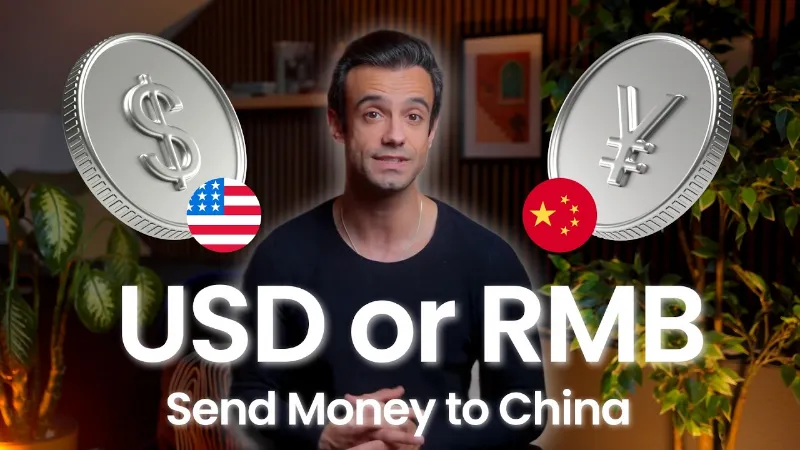
Don’t Send Money to China Until You Watch This: The USD vs. RMB Trap
What to check before sending your RMB deposit
A deposit confirms the order, gives your supplier a reason to start work and creates proof of payment you can match against the invoice if anything changes later.
Before you send money, check these points:
- Supplier identity: Make sure the business name on the invoice matches the supplier you are dealing with
- Order details: Check the product name, model, quantity, unit price, deposit amount and balance amount before paying
- Payment terms: Confirm how much you need to pay now, when the balance is due and what the supplier must share before the remaining payment
- Payment purpose: Use a purpose that matches the invoice, such as a sample order, goods purchase or product manufacturing
- Payment proof: Save the quotation, invoice, payment receipt and supplier confirmation in one place.
- Next production step: Ask what happens after the supplier receives the deposit, such as ordering materials, preparing a sample or starting production
How to pay Chinese suppliers in RMB from Malaysia
Once you agree on the quote and deposit, the payment should do three things: match the invoice, reach the right supplier and leave a record you can use for the balance payment.
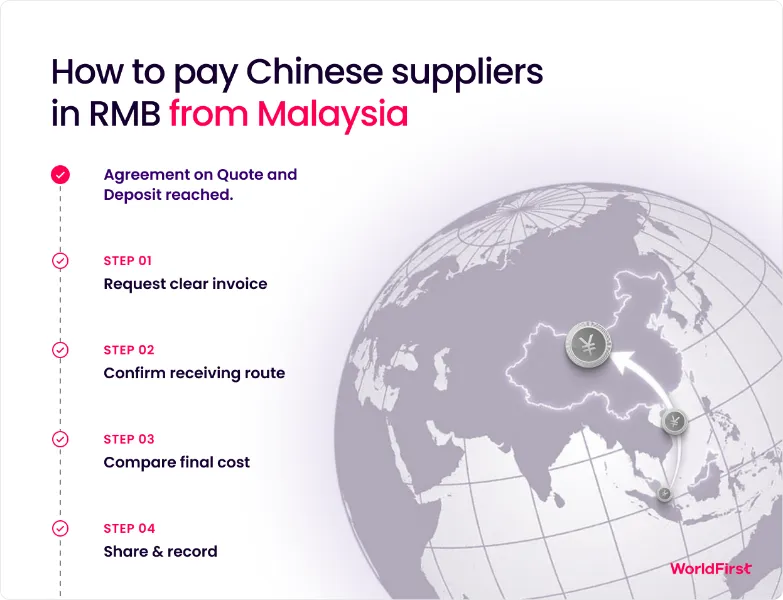
Start by asking for an invoice that clearly shows the supplier’s business name, product details, deposit amount, balance amount, receiving currency and bank details.
Then confirm that your supplier can receive the payment through the route you plan to use. If the receiving route does not match the invoice or the supplier’s instructions, resolve it before sending money.
Before confirming the transfer, compare the final MYR cost after the exchange rate, transfer fee and any recipient-side charges. After sending, share the receipt with your supplier and keep the invoice, payment receipt and confirmation together for the balance payment.
Common mistakes that delay RMB supplier payments
RMB supplier payments usually slow down when one payment detail does not match the order. Before you pay, check these five points against the supplier invoice:
- Using the wrong RMB route: RMB, CNY and CNH do not always work the same way in every payment system. Your supplier may ask for RMB, but an overseas payment from Malaysia may need to use CNH, so confirm the receiving currency before paying
- Sending money to mismatched account details: The company name, account name, currency and invoice details should all point to the same supplier and purchase. Any mismatch can affect how long the supplier needs to confirm your payment
- Paying a different company or individual: If your supplier asks you to pay another company or a personal account, get the reason in writing before sending money. Keep that confirmation with your invoice and order records
- Comparing only the RMB invoice amount: A lower RMB quote can still cost more after the exchange rate, transfer fee and recipient-side charges. Compare the full MYR cost before you pay the deposit or balance
- Treating supplier details as a formality: Money sent to the wrong recipient can be hard to recover. Bank Negara Malaysia reported that the impact of scams in Malaysia reached RM2.8 billion in 2025, so always double-check supplier details before sending funds
How WorldFirst helps Malaysian importers manage RMB supplier payments
One RMB deposit can look small until the FX margin changes the final MYR cost.
Say your supplier asks for a CNH100,000 deposit and the mid-market rate is RM0.60 per CNH. Before transfer fees or recipient-side charges, that equals RM60,000.
With a 2% bank FX margin, the same deposit would cost about RM61,200. With a 0.6% WorldFirst FX margin, it would cost about RM60,360. That is a difference of about RM840 on one deposit, before any transfer or recipient-side fees.
Use this as an illustration only. The actual rate, margin and fees can change before you confirm a payment, so always compare the final MYR cost on the day you pay.
For a new importer, the cost is only one part of the payment. You also need to confirm the supplier name, receiving currency, CNH account details, payment purpose and deposit record before production starts.
With a World Account, you can convert MYR into CNH where supported, add the supplier as a payee, match the payment purpose to the order and keep the payment record ready for the balance payment or next reorder.
For Malaysian importers, the key point is the CNH route. WorldFirst supports payments to suppliers’ CNH bank accounts in Mainland China, but not directly to their CNY accounts. Before you send money, make sure your supplier can receive CNH and understands any settlement documents they may need to provide locally.
How to pay Chinese suppliers in RMB from Malaysia with WorldFirst
Here’s how the supplier payment setup works in World Account:
- Add the supplier as a payee: Go to Payees, choose Add a new payee, select Add a single payee, and then select Third-party account
- Choose the payee account type: Select a personal or corporate account, based on the supplier’s account details
- Select CNH as the receiving currency: Enter the supplier’s CNH account details exactly as they appear on the invoice
- Choose the nature of services: Select the option that matches the order, such as goods, manufacturing or another relevant trade purpose
- Complete verification: Use Authy or SMS verification to add the supplier account as a payee
- Send the payment: Go to Payments, choose Send & Withdraw, then select the payment purpose that matches the trade between you and the supplier
- Enter the amount and confirm: Add the transfer amount, choose to send now or schedule the payment, then complete verification to book the transfer
For a new importer or dropshipper, this gives RMB supplier payments a more practical structure. You can add the supplier once, use the supported CNH route, match the payment purpose to the order and keep the record ready for the balance payment or next reorder.
WorldFirst isn’t a bank. It provides payment, FX and business account services through regulated WorldFirst entities. Supported currencies, payment routes and account features may depend on eligibility, account type and destination.
Open a World Account to manage RMB supplier payments from Malaysia and keep more control over currency, supplier details and payment timing.
FAQ
1. Can I negotiate a better price if I pay a Chinese supplier in RMB?
Yes, in some cases. Ask the supplier for both RMB and USD prices, then compare the full MYR cost after FX, transfer fees and any recipient charges.
2. What should I do if my supplier changes their bank details before payment?
Pause before sending money. Ask for written confirmation, check the new details against the invoice and confirm the change through a trusted contact.
3. Can I pay a Chinese supplier in RMB for a sample order only?
Yes, if the supplier can receive the payment through a supported RMB or CNH route. For smaller sample orders, carefully compare the total cost, because fees can affect the final price.
4. What happens if I send the wrong amount or use the wrong currency?
Contact your payment provider and supplier straight away. Your provider may need to change, return or manually match the payment, which can delay production.
5. Do I need a business account to pay Chinese suppliers in RMB from Malaysia?
A dedicated business payment account can make supplier payments easier to track. It helps you separate business costs, keep invoice records and manage repeat RMB payments more clearly.
Disclaimer:
This article is intended for general informational purposes only and does not constitute legal or professional advice. WorldFirst makes no representations or warranties regarding the accuracy, completeness or applicability of the content and readers are encouraged to consult with legal professionals or other professionals for advice tailored to their specific situation. WorldFirst does not guarantee the accuracy and completeness of this article and expressly disclaims any and all liability to any person in respect of the consequences of anything done or omitted to be done wholly or partly in reliance on this article.
Sources:
- https://www.matrade.gov.my/en/about-matrade/press-release/trade-exports-and-imports-in-the-first-quarter-q1-of-2026-remained-on-an-upward-trajectory-registering-highest-value-ever-for-q1-despite-ongoing-global-uncertainties
- https://www.reuters.com/business/finance/dbs-sees-rising-demand-yuan-settlements-chinese-exporters-2025-08-13/
- https://bnm.gov.my/publications/ar2025/box4

![TIN number (Tax Identification Number) in Malaysia [2026]: A guide](https://mdn.marmot-cloud.com/worldfirst/sites/10/2026/10/20261022193456868-300x206.webp)

![Public Bank USD account review [2026] Malaysia: Features, fees and more](https://mdn.marmot-cloud.com/worldfirst/sites/10/2026/10/20261021125931797-300x200.webp)
![CIMB USD account review [2026] Malaysia: Features, fees and more](https://mdn.marmot-cloud.com/worldfirst/sites/10/2026/10/20261021124553858-300x200.webp)
![Maybank USD account review [2026] Malaysia: Features, fees and more](https://mdn.marmot-cloud.com/worldfirst/sites/10/2026/10/20261021122232497-300x200.webp)